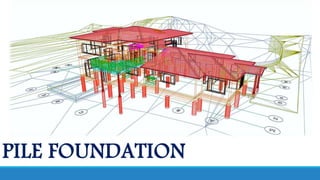
PILE FOUNDATION
Content
 Introduction
 Preliminary Investigations
 Ground Investigations
 Soil investigation report
 Choice of type
 Types of piles , Piling techniques
 Procedure
 Advantages and disadvantages
 Summary
Introduction
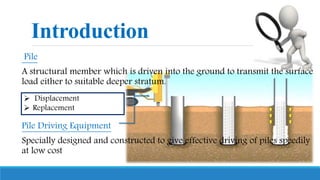
Pile
A structural member which is driven into the ground to transmit the surface
load either to suitable deeper stratum.
Pile Driving Equipment
Specially designed and constructed to give effective driving of piles speedily
at low cost
 Displacement
 Replacement
Preliminary Investigation
 Ground Investigation
 Soil tests
 Cohesive soil – Undisturbed soil sample obtained from boring , tested
for strength and compressibility.
 Granular soil – Disturbed soil sample obtained from boring , tested for
penetration and variation in ground condition.
Ground water test – Chemical analysis of ground water to eliminate
harmful constituents
Water Table – The variation of water table gradient between bore hole
should be noted.
To estimate the Length and spacing of the piles
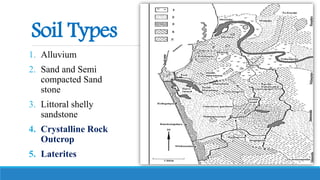
Soil Composition
Soil Types
1. Alluvium
2. Sand and Semi
compacted Sand
stone
3. Littoral shelly
sandstone
4. Crystalline Rock
Outcrop
5. Laterites
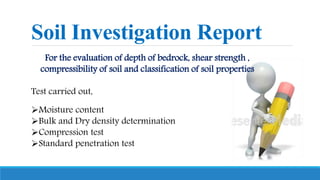
Soil Investigation Report
For the evaluation of depth of bedrock, shear strength ,
compressibility of soil and classification of soil properties
Test carried out,
Moisture content
Bulk and Dry density determination
Compression test
Standard penetration test
Reasons for selecting
 Weak topsoil - loess soils that lose their stability in the
presence of
 water, sand, clay, quicksand soils that heavily saturated
with water, loam and clay soils in their current and plastic
state.
 Subsurface soil consists of soft to very soft silt
clay with sand and underlined by stiff slit sand
and some laterites. The ground water level was
1.4 m below the existing rate.
Choice of Type Depending ,effect on the soil
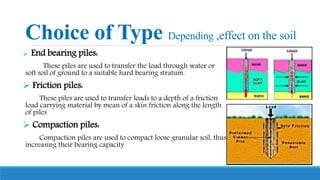
 End bearing piles:
These piles are used to transfer the load through water or
soft soil of ground to a suitable hard bearing stratum.
 Friction piles:
These piles are used to transfer loads to a depth of a friction
load carrying material by mean of a skin friction along the length
of piles
 Compaction piles:
Compaction piles are used to compact loose granular soil, thus
increasing their bearing capacity
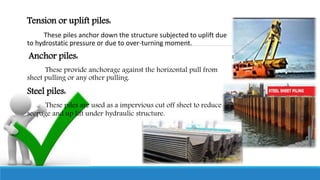
Tension or uplift piles:
These piles anchor down the structure subjected to uplift due
to hydrostatic pressure or due to over-turning moment.
Anchor piles:
These provide anchorage against the horizontal pull from
sheet pulling or any other pulling.
Steel piles:
These piles are used as a impervious cut off sheet to reduce
seepage and up lift under hydraulic structure.
Piling Techniques
Piling techniques can be split into 2 categories.
Displacement
Pre-cast concrete driven piles
Thick wall driven steel tubes
Thin wall bottom driven piles
Timber piles
Screw piles
Replacement
Open hole auger piles
Continuous flight auger
Large diameter rotary piles
Odes piles
Tripod piles
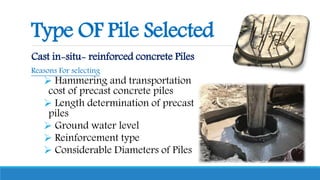
Type OF Pile Selected
Cast in-situ- reinforced concrete Piles
Reasons For selecting
 Hammering and transportation
cost of precast concrete piles
 Length determination of precast
piles
 Ground water level
 Reinforcement type
 Considerable Diameters of Piles
Procedure
Cost of Piles
 Boring Piles – rate depend On the Diameter of the Pile
 Ex, 1000mm Dia Rate Rs. 9975.00 Per m depth
Socketing in Hard rock - rate depend On the Diameter of the
Pile
Ex, 1000mm Dia Rate Rs. 81255.00 Per m
Concreting – rate depends on the grade of concrete, Dia of
Pile
 Grade 30 , 1000mm Rate Rs 25000 per m3
Reinforcement Basic Rate – Rs 104000.00
Contractors
D.P.Jayasinghe piling
Walkers Piling
Piles for law rise buildings
Advantages
 Piles can be pre-fabricated off-site which allows for efficient installation once on site.
 Driven piles displace and compact the soil which increases the bearing capacity of the pile.
Whereas, other deep foundations tend to require the removal of soil which can lead to
subsidence and other structural problems.
 They are cost-effective as a wide variety of materials and shapes can be easily fabricated to
specified dimensions, which can result in the need for fewer piles on site.
 Have superior structural strength than forms of foundation. Their high lateral and bending
resistance makes them ideal for challenging conditions such as wind, water, seismic
loading and so on.
Disadvantages Of Using Piles
 Advance planning is required for handling and driving, as well as the heavy
equipment on site.
 To be able to withstand handling stresses during transportation and
installation, precast or pre-stressed concrete piles must be adequately
reinforced.
 It may not be possible to determine the exact length required and so splicing
or cut-off techniques may be required which has time and cost implications.
 Driven piles may not suitable be where ground has poor drainage qualities.
 Driven piles may not suitable for compact sites, where the foundations of
structures in close proximity may be affected by the vibrations caused by
installation.
 Driven piles can be noisy to install and vibrations can result in complaints
from neighbors, who may become aware of pre-existing problems with their
own building that they then blame on piling vibration.
 Since the exact length required at the cannot be determined in advance, the
method involves cutting off extra lengths or adding more lengths. This
increases the cost of the project.
Raft foundation for law riser
As Alternative
Economic due to combination of foundation and floor slab.
 It requires little excavation.
 It can cope with mixed or poor ground condition.
 It reduces differential settlement.
 Cost is relatively low
Summary
 What is Pile foundation
 Reasons for selecting
 Soil Investigation report
 Types and techniques available
 Advantages and Disadvantages over Raft foundation
Pile Foundation

Pile Foundation

  • 1.
  • 2.
    Content  Introduction  PreliminaryInvestigations  Ground Investigations  Soil investigation report  Choice of type  Types of piles , Piling techniques  Procedure  Advantages and disadvantages  Summary
  • 3.
    Introduction Pile A structural memberwhich is driven into the ground to transmit the surface load either to suitable deeper stratum. Pile Driving Equipment Specially designed and constructed to give effective driving of piles speedily at low cost  Displacement  Replacement
  • 4.
    Preliminary Investigation  GroundInvestigation  Soil tests  Cohesive soil – Undisturbed soil sample obtained from boring , tested for strength and compressibility.  Granular soil – Disturbed soil sample obtained from boring , tested for penetration and variation in ground condition. Ground water test – Chemical analysis of ground water to eliminate harmful constituents Water Table – The variation of water table gradient between bore hole should be noted. To estimate the Length and spacing of the piles
  • 5.
  • 6.
    Soil Types 1. Alluvium 2.Sand and Semi compacted Sand stone 3. Littoral shelly sandstone 4. Crystalline Rock Outcrop 5. Laterites
  • 7.
    Soil Investigation Report Forthe evaluation of depth of bedrock, shear strength , compressibility of soil and classification of soil properties Test carried out, Moisture content Bulk and Dry density determination Compression test Standard penetration test
  • 8.
    Reasons for selecting Weak topsoil - loess soils that lose their stability in the presence of  water, sand, clay, quicksand soils that heavily saturated with water, loam and clay soils in their current and plastic state.  Subsurface soil consists of soft to very soft silt clay with sand and underlined by stiff slit sand and some laterites. The ground water level was 1.4 m below the existing rate.
  • 9.
    Choice of TypeDepending ,effect on the soil  End bearing piles: These piles are used to transfer the load through water or soft soil of ground to a suitable hard bearing stratum.  Friction piles: These piles are used to transfer loads to a depth of a friction load carrying material by mean of a skin friction along the length of piles  Compaction piles: Compaction piles are used to compact loose granular soil, thus increasing their bearing capacity
  • 10.
    Tension or upliftpiles: These piles anchor down the structure subjected to uplift due to hydrostatic pressure or due to over-turning moment. Anchor piles: These provide anchorage against the horizontal pull from sheet pulling or any other pulling. Steel piles: These piles are used as a impervious cut off sheet to reduce seepage and up lift under hydraulic structure.
  • 11.
    Piling Techniques Piling techniquescan be split into 2 categories. Displacement Pre-cast concrete driven piles Thick wall driven steel tubes Thin wall bottom driven piles Timber piles Screw piles Replacement Open hole auger piles Continuous flight auger Large diameter rotary piles Odes piles Tripod piles
  • 12.
    Type OF PileSelected Cast in-situ- reinforced concrete Piles Reasons For selecting  Hammering and transportation cost of precast concrete piles  Length determination of precast piles  Ground water level  Reinforcement type  Considerable Diameters of Piles
  • 13.
  • 14.
    Cost of Piles Boring Piles – rate depend On the Diameter of the Pile  Ex, 1000mm Dia Rate Rs. 9975.00 Per m depth Socketing in Hard rock - rate depend On the Diameter of the Pile Ex, 1000mm Dia Rate Rs. 81255.00 Per m Concreting – rate depends on the grade of concrete, Dia of Pile  Grade 30 , 1000mm Rate Rs 25000 per m3 Reinforcement Basic Rate – Rs 104000.00
  • 15.
  • 16.
    Piles for lawrise buildings
  • 17.
    Advantages  Piles canbe pre-fabricated off-site which allows for efficient installation once on site.  Driven piles displace and compact the soil which increases the bearing capacity of the pile. Whereas, other deep foundations tend to require the removal of soil which can lead to subsidence and other structural problems.  They are cost-effective as a wide variety of materials and shapes can be easily fabricated to specified dimensions, which can result in the need for fewer piles on site.  Have superior structural strength than forms of foundation. Their high lateral and bending resistance makes them ideal for challenging conditions such as wind, water, seismic loading and so on.
  • 18.
    Disadvantages Of UsingPiles  Advance planning is required for handling and driving, as well as the heavy equipment on site.  To be able to withstand handling stresses during transportation and installation, precast or pre-stressed concrete piles must be adequately reinforced.  It may not be possible to determine the exact length required and so splicing or cut-off techniques may be required which has time and cost implications.  Driven piles may not suitable be where ground has poor drainage qualities.
  • 19.
     Driven pilesmay not suitable for compact sites, where the foundations of structures in close proximity may be affected by the vibrations caused by installation.  Driven piles can be noisy to install and vibrations can result in complaints from neighbors, who may become aware of pre-existing problems with their own building that they then blame on piling vibration.  Since the exact length required at the cannot be determined in advance, the method involves cutting off extra lengths or adding more lengths. This increases the cost of the project.
  • 20.
    Raft foundation forlaw riser As Alternative Economic due to combination of foundation and floor slab.  It requires little excavation.  It can cope with mixed or poor ground condition.  It reduces differential settlement.  Cost is relatively low
  • 21.
    Summary  What isPile foundation  Reasons for selecting  Soil Investigation report  Types and techniques available  Advantages and Disadvantages over Raft foundation