Canada’s Strategy for Patient-
Oriented Research (SPOR)
SPOR Network in Primary and Integrated
Health Care Innovations (PIHCI)
Programmatic Grants
1
Overview
• Strategy for Patient-Oriented Research
(SPOR)
• PIHCI Network
• Programmatic Grants Funding Opportunity
2
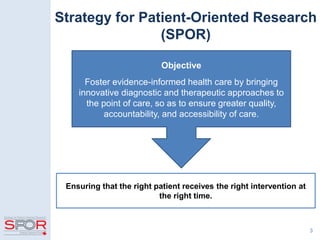
Strategy for Patient-Oriented Research
(SPOR)
3
Ensuring that the right patient receives the right intervention at
the right time.
Objective
Foster evidence-informed health care by bringing
innovative diagnostic and therapeutic approaches to
the point of care, so as to ensure greater quality,
accountability, and accessibility of care.
4
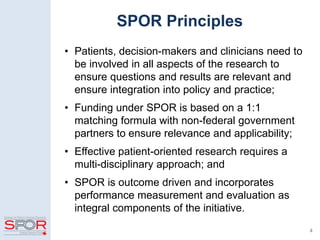
SPOR Principles
• Patients, decision-makers and clinicians need to
be involved in all aspects of the research to
ensure questions and results are relevant and
ensure integration into policy and practice;
• Funding under SPOR is based on a 1:1
matching formula with non-federal government
partners to ensure relevance and applicability;
• Effective patient-oriented research requires a
multi-disciplinary approach; and
• SPOR is outcome driven and incorporates
performance measurement and evaluation as
integral components of the initiative.
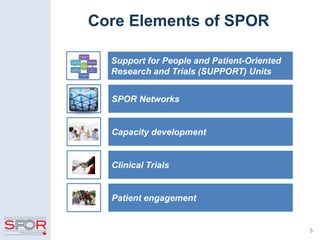
Core Elements of SPOR
5
Support for People and Patient-Oriented
Research and Trials (SUPPORT) Units
SPOR Networks
Capacity development
Clinical Trials
Patient engagement
Pan-Canadian SPOR Network in Primary
and Integrated Health Care Innovations
Distributed network of networks
Strategic scope: delivery of primary and integrated
health care (including primary prevention) both
horizontally and vertically across the care continuum
to address:
• Individuals with complex needs across the life
course, including age groups from children to
older adults; and,
• Multi-sector integration of upstream prevention
strategies and care delivery models.
7
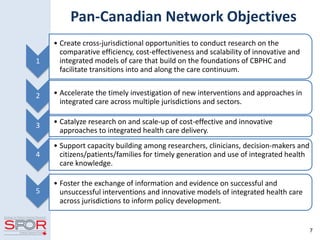
Pan-Canadian Network Objectives
1
• Create cross-jurisdictional opportunities to conduct research on the
comparative efficiency, cost-effectiveness and scalability of innovative and
integrated models of care that build on the foundations of CBPHC and
facilitate transitions into and along the care continuum.
2 • Accelerate the timely investigation of new interventions and approaches in
integrated care across multiple jurisdictions and sectors.
3 • Catalyze research on and scale-up of cost-effective and innovative
approaches to integrated health care delivery.
4
• Support capacity building among researchers, clinicians, decision-makers and
citizens/patients/families for timely generation and use of integrated health
care knowledge.
5
• Foster the exchange of information and evidence on successful and
unsuccessful interventions and innovative models of integrated health care
across jurisdictions to inform policy development.
8
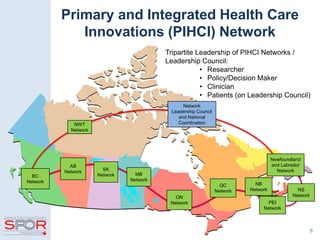
AB
Network
SK
Network MB
Network
ON
Network
QC
Network
BC
Network
NS
Network
Newfoundland
and Labrador
Network
Network
Leadership Council
and National
CoordinationNWT
Network
NB
Network
PEI
Network
Primary and Integrated Health Care
Innovations (PIHCI) Network
Tripartite Leadership of PIHCI Networks /
Leadership Council:
• Researcher
• Policy/Decision Maker
• Clinician
• Patients (on Leadership Council)
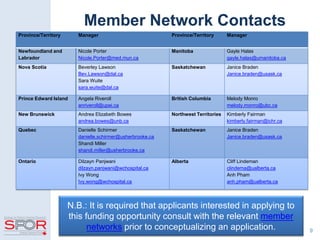
Member Network Contacts
9
N.B.: It is required that applicants interested in applying to
this funding opportunity consult with the relevant member
networks prior to conceptualizing an application.
Province/Territory Manager Province/Territory Manager
Newfoundland and
Labrador
Nicole Porter
Nicole.Porter@med.mun.ca
Manitoba Gayle Halas
gayle.halas@umanitoba.ca
Nova Scotia Beverley Lawson
Bev.Lawson@dal.ca
Sara Wuite
sara.wuite@dal.ca
Saskatchewan Janice Braden
Janice.braden@usask.ca
Prince Edward Island Angela Riveroll
anriveroll@upei.ca
British Columbia Melody Monro
melody.monro@ubc.ca
New Brunswick Andrea Elizabeth Bowes
andrea.bowes@unb.ca
Northwest Territories Kimberly Fairman
kimberly.fairman@ichr.ca
Quebec Danielle Schirmer
danielle.schirmer@usherbrooke.ca
Shandi Miller
shandi.miller@usherbrooke.ca
Saskatchewan Janice Braden
Janice.braden@usask.ca
Ontario Dilzayn Panjwani
dilzayn.panjwani@wchospital.ca
Ivy Wong
Ivy.wong@wchospital.ca
Alberta Cliff Lindeman
clindema@ualberta.ca
Anh Pham
anh.pham@ualberta.ca
10
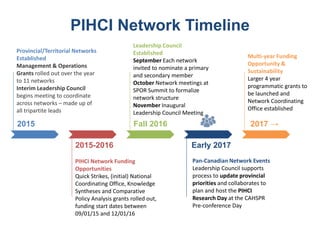
PIHCI Network Timeline
2015
2015-2016
Provincial/Territorial Networks
Established
Management & Operations
Grants rolled out over the year
to 11 networks
Interim Leadership Council
begins meeting to coordinate
across networks – made up of
all tripartite leads
2017 →
Leadership Council
Established
September Each network
invited to nominate a primary
and secondary member
October Network meetings at
SPOR Summit to formalize
network structure
November Inaugural
Leadership Council Meeting
Fall 2016
Multi-year Funding
Opportunity &
Sustainability
Larger 4 year
programmatic grants to
be launched and
Network Coordinating
Office established
Early 2017
PIHCI Network Funding
Opportunities
Quick Strikes, (initial) National
Coordinating Office, Knowledge
Syntheses and Comparative
Policy Analysis grants rolled out,
funding start dates between
09/01/15 and 12/01/16
Pan-Canadian Network Events
Leadership Council supports
process to update provincial
priorities and collaborates to
plan and host the PIHCI
Research Day at the CAHSPR
Pre-conference Day
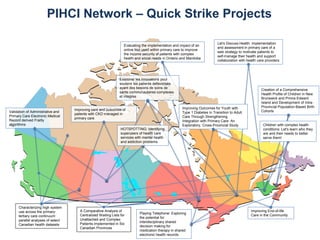
PIHCI Network – Quick Strike Projects
Playing Telephone: Exploring
the potential for
interdisciplinary shared
decision making for
medication therapy in shared
electronic health records
Let's Discuss Health: implementation
and assessment in primary care of a
web strategy to motivate patients to
self-manage their health and support
collaboration with health care providers
Evaluating the implementation and impact of an
online tool used within primary care to improve
the income security of patients with complex
health and social needs in Ontario and Manitoba
Characterizing high system
use across the primary-
tertiary care continuum:
parallel analyses of select
Canadian health datasets
Improving End-of-life
Care in the Community
Validation of Administrative and
Primary Care Electronic Medical
Record derived Frailty
algorithms
Improving care and outcomes of
patients with CKD managed in
primary care
A Comparative Analysis of
Centralized Waiting Lists for
Unattached and Complex
Patients Implemented in Six
Canadian Provinces
Improving Outcomes for Youth with
Type 1 Diabetes in Transition to Adult
Care Through Strengthening
Integration with Primary Care: An
Exploratory, Cross-Provincial Study
Creation of a Comprehensive
Health Profile of Children in New
Brunswick and Prince Edward
Island and Development of Intra-
Provincial Population-Based Birth
Cohorts
Children with complex health
conditions: Let's learn who they
are and their needs to better
serve them!
Examiner les innovations pour
soutenir les patients defavorises
ayant des besoins de soins de
sante communautaires complexes
et integres
HOTSPOTTING: Identifying
superusers of health care
services with mental health
and addiction problems
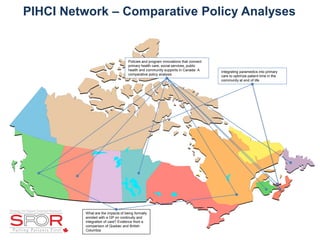
PIHCI Network – Comparative Policy Analyses
Integrating paramedics into primary
care to optimize patient time in the
community at end of life
Policies and program innovations that connect
primary health care, social services, public
health and community supports in Canada: A
comparative policy analysis
What are the impacts of being formally
enroled with a GP on continuity and
integration of care? Evidence from a
comparison of Quebec and British
Columbia
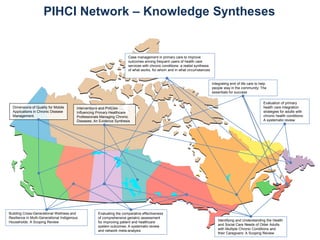
PIHCI Network – Knowledge Syntheses
Integrating end of life care to help
people stay in the community: The
essentials for success
Case management in primary care to improve
outcomes among frequent users of health care
services with chronic conditions: a realist synthesis
of what works, for whom and in what circumstances
Dimensions of Quality for Mobile
Applications in Chronic Disease
Management.
Interventions and Policies
Influencing Primary Healthcare
Professionals Managing Chronic
Diseases: An Evidence Synthesis
Building Cross-Generational Wellness and
Resilience in Multi-Generational Indigenous
Households: A Scoping Review Identifying and Understanding the Health
and Social Care Needs of Older Adults
with Multiple Chronic Conditions and
their Caregivers: A Scoping Review
Evaluating the comparative effectiveness
of comprehensive geriatric assessment
for improving patient and healthcare
system outcomes: A systematic review
and network meta-analysis
Evaluation of primary
health care integration
strategies for adults with
chronic health conditions:
A systematic review
14
SPOR PIHCI Network –
Programmatic Grants
Objective
To support cross-jurisdictional programs of
research that respond to the priorities of the
Primary and Integrated Health Care
Innovations (PIHCI) Network in order to
generate findings that will guide evidence-
informed policy decision-making, with the
intent of having an impact on the health
system for all Canadians within four years.
15
Research Areas
• Cross-jurisdictional research projects must respond to one
or more of the Network priorities, which were determined in
consultation with the PIHCI member networks and their
stakeholders.
• Research questions must focus on patients with complex
needs across the life course (a relatively small subgroup
of the population with high health needs that accounts for a
significant amount of health care utilization and costs – from
children to older adults)
16
17
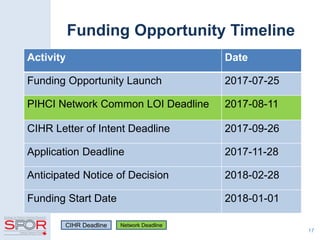
Funding Opportunity Timeline
Activity Date
Funding Opportunity Launch 2017-07-25
PIHCI Network Common LOI Deadline 2017-08-11
CIHR Letter of Intent Deadline 2017-09-26
Application Deadline 2017-11-28
Anticipated Notice of Decision 2018-02-28
Funding Start Date 2018-01-01
CIHR Deadline Network Deadline
18
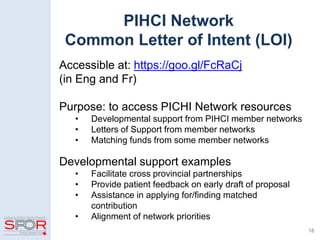
PIHCI Network
Common Letter of Intent (LOI)
Accessible at: https://goo.gl/FcRaCj
(in Eng and Fr)
Purpose: to access PICHI Network resources
• Developmental support from PIHCI member networks
• Letters of Support from member networks
• Matching funds from some member networks
Developmental support examples
• Facilitate cross provincial partnerships
• Provide patient feedback on early draft of proposal
• Assistance in applying for/finding matched
contribution
• Alignment of network priorities
19
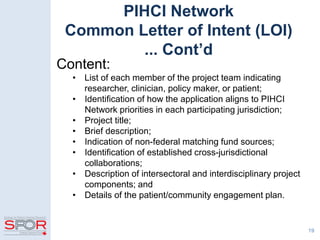
PIHCI Network
Common Letter of Intent (LOI)
... Cont’d
Content:
• List of each member of the project team indicating
researcher, clinician, policy maker, or patient;
• Identification of how the application aligns to PIHCI
Network priorities in each participating jurisdiction;
• Project title;
• Brief description;
• Indication of non-federal matching fund sources;
• Identification of established cross-jurisdictional
collaborations;
• Description of intersectoral and interdisciplinary project
components; and
• Details of the patient/community engagement plan.
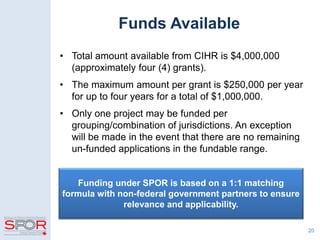
• Total amount available from CIHR is $4,000,000
(approximately four (4) grants).
• The maximum amount per grant is $250,000 per year
for up to four years for a total of $1,000,000.
• Only one project may be funded per
grouping/combination of jurisdictions. An exception
will be made in the event that there are no remaining
un-funded applications in the fundable range.
20
Funding under SPOR is based on a 1:1 matching
formula with non-federal government partners to ensure
relevance and applicability.
Funds Available
Eligibility
• The Nominated Principal Applicant (NPA) must
be an independent researcher or knowledge
user affiliated with a CIHR eligible institution.
• All research projects must be cross-
jurisdictional in scope:
̵ A minimum of four member networks must
be involved
̵ A letter of support from the tripartite
leadership of each member network
involved is required if one of the leads is not
listed as a Principal Applicant.
21
Eligibility (Continued)
• Each member network involved must have at
least one Principal Applicant or Knowledge
User listed on the application
• Patients must play a key role on the research
team; a minimum of one Principal Applicant or
Principal Knowledge User must be a patient
22
Application Process
• Please read all instructions in THE FUNDING OPPORTUNITY to
familiarize yourself with the application process before applying.
• An overview of CIHR’s application processes can be found under
Application Process.
• The application process for these funding opportunities is
comprised of two steps: LOI and Application.
• To complete your Letter of Intent and full application, follow the
instructions in the Grants – Application Guidelines along with any
additional instructions found below under “Specific Instructions
• All participants listed (other than Collaborators) will require a CIHR
PIN.
• Reminder to applicants: Please ensure that your application is
complete (includes all required signatures) and is submitted on time
to CIHR. 23
Evaluation Criteria
To support the strategic objectives of this funding
opportunity, the *following factors will be
considered:
1. Research Approach
2. Potential Impact
3. Patient Engagement and Partnership
*Please review the funding opportunity for the detailed evaluation criteria
24
Peer Review
• The peer review committee will be created
specifically for this funding opportunity.
• Multidisciplinary International panel Members
will include, but are not limited to, patients,
patient engagement experts, researchers,
health professionals and policy makers.
• For further information on CIHR’s peer review
principles, see Peer Review: Overview section
of CIHR’s website.
25
For more information
26
For all questions on the Funding Opportunity
and How to Apply:
CIHR Contact Centre
Telephone: 613-954-1968
Toll Free: 1-888-603-4178
Email: support@cihr-irsc.gc.ca
For questions related to Network proposal
development and support :
Contact the manager of the member network
(contact info on Slide 9)

PIHCI programmatic grants webinar (en) for circulation

  • 1.
    Canada’s Strategy forPatient- Oriented Research (SPOR) SPOR Network in Primary and Integrated Health Care Innovations (PIHCI) Programmatic Grants 1
  • 2.
    Overview • Strategy forPatient-Oriented Research (SPOR) • PIHCI Network • Programmatic Grants Funding Opportunity 2
  • 3.
    Strategy for Patient-OrientedResearch (SPOR) 3 Ensuring that the right patient receives the right intervention at the right time. Objective Foster evidence-informed health care by bringing innovative diagnostic and therapeutic approaches to the point of care, so as to ensure greater quality, accountability, and accessibility of care.
  • 4.
    4 SPOR Principles • Patients,decision-makers and clinicians need to be involved in all aspects of the research to ensure questions and results are relevant and ensure integration into policy and practice; • Funding under SPOR is based on a 1:1 matching formula with non-federal government partners to ensure relevance and applicability; • Effective patient-oriented research requires a multi-disciplinary approach; and • SPOR is outcome driven and incorporates performance measurement and evaluation as integral components of the initiative.
  • 5.
    Core Elements ofSPOR 5 Support for People and Patient-Oriented Research and Trials (SUPPORT) Units SPOR Networks Capacity development Clinical Trials Patient engagement
  • 6.
    Pan-Canadian SPOR Networkin Primary and Integrated Health Care Innovations Distributed network of networks Strategic scope: delivery of primary and integrated health care (including primary prevention) both horizontally and vertically across the care continuum to address: • Individuals with complex needs across the life course, including age groups from children to older adults; and, • Multi-sector integration of upstream prevention strategies and care delivery models.
  • 7.
    7 Pan-Canadian Network Objectives 1 •Create cross-jurisdictional opportunities to conduct research on the comparative efficiency, cost-effectiveness and scalability of innovative and integrated models of care that build on the foundations of CBPHC and facilitate transitions into and along the care continuum. 2 • Accelerate the timely investigation of new interventions and approaches in integrated care across multiple jurisdictions and sectors. 3 • Catalyze research on and scale-up of cost-effective and innovative approaches to integrated health care delivery. 4 • Support capacity building among researchers, clinicians, decision-makers and citizens/patients/families for timely generation and use of integrated health care knowledge. 5 • Foster the exchange of information and evidence on successful and unsuccessful interventions and innovative models of integrated health care across jurisdictions to inform policy development.
  • 8.
    8 AB Network SK Network MB Network ON Network QC Network BC Network NS Network Newfoundland and Labrador Network Network LeadershipCouncil and National CoordinationNWT Network NB Network PEI Network Primary and Integrated Health Care Innovations (PIHCI) Network Tripartite Leadership of PIHCI Networks / Leadership Council: • Researcher • Policy/Decision Maker • Clinician • Patients (on Leadership Council)
  • 9.
    Member Network Contacts 9 N.B.:It is required that applicants interested in applying to this funding opportunity consult with the relevant member networks prior to conceptualizing an application. Province/Territory Manager Province/Territory Manager Newfoundland and Labrador Nicole Porter Nicole.Porter@med.mun.ca Manitoba Gayle Halas gayle.halas@umanitoba.ca Nova Scotia Beverley Lawson Bev.Lawson@dal.ca Sara Wuite sara.wuite@dal.ca Saskatchewan Janice Braden Janice.braden@usask.ca Prince Edward Island Angela Riveroll anriveroll@upei.ca British Columbia Melody Monro melody.monro@ubc.ca New Brunswick Andrea Elizabeth Bowes andrea.bowes@unb.ca Northwest Territories Kimberly Fairman kimberly.fairman@ichr.ca Quebec Danielle Schirmer danielle.schirmer@usherbrooke.ca Shandi Miller shandi.miller@usherbrooke.ca Saskatchewan Janice Braden Janice.braden@usask.ca Ontario Dilzayn Panjwani dilzayn.panjwani@wchospital.ca Ivy Wong Ivy.wong@wchospital.ca Alberta Cliff Lindeman clindema@ualberta.ca Anh Pham anh.pham@ualberta.ca
  • 10.
    10 PIHCI Network Timeline 2015 2015-2016 Provincial/TerritorialNetworks Established Management & Operations Grants rolled out over the year to 11 networks Interim Leadership Council begins meeting to coordinate across networks – made up of all tripartite leads 2017 → Leadership Council Established September Each network invited to nominate a primary and secondary member October Network meetings at SPOR Summit to formalize network structure November Inaugural Leadership Council Meeting Fall 2016 Multi-year Funding Opportunity & Sustainability Larger 4 year programmatic grants to be launched and Network Coordinating Office established Early 2017 PIHCI Network Funding Opportunities Quick Strikes, (initial) National Coordinating Office, Knowledge Syntheses and Comparative Policy Analysis grants rolled out, funding start dates between 09/01/15 and 12/01/16 Pan-Canadian Network Events Leadership Council supports process to update provincial priorities and collaborates to plan and host the PIHCI Research Day at the CAHSPR Pre-conference Day
  • 11.
    PIHCI Network –Quick Strike Projects Playing Telephone: Exploring the potential for interdisciplinary shared decision making for medication therapy in shared electronic health records Let's Discuss Health: implementation and assessment in primary care of a web strategy to motivate patients to self-manage their health and support collaboration with health care providers Evaluating the implementation and impact of an online tool used within primary care to improve the income security of patients with complex health and social needs in Ontario and Manitoba Characterizing high system use across the primary- tertiary care continuum: parallel analyses of select Canadian health datasets Improving End-of-life Care in the Community Validation of Administrative and Primary Care Electronic Medical Record derived Frailty algorithms Improving care and outcomes of patients with CKD managed in primary care A Comparative Analysis of Centralized Waiting Lists for Unattached and Complex Patients Implemented in Six Canadian Provinces Improving Outcomes for Youth with Type 1 Diabetes in Transition to Adult Care Through Strengthening Integration with Primary Care: An Exploratory, Cross-Provincial Study Creation of a Comprehensive Health Profile of Children in New Brunswick and Prince Edward Island and Development of Intra- Provincial Population-Based Birth Cohorts Children with complex health conditions: Let's learn who they are and their needs to better serve them! Examiner les innovations pour soutenir les patients defavorises ayant des besoins de soins de sante communautaires complexes et integres HOTSPOTTING: Identifying superusers of health care services with mental health and addiction problems
  • 12.
    PIHCI Network –Comparative Policy Analyses Integrating paramedics into primary care to optimize patient time in the community at end of life Policies and program innovations that connect primary health care, social services, public health and community supports in Canada: A comparative policy analysis What are the impacts of being formally enroled with a GP on continuity and integration of care? Evidence from a comparison of Quebec and British Columbia
  • 13.
    PIHCI Network –Knowledge Syntheses Integrating end of life care to help people stay in the community: The essentials for success Case management in primary care to improve outcomes among frequent users of health care services with chronic conditions: a realist synthesis of what works, for whom and in what circumstances Dimensions of Quality for Mobile Applications in Chronic Disease Management. Interventions and Policies Influencing Primary Healthcare Professionals Managing Chronic Diseases: An Evidence Synthesis Building Cross-Generational Wellness and Resilience in Multi-Generational Indigenous Households: A Scoping Review Identifying and Understanding the Health and Social Care Needs of Older Adults with Multiple Chronic Conditions and their Caregivers: A Scoping Review Evaluating the comparative effectiveness of comprehensive geriatric assessment for improving patient and healthcare system outcomes: A systematic review and network meta-analysis Evaluation of primary health care integration strategies for adults with chronic health conditions: A systematic review
  • 14.
    14 SPOR PIHCI Network– Programmatic Grants
  • 15.
    Objective To support cross-jurisdictionalprograms of research that respond to the priorities of the Primary and Integrated Health Care Innovations (PIHCI) Network in order to generate findings that will guide evidence- informed policy decision-making, with the intent of having an impact on the health system for all Canadians within four years. 15
  • 16.
    Research Areas • Cross-jurisdictionalresearch projects must respond to one or more of the Network priorities, which were determined in consultation with the PIHCI member networks and their stakeholders. • Research questions must focus on patients with complex needs across the life course (a relatively small subgroup of the population with high health needs that accounts for a significant amount of health care utilization and costs – from children to older adults) 16
  • 17.
    17 Funding Opportunity Timeline ActivityDate Funding Opportunity Launch 2017-07-25 PIHCI Network Common LOI Deadline 2017-08-11 CIHR Letter of Intent Deadline 2017-09-26 Application Deadline 2017-11-28 Anticipated Notice of Decision 2018-02-28 Funding Start Date 2018-01-01 CIHR Deadline Network Deadline
  • 18.
    18 PIHCI Network Common Letterof Intent (LOI) Accessible at: https://goo.gl/FcRaCj (in Eng and Fr) Purpose: to access PICHI Network resources • Developmental support from PIHCI member networks • Letters of Support from member networks • Matching funds from some member networks Developmental support examples • Facilitate cross provincial partnerships • Provide patient feedback on early draft of proposal • Assistance in applying for/finding matched contribution • Alignment of network priorities
  • 19.
    19 PIHCI Network Common Letterof Intent (LOI) ... Cont’d Content: • List of each member of the project team indicating researcher, clinician, policy maker, or patient; • Identification of how the application aligns to PIHCI Network priorities in each participating jurisdiction; • Project title; • Brief description; • Indication of non-federal matching fund sources; • Identification of established cross-jurisdictional collaborations; • Description of intersectoral and interdisciplinary project components; and • Details of the patient/community engagement plan.
  • 20.
    • Total amountavailable from CIHR is $4,000,000 (approximately four (4) grants). • The maximum amount per grant is $250,000 per year for up to four years for a total of $1,000,000. • Only one project may be funded per grouping/combination of jurisdictions. An exception will be made in the event that there are no remaining un-funded applications in the fundable range. 20 Funding under SPOR is based on a 1:1 matching formula with non-federal government partners to ensure relevance and applicability. Funds Available
  • 21.
    Eligibility • The NominatedPrincipal Applicant (NPA) must be an independent researcher or knowledge user affiliated with a CIHR eligible institution. • All research projects must be cross- jurisdictional in scope: ̵ A minimum of four member networks must be involved ̵ A letter of support from the tripartite leadership of each member network involved is required if one of the leads is not listed as a Principal Applicant. 21
  • 22.
    Eligibility (Continued) • Eachmember network involved must have at least one Principal Applicant or Knowledge User listed on the application • Patients must play a key role on the research team; a minimum of one Principal Applicant or Principal Knowledge User must be a patient 22
  • 23.
    Application Process • Pleaseread all instructions in THE FUNDING OPPORTUNITY to familiarize yourself with the application process before applying. • An overview of CIHR’s application processes can be found under Application Process. • The application process for these funding opportunities is comprised of two steps: LOI and Application. • To complete your Letter of Intent and full application, follow the instructions in the Grants – Application Guidelines along with any additional instructions found below under “Specific Instructions • All participants listed (other than Collaborators) will require a CIHR PIN. • Reminder to applicants: Please ensure that your application is complete (includes all required signatures) and is submitted on time to CIHR. 23
  • 24.
    Evaluation Criteria To supportthe strategic objectives of this funding opportunity, the *following factors will be considered: 1. Research Approach 2. Potential Impact 3. Patient Engagement and Partnership *Please review the funding opportunity for the detailed evaluation criteria 24
  • 25.
    Peer Review • Thepeer review committee will be created specifically for this funding opportunity. • Multidisciplinary International panel Members will include, but are not limited to, patients, patient engagement experts, researchers, health professionals and policy makers. • For further information on CIHR’s peer review principles, see Peer Review: Overview section of CIHR’s website. 25
  • 26.
    For more information 26 Forall questions on the Funding Opportunity and How to Apply: CIHR Contact Centre Telephone: 613-954-1968 Toll Free: 1-888-603-4178 Email: support@cihr-irsc.gc.ca For questions related to Network proposal development and support : Contact the manager of the member network (contact info on Slide 9)