Aligning Innovation with both
Health Service Needs &
Economic Opportunity
Life Sciences International Summit 2010
Croke Park, Dublin
11th November 2010
Jim Breslin,Jim Breslin,
Department of Health & ChildrenDepartment of Health & Children
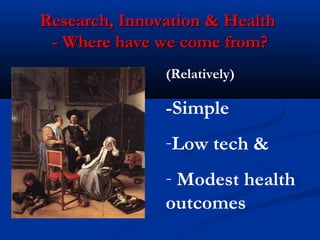
Research, Innovation & HealthResearch, Innovation & Health
- Where have we come from?- Where have we come from?
(Relatively)
-Simple
-Low tech &
- Modest health
outcomes
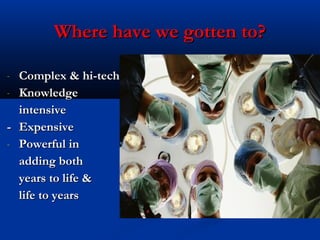
Where have we gotten to?Where have we gotten to?
- Complex & hi-techComplex & hi-tech
- KnowledgeKnowledge
intensiveintensive
-- ExpensiveExpensive
- Powerful inPowerful in
adding bothadding both
years to life &years to life &
life to yearslife to years
Health Service TransformationHealth Service Transformation
- Today’s Drivers- Today’s Drivers
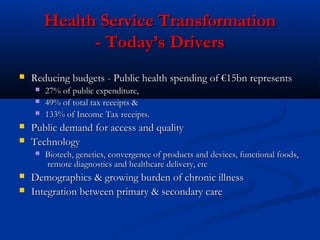
 Reducing budgets - Public health spending of €15bn representsReducing budgets - Public health spending of €15bn represents
 27% of public expenditure,27% of public expenditure,
 49% of total tax receipts &49% of total tax receipts &
 133% of Income Tax receipts.133% of Income Tax receipts.
 Public demand for access and qualityPublic demand for access and quality
 TechnologyTechnology
 Biotech, genetics, convergence of products and devices, functional foods,Biotech, genetics, convergence of products and devices, functional foods,
remote diagnostics and healthcare delivery, etcremote diagnostics and healthcare delivery, etc
 Demographics & growing burden of chronic illnessDemographics & growing burden of chronic illness
 Integration between primary & secondary careIntegration between primary & secondary care
Health Service TransformationHealth Service Transformation
- Preferred Model- Preferred Model
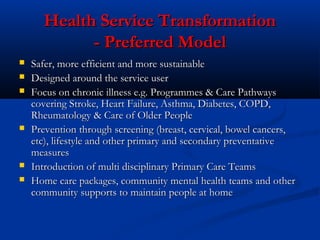
 Safer, more efficient and more sustainableSafer, more efficient and more sustainable
 Designed around the service userDesigned around the service user
 Focus on chronic illness e.g. Programmes & Care PathwaysFocus on chronic illness e.g. Programmes & Care Pathways
covering Stroke, Heart Failure, Asthma, Diabetes, COPD,covering Stroke, Heart Failure, Asthma, Diabetes, COPD,
Rheumatology & Care of Older PeopleRheumatology & Care of Older People
 Prevention through screening (breast, cervical, bowel cancers,Prevention through screening (breast, cervical, bowel cancers,
etc), lifestyle and other primary and secondary preventativeetc), lifestyle and other primary and secondary preventative
measuresmeasures
 Introduction of multi disciplinary Primary Care TeamsIntroduction of multi disciplinary Primary Care Teams
 Home care packages, community mental health teams and otherHome care packages, community mental health teams and other
community supports to maintain people at homecommunity supports to maintain people at home
Health Service TransformationHealth Service Transformation
- Preferred Model- Preferred Model
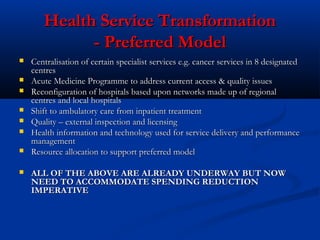
 Centralisation of certain specialist services e.g. cancer services in 8 designatedCentralisation of certain specialist services e.g. cancer services in 8 designated
centrescentres
 Acute Medicine Programme to address current access & quality issuesAcute Medicine Programme to address current access & quality issues
 Reconfiguration of hospitals based upon networks made up of regionalReconfiguration of hospitals based upon networks made up of regional
centres and local hospitalscentres and local hospitals
 Shift to ambulatory care from inpatient treatmentShift to ambulatory care from inpatient treatment
 Quality – external inspection and licensingQuality – external inspection and licensing
 Health information and technology used for service delivery and performanceHealth information and technology used for service delivery and performance
managementmanagement
 Resource allocation to support preferred modelResource allocation to support preferred model
 ALL OF THE ABOVE ARE ALREADY UNDERWAY BUT NOWALL OF THE ABOVE ARE ALREADY UNDERWAY BUT NOW
NEED TO ACCOMMODATE SPENDING REDUCTIONNEED TO ACCOMMODATE SPENDING REDUCTION
IMPERATIVEIMPERATIVE
The Role for Health Research:The Role for Health Research:
The InterconnectionsThe Interconnections
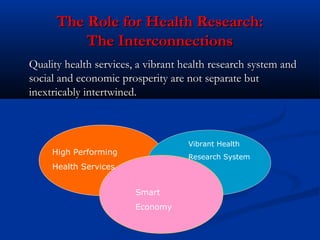
Quality health services, a vibrant health research system andQuality health services, a vibrant health research system and
social and economic prosperity are not separate butsocial and economic prosperity are not separate but
inextricably intertwined.inextricably intertwined.
High Performing
Health Services
Vibrant Health
Research System
Smart
Economy
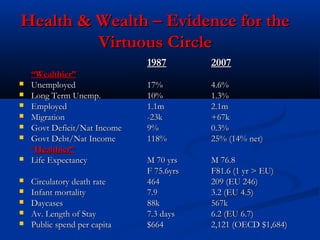
Health & Wealth – Evidence for theHealth & Wealth – Evidence for the
Virtuous CircleVirtuous Circle
19871987 20072007
““Wealthier”Wealthier”
 UnemployedUnemployed 17%17% 4.6%4.6%
 Long Term Unemp.Long Term Unemp. 10%10% 1.3%1.3%
 EmployedEmployed 1.1m1.1m 2.1m2.1m
 MigrationMigration -23k-23k +67k+67k
 Govt Deficit/Nat IncomeGovt Deficit/Nat Income 9%9% 0.3%0.3%
 Govt Debt/Nat IncomeGovt Debt/Nat Income 118%118% 25% (14% net)25% (14% net)
““Healthier”Healthier”
 Life ExpectancyLife Expectancy M 70 yrsM 70 yrs M 76.8M 76.8
F 75.6yrsF 75.6yrs F81.6 (1 yr > EU)F81.6 (1 yr > EU)
 Circulatory death rateCirculatory death rate 464464 209 (EU 246)209 (EU 246)
 Infant mortalityInfant mortality 7.97.9 3.2 (EU 4.5)3.2 (EU 4.5)
 DaycasesDaycases 88k88k 567k567k
 Av. Length of StayAv. Length of Stay 7.3 days7.3 days 6.2 (EU 6.7)6.2 (EU 6.7)
 Public spend per capitaPublic spend per capita $664$664 2,121 (OECD $1,684)2,121 (OECD $1,684)
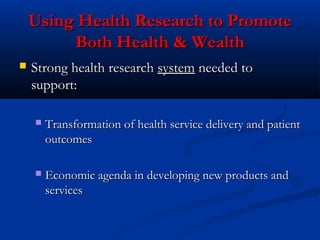
Using Health Research to PromoteUsing Health Research to Promote
Both Health & WealthBoth Health & Wealth
 Strong health researchStrong health research systemsystem needed toneeded to
support:support:
 Transformation of health service delivery and patientTransformation of health service delivery and patient
outcomesoutcomes
 Economic agenda in developing new products andEconomic agenda in developing new products and
servicesservices
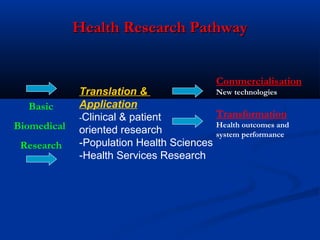
Health Research PathwayHealth Research Pathway
Translation &
Application
-Clinical & patient
oriented research
-Population Health Sciences
-Health Services Research
Basic
Biomedical
Research
Transformation
Health outcomes and
system performance
Commercialisation
New technologies
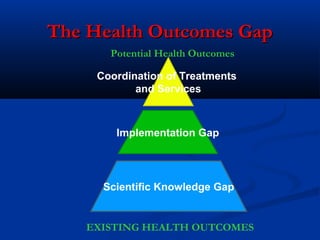
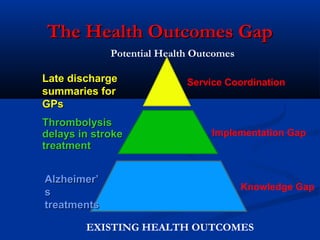
The Health Outcomes GapThe Health Outcomes Gap
Coordination of Treatments
and Services
Implementation Gap
Scientific Knowledge Gap
EXISTING HEALTH OUTCOMES
Potential Health Outcomes
The Health Outcomes GapThe Health Outcomes Gap
Service Coordination
Implementation Gap
Knowledge Gap
EXISTING HEALTH OUTCOMES
Potential Health Outcomes
Alzheimer’Alzheimer’
ss
treatmentstreatments
ThrombolysisThrombolysis
delays in strokedelays in stroke
treatmenttreatment
Late dischargeLate discharge
summaries forsummaries for
GPsGPs
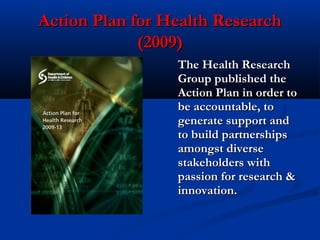
Action Plan for Health ResearchAction Plan for Health Research
(2009)(2009)
The Health ResearchThe Health Research
Group published theGroup published the
Action Plan in order toAction Plan in order to
be accountable, tobe accountable, to
generate support andgenerate support and
to build partnershipsto build partnerships
amongst diverseamongst diverse
stakeholders withstakeholders with
passion for research &passion for research &
innovation.innovation.
What will the Action Plan for HealthWhat will the Action Plan for Health
Research Achieve?Research Achieve?
1.1. Framework for co-ordination & accountability acrossFramework for co-ordination & accountability across
diverse stakeholders.diverse stakeholders.
2.2. National priorities for health research.National priorities for health research.
3.3. Enabling research infrastructure; in particular clinicalEnabling research infrastructure; in particular clinical
research facilities in our main academic hospitals &research facilities in our main academic hospitals &
scalable informatics and bio-banking solutions.scalable informatics and bio-banking solutions.
4.4. More clinical trials networks, internationally linked.More clinical trials networks, internationally linked.
5.5. Focus on commercialisation & industry partnerships.Focus on commercialisation & industry partnerships.
6.6. Streamlined and predictable regulatory environment.Streamlined and predictable regulatory environment.
What will the Action Plan Achieve?What will the Action Plan Achieve?
7.7. More clinicians & health care professionals doingMore clinicians & health care professionals doing
high quality patient focused research.high quality patient focused research.
8.8. Rebalancing activity towards patient relatedRebalancing activity towards patient related
outcomes.outcomes.
9.9. Increased capacity for population health and healthIncreased capacity for population health and health
services research.services research.
10.10. Transformation of care pathways informed byTransformation of care pathways informed by
(locally adapted) international research evidence.(locally adapted) international research evidence.
11.11. Mechanisms to monitor and evaluate investment,Mechanisms to monitor and evaluate investment,
across both health and economic dimensions.across both health and economic dimensions.
Action Plan – Year 1Action Plan – Year 1
ProgressProgress
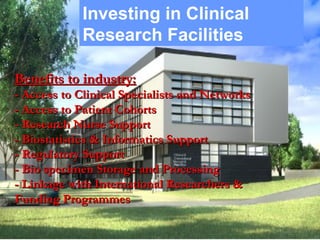
Investing in Clinical
Research Facilities
Benefits to industry:Benefits to industry:
- Access to Clinical Specialists and Networks- Access to Clinical Specialists and Networks
- Access to Patient Cohorts- Access to Patient Cohorts
- Research Nurse Support- Research Nurse Support
- Biostatistics & Informatics Support- Biostatistics & Informatics Support
- Regulatory Support- Regulatory Support
- Bio specimen Storage and Processing- Bio specimen Storage and Processing
- Linkage with International Researchers &- Linkage with International Researchers &
Funding ProgrammesFunding Programmes
Other Highlights of Year 1 ProgressOther Highlights of Year 1 Progress
 InfrastructureInfrastructure
 Growing & Networking Clinical Research FacilitiesGrowing & Networking Clinical Research Facilities
 National bio-banking solutionNational bio-banking solution
 Centre of Excellence for Successful Ageing approvedCentre of Excellence for Successful Ageing approved
 GovernanceGovernance
 Revamp of Research Ethics Committee StructuresRevamp of Research Ethics Committee Structures
 HSE research governance brought under Quality & ClinicalHSE research governance brought under Quality & Clinical
Care Directorate & aligned with Clinical Care ProgrammesCare Directorate & aligned with Clinical Care Programmes
 Commercial LinkagesCommercial Linkages
 HSE Quality & Clinical Care partnering with EnterpriseHSE Quality & Clinical Care partnering with Enterprise
agencies on Innovationagencies on Innovation
Year 1 Progress Contd.Year 1 Progress Contd.
 Clinical Trials - Cardiovascular and Stroke NetworkClinical Trials - Cardiovascular and Stroke Network
under developmentunder development
 FundingFunding
 HRB awards have been aligned more towards patient andHRB awards have been aligned more towards patient and
health service benefitshealth service benefits
 New HRB/SFI Translational Research AwardsNew HRB/SFI Translational Research Awards
 SFI/HRB/Wellcome Trust Biomedical Research PartnershipSFI/HRB/Wellcome Trust Biomedical Research Partnership
 International – Tripling in latest FP7 funding awards toInternational – Tripling in latest FP7 funding awards to
€17.4. Strong Irish participation in Joint Programming in€17.4. Strong Irish participation in Joint Programming in
Neuro-degenerative and Food areas.Neuro-degenerative and Food areas.
Thank YouThank You

Life Sciences

  • 1.
    Aligning Innovation withboth Health Service Needs & Economic Opportunity Life Sciences International Summit 2010 Croke Park, Dublin 11th November 2010 Jim Breslin,Jim Breslin, Department of Health & ChildrenDepartment of Health & Children
  • 2.
    Research, Innovation &HealthResearch, Innovation & Health - Where have we come from?- Where have we come from? (Relatively) -Simple -Low tech & - Modest health outcomes
  • 3.
    Where have wegotten to?Where have we gotten to? - Complex & hi-techComplex & hi-tech - KnowledgeKnowledge intensiveintensive -- ExpensiveExpensive - Powerful inPowerful in adding bothadding both years to life &years to life & life to yearslife to years
  • 4.
    Health Service TransformationHealthService Transformation - Today’s Drivers- Today’s Drivers  Reducing budgets - Public health spending of €15bn representsReducing budgets - Public health spending of €15bn represents  27% of public expenditure,27% of public expenditure,  49% of total tax receipts &49% of total tax receipts &  133% of Income Tax receipts.133% of Income Tax receipts.  Public demand for access and qualityPublic demand for access and quality  TechnologyTechnology  Biotech, genetics, convergence of products and devices, functional foods,Biotech, genetics, convergence of products and devices, functional foods, remote diagnostics and healthcare delivery, etcremote diagnostics and healthcare delivery, etc  Demographics & growing burden of chronic illnessDemographics & growing burden of chronic illness  Integration between primary & secondary careIntegration between primary & secondary care
  • 5.
    Health Service TransformationHealthService Transformation - Preferred Model- Preferred Model  Safer, more efficient and more sustainableSafer, more efficient and more sustainable  Designed around the service userDesigned around the service user  Focus on chronic illness e.g. Programmes & Care PathwaysFocus on chronic illness e.g. Programmes & Care Pathways covering Stroke, Heart Failure, Asthma, Diabetes, COPD,covering Stroke, Heart Failure, Asthma, Diabetes, COPD, Rheumatology & Care of Older PeopleRheumatology & Care of Older People  Prevention through screening (breast, cervical, bowel cancers,Prevention through screening (breast, cervical, bowel cancers, etc), lifestyle and other primary and secondary preventativeetc), lifestyle and other primary and secondary preventative measuresmeasures  Introduction of multi disciplinary Primary Care TeamsIntroduction of multi disciplinary Primary Care Teams  Home care packages, community mental health teams and otherHome care packages, community mental health teams and other community supports to maintain people at homecommunity supports to maintain people at home
  • 6.
    Health Service TransformationHealthService Transformation - Preferred Model- Preferred Model  Centralisation of certain specialist services e.g. cancer services in 8 designatedCentralisation of certain specialist services e.g. cancer services in 8 designated centrescentres  Acute Medicine Programme to address current access & quality issuesAcute Medicine Programme to address current access & quality issues  Reconfiguration of hospitals based upon networks made up of regionalReconfiguration of hospitals based upon networks made up of regional centres and local hospitalscentres and local hospitals  Shift to ambulatory care from inpatient treatmentShift to ambulatory care from inpatient treatment  Quality – external inspection and licensingQuality – external inspection and licensing  Health information and technology used for service delivery and performanceHealth information and technology used for service delivery and performance managementmanagement  Resource allocation to support preferred modelResource allocation to support preferred model  ALL OF THE ABOVE ARE ALREADY UNDERWAY BUT NOWALL OF THE ABOVE ARE ALREADY UNDERWAY BUT NOW NEED TO ACCOMMODATE SPENDING REDUCTIONNEED TO ACCOMMODATE SPENDING REDUCTION IMPERATIVEIMPERATIVE
  • 7.
    The Role forHealth Research:The Role for Health Research: The InterconnectionsThe Interconnections Quality health services, a vibrant health research system andQuality health services, a vibrant health research system and social and economic prosperity are not separate butsocial and economic prosperity are not separate but inextricably intertwined.inextricably intertwined. High Performing Health Services Vibrant Health Research System Smart Economy
  • 8.
    Health & Wealth– Evidence for theHealth & Wealth – Evidence for the Virtuous CircleVirtuous Circle 19871987 20072007 ““Wealthier”Wealthier”  UnemployedUnemployed 17%17% 4.6%4.6%  Long Term Unemp.Long Term Unemp. 10%10% 1.3%1.3%  EmployedEmployed 1.1m1.1m 2.1m2.1m  MigrationMigration -23k-23k +67k+67k  Govt Deficit/Nat IncomeGovt Deficit/Nat Income 9%9% 0.3%0.3%  Govt Debt/Nat IncomeGovt Debt/Nat Income 118%118% 25% (14% net)25% (14% net) ““Healthier”Healthier”  Life ExpectancyLife Expectancy M 70 yrsM 70 yrs M 76.8M 76.8 F 75.6yrsF 75.6yrs F81.6 (1 yr > EU)F81.6 (1 yr > EU)  Circulatory death rateCirculatory death rate 464464 209 (EU 246)209 (EU 246)  Infant mortalityInfant mortality 7.97.9 3.2 (EU 4.5)3.2 (EU 4.5)  DaycasesDaycases 88k88k 567k567k  Av. Length of StayAv. Length of Stay 7.3 days7.3 days 6.2 (EU 6.7)6.2 (EU 6.7)  Public spend per capitaPublic spend per capita $664$664 2,121 (OECD $1,684)2,121 (OECD $1,684)
  • 9.
    Using Health Researchto PromoteUsing Health Research to Promote Both Health & WealthBoth Health & Wealth  Strong health researchStrong health research systemsystem needed toneeded to support:support:  Transformation of health service delivery and patientTransformation of health service delivery and patient outcomesoutcomes  Economic agenda in developing new products andEconomic agenda in developing new products and servicesservices
  • 10.
    Health Research PathwayHealthResearch Pathway Translation & Application -Clinical & patient oriented research -Population Health Sciences -Health Services Research Basic Biomedical Research Transformation Health outcomes and system performance Commercialisation New technologies
  • 11.
    The Health OutcomesGapThe Health Outcomes Gap Coordination of Treatments and Services Implementation Gap Scientific Knowledge Gap EXISTING HEALTH OUTCOMES Potential Health Outcomes
  • 12.
    The Health OutcomesGapThe Health Outcomes Gap Service Coordination Implementation Gap Knowledge Gap EXISTING HEALTH OUTCOMES Potential Health Outcomes Alzheimer’Alzheimer’ ss treatmentstreatments ThrombolysisThrombolysis delays in strokedelays in stroke treatmenttreatment Late dischargeLate discharge summaries forsummaries for GPsGPs
  • 13.
    Action Plan forHealth ResearchAction Plan for Health Research (2009)(2009) The Health ResearchThe Health Research Group published theGroup published the Action Plan in order toAction Plan in order to be accountable, tobe accountable, to generate support andgenerate support and to build partnershipsto build partnerships amongst diverseamongst diverse stakeholders withstakeholders with passion for research &passion for research & innovation.innovation.
  • 14.
    What will theAction Plan for HealthWhat will the Action Plan for Health Research Achieve?Research Achieve? 1.1. Framework for co-ordination & accountability acrossFramework for co-ordination & accountability across diverse stakeholders.diverse stakeholders. 2.2. National priorities for health research.National priorities for health research. 3.3. Enabling research infrastructure; in particular clinicalEnabling research infrastructure; in particular clinical research facilities in our main academic hospitals &research facilities in our main academic hospitals & scalable informatics and bio-banking solutions.scalable informatics and bio-banking solutions. 4.4. More clinical trials networks, internationally linked.More clinical trials networks, internationally linked. 5.5. Focus on commercialisation & industry partnerships.Focus on commercialisation & industry partnerships. 6.6. Streamlined and predictable regulatory environment.Streamlined and predictable regulatory environment.
  • 15.
    What will theAction Plan Achieve?What will the Action Plan Achieve? 7.7. More clinicians & health care professionals doingMore clinicians & health care professionals doing high quality patient focused research.high quality patient focused research. 8.8. Rebalancing activity towards patient relatedRebalancing activity towards patient related outcomes.outcomes. 9.9. Increased capacity for population health and healthIncreased capacity for population health and health services research.services research. 10.10. Transformation of care pathways informed byTransformation of care pathways informed by (locally adapted) international research evidence.(locally adapted) international research evidence. 11.11. Mechanisms to monitor and evaluate investment,Mechanisms to monitor and evaluate investment, across both health and economic dimensions.across both health and economic dimensions.
  • 16.
    Action Plan –Year 1Action Plan – Year 1 ProgressProgress
  • 17.
    Investing in Clinical ResearchFacilities Benefits to industry:Benefits to industry: - Access to Clinical Specialists and Networks- Access to Clinical Specialists and Networks - Access to Patient Cohorts- Access to Patient Cohorts - Research Nurse Support- Research Nurse Support - Biostatistics & Informatics Support- Biostatistics & Informatics Support - Regulatory Support- Regulatory Support - Bio specimen Storage and Processing- Bio specimen Storage and Processing - Linkage with International Researchers &- Linkage with International Researchers & Funding ProgrammesFunding Programmes
  • 18.
    Other Highlights ofYear 1 ProgressOther Highlights of Year 1 Progress  InfrastructureInfrastructure  Growing & Networking Clinical Research FacilitiesGrowing & Networking Clinical Research Facilities  National bio-banking solutionNational bio-banking solution  Centre of Excellence for Successful Ageing approvedCentre of Excellence for Successful Ageing approved  GovernanceGovernance  Revamp of Research Ethics Committee StructuresRevamp of Research Ethics Committee Structures  HSE research governance brought under Quality & ClinicalHSE research governance brought under Quality & Clinical Care Directorate & aligned with Clinical Care ProgrammesCare Directorate & aligned with Clinical Care Programmes  Commercial LinkagesCommercial Linkages  HSE Quality & Clinical Care partnering with EnterpriseHSE Quality & Clinical Care partnering with Enterprise agencies on Innovationagencies on Innovation
  • 19.
    Year 1 ProgressContd.Year 1 Progress Contd.  Clinical Trials - Cardiovascular and Stroke NetworkClinical Trials - Cardiovascular and Stroke Network under developmentunder development  FundingFunding  HRB awards have been aligned more towards patient andHRB awards have been aligned more towards patient and health service benefitshealth service benefits  New HRB/SFI Translational Research AwardsNew HRB/SFI Translational Research Awards  SFI/HRB/Wellcome Trust Biomedical Research PartnershipSFI/HRB/Wellcome Trust Biomedical Research Partnership  International – Tripling in latest FP7 funding awards toInternational – Tripling in latest FP7 funding awards to €17.4. Strong Irish participation in Joint Programming in€17.4. Strong Irish participation in Joint Programming in Neuro-degenerative and Food areas.Neuro-degenerative and Food areas.
  • 20.

Editor's Notes

  • #9 Life Science sector provides real opportunities for economic growth. Life Sciences sector in Ireland currently - employs in excess of 52,000 people in over 350 enterprises.  - contributes almost 30% toward total exports which were valued at €44.4 billion in 2008.  Ireland is well positioned to take advantage of global trends in the sector including convergence products and devices, functional foods, and remote diagnostics and healthcare delivery.  Investments made in R&D in areas directly relevant to the sector, together with our depth of capabilities in ICT and engineering will continue to serve us well as we shift towards increasingly innovative and research intensive activities. 
  • #13 Service Coordination Gap – Of 500 GPs, 70% reported late discharge summaries “often” or “very often”; 90% reported it compromised clinical care 68% it compromised patient safety (Karolinska Institute)