VV
It is heartily thanks to the principal mam of
for the given facilities and
opportunity. Primarily I would thank god being able to complete
this project with success. Then I would like to thank my physics
teacher Mrs. DEEPIKA , whose valuable guidance has been the
once that helped me patch this project and make it full proof success
, her suggestions and her instructions has served as the major
contributor towards the completion of project .
 Then I would like to thank my parents and friends who
have helped me with their valuable suggestions and guidance has
been helpful in various phases of the completion of project .
 Last but not the least I would like to thank my friends
who have helped me a lot .
CERTIFICATE
oThis is hereby to certify that the original and genuine
investigation work has been carried out to investigate
about the subject matter and the related data
collection and investigation has been completed
sincerely and satisfactorily by ISHA GOYAL of class
12th‘B’ of S.A. JAIN SENIOR MODEL SCHOOL
,regarding her project titled
o “TO STUDY THE NO. OF TURNINGS IN THE
SECONDARY AND PRIMARY COIL OF
TRANSFORMER”.
 INTRODUCTION
 THEORY
 IN A STEP DOWN
TRANSFORMER
 IN A STEP UP
TRANSFORMER
 EFFICIENCY
 AIM
 APPARATUS
REQUIRED
 PROCEDURE
 ENERGY LOSSES
 USES OF TRANSFORMERS
 NUTSHELL
 PRECAUTIONS
 SOURCES OF ERROR
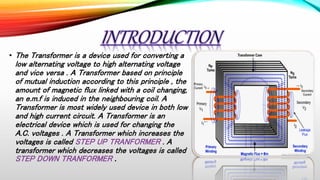
• The Transformer is a device used for converting a
low alternating voltage to high alternating voltage
and vice versa . A Transformer based on principle
of mutual induction according to this principle , the
amount of magnetic flux linked with a coil changing,
an e.m.f is induced in the neighbouring coil. A
Transformer is most widely used device in both low
and high current circuit. A Transformer is an
electrical device which is used for changing the
A.C. voltages . A Transformer which increases the
voltages is called STEP UP TRANFORMER . A
transformer which decreases the voltages is called
STEP DOWN TRANFORMER .
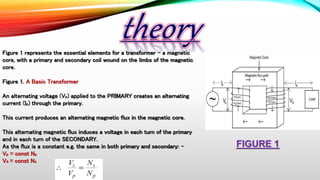
Figure 1 represents the essential elements for a transformer - a magnetic
core, with a primary and secondary coil wound on the limbs of the magnetic
core.
Figure 1. A Basic Transformer
An alternating voltage (Vp) applied to the PRIMARY creates an alternating
current (Ip) through the primary.
This current produces an alternating magnetic flux in the magnetic core.
This alternating magnetic flux induces a voltage in each turn of the primary
and in each turn of the SECONDARY.
As the flux is a constant e.g. the same in both primary and secondary: -
Vp = const Np
Vs = const Ns
FIGURE 1
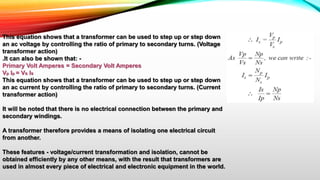
This equation shows that a transformer can be used to step up or step down
an ac voltage by controlling the ratio of primary to secondary turns. (Voltage
transformer action)
.It can also be shown that: -
Primary Volt Amperes = Secondary Volt Amperes
Vp Ip = Vs Is
This equation shows that a transformer can be used to step up or step down
an ac current by controlling the ratio of primary to secondary turns. (Current
transformer action)
It will be noted that there is no electrical connection between the primary and
secondary windings.
A transformer therefore provides a means of isolating one electrical circuit
from another.
These features - voltage/current transformation and isolation, cannot be
obtained efficiently by any other means, with the result that transformers are
used in almost every piece of electrical and electronic equipment in the world.
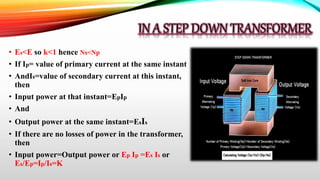
• Es<E so k<1 hence Ns<Np
• If Ip= value of primary current at the same instant
• AndIs=value of secondary current at this instant,
then
• Input power at that instant=EpIp
• And
• Output power at the same instant=EsIs
• If there are no losses of power in the transformer,
then
• Input power=Output power or Ep Ip =Es Is or
Es/Ep=Ip/Is=K
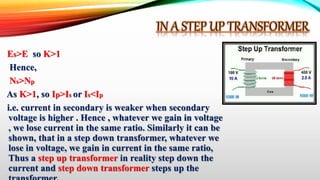
Es>E so K>1
Hence,
Ns>Np
As K>1, so Ip>Is or Is<Ip
i.e. current in secondary is weaker when secondary
voltage is higher . Hence , whatever we gain in voltage
, we lose current in the same ratio. Similarly it can be
shown, that in a step down transformer, whatever we
lose in voltage, we gain in current in the same ratio,
Thus a step up transformer in reality step down the
current and step down transformer steps up the
EFFICIENCY
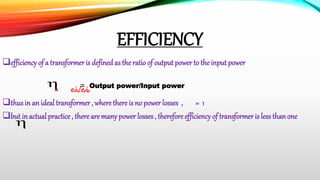
efficiency of a transformer is defined as the ratio of output power to the inputpower
= esis/epip
thus in an ideal transformer , where there is no power losses , = 1
but in actual practice , there are many power losses , therefore efficiency of transformer is less than one
=
Output power/Input power
To study the number of turnings in secondary and primary coil of transformer .
AIM OF THE EXPERIMENT
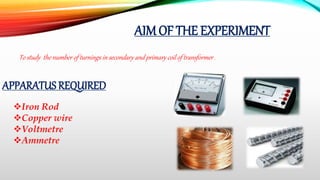
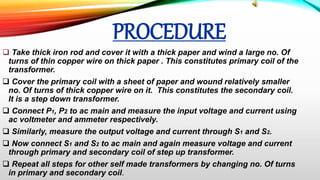
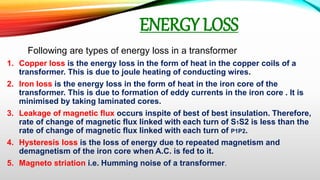
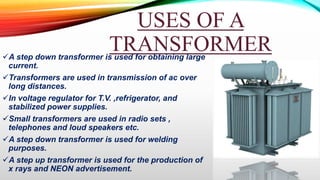
APPARATUS REQUIRED
Iron Rod
Copper wire
Voltmetre
Ammetre
PROCEDURE
 Take thick iron rod and cover it with a thick paper and wind a large no. Of
turns of thin copper wire on thick paper . This constitutes primary coil of the
transformer.
 Cover the primary coil with a sheet of paper and wound relatively smaller
no. Of turns of thick copper wire on it. This constitutes the secondary coil.
It is a step down transformer.
 Connect P1, P2 to ac main and measure the input voltage and current using
ac voltmeter and ammeter respectively.
 Similarly, measure the output voltage and current through S1 and S2.
 Now connect S1 and S2 to ac main and again measure voltage and current
through primary and secondary coil of step up transformer.
 Repeat all steps for other self made transformers by changing no. Of turns
in primary and secondary coil.
ENERGY LOSS
Following are types of energy loss in a transformer
1. Copper loss is the energy loss in the form of heat in the copper coils of a
transformer. This is due to joule heating of conducting wires.
2. Iron loss is the energy loss in the form of heat in the iron core of the
transformer. This is due to formation of eddy currents in the iron core . It is
minimised by taking laminated cores.
3. Leakage of magnetic flux occurs inspite of best of best insulation. Therefore,
rate of change of magnetic flux linked with each turn of S1S2 is less than the
rate of change of magnetic flux linked with each turn of P1P2.
4. Hysteresis loss is the loss of energy due to repeated magnetism and
demagnetism of the iron core when A.C. is fed to it.
5. Magneto striation i.e. Humming noise of a transformer.
USES OF A
TRANSFORMER
A step down transformer is used for obtaining large
current.
Transformers are used in transmission of ac over
long distances.
In voltage regulator for T.V. ,refrigerator, and
stabilized power supplies.
Small transformers are used in radio sets ,
telephones and loud speakers etc.
A step down transformer is used for welding
purposes.
A step up transformer is used for the production of
x rays and NEON advertisement.
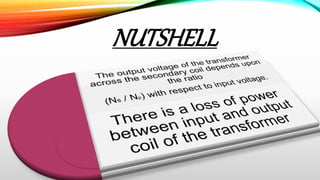
NUTSHELL
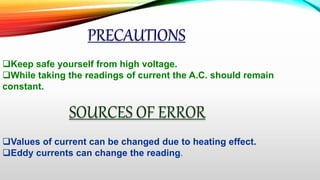
PRECAUTIONS
Keep safe yourself from high voltage.
While taking the readings of current the A.C. should remain
constant.
SOURCES OF ERROR
Values of current can be changed due to heating effect.
Eddy currents can change the reading.
BIBLIOGRAPHY
 LABORATARY MANUAL OF PHYSICS
 www.wikipedia.com
 Google
 Phys.org
ISHA  GOYAL 12THB PPT POWERPOINT.pptx

ISHA GOYAL 12THB PPT POWERPOINT.pptx

  • 1.
  • 2.
    It is heartilythanks to the principal mam of for the given facilities and opportunity. Primarily I would thank god being able to complete this project with success. Then I would like to thank my physics teacher Mrs. DEEPIKA , whose valuable guidance has been the once that helped me patch this project and make it full proof success , her suggestions and her instructions has served as the major contributor towards the completion of project .  Then I would like to thank my parents and friends who have helped me with their valuable suggestions and guidance has been helpful in various phases of the completion of project .  Last but not the least I would like to thank my friends who have helped me a lot .
  • 3.
    CERTIFICATE oThis is herebyto certify that the original and genuine investigation work has been carried out to investigate about the subject matter and the related data collection and investigation has been completed sincerely and satisfactorily by ISHA GOYAL of class 12th‘B’ of S.A. JAIN SENIOR MODEL SCHOOL ,regarding her project titled o “TO STUDY THE NO. OF TURNINGS IN THE SECONDARY AND PRIMARY COIL OF TRANSFORMER”.
  • 4.
     INTRODUCTION  THEORY IN A STEP DOWN TRANSFORMER  IN A STEP UP TRANSFORMER  EFFICIENCY  AIM  APPARATUS REQUIRED  PROCEDURE  ENERGY LOSSES  USES OF TRANSFORMERS  NUTSHELL  PRECAUTIONS  SOURCES OF ERROR
  • 6.
    • The Transformeris a device used for converting a low alternating voltage to high alternating voltage and vice versa . A Transformer based on principle of mutual induction according to this principle , the amount of magnetic flux linked with a coil changing, an e.m.f is induced in the neighbouring coil. A Transformer is most widely used device in both low and high current circuit. A Transformer is an electrical device which is used for changing the A.C. voltages . A Transformer which increases the voltages is called STEP UP TRANFORMER . A transformer which decreases the voltages is called STEP DOWN TRANFORMER .
  • 7.
    Figure 1 representsthe essential elements for a transformer - a magnetic core, with a primary and secondary coil wound on the limbs of the magnetic core. Figure 1. A Basic Transformer An alternating voltage (Vp) applied to the PRIMARY creates an alternating current (Ip) through the primary. This current produces an alternating magnetic flux in the magnetic core. This alternating magnetic flux induces a voltage in each turn of the primary and in each turn of the SECONDARY. As the flux is a constant e.g. the same in both primary and secondary: - Vp = const Np Vs = const Ns FIGURE 1
  • 8.
    This equation showsthat a transformer can be used to step up or step down an ac voltage by controlling the ratio of primary to secondary turns. (Voltage transformer action) .It can also be shown that: - Primary Volt Amperes = Secondary Volt Amperes Vp Ip = Vs Is This equation shows that a transformer can be used to step up or step down an ac current by controlling the ratio of primary to secondary turns. (Current transformer action) It will be noted that there is no electrical connection between the primary and secondary windings. A transformer therefore provides a means of isolating one electrical circuit from another. These features - voltage/current transformation and isolation, cannot be obtained efficiently by any other means, with the result that transformers are used in almost every piece of electrical and electronic equipment in the world.
  • 9.
    • Es<E sok<1 hence Ns<Np • If Ip= value of primary current at the same instant • AndIs=value of secondary current at this instant, then • Input power at that instant=EpIp • And • Output power at the same instant=EsIs • If there are no losses of power in the transformer, then • Input power=Output power or Ep Ip =Es Is or Es/Ep=Ip/Is=K
  • 10.
    Es>E so K>1 Hence, Ns>Np AsK>1, so Ip>Is or Is<Ip i.e. current in secondary is weaker when secondary voltage is higher . Hence , whatever we gain in voltage , we lose current in the same ratio. Similarly it can be shown, that in a step down transformer, whatever we lose in voltage, we gain in current in the same ratio, Thus a step up transformer in reality step down the current and step down transformer steps up the
  • 11.
    EFFICIENCY efficiency of atransformer is defined as the ratio of output power to the inputpower = esis/epip thus in an ideal transformer , where there is no power losses , = 1 but in actual practice , there are many power losses , therefore efficiency of transformer is less than one = Output power/Input power
  • 12.
    To study thenumber of turnings in secondary and primary coil of transformer . AIM OF THE EXPERIMENT APPARATUS REQUIRED Iron Rod Copper wire Voltmetre Ammetre
  • 13.
    PROCEDURE  Take thickiron rod and cover it with a thick paper and wind a large no. Of turns of thin copper wire on thick paper . This constitutes primary coil of the transformer.  Cover the primary coil with a sheet of paper and wound relatively smaller no. Of turns of thick copper wire on it. This constitutes the secondary coil. It is a step down transformer.  Connect P1, P2 to ac main and measure the input voltage and current using ac voltmeter and ammeter respectively.  Similarly, measure the output voltage and current through S1 and S2.  Now connect S1 and S2 to ac main and again measure voltage and current through primary and secondary coil of step up transformer.  Repeat all steps for other self made transformers by changing no. Of turns in primary and secondary coil.
  • 14.
    ENERGY LOSS Following aretypes of energy loss in a transformer 1. Copper loss is the energy loss in the form of heat in the copper coils of a transformer. This is due to joule heating of conducting wires. 2. Iron loss is the energy loss in the form of heat in the iron core of the transformer. This is due to formation of eddy currents in the iron core . It is minimised by taking laminated cores. 3. Leakage of magnetic flux occurs inspite of best of best insulation. Therefore, rate of change of magnetic flux linked with each turn of S1S2 is less than the rate of change of magnetic flux linked with each turn of P1P2. 4. Hysteresis loss is the loss of energy due to repeated magnetism and demagnetism of the iron core when A.C. is fed to it. 5. Magneto striation i.e. Humming noise of a transformer.
  • 15.
    USES OF A TRANSFORMER Astep down transformer is used for obtaining large current. Transformers are used in transmission of ac over long distances. In voltage regulator for T.V. ,refrigerator, and stabilized power supplies. Small transformers are used in radio sets , telephones and loud speakers etc. A step down transformer is used for welding purposes. A step up transformer is used for the production of x rays and NEON advertisement.
  • 16.
  • 17.
    PRECAUTIONS Keep safe yourselffrom high voltage. While taking the readings of current the A.C. should remain constant. SOURCES OF ERROR Values of current can be changed due to heating effect. Eddy currents can change the reading.
  • 18.
    BIBLIOGRAPHY  LABORATARY MANUALOF PHYSICS  www.wikipedia.com  Google  Phys.org