Experiment to verify Kirchhoff’s First Law
                             Nadia Wahika – Grade 11

Introduction:
Kirchhoff’s First Law, also known as Kirchhoff’s Current Law (KCL), is about the
conservation of charge. The law states that the algebraic sum of the currents
flowing through a junction is zero. In a parallel circuit, the current divides at a
junction, but the current entering the junction is the same as the current leaving
it. The fact that the current does not get ‘used up’ at a junction is because current
is the rate of flow of charge, and charges cannot accumulate or get ‘used up’ at a
junction. This means that the total current entering a junction and the total
current leaving a junction is equal. This experiment will verify this law.

Hypothesis:
According to this law, the current entering a junction will be equal to the current
leaving a junction. My hypothesis is that when added, the current in the two
branches will be equal to the current in the main branch. When the current in the
main branch is altered, it will also affect the currents in the two branches.
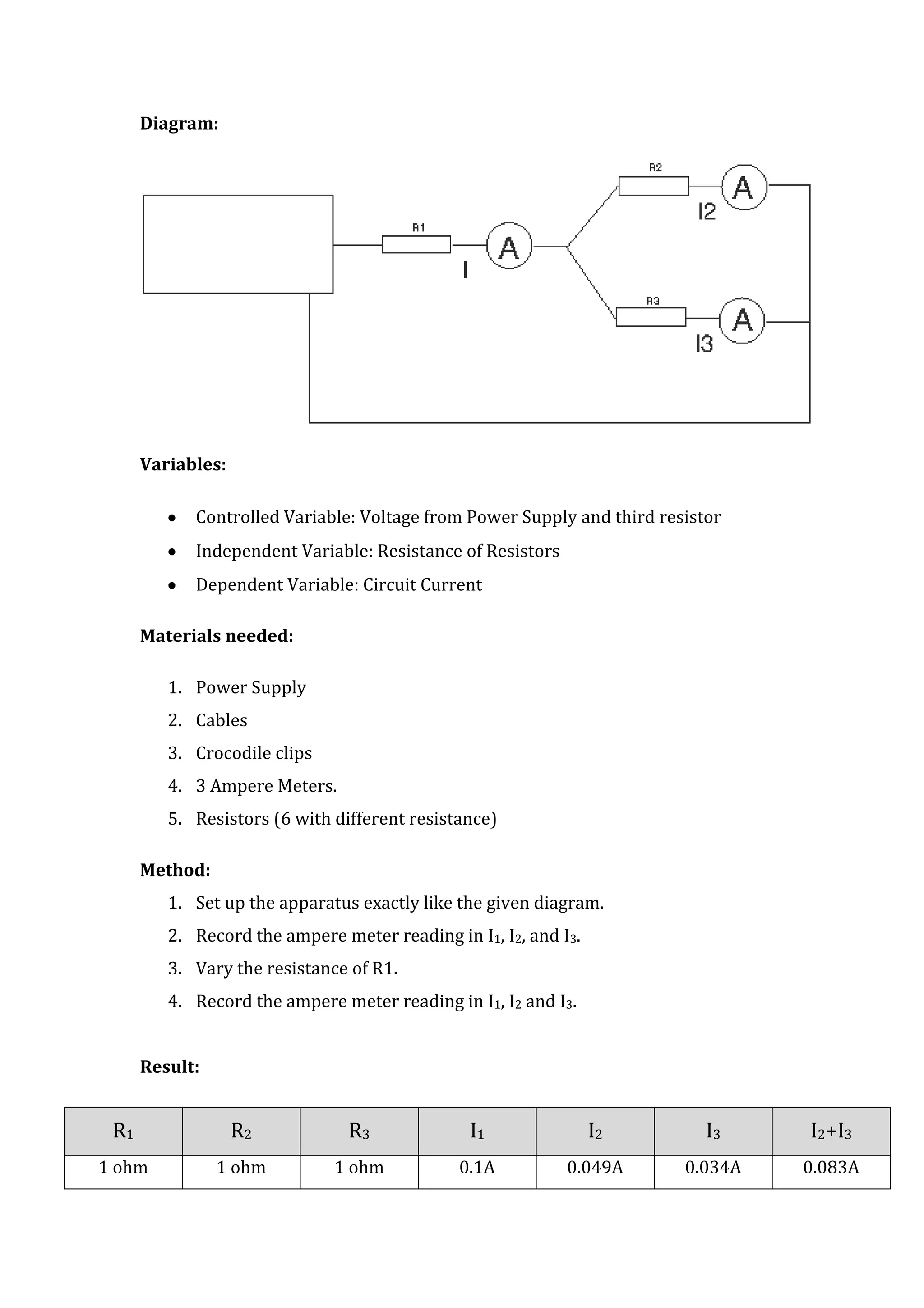
Diagram:


      Variables:

            Controlled Variable: Voltage from Power Supply and third resistor
            Independent Variable: Resistance of Resistors
            Dependent Variable: Circuit Current

      Materials needed:

         1. Power Supply
         2. Cables
         3. Crocodile clips
         4. 3 Ampere Meters.
         5. Resistors (6 with different resistance)

      Method:
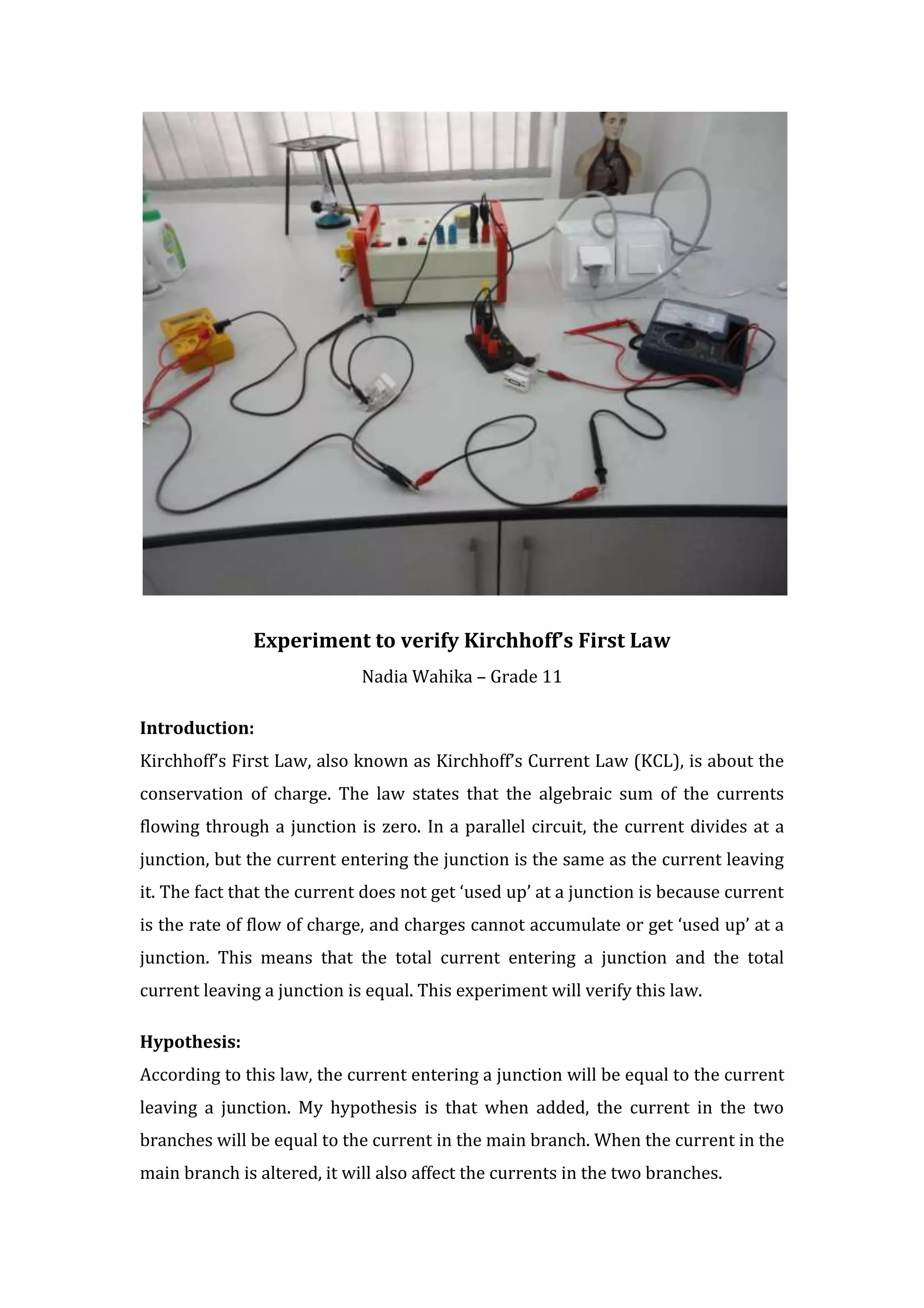
         1. Set up the apparatus exactly like the given diagram.
         2. Record the ampere meter reading in I1, I2, and I3.
         3. Vary the resistance of R1.
         4. Record the ampere meter reading in I1, I2 and I3.


      Result:


 R1                R2           R3             I1                I2        I3    I2+I3
1 ohm           1 ohm         1 ohm           0.1A          0.049A      0.034A   0.083A
4.7 ohm        1 ohm            1 ohm             0.06A    0.028A         0.024A        0.052A
10 ohm         1 ohm            1 ohm             0.04A    0.022A         0.012A        0.034A


     Theory:

     Theoretically, when added together the sum of I2 and I3 should equal I1 however
     this is not what always happen in practice. This is possibly because not all the
     current successfully flow through the wires. These currents might get dissipated
     at joints or somewhere along the wire instead. However, we can see that the sum
     of I2 and I3 are not that far off from I1.

     Conclusion:

     The conclusion of this experiment proves that Kirchhoff’s first law is true. The
     sum of the currents flowing through the branches of a parallel circuit will be
     equal to the current flowing through the main branch of a circuit.

Physics experiment

  • 1.
    Experiment to verifyKirchhoff’s First Law Nadia Wahika – Grade 11 Introduction: Kirchhoff’s First Law, also known as Kirchhoff’s Current Law (KCL), is about the conservation of charge. The law states that the algebraic sum of the currents flowing through a junction is zero. In a parallel circuit, the current divides at a junction, but the current entering the junction is the same as the current leaving it. The fact that the current does not get ‘used up’ at a junction is because current is the rate of flow of charge, and charges cannot accumulate or get ‘used up’ at a junction. This means that the total current entering a junction and the total current leaving a junction is equal. This experiment will verify this law. Hypothesis: According to this law, the current entering a junction will be equal to the current leaving a junction. My hypothesis is that when added, the current in the two branches will be equal to the current in the main branch. When the current in the main branch is altered, it will also affect the currents in the two branches.
  • 2.
    Diagram: Variables: Controlled Variable: Voltage from Power Supply and third resistor Independent Variable: Resistance of Resistors Dependent Variable: Circuit Current Materials needed: 1. Power Supply 2. Cables 3. Crocodile clips 4. 3 Ampere Meters. 5. Resistors (6 with different resistance) Method: 1. Set up the apparatus exactly like the given diagram. 2. Record the ampere meter reading in I1, I2, and I3. 3. Vary the resistance of R1. 4. Record the ampere meter reading in I1, I2 and I3. Result: R1 R2 R3 I1 I2 I3 I2+I3 1 ohm 1 ohm 1 ohm 0.1A 0.049A 0.034A 0.083A
  • 3.
    4.7 ohm 1 ohm 1 ohm 0.06A 0.028A 0.024A 0.052A 10 ohm 1 ohm 1 ohm 0.04A 0.022A 0.012A 0.034A Theory: Theoretically, when added together the sum of I2 and I3 should equal I1 however this is not what always happen in practice. This is possibly because not all the current successfully flow through the wires. These currents might get dissipated at joints or somewhere along the wire instead. However, we can see that the sum of I2 and I3 are not that far off from I1. Conclusion: The conclusion of this experiment proves that Kirchhoff’s first law is true. The sum of the currents flowing through the branches of a parallel circuit will be equal to the current flowing through the main branch of a circuit.