FORCES AND MOTION3rd Edition Sophia Chen
download
https://ebookultra.com/download/forces-and-motion-3rd-edition-
sophia-chen/
Explore and download more ebooks or textbooks
at ebookultra.com
2.
We believe theseproducts will be a great fit for you. Click
the link to download now, or visit ebookultra.com
to discover even more!
Energy 3rd Edition Sophia Chen
https://ebookultra.com/download/energy-3rd-edition-sophia-chen/
Multilevel and Longitudinal Modeling Using Stata 3rd
Edition Sophia Rabe-Hesketh
https://ebookultra.com/download/multilevel-and-longitudinal-modeling-
using-stata-3rd-edition-sophia-rabe-hesketh/
Terence and Interpretation 1st Edition Sophia Papaioannou
https://ebookultra.com/download/terence-and-interpretation-1st-
edition-sophia-papaioannou/
Beauvoir and Belle 1st Edition Kathryn Sophia Belle
https://ebookultra.com/download/beauvoir-and-belle-1st-edition-
kathryn-sophia-belle/
3.
Old Frame ChenFamily Taijiquan Mark Chen
https://ebookultra.com/download/old-frame-chen-family-taijiquan-mark-
chen/
Chen s Clinical Anatomy MCQs 1st Edition Chen
https://ebookultra.com/download/chen-s-clinical-anatomy-mcqs-1st-
edition-chen/
The Circuits and Filters Handbook Fundamentals of Circuits
and Filters 3rd Edition Wai-Kai Chen (Ed.)
https://ebookultra.com/download/the-circuits-and-filters-handbook-
fundamentals-of-circuits-and-filters-3rd-edition-wai-kai-chen-ed/
The circuits and filters handbook Computer aided design
and design automation 3rd ed Edition Wai-Kai Chen
https://ebookultra.com/download/the-circuits-and-filters-handbook-
computer-aided-design-and-design-automation-3rd-ed-edition-wai-kai-
chen/
Nuclear collective motion models and theory Rowe
https://ebookultra.com/download/nuclear-collective-motion-models-and-
theory-rowe/
5.
FORCES AND MOTION3rd Edition Sophia Chen
Digital Instant Download
Author(s): Sophia Chen; Amy Graves
ISBN(s): 9781646937349, 1646937341
Edition: 3
File Details: PDF, 2.87 MB
Language: english
Contents
Chapters
The Science ofMachines and More
Speed and Distance Calculation
Speed and Acceleration
Motion in Three Dimensions
Accelerated Motions
Forces
Forces and Accelerations
Support Materials
Glossary
Bibliography
About the Authors
Index
The Science ofMachines and More
The term physics comes from a Greek word that means "knowledge of nature."
Physicists are people who study the natural world. The way that physicists have
built up their rich knowledge is by combining hands-on experience,
philosophical thinking, and mathematics. Throughout history, the invention of
new technology has sparked progress in physics by enabling game-changing
observations. In addition, developments in pure mathematics have also opened
doors to new physics by offering new ways to organize and analyze
experimental results.
This text is about force and motion, which is a subfield of physics called
mechanics. Mechanics is the oldest branch of physics, in the sense that it was the
first one to be put in a form that is fairly complete and recognizable today. The
term mechanics refers to machines. (Today we would say that someone who
studies machines is a mechanical engineer.) Before the fifteenth century, people
had only scarce knowledge of basic science to guide their design of early
machines, such as the wind and water mills to grind grain, or the cranes used to
build Europe's cathedrals. The new science of mechanics explained, for example,
how these machines decrease the amount of force a person has to exert to
perform a task, or how they change one form of motion into another. This deeper
understanding thus helped people improve the workings of these classic
12.
machines.
Thinkers also wantedto understand the great "machine" in the sky: the motion of
the planets and stars. People have studied "celestial mechanics" throughout the
world since the start of recorded history. More than 3,000 years ago, Babylonian
scholars compiled detailed records of the positions of the Sun, Moon and stars.
However, they could not make very accurate predictions. In the fifteenth century
and onward, scholars wanted to knit their observations into a theory. A theory
would allow them to deduce new facts and make predictions. For example, if
you saw a new planet and charted its position over many nights, a theory of
planetary motion could allow you to deduce its distance from Earth and predict
its motion for years to come.
Theories often evolve to explain new experimental results or observations.
Occasionally, this may lead physicists to throw out a previously established
theory. Around A.D. 100, the Egyptian scholar Ptolemy compiled data from
earlier observations and combined it with a theory that predicted how the
celestial machine would evolve. Unfortunately, scholars later realized that
Ptolemy's theory contained a glaring error that placed the Earth at the center of
the universe, with the Sun and everything else in the cosmos orbiting around it.
We generally credit Nicolaus Copernicus with first proposing the theory that the
Earth moves around the Sun in his work On the Revolution of Heavenly Spheres
in 1543. This theory challenged the prevailing orthodoxy of the Roman Catholic
Church, and led to his work being placed on a list of forbidden books in 1616. A
prohibition on Copernicus's theory remained in effect until 1753, and his original
work was not removed from the forbidden book list until 1835.1
Still Copernicus's theory was incomplete. He thought the Sun was fixed at the
center of the universe. Using his ideas as a starting point, physicists later
understood that the Sun also moves around the center of our galaxy, the Milky
Way, which is just one of the estimated hundreds of billions of galaxies in the
universe.2
13.
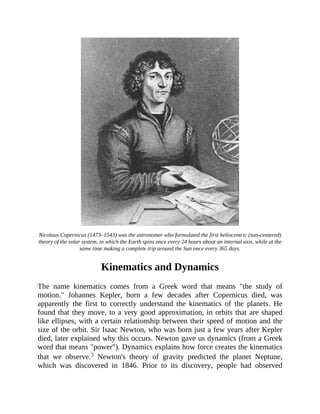
Nicolaus Copernicus (1473–1543)was the astronomer who formulated the first heliocentric (sun-centered)
theory of the solar system, in which the Earth spins once every 24 hours about an internal axis, while at the
same time making a complete trip around the Sun once every 365 days.
Kinematics and Dynamics
The name kinematics comes from a Greek word that means "the study of
motion." Johannes Kepler, born a few decades after Copernicus died, was
apparently the first to correctly understand the kinematics of the planets. He
found that they move, to a very good approximation, in orbits that are shaped
like ellipses, with a certain relationship between their speed of motion and the
size of the orbit. Sir Isaac Newton, who was born just a few years after Kepler
died, later explained why this occurs. Newton gave us dynamics (from a Greek
word that means "power"). Dynamics explains how force creates the kinematics
that we observe.3 Newton's theory of gravity predicted the planet Neptune,
which was discovered in 1846. Prior to its discovery, people had observed
14.
Neptune's perturbing effectson the orbit of the planet Uranus, which was already
known at that time.4 In the twentieth century, astrophysicists like Vera Rubin
have found that a large fraction of the stuff in our universe is "dark matter."5 It
does not shine like a star, planet, or gas cloud, with any known type of radiation.
Physicists believe dark matter exists because of the detailed way that galaxies
rotate around their centers. Some invisible type of matter is creating a force that
has a very noticeable dynamic effect on the visible matter around it.6
Many scholars contributed successfully to mechanics before and during
Newton's time. While Newton's work builds on others' work, Newton was
probably unique among these scholars in the way that he brought observation,
philosophy, and mathematics together. It is a powerful synergy that physicists
have aspired to ever since. Newton saw the unity between a rock falling from a
tower and the Moon orbiting Earth. They really are two siblings in the same
"family" of motions. Both are curves that come from solving a single equation:
Force = (mass) × (acceleration). For both, the force is the pull of Earth's gravity.
A physics book (this one is no exception) typically considers many situations
and applies the same mathematical theory to all of them, showing the unity
behind the apparent differences.
Roadmap for This Text
Chapters two through five deal with kinematics, while dynamics is discussed in
chapters six and seven. Within each chapter you will find the words, math
formulas, graphs, and pictures that are all familiar parts of the language of
physics. They will take you through the beginning of the kind of mechanics
course you might take in the last two years of high school or the first year of
college. We do not get to the topics of angular momentum or energy. We also do
not talk about Einstein's theories, which are needed for objects moving very
swiftly (near the speed of light) and/or subject to very large forces (say, near a
massive star).
Every chapter includes problems about motion or force. In chapter two, for
example, you will find the average speed of kids hurrying down a long hallway
to class. Examples illustrate the relationship between speed, time, and distance.
The section introduces the concept of displacement to pave the way for
understanding paths that do not necessarily lie along a straight line. In chapter
three, you will learn how to solve problems in two different ways: by
15.
manipulating symbols andequations, or by using geometry. You can use both
ways to solve problems about acceleration that involve a predator chasing its
prey or an ecologist measuring the speed of water in a stream.
Chapter four discusses vectors, an essential mathematical
tool for understanding the velocity of moving objects such as a plane. In that
chapter, we represent vectors both with pictures and in terms of their
components, and explore how to do algebra with them. We see how to use
displacement, velocity, and acceleration vectors to fully understand interesting
motion, and see how a simple accelerometer indicates the strength and direction
of acceleration. The importance of acceleration continues in chapter five, where
you will learn how to find the g-forces on a roller coaster. We explore examples
like a geosynchronous satellite and a plane that must "touch and go" from a
runway.
Chapter six discusses forces in the context of a science fiction scene in which
someone is expelled into outer space. The example explores the nature of motion
in the absence of any force (as when one is floating in space) in terms of
Newton's first law and the concept of center-of-mass. The example also
illustrates pressure forces, and how the human body balances Earth's
atmospheric pressure to keep itself from imploding.
Finally, chapter seven presents Newton's second and third laws. Here, we
introduce inertia, or mass, and the rule that an object feeling a force will
experience an acceleration inversely proportional to its inertia. The section
closes with an example that applies all three of Newton's laws and the vector
nature of velocity, in order to understand the consequences of a collision
between a deer and a vehicle.
1. Bald, Margaret. "Copernicus, Nicolaus" in Literature Suppressed on Religious
Grounds, 4th ed. (New York: Infobase, 2019).
2. Howell, Elizbeth. "How Many Galaxies Are There?" Space.com, March 19,
2018. Available online. URL: https://www.space.com/25303-how-many-
galaxies-are-in-the-universe.html. Accessed August 1, 2021.
3. Gleick, James. Isaac Newton. (New York: Pantheon Books, 2003).
16.
4. American PhysicalSociety. "September 23, 1846: Neptune’s Existence
Observationally Confirmed," APS News, 29, no. 8 (2020). Available online.
URL: https://www.aps.org/publications/apsnews/202008/history.cfm. Accessed
August 1, 2021.
5. Childers, Tim. "Vera Rubin: The Astronomer Who Brought Dark Matter to
Light," Space.com, June 11, 2019. Available online. URL:
https://www.space.com/vera-rubin.html. Accessed August 1, 2021.
6. Kusky, Timothy. "Dark Matter" in Encyclopedia of Earth and Space Science,
Revised Edition. (New York: Infobase, 2020).
17.
Speed and DistanceCalculation
A satellite in orbit; a sprinter hurtling down a track; an old-timey villain slipping
on a banana peel: these are all objects in motion. It turns out, one of the basic
tools of physics involves determining the average speed of an object in motion,
which you can use to predict where that object will be in the future. This chapter
will discuss the concept of average speed, and how it is used in everyday life.
Suppose that you notice a dog trotting by the side of a highway, with markers
every 1/10 of a mile. You catch sight of the dog starting to run at a marker that
says “20 miles” and you watch it run past 3 more markers. The dog has run this
far:
Distance traveled = (3)(1/10 mile) = 0.3 mile
It takes the dog 2 minutes to run this distance:
Time spent = 2 minutes
The average speed of anything moving is the distance traveled divided by the
time spent, as in the following equation:
Average speed = distance traveled/time spent
Before we plug in numbers, let's rewrite this equation in a way that uses the
conventional language of physics. However, before we do that, we must discuss
units.
Talking About Physics: Dimensions and Units
The three fundamental dimensions in mechanics are length, mass, and time.
When we refer to the "dimensions" of some quantity, we mean "What type of
real-world quantity is it?" For example, when we say that "The distance the dog
has run is 0.3 miles," the dimension of the number 0.3 is length. When someone
says, "Where have you been? I've been waiting 20 minutes," the number 20 has
the dimension of time. Sometimes, a quantity does not have any dimensions; it is
a pure number. For example, the five in the statement "Watch, I can fit five
18.
cookies in mymouth all at once!" is a pure number. The number "p" in the
statement, "A circle's circumference is p times the diameter," is also a pure
number.
We can combine the fundamental dimensions of length, mass, and time using the
rules of algebra to get new dimensions. For example, if we said that "The
diameter of the circle is 10 meters, so its area is 25π meters2," the diameter, 10,
has dimensions of length, and its area, 25π, has dimensions of (length)2. The
quantity of average speed, defined above, has dimensions of (length/time).
We describe these dimensions with units. A meter is a unit of the dimension
length, as is a mile. In physics, when we write down a real-world quantity with
dimensions, we need to associate units with it. Units make clear the scale of the
quantity. For example, if your friend said that her brother was 18, you might
think he was 18 years old. But if you saw that the brother was a baby, you would
realize that she meant 18 months. Often we write units using abbreviations, such
as "s" for seconds and "m" for meters.
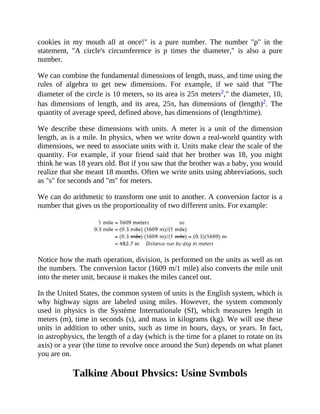
We can do arithmetic to transform one unit to another. A conversion factor is a
number that gives us the proportionality of two different units. For example:
Notice how the math operation, division, is performed on the units as well as on
the numbers. The conversion factor (1609 m/1 mile) also converts the mile unit
into the meter unit, because it makes the miles cancel out.
In the United States, the common system of units is the English system, which is
why highway signs are labeled using miles. However, the system commonly
used in physics is the Système Internationale (SI), which measures length in
meters (m), time in seconds (s), and mass in kilograms (kg). We will use these
units in addition to other units, such as time in hours, days, or years. In fact,
in astrophysics, the length of a day (which is the time for a planet to rotate on its
axis) or a year (the time to revolve once around the Sun) depends on what planet
you are on.
Talking About Physics: Using Symbols
19.
Talking About Physics:Using Symbols
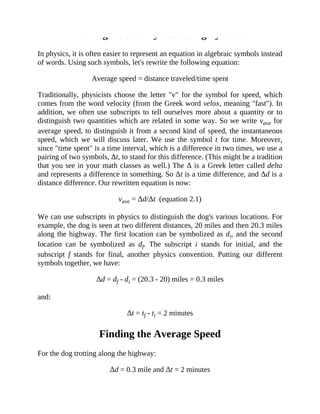
In physics, it is often easier to represent an equation in algebraic symbols instead
of words. Using such symbols, let's rewrite the following equation:
Average speed = distance traveled/time spent
Traditionally, physicists choose the letter "v" for the symbol for speed, which
comes from the word velocity (from the Greek word velox, meaning "fast"). In
addition, we often use subscripts to tell ourselves more about a quantity or to
distinguish two quantities which are related in some way. So we write vave for
average speed, to distinguish it from a second kind of speed, the instantaneous
speed, which we will discuss later. We use the symbol t for time. Moreover,
since "time spent" is a time interval, which is a difference in two times, we use a
pairing of two symbols, Δt, to stand for this difference. (This might be a tradition
that you see in your math classes as well.) The Δ is a Greek letter called delta
and represents a difference in something. So Δt is a time difference, and Δd is a
distance difference. Our rewritten equation is now:
vave = Δd/Δt (equation 2.1)
We can use subscripts in physics to distinguish the dog's various locations. For
example, the dog is seen at two different distances, 20 miles and then 20.3 miles
along the highway. The first location can be symbolized as di, and the second
location can be symbolized as df. The subscript i stands for initial, and the
subscript f stands for final, another physics convention. Putting our different
symbols together, we have:
Δd = df - di = (20.3 - 20) miles = 0.3 miles
and:
Δt = tf - ti = 2 minutes
Finding the Average Speed
For the dog trotting along the highway:
Δd = 0.3 mile and Δt = 2 minutes
20.
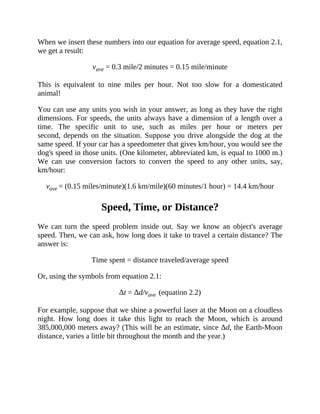
When we insertthese numbers into our equation for average speed, equation 2.1,
we get a result:
vave = 0.3 mile/2 minutes = 0.15 mile/minute
This is equivalent to nine miles per hour. Not too slow for a domesticated
animal!
You can use any units you wish in your answer, as long as they have the right
dimensions. For speeds, the units always have a dimension of a length over a
time. The specific unit to use, such as miles per hour or meters per
second, depends on the situation. Suppose you drive alongside the dog at the
same speed. If your car has a speedometer that gives km/hour, you would see the
dog's speed in those units. (One kilometer, abbreviated km, is equal to 1000 m.)
We can use conversion factors to convert the speed to any other units, say,
km/hour:
vave = (0.15 miles/minute)(1.6 km/mile)(60 minutes/1 hour) = 14.4 km/hour
Speed, Time, or Distance?
We can turn the speed problem inside out. Say we know an object's average
speed. Then, we can ask, how long does it take to travel a certain distance? The
answer is:
Time spent = distance traveled/average speed
Or, using the symbols from equation 2.1:
Δt = Δd/vave (equation 2.2)
For example, suppose that we shine a powerful laser at the Moon on a cloudless
night. How long does it take this light to reach the Moon, which is around
385,000,000 meters away? (This will be an estimate, since Δd, the Earth-Moon
distance, varies a little bit throughout the month and the year.)
dangerous to itssafety. This is the natural right of all nations, and
particularly of free countries, where the general welfare of the
community is the supreme law. While, however, a commerce
remains lawful, the citizen embarks in it with the same right to
expect protection as in any other lawful occupation; for a
Government to refuse it, is a violation of that fundamental principle
in free government; that protection on the part of the Government is
the basis of support on the part of the citizen. If we are unable or
unwilling to interpose in behalf of our citizens, when their personal
rights have been invaded—their property captured and condemned
under principles unknown to the law of nations—let us give up the
farce of pretending to self-government, and go back to the degraded
state of colonies.
The ground of difference between the United States and Great
Britain is too well known for me to dwell on this part of the subject.
It has been stated on this floor by a gentleman from Massachusetts,
in terms clear, forcible, and manly. The impressment and detention
of our seamen is an injury which has justly excited the indignation of
the people of America for the last ten years. Every attempt to arrest
by negotiation this serious injury has failed, and each year adds new
victims to the roll of impressed seamen. The recent captures of
American property to the amount of six millions of dollars, under
doctrines new and manifestly unjust, is a serious injury to the
individuals and to the community. And although I have no doubt, as
has been eloquently stated on this floor, that American merchants
have in some instances disgraced that character by covering the
property of the enemies of Great Britain, I am equally certain that
the injuries done to bona fide American merchants, trading fairly on
American capital, are sufficiently numerous to justify and demand
the interposition of this Government.
While, however, I have no doubt as to the right of the citizen on
the one hand to demand protection, and of the duty of the
Government on the other to extend it to him, I am willing to
acknowledge all the difficulties of our present situation. I consider it
no disgrace to this infant nation to say we are not able to meet on
23.
the ocean anation—a match on that element for all the world
combined. I hope the period will never arrive when the substance of
the citizen here shall be squandered on a navy competent to meet
on the ocean the navy of Great Britain. Separated from the rest of
the world, at too great a distance to fear invasion, possessing a
country abounding with productions valuable to the different nations
of Europe with whom we have commercial relations—if we are not
able to meet on the ocean Great Britain or any other European
power, we can say to them all, Respect in your intercourse with us
the principles of justice, or we hold no intercourse with you; if you
will not traffic with us on principles that are fair, we will neither
receive your manufactures, nor send to you our productions. We are
now for the first time about to test this principle so important to a
nation jealous of fleets and armies. Of the various measures of the
kind which may be resorted to—high discriminating duties—a
prohibition of certain enumerated articles, a general prohibition, and
as a dernier resort a suspension of all intercourse, are the remedies
within our reach. It is a mere question of convenience and
expediency to which of these we shall resort. I should prefer for
myself, as a first step, the mildest. It is not, in my opinion, the
interest of this nation to dissolve at a single blow its commercial
connection with Great Britain. The commerce, if carried on, on
principles that are fair, is mutually advantageous to the two
countries. In Great Britain we find the best market for our most
valuable productions, and with us she finds the best market for her
manufactures. To prohibit, at a single blow, imports to the amount of
thirty-five millions of dollars, however injurious it might be to the
manufacturers of Great Britain, would certainly be a serious injury to
our own citizens. I cannot but hope that a milder measure will cause
the British Government to respect our rights and pursue a course
manifestly dictated by a regard to its own interest. If, however, Great
Britain is so lost to her own interest as to persevere in a system of
injustice calculated to deprive her of the best market for her
manufactures—a market daily increasing, with the increasing
population of this infant country—let us on our part proceed with
that caution and moderation, which shall evince that the course we
24.
are determined topursue is founded on principle, and will never be
abandoned until our wrongs are redressed. I am willing to adopt for
the present a prohibition of enumerated articles; if that shall fail, to
pass hereafter a total prohibition, and finally, to put forth our whole
strength, and say, we hold no future intercourse with you; but
dissolve for ever all commercial relations with a nation, which takes
for its national law the base principle of necessity, and makes itself
the exclusive judge of that necessity.
Mr. Nicholson said he had been desirous for some days to offer to
the committee his opinions on the subject now under consideration;
but as other gentlemen had manifested a similar disposition, he had
yielded the floor to them. It was now his intention to offer such
remarks as appeared to him pertinent.
The resolution of the gentleman from Pennsylvania, (Mr. Gregg,) in
his opinion, was objectionable in all its parts. There was no point of
light in which he could view it, in which objections did not present
themselves. He read and commented on the preamble; the style of
which he said he did not like, because, instead of a spirit of amity
and conciliation, it breathed little less than defiance. While we
profess to speak the language of peace, we declare to Great Britain,
that unless she will meet us at that precise point which we think
proper to mark, we will, in the words of the gentleman from
Pennsylvania, stab her in the vitals. While we declare that we
approach her as friends, yet our style is that of an enemy. The olive
branch that is held out conceals a dagger in its boughs. This
threatening manner he said was not calculated to preserve peace in
private life, and how could it be expected to succeed between
nations? Did gentlemen imagine that Great Britain, even surrounded
as she was by her enemies, was yet so tame as to submit to
threats? Was the character of her first Minister so little known, as to
induce a belief that he would tremble at the rod held over him? No,
sir, they are not sunk so low; and if we really wish for an amicable
adjustment of our differences, we ought to proceed as friends and
not as enemies. A mere commercial regulation, he said, might not,
perhaps, produce war; it was the threat held out in the preamble,
25.
and the hostilitymanifested on the floor of the House of
Representatives, that were calculated to wound the national pride of
Britain, and, therefore, to excite enmity between the two countries.
What does the preamble say? We have marked a point from which
we will not recede, and to which we demand that you shall come; if
you do not, we strike at your most essential interests; in the
language of the gentleman from Pennsylvania, we will stab you in
your vitals. Is this the way to conciliate? Is this your method of
opening a negotiation? Believe me, sir, instead of presenting the
olive branch, we carry a firebrand that will kindle a flame which we
may find it difficult to extinguish. Great Britain will feel all this—she
will at once ask, is it fair, is it manly, is it honorable to threaten me
now, when I am contending for all that is dear to me? Will you insult
me in my distress, and while you sustain my enemy on one hand,
with the other endeavor to unnerve the arm which you acknowledge
is raised in defence of its own existence?
If the subsequent parts of the resolution were unobjectionable,
the preamble itself would determine me against the whole. To
preserve peace, let us proceed to our object in a peaceable manner.
If, indeed, gentlemen are for war, then they are right in advocating
this measure.
The resolution, he said, embraced two points: the one related to
the carrying trade; the other to the impressment of American
seamen. The latter had always been a source of great anxiety to
him. No man in America had deplored the evil more than he did, and
none should be more ready to apply the remedy, when an effectual
remedy could be devised. To him, however, it was a matter of no
little surprise, that gentlemen had so long slept upon a subject, on
which they now appeared to manifest so much zeal. He himself
twice proposed measures with a view to obtain redress, but he had
not been able to carry them through the House. Gentlemen, who
now zealously volunteered their services, rendered him no assistance
then. At the last session he had introduced a bill on the subject, and
such were the variety of objections to it, that it was committed and
recommitted several times. Difficulties presented themselves from all
26.
quarters; alterations andamendments innumerable were adopted,
until finally it was shuffled through the House, in so imperfect a
state that it was not worth the time which had been spent on it.
Strong measures were not then the order of the day, nor would they
be now, if the impressment of American seamen was the only
ground of complaint. Great Britain has pursued this practice for ten
or twelve years past, but these patriotic merchants, who are now so
clamorous, presented you with no memorials on the subject. No, sir.
It is the carrying trade alone, which has covered your tables with the
memorials of the merchants, because their interests are affected,
and it is out of this that the resolution of the gentleman from
Pennsylvania has grown. Although I do not admit the correctness of
the principle assumed by Great Britain, in relation to the carrying
trade, yet I am willing to acknowledge that with me it is an object of
secondary importance only, when compared with the other violations
of our flag, in the impressment of our seamen.
I have thus endeavored to show with what success the committee
must determine, that, by adopting this resolution, we hazard a war;
that the course of commerce will be materially, suddenly, and,
therefore, injuriously changed; that inasmuch as we cannot procure
from other countries many important articles with which Britain
supplies us, the revenue will be much diminished; and that the value
of our own products will be lessened to an incalculable amount.
Having been a considerable time on the floor, I feel extremely
exhausted, and will, therefore, close my remarks, although it was my
wish to have said much more on this subject; particularly to point
out the different effects to be produced by the adoption of the
measure now under discussion, and that which was submitted by
myself. To my own proposition, however, I am not exclusively
attached. I have thought and do still think it the best which has
been proposed. This I trust will be the opinion of the House.
Believing the conduct of Great Britain towards this country not to be
justified, I am willing to unite in such measures as may induce her to
do us justice. But I will not go to the extent proposed in this
resolution, because I am persuaded it will operate much more
27.
injuriously upon ourselves,than upon those whom we intend to
affect by it.
Mr. Macon.—Mr. Chairman, I feel myself bound by the call which
has been made by three gentlemen from Pennsylvania, (Messrs.
Gregg, Smilie, and Findlay,) with whom I have long been in the habit
of friendship, a friendship on my part sincere, to state the reasons
which will govern my conduct on this occasion; whether they may be
satisfactory to others or not, they are perfectly so to me. That a
difference of opinion subsists between the members with regard to
the measures best adapted to the present crisis of our affairs, is
evident from the number of resolutions on your table. An attempt
has been made to liken this resolution to one agreed to in 1793; but
are they alike? I think not. That was general, and operated alike on
every part of the Union, while this, in my opinion, is special, and will
only operate on one part of the Union; and this partial operation will
be severely felt by that section of the country which I in part
represent. Besides this clear difference in the two resolutions, will
not all the three gentlemen agree that there is a great and striking
difference in our affairs with Great Britain—in 1793 and now? Her
motives may be as unfriendly now as then; but I speak of facts
known to all, not of motives; she then held the western posts, she
then detained an immense property belonging to the Southern
people, both in violation of the treaty of peace. She then instigated
the Indians to war on the frontiers, and then, as at this time,
impressed our sailors and captured our vessels; besides, the United
States had not then relinquished the principle, that free ships should
make free goods. In relinquishing this principle, they, in a great
measure lost sight of the carrying trade, by peaceable means; but, if
gentlemen wish to turn to Europe, they will find that, in 1793, the
treaties of Pavia and Pilnitz were in force. Let the facts which I have
stated be compared with those of the present day, and all must
confess that there is a very considerable difference. I have said this
much to show that there is no analogy in the facts of the present
time and those of 1793, and that there is no change of opinion in
me. If, however, I am mistaken, it is an honest mistake.
28.
This nation, inmy opinion, must take her choice of two
alternatives: to be happy and contented without war, and without
internal taxes; or to be warlike and glorious, abounding with what is
called honor and dignity, or in other words taxes and blood. If it be
the first, the people will continue to enjoy that which they have
hitherto enjoyed—more privileges than have fallen to the lot of any
nation with whose history we are acquainted; they will, as they have
done, live plentifully on their farms, and such as choose, will carry
on a fair trade, by exchanging our surplus productions for such
foreign articles as we may want. If we take the other ground we
shall, I fear, pursue the same career, which has nearly, or quite
ruined all the other nations of the globe. Look at the people of
England, legally free, but half their time fighting for the honor and
dignity of the Crown, and the carrying trade, and see whether they
have gained any thing by all their battles for the nation except taxes,
and these they have in the greatest abundance. Look also at France,
before the Revolution, and we shall see a people possessing a fertile
country and fine climate, having the honor to fight, and be taxed as
much as they could bear, for the glory and dignity of the grand
monarque. Let us turn from these two great nations, and view
Switzerland during the same period; though not powerful like the
others, we shall see the people free and happy without wars,
contented at home, because they had enough to live comfortably
on, and not overtaxed. The history of these three nations ought to
convince us that public force and liberty cannot dwell in the same
country.
I mean not to impute improper motives to any one, nor to
examine the Journal after changes, though I am perfectly willing to
have it thumbed over, from the day I took a seat in the House to the
present, after my name; and if, on examination, it shall appear that I
have changed my political principles, or have not uniformly adhered
to them, I am willing to bear the name of a political hypocrite. I
have formerly been, on very great questions, in very small
minorities; on a most important question, in a minority not sufficient
to command the yeas and nays. I will say no more on this subject;
29.
nothing can bemore disagreeable than to talk about one’s self, and
nothing could justify it but the call which has been made; perhaps I
have already said too much on it, but it was impossible to say less.
The dispute with Great Britain is most unquestionably for the
carrying trade; a trade which is less beneficial to the nation than any
other, and a trade which has produced most of our disputes with
foreign nations, and it is the only trade that requires expensive
protection. Will any one contend that this trade is half as important
as the coasting trade? This cannot and will not be contended, for
every one knows that the coasting is the best trade. It not only
exchanges the products of one part of the nation for those of
another, but it also tends, by making us better acquainted with each
other, to connect us more intimately, and to make every part
harmonize for the public good. The trade which I consider the next
best for a nation to carry on, is the direct trade for home
consumption, by which the surplus produce of one country is
exchanged for that of another; and in this as in every branch of
trade, this great rule will be adhered to—buy cheap and sell dear if
you can. With the coasting and direct trade agriculture is more
nearly connected than with any other. But a nation may be
agricultural without being commercial. The Swiss cantons and Milan
were of this description, and it may be remarked that Milan is the
most populous country in Europe. China is said to be of the same
character; but, as little is known of that country, I shall not quote it
to establish a fact which is clearly established by the other two. A
country may also be commercial without being highly agricultural, as
was the case with Venice and some other European powers. But let
us pursue that system which our own experience has proved to be
the best for the United States; for, since the adoption of the present
constitution, and before this day, we have had trying times. It will be
remembered, that during the French Revolution, we had complaints
against France. Her government issued orders of which we justly
complained; one of them, I believe, declared all the productions and
manufactures in Great Britain to be contraband of war; this, if
executed, would have nearly cut off all communication with a nation
30.
with whom wecarried on the greatest trade. What did we then do?
We sent ministers to France, with two of whom she refused to have
any intercourse, but pretended to be willing to negotiate with the
other. All the ministers finally returned home, and we took half-way
measures against her, which are the worst of all measures, and
which produced a sort of half war, which I believe injured us more
than her—for besides the actual expense, which may be estimated
at not less than $10,000,000, it nearly ruined the agricultural people
by reducing the price of produce; flour it reduced from twelve and
fourteen dollars per barrel to six; and tobacco, from ten and twelve
dollars per hundred to three; and it had no doubt the same effect on
other articles of exportation. And how were we relieved from these
evils? We again sent ministers, who were received, and they made a
treaty. Besides what has been before stated of the conduct of Great
Britain, it will not be forgotten that she declared all France in a state
of blockade, and this order would have cut off all commercial
intercourse with her, who then wanted much of our produce. To
Great Britain, also, a minister was sent, and he made a treaty. I am
now desirous that the same steps should be pursued before we
adopt decisive measures. We once laid an embargo, of which we
tired. This shows the necessity of acting cautiously, and of taking no
measures which we cannot adhere to. All the gentlemen who have
supported the resolution now under consideration, have expressed
doubts whether it would produce greater effects on Britain or
ourselves. This is surely doubting its policy, and if its policy be
doubted by its friends, what ought to be the result of our inquiries,
especially when it is believed that its adoption will materially injure
one part of the country, and that part entirely agricultural? Does the
public good, about which we have heard so much, require that a
measure which its friends seem to think of doubtful policy, ought to
be adopted, when none can doubt but it will injure, if not sacrifice,
the real interest of a part of the community? Examine the report of
the Secretary of the Treasury, and it will, at one glance, show from
what quarter the great export is made to Great Britain; cut off the
import, and you will lessen the price of the export, if it shall be
exported. But we are told that we are bound to protect commerce,
31.
meaning, I suppose,that this resolution must be adopted. Then if
we are really bound, and there is no discretion, nothing of
expediency, there is no occasion for this investigation. But
gentlemen well know, that on every question, discretion may and
will be exercised. But have we really done nothing for commerce and
navigation? On this subject I can confidently appeal to those most
interested. What, since the adoption of the present constitution, has
made this the second commercial nation in the world? Before that
we had but little claim to the character of a commercial people. Have
not the protecting duties on the tonnage of foreign vessels, and on
goods imported in them, produced the effect? They have secured to
our vessels the carrying our own productions, which encourages
navigation in proportion to their bulk. Let gentlemen inquire the
number of cargoes which tobacco and cotton alone furnish the
American vessels. Besides this encouragement given to navigation,
has not a law been passed to favor the fisheries, and thereby to
form sailors for the use of the merchant service? It may be right
here to observe that I neither approved nor voted for that law, but
no attempt has ever been made to repeal it. This is the
encouragement by which, during a time of peace, we have become
the second commercial nation in the world, and this too in the short
space of time since the adoption of the present constitution—say, if
you please, since the 3d of March, 1789. One consequence, a little
curious, is produced by this encouragement, which is this: When
Europe is at peace, the protecting duties prevent any competition by
foreign vessels to carry our productions, and when at war, so many
of our vessels carry for the belligerent nations, that freight is nearly
as high with us as it is with them, so that what the agricultural
people pay in time of peace to encourage, they lose the benefit of
when Europe is at war, and when it is most wanted.
Among the arguments urged to show the effect of this measure
on Great Britain, one is that it will ensure us a powerful aid in that
country; that the British merchants and manufacturers, whose
interests will be seriously affected, will give you all their assistance.
This argument has been completely answered by a gentleman from
32.
Georgia, (Mr. Early.)But if gentlemen really calculate to make friends
on the other side of the water, it seems to me that a different plan
would produce more effect. Cut off all intercourse between them
and us, and adhere to the plan long enough, and you will find the
merchants and manufacturers of England joined by all the
inhabitants of the West Indies, to have the intercourse opened. The
Assembly of Jamaica have acknowledged that they cannot get
supplies in plenty except from the United States; but this plan would
operate as much on beef, pork, fish, and flour, as on tobacco or
cotton. But this would be too strong for them, while they are
desirous to adopt a measure which will have the same effect on
cotton and tobacco. What is this but a sacrifice of a part of the
agricultural interests of the country to what they believe will be a
protection for the carrying trade? I should like it quite as well if the
attempt was not to be made solely at the risk of one part of the
Union. The evil is felt in one part, but the remedy is to be applied in
another. Adopt general measures, which will operate equally in every
part of the country, and if the shoe is to pinch, let it pinch all alike,
and all will then be willing to have it off as soon as possible.
I am willing to acknowledge that a dollar got by this carrying
trade, and made the property of the nation, is just as good as a
dollar got any other way, even by the cultivation of land. But does it
follow from thence that you are to make more sacrifices to get the
dollar in that way than it is worth? I think not. The adoption of the
resolution, besides its unjust and partial operation, will considerably
affect the revenue, and no ways and means are proposed to meet
any deficiency. On the present question we risk a revenue of ten
millions of dollars raised on the consumption of foreign articles in the
Union, to gain—what? (I speak only of revenue) an additional sum
of $850,000, which additional sum you will lose as soon as you
depart from your neutrality. It is asked again and again, if we have
not a right to the trade about which so much has been said? If the
doctrine that free ships should make free goods had obtained, there
could be no doubt on the question; but I mean not to examine the
right but the effect of the resolution; nor do I mean to deny that the
33.
trade is ofsome use to the nation. Merchants would not so anxiously
pursue it, if they made no profit by it; and their profit adds to the
national stock, and may affect the price of native articles offered for
sale. I am also willing to acknowledge that a cargo of flour or any
other native production sent to the West Indies, and there fairly
exchanged for sugar, and the sugar brought home, that the sugar is
as much ours as the produce of our own soil, and this sugar so
obtained we have a right to carry to those that may want it. But the
question before the committee is not a question of right, but of
expediency. Is the protection which will be given to this carrying
trade, by the adoption of the resolution, of that sort and of such
certainty, as to justify the adoption of a measure, which will operate
excessively hard on one part of the Union? The right of deposit at
New Orleans before we purchased the country, was certainly as well
established as our right to carry coffee and sugar to France and
Spain, or any where else—it was a right acknowledged by treaty. But
when the deposit was refused, what did we do? we took pacific
measures, and succeeded. We heard then much about honor and
dignity, and that it was our duty to enforce our right by arms; but
notwithstanding all this, we adopted no measure like the present;
we then acted for the general welfare. Does it follow, because I am
opposed to the resolution, that I am unwilling for our citizens to own
vessels? It does not. I am willing they may have as many as they
please, and do as they please with them, so that they do not involve
the nation in war by them. On this subject the interests of the
husbandman in New Hampshire and Georgia are the same.
The gentleman who introduced the resolution expressed a wish
that no party or geographical feelings should be brought into the
debate. If there was no cause for geographical feelings, why then
wish, or why anticipate them? Let the report of the Secretary of the
Treasury be examined, and it will be seen that there is cause for this
feeling; indeed, the statement, made from that document by a
gentleman from Georgia (Mr. Early) must have convinced all of the
partial operation of the resolution. On the first page of the report it
appears, that the annual exports to Great Britain and her
34.
dependencies are estimatedat about $15,690,000, of which sum,
tobacco and cotton alone make $8,860,000; it also appears, that we
exported to the dominions of Great Britain in Europe, for each of the
three years ending on 30th September:—in 1802, the sum of
$12,066,521; and that cotton, tobacco, rice, pitch, tar and rosin,
made of that sum $8,485,762; in 1803, the sum of $16,459,264, and
that the same articles made of that sum, $11,912,493; in 1804, the
sum of $11,787,659, and that the same articles made of that sum,
$9,443,807. These articles are selected, because they are the
produce of one section of the Union. The same part of the country
produces the following articles in common with other parts of the
nation, but the proportion of each is not known:—flour, wheat, beef,
pork, staves, heading, boards, plank, scantling, timber, flaxseed,
skins, wax, hams, bacon, turpentine, spirits, lard, and Indian meal,
and I may add, pickled fish; some of these articles are carried to the
Middle and perhaps to the Eastern States, and are there exported, or
consumed; and, if consumed, enable them to export more of their
own productions.
It has also been said, that if we adopt the resolution, and cannot
get what we want from Great Britain, we will manufacture for
ourselves. This sounds well on this floor, but I very much doubt the
practicability of making this nation manufacture for itself, while we
have land enough for every industrious citizen to become a
landholder, and a cultivator of the soil. Connecticut and
Massachusetts have tried the experiment, and both without success,
and both on articles in which it was most likely to succeed; if these
States, with their population, could not succeed, what chance of
success is there in other States? The practicability ought to be
satisfactorily shown before we enter on the plan. It may, as has
been said, prevent our wives from wearing silk gowns, and ourselves
from wearing broadcloth; whether it will produce this effect is quite
uncertain; fashion is as great a tyrant as any we have to contend
with; it will, I fear, be difficult to destroy its influence by legislating.
The gentleman from Pennsylvania (Mr. Smilie) and myself, plain as
35.
we are, areboth obliged in some degree to yield to it; we can no
more contend with it, than we can fly to Europe.
I come now to that part of the subject where every man must feel
the injury done to his fellow-citizens; I mean the impressment of our
seamen. Is there a father who does not feel this? No; not one in the
nation; and that man who shall devise a certain remedy for this evil,
will deserve the thanks of his country; he will, indeed, be its greatest
benefactor; he, like the impressed sailor, will have a place in the
tenderest part of the hearts of his countrymen. If a plan to prevent
this injury was only made known, the very knowledge of the plan
would put an end to the injury. But can gentlemen seriously believe
that the adoption of the resolution will produce this effect? The
means are not adequate to the end, I conceive; at least, it remains
to be shown that they are. I will, without hesitation, state what I
believe to be the best remedy for the evil. It is this: to agree with
Great Britain that neither country shall employ the sailors of the
other; and to agree, also, on the proof that shall be required on both
sides; we might expect that Great Britain would adhere to an
agreement of this kind, because it would be her interest to do so,
and on her interest alone, I should rely. In considering this subject,
we must look at things as they really are, and not as we would wish
them to be. The British Government exercise the right, or rather the
power, of impressing their sailors; and, I believe, in time of war, of
prohibiting their going into foreign service. Under these
circumstances, it may be advisable for us not to employ them,
notwithstanding we may do it with their consent, especially if it
would prevent their impressing our countrymen. If the merchants
really be the friends of the American sailors, they would willingly
agree to such a regulation. If they would not be willing, is it not
clear they would employ British sailors at the risk of having ours
impressed? On this subject it might not be improper to state that I
have been informed, in some parts of the world, certificates of
persons being American citizens are sold, and that the market has
been well supplied. I have also been informed that a British officer in
Philadelphia actually procured one for the purpose of enabling him
36.
to go home.This favored Great Britain. I have given this
information, to show that others, besides citizens, may obtain
certificates. Impressments, I fear, can only be prevented by
negotiation; indeed, I have heard that the two Governments have
been engaged on this interesting subject. I hope it will be resumed,
and that it will end in securing to our countrymen their safety on the
ocean.
We are told that the nation calls for strong measures, that the
President has recommended them, and that men of the greatest
talents think them requisite. This may be true, but as I have neither
seen nor heard of this call of the nation, and as I do not know the
opinions of others, I shall certainly pursue my own. The first
Message of the President to Congress, most unquestionably pointed
as strong towards Spain as it did to Great Britain; and, hitherto, but
little has been said about the usage we received from her. But the
recommendation of the President alone, is not always a good reason
for legislating, I apprehend, because every President has
recommended subjects for the consideration of Congress, on which
no act was ever passed. If ever the liberties of this nation are
destroyed by strong measures, it will be when the recommendation
of the President shall alone be deemed good cause for their
adoption. At present, we have choice of all the resolutions on the
table, notwithstanding all that has been said in favor of the one now
under consideration. No doubt can be entertained, but the mover of
each thinks his own the best. From the number, it would seem there
was no difficulty in finding remedies for the injuries we have
received.
Again: we must adopt this resolution, or we shall be degraded.
This is no new phrase to me; I have formerly heard it so often, and
on so many occasions, that I have become a sort of a skeptic on it.
We shall not be degraded by living in peace with all the world. We
shall not be degraded by not following the example of the European
nations, by rushing into war, on every opportunity that may offer.
War is nothing but another name for blood and taxes; we shall not
be degraded, being free and happy at home; but we shall be
37.
degraded, if wefail in paying the national debt, or if we refuse to
observe treaties constitutionally made. This will be the worst kind of
degradation, because it will proceed from a want of morality. In
order to induce us to adopt the resolution, we are seriously told that
the revenue is derived from commerce. This I deny, and say that it is
derived from the whole labor of the community. Stop the laborer in
his field, and the revenue is gone. Commerce is useful, it is the
means by which our productions are exchanged for the productions
of other countries.
It has been said that the land tax overthrew one Administration;
adopt this measure, and you may possibly overthrow another. I
doubt whether the gentleman who made the assertion is altogether
correct in point of fact; it may have aided, but other laws were
passed, which undoubtedly had more effect, and were more
obnoxious in the part of the country where I live. I mean the
attempt to raise an army without an actual war; an army of officers,
almost without soldiers; the Alien and Sedition laws. It was also said,
we were pledged to protect this carrying trade. This reminds me of
what I once heard said before, which is this: that we were pledged
to pay the salaries of certain judges, after the law was repealed
under which they were appointed. I believe we are as much pledged
in one case as in the other, and not more; I know of nothing binding
in this country, except the constitution and the laws. A majority of
both Houses of Congress may pass a law to give the carrying trade
what protection they please, and that law will be binding. We are
also called on to become the champions of the laws of nations, as if
all nations would at once agree with us what these laws really are,
and as if a majority of them adhered to their principles; when we
know that scarcely a nation in Europe pays any regard to them; and
that they will, at different times, entertain different opinions on the
same subject. Have not most of them formerly declared, that free
ships should make free goods, and have not some of the same
nations since given up the principle? Before we undertake this
business, would it not be prudent to endeavor to ascertain the
opinions of other nations, whose interest may be most like our own?
38.
I wish noalliance with any of them; but, if all the nations of Europe
should be willing to yield the principle which we are desirous to
maintain, no man will be mad enough to say we ought to contend
for it. There is certainly a great difference of opinion as to the nature
of the measure. Some think it a war measure; others that it may
lead to war, and others again, consider it entirely pacific. Without
attempting now to inquire which of the three opinions is most
correct, it is sufficient for me, that I believe it will not produce the
effect intended, and that its operation on the United States will be
partial. If, however, it should be adopted, and produce war, that war
we must support with all our strength; and if it produce a good
effect, I, for one, will rejoice as much as any man in this House. A
great many appeals have been made to the spirit of 1776; that spirit
was not only the spirit of liberty, but also of magnanimity and
justice; all the measures then taken operated equally on every part
of the Union.
It is said, this is the right time to settle all our disputes with Great
Britain, because she is now hard pushed. If we wish to make a
treaty that may be lasting, we ought not to take any unjust
advantage of her situation; if we do, whenever she shall be free
from her present embarrassments, she will be discontented and
restless under it, and never satisfied until she gets clear of it. The
true rule for us, is to take no advantage, and in all cases to act
justly.
I agree in opinion with the gentleman from Pennsylvania, (Mr.
Smilie,) that war destroys the morals of the people. Hence I was
greatly surprised when he followed this correct sentiment with an
assertion that he would rather have war than loss of national honor.
This thing called national honor has ruined more than half the
people in the world, and has almost banished liberty and happiness
from Europe. Destroy the morals of the people, and we may play
over such a game of war as has been played in France; nothing less
than to perpetuate the liberty and happiness of the nation ought to
induce us to go to war.
39.
It is alittle remarkable that the United States have, since the
adoption of the present constitution, become the second commercial
power in the world; when, if we believe the public prints, she has
lost capital enough to have ruined the most wealthy nation in
Europe. Million after million is lost, and yet her prosperity is
unrivalled, either in ancient or modern times. I know full well that,
according to the opinions of the writers on the laws of nations, we
have just cause of war against Great Britain. I also know as well,
that we have heretofore had as good a cause of war against both
Great Britain and France. We then preferred peace—the result has
been prosperity. What destroyed the prosperity and liberty of Venice,
of Genoa, and of Holland? Wars, and wars, too, generally
undertaken to protect the carrying trade.
Tuesday, March 11.
Importation of British Goods.
Mr. Macon.—Much has been said about the spirit of the nation, and
that we are far behind it—meaning, I suppose, those who oppose
the resolution. As to my part, I know not how the spirit of the nation
has been ascertained. There is no manifestation of it on the table. It
is, however, true, that two towns have sent resolutions pledging
their lives and fortunes to support whatever measures Congress may
adopt. There are, also, several memorials from the merchants and
insurance companies; but if gentlemen take these for the
manifestation of the national spirit, they are, I think, mistaken. The
national spirit is to be found nowhere but among those who are to
fight your battles. These people may, for aught I know, be of that
number. They may have been before Tripoli, and they may now be
ready to enter into the army or navy. Addresses, we well know, will
not fight battles, nor fill regiments. We have seen, in former days,
the Speaker’s table loaded with addresses from almost every part of
the Union, pledging, also, their lives and fortunes to support any
measures that the then Administration might adopt. What was done?
40.
Among other acts,one was passed to raise twelve regiments of
infantry. There was no difficulty in getting officers—unless, indeed, it
was to make the selection out of the great number who applied—but
how was it about privates? Instead of getting enough for the twelve
regiments, scarcely enough for four could be enlisted. At that time,
too, we heard a great deal about the spirit of the nation, and saw a
something of the spirit then talked of, in a corps called the ——
Blues. Those who then spoke of the spirit of the nation were
deceived. They took the vaporings of the towns and the noise of the
addressers to be really the spirit of the nation. But, be assured, sir,
that whenever the spirit of this nation shall move, every individual,
in every department of the government, will move too.
The ocean must be considered a common and undivided property,
to which each nation has a right; hence the difficulty of affording the
same security and protection there as on land, where each knows
the spot where his dominion ends and his neighbor’s begins. It is
vain, therefore, the real situation of the United States being
considered, to expect from her that perfect protection on the ocean
which she can afford within her territorial limits. I believe this cannot
be done, even to that part of the ocean from whence we get our
exports. Other nations also frequent the same place, for the same
purpose. This, like the rest, is joint property. Not so with our land,
no nation pretends to claim a right to cultivate that.
The gentleman from Vermont (Mr. Elliot) has told us, that by
adopting the resolution we shall encourage other European nations
to manufacture for us. It is, I conceive, quite enough for the
agricultural part of the community to pay their money to encourage
the manufactures of this country. It is as much as I am willing to do.
But what certainty have we, if we adopt the resolution, and give the
proposed encouragement, that any of them will leave their present
occupation, be that what it may, to take our advice? Each one of
them may think that their interest is as well understood at home as
we can possibly understand it.
41.
The gentleman fromMassachusetts (Mr. Bidwell) stated the case
of our prisoners at Tripoli, as a case in point. He is, I think,
mistaken. We were at open war with that power, when the frigate
Philadelphia unfortunately struck on the rocks in the harbor of
Tripoli. The result is known. The enemy got possession of the vessel,
and the crew were made prisoners of war. There then existed a state
of actual war between the United States and the Tripolitans. In the
present case we have just cause of complaints against Britain, and
are endeavoring to have them settled by negotiation. I will state a
case which seems to me to compare better with the situation of our
unfortunate countrymen who may be now impressed on board the
British ships of war. It is the case of Captain O’Brian and his crew,
who were captured by the Algerines, and remained with them so
long, that I believe the captain, in the latter part of the time, dated
all his letters to his friends by the year of his captivity. I have
understood they suffered as much as any people could bear. We had
then, I believe, no addresses, no resolutions, nor memorials from
the merchants and insurance companies. But this case may not be
thought to apply to that part of our complaints which relate to the
capture of our vessels, carrying coffee and sugar to France and
Spain, by the British armed ships. I will state one which I think has
some; it is the case of Scott, of South Carolina, which has been
decided in this House. He claimed pay for property taken by the
Indians at a time when no open and declared war existed. He got
nothing from the national Government. The United States in a treaty
gave the property up to the Indians. I believe, at the time it was
taken, some hostilities had been committed. Permit me here to
observe, that no agent was appointed by the Government to
endeavor to recover this property, and that I well recollect, when the
claim was under debate, that it was stated by a member of the
House that one of the Indian agents had got the treaty, at his desire,
so formed, as to relinquish a claim for the property.
I have endeavored to confine my observations to the resolution
now under consideration, and to answer some of the arguments
urged in its support; though I confess, that, while examining this, I
42.
have also paidsome attention to the others on the table. I wish
gentlemen, before they vote, would seriously consider whether this
is the best. I think it is not. When we reflect on the happiness we
enjoy, the prosperity of the nation, the growth of the villages, towns,
and cities, the improving state of agriculture, the number of turnpike
roads, bridges, and canals, which are undertaken in many parts of
the Union, and that one improper act may alter for a time this happy
state, and retard every improvement, we ought to be cautious
before we change the ground on which we stand. Complaints have
been made of delay on this important subject; they are, in my
opinion, without foundation. It required serious deliberation and no
time has been lost. It is always far better to decide rightly than
quickly. It is immaterial to other nations what estimate we form of
our own strength—there are two rules by which they will judge: the
number of men and the state of the treasury. Indeed, it seems of
late to have become a maxim in war, that the longest purse is the
longest sword. It is true that we have a single million in the treasury
to spare; it is equally true that resolutions are before us, which, if
adopted, will require at least that sum to carry them into execution.
In this situation, ought we to take measures which may endanger
the revenue without providing ways and means to meet any
deficiency? We talk of war with an almost empty treasury; no two
things can be less connected, except that they are both bad. I have
stated that which appeared to me to be the best plan to secure our
seamen from impressment; but the man who shall actually produce
the plan which shall have the effect, will deserve the gratitude of the
nation.
In this time of difficulty we are all embarked in the same ship; my
ardent prayer is, that whatever shall be done, may promote the
interest and happiness of all.
Mr. G. W. Campbell.—Mr. Chairman, I rise to submit to the
committee some of the reasons that will govern my vote on the
measure now under discussion. In doing this, it is not my intention
to go over the various grounds taken in this debate, or to answer
the several arguments that have been advanced, in support of
43.
principles to whichI am opposed. My object will be to lay before the
committee such a view of the subject as I conceive best calculated
to ascertain the true ground on which we stand, and the measures
which, in the present crisis of our affairs, it would be advisable to
adopt.
I am not disposed, Mr. Chairman, to pursue measures that will
crimson the American fields with the blood of her citizens, any more
than other gentlemen who have spoken on this subject; nor am I
willing that thousands of innocent persons should suffer distress and
ruin, for the benefit of a few individuals—a few merchants; which, it
has been stated, will be the effect of the measure before you;
neither, sir, will I ever give my vote for any measure that shall
appear to me calculated to sacrifice the agricultural interest of this
nation to that of commerce, or have a tendency to enhance the
latter at the expense of the former; and so far as the resolution
before you appears to me likely to produce this effect, I shall oppose
it. The people whom I have the honor to represent are chiefly
agriculturists, and it will always be my wish and my pride, to support
their interests, and to cherish and promote the agricultural interest
of this country in general, so far as it may be in my power. But I am
not, at the same time, prepared to see the nation suffer, without
resistance, every indignity with which Great Britain may choose to
treat her, and submit patiently to every aggression and outrage her
cruisers, under her authority, may choose to commit on our citizens
and our commerce. I conceive it our duty to take such measures as
will prove to the world a determination on our part to resist injuries
and maintain our rights. In regard to the commercial relations of this
country with foreign powers, I deem it proper on this occasion to
declare it as my opinion, which I have always entertained, that it
would have been better for the American people, if Government had
never given protection to commerce, out of sight of our own
territory, or beyond the reach of our cannon from our shores. It
would have been well for us, if the American flag had never floated
on the ocean, under the authority of Government, to waft to this
country the luxuries and vices of European nations that effeminate
44.
and corrupt ourpeople, to excite the jealousies and cupidity of those
powers whose existence, in a great degree, depends on commerce,
and to court, as it were, their aggressions, and embroil us in their
unjust and bloody contests. If we had guarded against those
pending evils by leaving commerce to seek her own protection,
except within the limits of our own jurisdiction, we should have had
a fair prospect of continuing to flourish a free, independent, and
happy nation, much longer than I fear will be our destiny to do, if
we continue to become more and more entangled in European
politics and intrigues—to be subject to feel the effects of European
convulsions, and national contests, in consequence of being deeply
engaged in commercial relations with European powers. If we had
adopted this policy, foreign nations would have vied with each other
for our commerce and our friendship, and would convey the surplus
productions of our country from our storehouses, and furnish us in
return with those articles and manufactures of their countries, which
our necessities or convenience might require; and we might then
behold the collisions of the great powers on the continent of Europe,
and their jarring interests contending for superiority, without
endangering our peace or our happiness, and with no other
inconvenience than the regret we might feel for the miseries and
sufferings of that portion of the human family, with whom, however,
we had no immediate connections.
But, Mr. Chairman, we have assumed the character of a
commercial nation, abroad as well as at home. Our Government has,
in some degree, pledged the nation to protect commerce, and under
this impression our citizens have embarked largely in trade, and
made considerable progress therein. The enterprising spirit of our
merchants has raised this nation to rank, in regard to commerce, the
second in the world, and from this source also, our revenue is chiefly
derived. Under these circumstances, I am not prepared to say this is
the propitious moment to retrace our steps, and without even giving
notice of our intention to do so, abandon our merchants and their
property to the rapacity of a foreign nation. I conceive, on the
contrary, it is our duty to afford them such protection as the
45.
resources of ourcountry, and the prospects we have heretofore held
out, would authorize them to expect.
In examining this subject, the first important inquiry that presents
itself, is, in regard to the grounds of complaint which have
occasioned the resolution before you to be proposed. There are two.
First, the impressment of our seamen; and second, the unjust, and,
as we believe, unauthorized aggressions committed on our
commerce by the cruisers of Great Britain. If you look at the
documents on your table, you will see that our seamen have been
impressed by that nation for years past, without the color of right,
and in a manner, which it is not pretended, on this floor, is
authorized by justice, or sanctioned by the laws or usages of
nations. They have been treated in the most inhuman manner, if
information is to be relied upon; compelled to perform the hardest
duty in her ships of war, and forced against their will to fight her
enemies, who were at the same time on terms of friendship with us.
They have been taken from sea to sea, and from place to place—
from one country or island to another; shifted from ship to ship, and
often sent to distant parts of the world, so as to place them beyond
the research of their friends or their country, and put it out of the
power of either to reclaim them, by producing the proofs required of
their citizenship to obtain their liberation. It has been stated that
Great Britain has always been willing to deliver up such impressed
seamen as were proved to be bona fide American citizens. But this is
a fallacious pretext on her part, from which little or no benefit can
arise to us. She impresses our people, without inquiring in regard to
their citizenship, or paying the least regard to their protections. Their
friends knew not where to find them, the Government cannot
ascertain where they are, and years sometimes pass before it is
known whither they have been carried. It has, therefore, in most
cases, been found impossible to procure their release, and restore
them to their friends and their country; and there are at this
moment, unjustly detained by that nation, between two and three
thousand of our seamen; who have been impressed without any
other pretext, than that they spoke the English language, or
46.
resembled, in theirpersons, the inhabitants of the British empire.
Our Government has, in vain, remonstrated, time after time, on this
subject to the Court of St. James. No satisfactory arrangements
could be obtained, nor is there any fair ground to expect a change in
the conduct of that Government in this respect. Complaints have
been made and repeated in every quarter of the Union on this
subject. The outrages committed on our citizens have made an
impression on the public mind, that demands on our part the
adoption of some decisive measure to correct the growing evil. It
has, indeed, been said by some gentlemen on this floor, that there
exists the prospect of the fair adjustment of our differences with
Great Britain on this subject. I would ask those gentlemen, upon
what information this opinion is founded? For myself, Mr. Chairman, I
know of no just ground to authorize such expectation. The
documents on your table do not justify a belief, that there is at this
time the least prospect of adjustment. They inform us, there was
once such a prospect, but that it has long since vanished; and so far
as we can collect information from those documents, as well as from
other sources, there is not to be found in the conduct of the British
Ministers, the slightest foundation for a belief that they are disposed
to relinquish the ground they have taken, unless it is rendered
necessary by some effective measures on our part. I would then put
it to gentlemen to say, if we are not at this time to take any step
whatever, towards vindicating our violated rights, when will be the
proper time for us to act? Have we not patiently endured those
injuries long enough? And if not, how much longer must we tamely
submit to them? What time can be more favorable than the present
to resist them? Will it be when Great Britain has got into her
possession a greater number of our seamen? When, instead of near
three thousand, she will have gotten six, eight, or ten thousand? Will
it then be a more proper time to make a stand—to call upon her by
some efficient measure to do us justice—to treat us as an
independent nation, or to tell her, that we will at least cease to treat
her as a friend? I presume not, sir. I cannot conceive it proper that
we should wait for such an event, before we make a stand in
defence of our rights. On the contrary, it is my opinion, there can be
47.
no time morelikely than the present, to render effectual any
measures we may adopt. The present state of the war in Europe,
which sufficiently occupies the great powers in that quarter, if
properly considered, and its probable results, in regard to us, duly
weighed, ought, it appears to me, to convince any man of reflection
that this is the most favorable moment to insist on finally adjusting
our differences on this subject with Great Britain. The right of our
seamen to protection, while they sail under our flag is undeniable. It
is a perfect right, as much so as the right to be protected within our
houses, or in our carriages on the highway. You ought, therefore,
never to abandon it, on any pretence whatever; nay, sir, you cannot
abandon it, in justice to your citizens, unless, indeed, you are willing
to surrender your independence as a nation. The ocean is a highway
for all nations, over which no one power has exclusive jurisdiction. If
you resign this right now to Great Britain, what reason have you to
believe she will not push her demands further, and urge you to
resign another, that may be still more important? It is high time that
this business was brought to a final close, for if your seamen are to
be seized wherever they are found on the ocean, you had better
strip your ships of every sail they carry, confine your citizens within
the limits of your own jurisdiction, to fight your own battles, should
it become necessary, rather than see them exposed against their
will, in fighting the battles of a foreign nation.
The second ground of complaint is the aggressions committed on
our commerce, contrary to the law of nations, and in violation of
every principle of justice. Great Britain assumes to herself the right
to interdict to neutral nations a commercial intercourse with the
colonies of her enemies, except under such modifications as she has
been pleased to prescribe. She justifies the capture of your vessels
on the ground of their being engaged in a commerce, during the
war, that was not open to them in time of peace. If this principle be
once admitted as correct, and carried to the full extent of which it is
capable, it will be found, in its consequences, almost wholly to
destroy, not only the commerce of this country as a neutral, but that
of every neutral nation in the world. You are told you must not in
48.
time of warexceed your accustomed traffic in time of peace. What is
the consequence? War, in a great degree, destroys the trade which
you were accustomed to enjoy in time of peace, as a great part of it
becomes contraband of war; and this new principle shuts up all the
avenues of commerce that were opened, in consequence of, or even
during the war. What commerce, then, let me ask, will be left to the
neutral? None, sir, that will deserve the name of commerce. But the
reasons advanced in support of this principle, will go still further to
show its destructive consequences. One of the reasons given why
you must not carry on this trade, is, because it is beneficial to the
enemies of Great Britain, as you thereby furnish them with
provisions and other articles of merchandise, which relieve them
from the pressure of the war, and prevent her from deriving all the
benefits she otherwise would do, from her superiority at sea. If there
is any solidity in this reasoning it will go the whole length to prohibit
you from carrying the productions of your own farms to any nation
the enemy of Great Britain. Your provisions, bread stuffs, beef, and
pork, are surely as useful for carrying on war as the produce of the
West India islands. She has hitherto, it is true, applied this reasoning
only to the productions of the colonies, but it will equally apply to
those of your own country. Hence, the injustice and absurdity of the
principle must appear evident to every discerning and unprejudiced
mind. But she has already, in carrying into effect her new principle,
gone further than merely to prohibit neutrals from carrying colonial
produce directly to the ports of her enemies. She has laid the
groundwork to prevent you from carrying to those ports your own
productions. Your vessels are seized and condemned for being
engaged in conveying to her enemies colonial produce, which has
been fairly purchased and paid for by your citizens, brought to this
country, and, according to your revenue laws, made a part of the
common stock of the nation. If there is a shade of difference in
principle between this case and that in which the produce of your
own farms should be captured on its way to the same enemy’s ports,
it is as flimsy as can be conceived to exist. When your people have
purchased the productions of other countries, and fairly paid for
them; brought them into your own, and complied with your
49.
municipal regulations respectingthem, they become neutralized, and
as much a part of the common stock of the nation as if they had
been raised on your own farms; and the same principle that would
inhibit you from carrying these to the ports of a belligerent, would,
by parity of reasoning, prevent you from carrying to the same ports
the productions of your own farms.
But, Mr. Chairman, let us for a moment inquire whence Great
Britain derives the right, according to any known principle of law or
justice, to seize and condemn colonial produce, the property of a
neutral, in consequence of its being destined for the ports of the
parent State, her enemy? Strangers can acquire no rights against
each other, in consequence of the domestic regulations relative to
commerce, which a power independent of them may choose to
establish. Suppose France, by law, in time of peace, should prohibit
the importation of colonial produce to her ports, on the continent,
except in her own vessels, Great Britain could have no right to
capture an American vessel engaged in such trade. France alone
could rightfully seize and condemn such vessel for the infraction of
her laws; but no other power could have such right. Suppose such
prohibitions removed by France during a war, and the trade declared
lawful, could Great Britain thereby acquire a right to capture such
vessels for being engaged in a trade now declared lawful, which she
could not do when it was unlawful? Certainly she would not. Such
doctrine would be contrary to the plainest dictates of reason and
common sense. She had no right to capture such vessel while the
prohibition continued, and she could not certainly acquire the right
by such prohibition being removed. The intervention of war cannot
alter the case, for the rights of neutrals, except as to contraband,
remain the same in time of war as they were during peace. I must
therefore consider this principle assumed by Great Britain as a
flagrant violation of the law of nations, contrary to every principle of
justice, and such as ought not to be sanctioned by this or any other
independent nation. If you tamely submit in this instance, she will
assuredly push her aggressions still further; encroach on your rights,
step by step, as her convenience and interest may require, until she
50.
has effectually destroyedyour commerce, and monopolized to
herself the whole of its profits. That part of our commerce that
becomes immediately subject to the operation of this new principle,
has been stated as very unimportant, and under the name of the
carrying trade, has been ridiculed as not meriting the notice of
Government. A very few remarks however will, I apprehend, show
that it is not so insignificant as has been represented. In our trade
with Great Britain, there is a balance in her favor of nearly twelve
millions of dollars. This balance must be paid out of the proceeds of
the exports of the United States to other countries. Many of those
countries that consume a great portion of our produce, cannot give
us specie in return. Our merchants must, therefore, in all such cases,
return the produce and manufactures of such countries instead of
specie; and, as the quantity of foreign produce and goods thus
received exceeds the amount necessary to supply the demands for
consumption in this country, it becomes important that this surplus
should be carried to other markets, where there is a demand for it,
and where specie can be obtained in return. This has heretofore
been done by our merchants, by first importing such foreign produce
into our own country, and then re-exporting the same for a market;
and by means of this trade alone have they been enabled to
discharge the balance against us in our trade with Great Britain. The
annual value of imports into the United States amounts to about
seventy-five millions of dollars; of this, twenty-eight millions are re-
exported to all parts of the world, and of that amount, eighteen
millions go to the dominions of Holland, France, Spain, and Italy—
the greater part of which is subject to capture by the new principle
of the law of nations acted upon by Great Britain. This is the
carrying trade, sir, which gentlemen have considered so unimportant
as not to merit the attention of Government. Instead of estimating
this trade at $850,000, as gentlemen have done, being the net
revenue derived therefrom, (and which is not considered as paid by
citizens of the United States,) it may fairly be estimated at nearly
eighteen millions, or about one-fourth of the whole of your imports,
nearly in the proportion of eighteen million to seventy-five. For if
your merchants are not permitted to re-export the surplus foreign
51.
produce to thosemarkets where there is a demand for it, it will
remain on their hands and rot in their storehouses. This would also
sink the price of your own produce, as there could not be a sufficient
demand for it, because your merchants would not receive in return
foreign produce. Your trade must, therefore, be diminished nearly in
the proportion before stated. I ask gentlemen if this trade is cut off,
how your merchants are to get specie to meet the balance in favor
of Great Britain of twelve millions of dollars? If this cannot be done,
your imports must diminish in proportion as the means of remittance
fail, and your revenue must also feel the shock, and suffer in the
same proportion as your importations are lessened. This is a view of
the subject which I presume deserves at least the serious
consideration of gentlemen, and I beg of them to pause before they
agree to relinquish, without a struggle, this portion of our national
rights—for, if you submit in this instance to the interdiction imposed
by Great Britain of carrying colonial produce to the ports of her
enemies, she will assuredly advance her pretensions, as already
stated, still further, and insist on the right to prohibit you from
supplying them with your own; and it may fairly be asked, on the
ground she has taken, where is the difference between sending
colonial produce to her enemies and sending your own produce? The
quantum of injury to her, and of benefit to them, will be the same;
and she will have nearly the same right to prohibit in the one case
as in the other. This shows the necessity of taking some decisive
step that will convince Great Britain that we are determined not to
submit to these aggressions; that will tell her, in firm and manly
language, thus far you may go, but not farther. On this subject, also,
our Government has remonstrated to that of Great Britain without
effect. No satisfactory arrangements could be obtained, and there is
no greater prospect of an amicable adjustment of our differences
with that nation at this moment than there was a year ago, nor have
I any idea that we shall find ourselves in a better situation in this
respect, one, two, or three years hence, if we tamely acquiesce,
than we now are. There is, therefore, no ground for delay; we can
derive no benefit from it; this is the time we ought to act, the most
propitious that is likely to present itself.
52.
But, it isinsisted, this measure will produce war; I consider it
entirely in the nature of a commercial regulation, and such as
cannot, as already stated, give any just cause of war. But, it is
asked, will Great Britain inquire whether it is, or is not, just cause of
war? Will she not consider it so, because it is against her interest? If
gentlemen will have it that Great Britain has abandoned every
principle of justice, it is vain to expect she will, on any occasion, be
governed by reason, or motives of propriety, in her conduct toward
us; if she is totally regardless of common right, and governed by her
interests alone, she waits only a more favorable opportunity to give
our commerce a more deadly blow; and it is, therefore, high time to
withdraw ourselves from all connections with her. But, I am not
prepared to go this length; I cannot believe a great nation, who
holds a dignified rank among the powers of the earth, would expose
herself to the indignation and derision of the world, by abandoning
all respect for justice and public right. I must believe she still retains
some regard for her national honor; and, if not for her honor, she
does for her interest: all that she could say, with any color of justice,
would be, that she has the right to adopt other regulations on her
part to counteract yours. Let us inquire into the effect of such
regulations. She may say, your produce shall not go to her colonies,
her islands, or any of her dominions. If she takes this measure, she
will prepare the most effectual scourge for her own subjects. She
will reduce the inhabitants of those islands not only to a state of
starvation, but force them at length, in all probability, into
insurrection. We have already witnessed the complaints of those
people to the mother country. We have seen the picture they have
drawn of their sufferings and distress, and their declarations that
they cannot exist without the produce of the United States. How,
then, shall Britain retaliate? She cannot do it effectually without
injuring herself more than she will you. Hence, I am clearly of
opinion, the adoption of proper measures on our part—of measures
similar to that before you—would be likely to produce the desired
effect in the conduct of Great Britain toward us.
53.
It has, Mr.Chairman, been observed by a gentleman from New
York, (Mr. Masters,) that national animosity produced the resolution
before you. I regret that such an idea should be expressed on this
floor. I know of no such animosity, but I believe, on the contrary, if a
national partiality exists in this country, it is in favor of Great Britain;
not that I believe such partiality criminal; but Great Britain being the
parent country, speaking the same language with ourselves, and so
many of her subjects becoming citizens of this country, there is
naturally felt a degree of attachment towards the people of that
nation. If these feelings do not go too far, they are laudable; but in
regard to a national animosity to Great Britain, I do not believe it
exists in this country, at least to any considerable extent. If
gentlemen mean that this animosity exists against tyranny, I hope it
will eternally exist, so long as its cause exists.
But, Mr. Chairman, I hope we shall not cherish animosity against
France, any more than against Great Britain. Nor do I wish us to
cherish partiality for either. There was, I believe, sir, a time when the
people of this country felt a generous impulse in favor of the French
nation. The flame of liberty that issued from the bosom of America,
during the Revolution, had kindled up anew in France, and promised
for awhile to illuminate the whole world. The American people
rejoiced at the prospect, and felt a generous sentiment of
enthusiasm towards those who appeared to be advocating the cause
of liberty and the freedom of man. But I am not prepared to say,
that their flame has continued to burn, or that the expectations it
created have been realized; but I may, I presume, say, there is no
ground to believe that this nation entertains a criminal animosity
against or partiality for either Great Britain or France. The same
gentleman has observed, what I admit is too true, that Great Britain
governs the commerce of the world. This, however, is the strongest
reason that could be advanced, against a tame submission to every
act of aggression which that Government may choose to commit on
your commerce, unless, indeed, you are willing to acknowledge a
national pusillanimity, and an inability to resist injury. If we are
unable to oppose Great Britain on the ocean, and she will persist in
54.
her unjust violationof our rights, let us withdraw from all
connections with her—confine ourselves within the limits of our
territory, and live independent of her luxuries and her commerce, on
the productions and manufactures of our own country.
To conclude my remarks on this subject, I will briefly repeat, that I
am decidedly of opinion, the conduct of Great Britain is such, in
impressing our seamen, and capturing merchant vessels, on the
ground of their being engaged in a trade with her enemies, not open
to them in time of peace, is manifestly unjust and unauthorized by
the laws of nations. I conceive we have an undoubted right, without
giving just cause of war, to regulate our own commerce, and to say
from what nations we will, or will not, import articles of
consumption; and what description, and under what circumstances.
I also believe it our duty at this time to adopt some decisive
measure on the subject, that will evince to Great Britain our
determination to resist aggression, and to maintain our rights. I
would, sir, prefer a measure in which we could, and would
persevere, unless it should be found our interest to change it—a
measure that would be least likely to paralyze our revenue or affect
the agricultural interest. With this view, I would prefer, in the first
instance, imposing additional or discriminating duties on certain
specified articles, imported from Great Britain; such as would give
the preference to other European markets. Or, if more agreeable to
the majority of this House, I would concur in interdicting the
importation of such articles. And if this should not prove effectual, I
would take still stronger ground. I would prohibit the importation of
all merchandise, the growth or manufacture of the British dominions.
And, should it become necessary, I would cut off all intercourse with
that nation; which would effectually starve her West India islands,
and compel her to come to just terms, or abandon her colonies to
distress and ruin. These measures I am willing to take, and support
in succession, as the occasion may require; and in doing so I shall
act under the conscientious and perfect conviction that they are for
the good of the nation; that they are necessary to vindicate the
55.
injured rights andinsulted honor of my country; and that country
will, I am confident, in this, justify my conduct.
Mr. Jackson.—My conviction of the importance of this subject will
plead my apology for the trespass I shall make on the time of the
committee. I purpose to take a rapid review of the points in
discussion between this country and Great Britain, and to touch
lightly upon the arguments of gentlemen, who have contended that
it is better to surrender them than to assume an attitude of
resistance, or to adopt measures perfectly pacific for the purpose of
producing a relaxation of the arbitrary systematic attacks upon our
neutral rights; for, with one or two exceptions, the objections
adduced go to sanction the opinion that the commerce in question
ought to be abandoned; and that this Government ought not to do
any thing to protect it. The measure presented to the consideration
of this committee is calculated to produce a redress of the
grievances complained of with so much justice. First, the capture of
our vessels sailing on the high seas, in strict observance and
obedience to the law of nations; and, secondly, the impressment of
our seamen, bona fide citizens, protected by the flag of the nation.
While we are discussing the proposition of resorting to a remedy to
redress these evils, we are met by gentlemen who deny that it is
right to do any thing. First, because the Executive has not
recommended any particular measure; and, secondly, because the
trade under consideration is fraudulent, and the citizens impressed
are the subjects of Great Britain.
With regard to the first allegation, that the Executive has not
recommended any specific measure, was it not objected under a
former Administration that the Executive interfered improperly in
legislative measures? Congress possesses the constitutional power of
declaring war, and should the Executive recommend a declaration of
war to us, I presume we should hear much of the Executive
attempting an undue and indecent influence over our legislative
powers; for, judging by the past, I have no doubt that whenever
such a recommendation shall be made by the Executive, it will be
56.
opposed by thesame persons who now call for his recommendation,
and express dissatisfaction at his withholding it.
But it is asserted this trade is fraudulent, and it is dishonorable to
protect it. So much has been said and written on this subject, that it
is altogether useless to combat the arguments urged on this floor;
for it is not because a celebrated pamphlet, without an author, has
been written on the subject on this side of the water, vindicating the
fairness and legality of the trade, or as gentlemen will have it,
surrendering the question at the threshold, or because another
equally celebrated has been written on the other, declaring it “War in
Disguise,” that we will consent to be concluded on the question, as
they are all free game, and ought to pass for nothing unless their
arguments carry conviction to the mind. The question resolves itself
into the consideration whether this trade is fraudulent or not. Can
we exchange our productions with the colonies of the belligerent
nations—bring here theirs, and carry any surplus beyond our wants
to other nations? I conceive that we can; common sense sanctions
the opinion. Gentlemen, however, say we cannot. That the property
is not changed, but still belongs to the original owner of it, and that
our neutral flag fraudulently covers the enemy’s property. But
gentlemen deal in a mere coinage of the fancy when they say so. I
demand their proofs; they will not accept our opinions; and I with
equal propriety reject theirs. How will they show that this is not our
property? It is said that a want of capital is a proof of it; but, on
investigation, it will be found, that the American capital is fully
adequate to the carrying on this trade. Do not we find our
merchants engaged in the trade to the East Indies, which requires a
capital of three and four hundred thousand dollars, and if the trade
to the West India islands be equally profitable, is it not to be
presumed that they will likewise engage in it? If this property does
not pass by the transfer, as we contend it does, it may be
maintained that a horse sold in the open market will be subject to an
execution subsequently issued against its previous owner; nay, even
that the executor of such owner may sue for and recover it. But this
argument shakes every principle involved in commerce to its
57.
Welcome to ourwebsite – the ideal destination for book lovers and
knowledge seekers. With a mission to inspire endlessly, we offer a
vast collection of books, ranging from classic literary works to
specialized publications, self-development books, and children's
literature. Each book is a new journey of discovery, expanding
knowledge and enriching the soul of the reade
Our website is not just a platform for buying books, but a bridge
connecting readers to the timeless values of culture and wisdom. With
an elegant, user-friendly interface and an intelligent search system,
we are committed to providing a quick and convenient shopping
experience. Additionally, our special promotions and home delivery
services ensure that you save time and fully enjoy the joy of reading.
Let us accompany you on the journey of exploring knowledge and
personal growth!
ebookultra.com