JOURNAL CLUB
PHYSICIAN BURNOUT
PRESENTED BY – DR HEEMANSHU
DR SAOOD MALIK
MODERATOR – DR S ANURADHA
INTRODUCTION
• Burnout is a major issue among physicians , & recent tragedies of physician
suicide show just how devastating this situation remains.
• What is Burnout?
exhaustion of physical or emotional strength or motivation
usually as a result of prolonged stress or frustration
• Components of Burnout - 1. Emotional exhaustion or loss of passion
for one’s work
2. Depersonalization, or treating patients as
objects
3. Sense that your work is no longer
meaningful
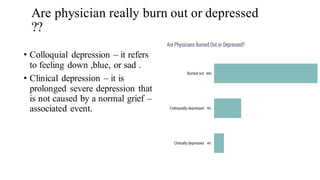
Are physician really burn out or depressed
??
• Colloquial depression – it refers
to feeling down ,blue, or sad .
• Clinical depression – it is
prolonged severe depression that
is not caused by a normal grief –
associated event.
Physician Distress: Key Drivers
• Excessive workload
• Inefficient work environment, inadequate support
• Problems with work-life integration
• Loss autonomy/flexibility/control
• Loss of values and meaning in work
Measure of burnout
• MBI is designed to assess the three componets of the burnout
syndrome : emotional exhaustional , depersonalization & reduced
personal accomplishment
• There are 22 items , which are divided into three subscales.
1. MBI- human services survey ( MBI-HSS)
2. MBI - educators survey ( MBI- ES)
3. MBI – General survey ( MBI-GS)
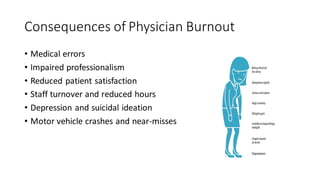
Consequences of Physician Burnout
• Medical errors
• Impaired professionalism
• Reduced patient satisfaction
• Staff turnover and reduced hours
• Depression and suicidal ideation
• Motor vehicle crashes and near-misses
JOURNAL NUMBER - 1
• Journal name : journal of postgraduate medicine
• Article : Prevalence of burnout and its correlates
amongresidents in a tertiary medical center in Kerala,India
• Year of publish : 2016
• Author : Ratnakaran B et al.
• Study type : cross-sectional study
AIM
• Study the prevalence of burn out and its correlates among interns and
residents doctors.
METHOD
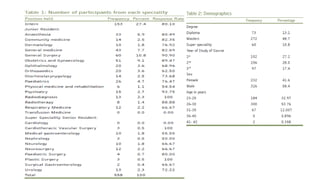
• STUDY POPULATION : 558 interns and residents were taken from
Government Medical College, Thiruvantharapuram,Kerala,India
• Residents (junior or senior) were further sub grouped
• Medical
• Surgical
• Non-medical / non-surgical residents – radio diagnosis, radiotherapy,
community medicine, transfusion medicine, physical medicine and
rehabilitation departments
• The residents who did not contribute to patient care directly were
excluded (anatomy, physiology, biochemistry, pharmacology,
pathology, forensic medicine, and microbiology).
STUDY TOOL
• Burnout was measured with the Copenhagen Burnout Inventory(CBI),
which is a reliable and validated 19-item questionnaire.
• The CBI focuses on exhaustion and its attribution by the person.
• The CBI has scales on
• personal burnout (six items on general exhaustion without a specific
attribution),
• work-related burnout (seven items on exhaustion attributed to work in
general), and
• client-related burnout (six items on exhaustion attributed to work with clients)
(client in our study would mean patients).
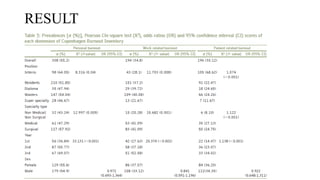
RESULT
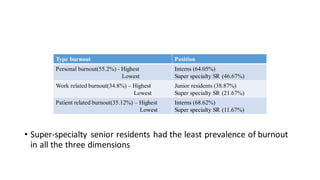
• Super-specialty senior residents had the least prevalence of burnout
in all the three dimensions
Type burnout Position
Personal burnout(55.2%) - Highest
Lowest
Interns (64.05%)
Super specialty SR (46.67%)
Work related burnout(34.8%) – Highest
Lowest
Junior residents (38.87%)
Super specialty SR (21.67%)
Patient related burnout(35.12%) – Highest
Lowest
Interns (68.62%)
Super specialty SR (11.67%)
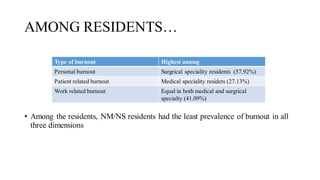
AMONG RESIDENTS…
• Among the residents, NM/NS residents had the least prevalence of burnout in all
three dimensions
Type of burnout Highest among
Personal burnout Surgrical speciality residents (57.92%)
Patient related burnout Medical speciality residets (27.13%)
Work related burnout Equal in both medical and surgrical
specialty (41.09%)
DISCUSSION
• More than one-third of the participants were found to have burnout in
one dimension or another
• The lack of direction in their career, lack of participation in decision-
making, the frequent rotations in different departments, and changing
patient profile might be the cause of high personal and patient-related
burnout among interns
• Favorable identity status and work engagement may be the reasons
for the low burnout found among super-specialty senior residents
• The increase in burnout associated with number of years in work could
be an indicator of long-term stress being a factor in burnout
• Medical residents have more interaction with patients that might the
cause for higher patient-related burnout when compared with surgical
residents
• Personal burnout was higher for surgical residents in our study
• NM/NS residents might have lesser work demands, workload, and
emergencies at work that could be the cause of lesser prevalence
across all three types of burnout
LIMITATIONS
• The study has been done at a single center that might not replicate the
same study environment in other centers
• The relation of age and specific specialty wise variables with burnout
were not assessed due to lower number of participants available for
grouping
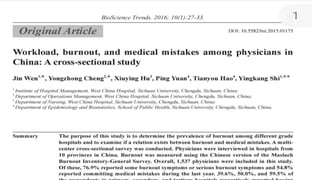
JOURNAL NUMBER – 2
• JOURNAL NAME : BioScience Trends
• ARTICLE : Workload, burnout, and medical mistakes among
physicians in China
• AUTHOR : Jin Wen1, Yongzhong Cheng2, Xiuying Hu3 et.al
• Year of publish : 2016
• Study type : Cross sectional
OBJECTIVE
• To determine the prevalence of burnout among different grade
hospitals and to examine if a relation exists between burnout and
medical mistakes
STUDY METHOD
• A multi-center cross-sectional survey was conducted in China from
November to December 2013.
• Physicians in hospitals from 10 provinces were selected. Overall 12
tertiary, 9 secondary, and 25 primary hospitals were included in this
study.
• physicians from at least 10 clinical departments and no less than 10
persons in each age group (across a total of 4 age groups).
• Workload was measured by two indicators.
• The first was work hours per week, and the second was number of
daily service patients.
• Medical mistakes include self-report of any of the following: i) patient
was harmed, ii) medication errors, iii) treatment delayed, and iv)
incomplete or incorrect item in the patient's record.
• Burnout was measured with the Chinese version of Maslach Burnout
Inventory-General Scale (MBI-GS) (10) which includes 15 items for
measuring the three dimensions of burnout: exhaustion (5 items),
cynicism (4 items), and reduced professional efficacy (6 items).
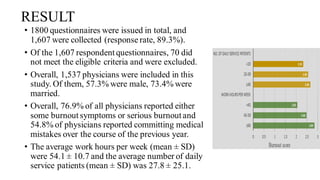
RESULT
• 1800 questionnaires were issued in total, and
1,607 were collected (response rate, 89.3%).
• Of the 1,607 respondentquestionnaires, 70 did
not meet the eligible criteria and were excluded.
• Overall, 1,537 physicians were included in this
study. Of them, 57.3% were male, 73.4% were
married.
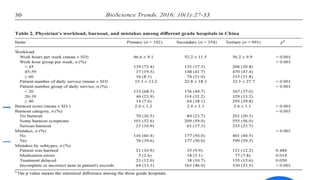
• Overall, 76.9% of all physicians reported either
some burnoutsymptoms or serious burnoutand
54.8% of physicians reported committing medical
mistakes over the course of the previous year.
• The average work hours per week (mean ± SD)
were 54.1 ± 10.7 and the average number of daily
service patients (mean ± SD) was 27.8 ± 25.1.
• 39.6%, 50.0%, and 59.5% of the respondents in primary, secondary,
and tertiary hospitals respectively reported having made mistakes over
the course of the previous year.
• Multivariate analysis demonstrated that being female was protective
against medical mistakes (OR = 0.72, 95% CI: 0.58-0.89).
• Physician-reported 60 or more work hours per week (OR = 1.65, 95%
CI: 1.22- 2.22), and physicians who reported serious burnout (OR =
2.28, 95% CI: 1.63-3.17) were independently associated with higher
incidence of medical mistakes
DISCUSSION
• Physician burnout is not only a critical issue involving physician
health, but also that of patient safety.
• This multicenter cross sectional survey revealed that being male,
longer work hours per week, and increased burnout symptoms were all
risk factors for medical mistakes.
• Meanwhile, doctors in tertiary hospitals were most overworked,
suffered the most serious burnout, and made the most mistakes, while
those in primary hospitals were least overworked, with least burnout
symptoms, and made the least mistakes.
LIMITATION
• The medical mistakes were self-reported, which might lead to
unreliable findings.
• participants are more likely to underestimate rather than overestimate
the number of mistakes they made in the past year.
• The study design was not random and consisted of a convenient
sample which could potentially impact the findings of this paper in
that participants were biased in their responses by their inclusion in the
study.
JOURNAL NUMBER – 3
• JOURNAL NAME : Journal of primary care and community health
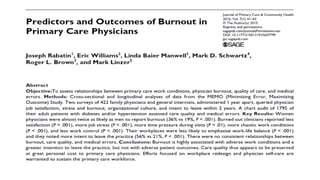
• ARTICLE : Predictors and outcome of burnout in primary care
physicians
• AUTHOR : Joseph Rabatin, et al.
• Year of publish : 2016
• Study type : Cross sectional
OBJECTIVE
• To assess relationships between primary care work conditions,
physician burnout, quality of care, and medical errors
STUDY METHOD
• Cross-sectional and longitudinal analyses of data from the MEMO
(Minimizing Error, MaximizingOutcome) Study
• Two surveys were done simultaneous
1. A total of 449 physicians (59.6% of those approached) consented to
participate, and 422 complete the baseline survey (participation rate 56.0%,
187 women and 235 men) queried physician job satisfaction, stress and
burnout, organizational culture, and intent to leave within 2 years
2. A total of 1795 patients were recruited in clinic waiting rooms or via mailed
invitations with opt-in postcards , of these, 1419 had their charts audited for
care quality and medical errors
RESULT
RESULT
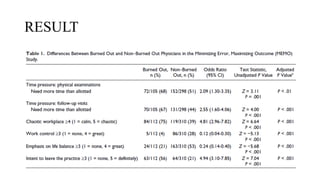
• Women were more likely than men to report burnout (36% vs 19%),
• there were no differences in burnout by age, race/ethnicity, or specialty,
• burned out physicians reported lower satisfaction(9% satisfied vs 59%
among non–burned out physicians)
• poorer work control (4% sensing very good control vs 28% of non–burned
out physicians),
• burned out physicians were 4 times more likely to note chaotic workplaces
• burned out physicians noted a greater intent to leave the practice (56%
vs21%),
DISCUSSION
• Physician burnout was associated with less satisfaction and a greater
intent to leave the practice
• Practice conditions associated with burnout included time pressure,
chaos, and lack of control
• Quality of care is preserved but at great personal cost to providers
LIMITATIONS
• self-reported data,
• nonrandom site selection,
• limited number of patient outcomes
JOURNAL NUMBER - 4
JOURNAL NAME : Mayo Foundation for Medical Education and
Research
ARTICLE NAME : Physician Burnout, Well-being, and Work Unit
Safety Grades in Relationship to Reported Medical Errors
Year of publish : 2018
Author : Daniel S. Tawfik, et al.
Study type : Cross sectional
AIM AND OBJECTIVE
• To evaluate physician burnout, well-being, and work unit safety grades
in relationship to perceived major medical errors
METHODS
• National survey of US physician was conducted between 28th
August,2014 and 6th October,2014
• Participation was voluntary, and all responses were anonymous
• Of the 35,922 physicians who opened an invitation, 6880 (19.2%)
completed surveys
• Survey included 60 questions
• Burnout was measured using the Maslach Burnout Inventory, a 22-
item questionnaire considered the criterion standard for measuring
burnout
• we classified physicians with a high score on the depersonalization
(DP) or emotional exhaustion (EE) subscale of the Maslach Burnout
Inventory as having at least one manifestation of professional burnout
• Fatigue was measured using a standardized linear analog self-
assessment question
• Work unit safety grade based on perceived quality and safety in the
work area where physicians practiced
• “Please give the work area (clinic/hospital/other) where you spend most of
your time an overall grade on patient safety.” Response options were A
(excellent), B (very good), C (acceptable), D (poor), and F (failing).
• Recent, self-perceived medical errors were evaluated by asking
physicians
• “Are you concerned you have made any major medical errors in the last 3
months?”
• For those who answered “yes,” 2 follow-up questions were asked: “Which of
the following best describes your most recent error?” and “What was the
outcome of your most recent error?”
RESULT
• A total of 4355 of 6490 (67%) respondents were male,
• with a median age of 56 (interquartile range [IQR], 45-63) years,
• median of 50 hours worked per week, and a median of 1 nights on call per week
Conti…
• Of 6586 respondents, 691 (10.5%) reported a self-perceived major medical error
in the previous 3 months
• Errors were most commonly categorized as an
• error in judgment (266 of 679 respondents[39.2%]),
• wrong diagnosis (136 of 679 [20.0%]), or
• technical mistake (88 of 679 [13.0%])
• The highest prevalence of medical errors was reported
by respondentsfrom radiology (58 of 249 respondents
[23.3%]), neurosurgery (12 of 55 [21.8%]), and
emergency medicine (74 of 346 [21.4%])
• More than half of all errors (367 of 663 respondents
[55.4%])had no perceived effect on patient outcome,
but 35 (5.3%) resulted in “significant permanent
morbidity” and 30 (4.5%) in a patient death
Conti…
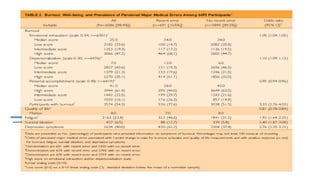
• Among the 6586 participants who provided information on these symptoms,
• 3066 (47.2%)had high EE,
• 2270 (35.1%)had high DP, and
• 1033 (16.1%)had low personal accomplishment (PA)
• A total of 3574 (54.3%) had a high score on EE and/or DP and were categorized as
having at least one symptom of burnout
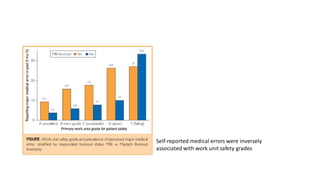
Self-reported medical errors were inversely
associated with work unit safety grades
CONCLUSION
• In this large national study, physician burnout, fatigue, and work unit
safety grades were independently associated with major medical
errors.
• Interventions to reduce rates of medical errors must address both
physician well-being and work unit safety.
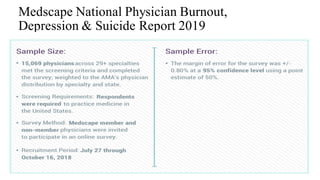
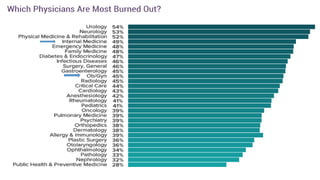
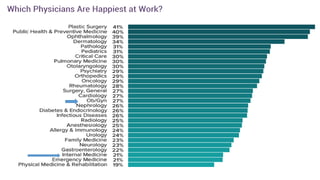
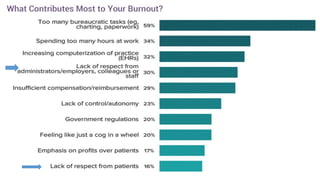
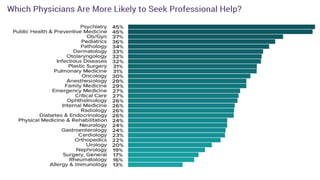
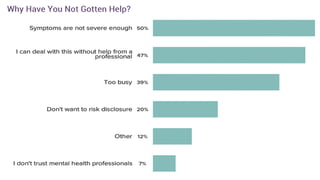
Medscape National Physician Burnout,
Depression & Suicide Report 2019
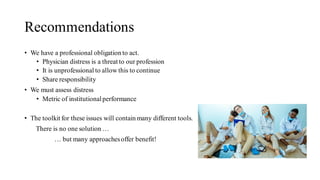
Recommendations
• We have a professional obligation to act.
• Physician distress is a threat to our profession
• It is unprofessional to allow this to continue
• Share responsibility
• We must assess distress
• Metric of institutionalperformance
• The toolkit for these issues will contain many different tools.
There is no one solution …
… but many approachesoffer benefit!
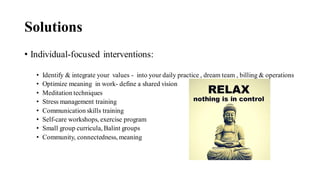
Solutions
• Individual-focused interventions:
• Identify & integrate your values - into your daily practice , dream team , billing & operations
• Optimize meaning in work- define a shared vision
• Meditation techniques
• Stress management training
• Communication skills training
• Self-care workshops, exercise program
• Small group curricula, Balint groups
• Community, connectedness, meaning
What Can Organizations Do?
• Be value oriented
• Promote values of the medical profession
• Congruence between values and expectations
• Provide adequate resources (efficiency)
• Organization and work unit level
• Promote autonomy
• Flexibility, input, sense control
• Promote work-home integration
• Promote meaning in work
Physician burnout

Physician burnout

  • 1.
    JOURNAL CLUB PHYSICIAN BURNOUT PRESENTEDBY – DR HEEMANSHU DR SAOOD MALIK MODERATOR – DR S ANURADHA
  • 2.
    INTRODUCTION • Burnout isa major issue among physicians , & recent tragedies of physician suicide show just how devastating this situation remains. • What is Burnout? exhaustion of physical or emotional strength or motivation usually as a result of prolonged stress or frustration • Components of Burnout - 1. Emotional exhaustion or loss of passion for one’s work 2. Depersonalization, or treating patients as objects 3. Sense that your work is no longer meaningful
  • 3.
    Are physician reallyburn out or depressed ?? • Colloquial depression – it refers to feeling down ,blue, or sad . • Clinical depression – it is prolonged severe depression that is not caused by a normal grief – associated event.
  • 4.
    Physician Distress: KeyDrivers • Excessive workload • Inefficient work environment, inadequate support • Problems with work-life integration • Loss autonomy/flexibility/control • Loss of values and meaning in work
  • 5.
    Measure of burnout •MBI is designed to assess the three componets of the burnout syndrome : emotional exhaustional , depersonalization & reduced personal accomplishment • There are 22 items , which are divided into three subscales. 1. MBI- human services survey ( MBI-HSS) 2. MBI - educators survey ( MBI- ES) 3. MBI – General survey ( MBI-GS)
  • 6.
    Consequences of PhysicianBurnout • Medical errors • Impaired professionalism • Reduced patient satisfaction • Staff turnover and reduced hours • Depression and suicidal ideation • Motor vehicle crashes and near-misses
  • 7.
    JOURNAL NUMBER -1 • Journal name : journal of postgraduate medicine • Article : Prevalence of burnout and its correlates amongresidents in a tertiary medical center in Kerala,India • Year of publish : 2016 • Author : Ratnakaran B et al. • Study type : cross-sectional study
  • 9.
    AIM • Study theprevalence of burn out and its correlates among interns and residents doctors.
  • 10.
    METHOD • STUDY POPULATION: 558 interns and residents were taken from Government Medical College, Thiruvantharapuram,Kerala,India • Residents (junior or senior) were further sub grouped • Medical • Surgical • Non-medical / non-surgical residents – radio diagnosis, radiotherapy, community medicine, transfusion medicine, physical medicine and rehabilitation departments • The residents who did not contribute to patient care directly were excluded (anatomy, physiology, biochemistry, pharmacology, pathology, forensic medicine, and microbiology).
  • 12.
    STUDY TOOL • Burnoutwas measured with the Copenhagen Burnout Inventory(CBI), which is a reliable and validated 19-item questionnaire. • The CBI focuses on exhaustion and its attribution by the person. • The CBI has scales on • personal burnout (six items on general exhaustion without a specific attribution), • work-related burnout (seven items on exhaustion attributed to work in general), and • client-related burnout (six items on exhaustion attributed to work with clients) (client in our study would mean patients).
  • 13.
  • 14.
    • Super-specialty seniorresidents had the least prevalence of burnout in all the three dimensions Type burnout Position Personal burnout(55.2%) - Highest Lowest Interns (64.05%) Super specialty SR (46.67%) Work related burnout(34.8%) – Highest Lowest Junior residents (38.87%) Super specialty SR (21.67%) Patient related burnout(35.12%) – Highest Lowest Interns (68.62%) Super specialty SR (11.67%)
  • 15.
    AMONG RESIDENTS… • Amongthe residents, NM/NS residents had the least prevalence of burnout in all three dimensions Type of burnout Highest among Personal burnout Surgrical speciality residents (57.92%) Patient related burnout Medical speciality residets (27.13%) Work related burnout Equal in both medical and surgrical specialty (41.09%)
  • 16.
    DISCUSSION • More thanone-third of the participants were found to have burnout in one dimension or another • The lack of direction in their career, lack of participation in decision- making, the frequent rotations in different departments, and changing patient profile might be the cause of high personal and patient-related burnout among interns • Favorable identity status and work engagement may be the reasons for the low burnout found among super-specialty senior residents • The increase in burnout associated with number of years in work could be an indicator of long-term stress being a factor in burnout
  • 17.
    • Medical residentshave more interaction with patients that might the cause for higher patient-related burnout when compared with surgical residents • Personal burnout was higher for surgical residents in our study • NM/NS residents might have lesser work demands, workload, and emergencies at work that could be the cause of lesser prevalence across all three types of burnout
  • 18.
    LIMITATIONS • The studyhas been done at a single center that might not replicate the same study environment in other centers • The relation of age and specific specialty wise variables with burnout were not assessed due to lower number of participants available for grouping
  • 19.
    JOURNAL NUMBER –2 • JOURNAL NAME : BioScience Trends • ARTICLE : Workload, burnout, and medical mistakes among physicians in China • AUTHOR : Jin Wen1, Yongzhong Cheng2, Xiuying Hu3 et.al • Year of publish : 2016 • Study type : Cross sectional
  • 21.
    OBJECTIVE • To determinethe prevalence of burnout among different grade hospitals and to examine if a relation exists between burnout and medical mistakes
  • 22.
    STUDY METHOD • Amulti-center cross-sectional survey was conducted in China from November to December 2013. • Physicians in hospitals from 10 provinces were selected. Overall 12 tertiary, 9 secondary, and 25 primary hospitals were included in this study. • physicians from at least 10 clinical departments and no less than 10 persons in each age group (across a total of 4 age groups). • Workload was measured by two indicators. • The first was work hours per week, and the second was number of daily service patients. • Medical mistakes include self-report of any of the following: i) patient was harmed, ii) medication errors, iii) treatment delayed, and iv) incomplete or incorrect item in the patient's record.
  • 23.
    • Burnout wasmeasured with the Chinese version of Maslach Burnout Inventory-General Scale (MBI-GS) (10) which includes 15 items for measuring the three dimensions of burnout: exhaustion (5 items), cynicism (4 items), and reduced professional efficacy (6 items).
  • 24.
    RESULT • 1800 questionnaireswere issued in total, and 1,607 were collected (response rate, 89.3%). • Of the 1,607 respondentquestionnaires, 70 did not meet the eligible criteria and were excluded. • Overall, 1,537 physicians were included in this study. Of them, 57.3% were male, 73.4% were married. • Overall, 76.9% of all physicians reported either some burnoutsymptoms or serious burnoutand 54.8% of physicians reported committing medical mistakes over the course of the previous year. • The average work hours per week (mean ± SD) were 54.1 ± 10.7 and the average number of daily service patients (mean ± SD) was 27.8 ± 25.1.
  • 25.
    • 39.6%, 50.0%,and 59.5% of the respondents in primary, secondary, and tertiary hospitals respectively reported having made mistakes over the course of the previous year. • Multivariate analysis demonstrated that being female was protective against medical mistakes (OR = 0.72, 95% CI: 0.58-0.89). • Physician-reported 60 or more work hours per week (OR = 1.65, 95% CI: 1.22- 2.22), and physicians who reported serious burnout (OR = 2.28, 95% CI: 1.63-3.17) were independently associated with higher incidence of medical mistakes
  • 27.
    DISCUSSION • Physician burnoutis not only a critical issue involving physician health, but also that of patient safety. • This multicenter cross sectional survey revealed that being male, longer work hours per week, and increased burnout symptoms were all risk factors for medical mistakes. • Meanwhile, doctors in tertiary hospitals were most overworked, suffered the most serious burnout, and made the most mistakes, while those in primary hospitals were least overworked, with least burnout symptoms, and made the least mistakes.
  • 28.
    LIMITATION • The medicalmistakes were self-reported, which might lead to unreliable findings. • participants are more likely to underestimate rather than overestimate the number of mistakes they made in the past year. • The study design was not random and consisted of a convenient sample which could potentially impact the findings of this paper in that participants were biased in their responses by their inclusion in the study.
  • 29.
    JOURNAL NUMBER –3 • JOURNAL NAME : Journal of primary care and community health • ARTICLE : Predictors and outcome of burnout in primary care physicians • AUTHOR : Joseph Rabatin, et al. • Year of publish : 2016 • Study type : Cross sectional
  • 31.
    OBJECTIVE • To assessrelationships between primary care work conditions, physician burnout, quality of care, and medical errors
  • 32.
    STUDY METHOD • Cross-sectionaland longitudinal analyses of data from the MEMO (Minimizing Error, MaximizingOutcome) Study • Two surveys were done simultaneous 1. A total of 449 physicians (59.6% of those approached) consented to participate, and 422 complete the baseline survey (participation rate 56.0%, 187 women and 235 men) queried physician job satisfaction, stress and burnout, organizational culture, and intent to leave within 2 years 2. A total of 1795 patients were recruited in clinic waiting rooms or via mailed invitations with opt-in postcards , of these, 1419 had their charts audited for care quality and medical errors
  • 33.
  • 34.
    RESULT • Women weremore likely than men to report burnout (36% vs 19%), • there were no differences in burnout by age, race/ethnicity, or specialty, • burned out physicians reported lower satisfaction(9% satisfied vs 59% among non–burned out physicians) • poorer work control (4% sensing very good control vs 28% of non–burned out physicians), • burned out physicians were 4 times more likely to note chaotic workplaces • burned out physicians noted a greater intent to leave the practice (56% vs21%),
  • 35.
    DISCUSSION • Physician burnoutwas associated with less satisfaction and a greater intent to leave the practice • Practice conditions associated with burnout included time pressure, chaos, and lack of control • Quality of care is preserved but at great personal cost to providers
  • 36.
    LIMITATIONS • self-reported data, •nonrandom site selection, • limited number of patient outcomes
  • 37.
    JOURNAL NUMBER -4 JOURNAL NAME : Mayo Foundation for Medical Education and Research ARTICLE NAME : Physician Burnout, Well-being, and Work Unit Safety Grades in Relationship to Reported Medical Errors Year of publish : 2018 Author : Daniel S. Tawfik, et al. Study type : Cross sectional
  • 38.
    AIM AND OBJECTIVE •To evaluate physician burnout, well-being, and work unit safety grades in relationship to perceived major medical errors
  • 39.
    METHODS • National surveyof US physician was conducted between 28th August,2014 and 6th October,2014 • Participation was voluntary, and all responses were anonymous • Of the 35,922 physicians who opened an invitation, 6880 (19.2%) completed surveys • Survey included 60 questions
  • 40.
    • Burnout wasmeasured using the Maslach Burnout Inventory, a 22- item questionnaire considered the criterion standard for measuring burnout • we classified physicians with a high score on the depersonalization (DP) or emotional exhaustion (EE) subscale of the Maslach Burnout Inventory as having at least one manifestation of professional burnout • Fatigue was measured using a standardized linear analog self- assessment question
  • 41.
    • Work unitsafety grade based on perceived quality and safety in the work area where physicians practiced • “Please give the work area (clinic/hospital/other) where you spend most of your time an overall grade on patient safety.” Response options were A (excellent), B (very good), C (acceptable), D (poor), and F (failing). • Recent, self-perceived medical errors were evaluated by asking physicians • “Are you concerned you have made any major medical errors in the last 3 months?” • For those who answered “yes,” 2 follow-up questions were asked: “Which of the following best describes your most recent error?” and “What was the outcome of your most recent error?”
  • 42.
    RESULT • A totalof 4355 of 6490 (67%) respondents were male, • with a median age of 56 (interquartile range [IQR], 45-63) years, • median of 50 hours worked per week, and a median of 1 nights on call per week
  • 43.
    Conti… • Of 6586respondents, 691 (10.5%) reported a self-perceived major medical error in the previous 3 months • Errors were most commonly categorized as an • error in judgment (266 of 679 respondents[39.2%]), • wrong diagnosis (136 of 679 [20.0%]), or • technical mistake (88 of 679 [13.0%])
  • 44.
    • The highestprevalence of medical errors was reported by respondentsfrom radiology (58 of 249 respondents [23.3%]), neurosurgery (12 of 55 [21.8%]), and emergency medicine (74 of 346 [21.4%]) • More than half of all errors (367 of 663 respondents [55.4%])had no perceived effect on patient outcome, but 35 (5.3%) resulted in “significant permanent morbidity” and 30 (4.5%) in a patient death
  • 45.
    Conti… • Among the6586 participants who provided information on these symptoms, • 3066 (47.2%)had high EE, • 2270 (35.1%)had high DP, and • 1033 (16.1%)had low personal accomplishment (PA) • A total of 3574 (54.3%) had a high score on EE and/or DP and were categorized as having at least one symptom of burnout
  • 47.
    Self-reported medical errorswere inversely associated with work unit safety grades
  • 48.
    CONCLUSION • In thislarge national study, physician burnout, fatigue, and work unit safety grades were independently associated with major medical errors. • Interventions to reduce rates of medical errors must address both physician well-being and work unit safety.
  • 49.
    Medscape National PhysicianBurnout, Depression & Suicide Report 2019
  • 55.
    Recommendations • We havea professional obligation to act. • Physician distress is a threat to our profession • It is unprofessional to allow this to continue • Share responsibility • We must assess distress • Metric of institutionalperformance • The toolkit for these issues will contain many different tools. There is no one solution … … but many approachesoffer benefit!
  • 56.
    Solutions • Individual-focused interventions: •Identify & integrate your values - into your daily practice , dream team , billing & operations • Optimize meaning in work- define a shared vision • Meditation techniques • Stress management training • Communication skills training • Self-care workshops, exercise program • Small group curricula, Balint groups • Community, connectedness, meaning
  • 57.
    What Can OrganizationsDo? • Be value oriented • Promote values of the medical profession • Congruence between values and expectations • Provide adequate resources (efficiency) • Organization and work unit level • Promote autonomy • Flexibility, input, sense control • Promote work-home integration • Promote meaning in work