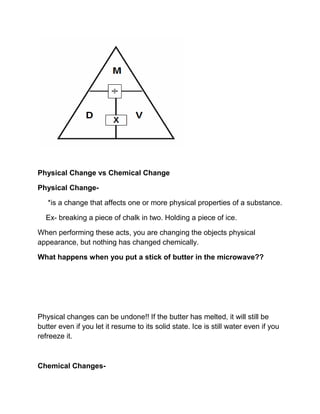
Physical Properties of Matter:-Mass is a measure of InertiaPhysical Properties: Of matter can be observed or measured without changing the identity of the matter. Ex- describing a red apple**How to Identify matter-Ex- thermal conductivity-energy transfer-State-of matter can be  solid, liquid, gas-Malleability- ability to be pounded in to thin sheets, won’t break-Ductility- drawn or pulled into wire-Solubility- ability to dissolve into another substance-Density- Mass per unit volume**Density is useful to identify substances for two reasons--density is always the same of a substance at a given pressure and temperatureThe equation that is used to identify density is alwaysD=M/VDensity is measured in g/cm3Ex- Which object would be more dense, a golf ball or a ping pong ball? Chemical Properties-describe a substance based on its ability to change into a new substance with different properties.Ex- a piece of wood can be burned to create new substances  (ash and smoke)Wood has the chemical property of Flammability. Substances that do not burn have the chemical property of non flammability. Other chemical properties include reactivity with oxygen, reactivity with acid, and reactivity with water.  Density: the amount of mass in a given amount of spaceDensity = Mass ÷ VolumeMass = Density x VolumeVolume = Mass ÷ DensityD= M/VM=DxVV=M/D\Physical Change vs Chemical ChangePhysical Change-     *is a change that affects one or more physical properties of a substance.     Ex- breaking a piece of chalk in two. Holding a piece of ice. When performing these acts, you are changing the objects physical appearance, but nothing has changed chemically. What happens when you put a stick of butter in the microwave??Physical changes can be undone!! If the butter has melted, it will still be butter even if you let it resume to its solid state. Ice is still water even if you refreeze it. Chemical Changes-     -Produce new substances with different properties:                               *bake a cake/ cause a color change/fizzing/foaming/heat/sound/light/odorHOMEWORK TUESDAY NIGHT:Classify each of the following properties as either physical or chemical: reacts with water, dissolves in acetone, is blue, does not react with hydrogen.States of Matter
Physical  Properties Of  Matter  Notes

Physical Properties Of Matter Notes

  • 1.
    Physical Properties ofMatter:-Mass is a measure of InertiaPhysical Properties: Of matter can be observed or measured without changing the identity of the matter. Ex- describing a red apple**How to Identify matter-Ex- thermal conductivity-energy transfer-State-of matter can be solid, liquid, gas-Malleability- ability to be pounded in to thin sheets, won’t break-Ductility- drawn or pulled into wire-Solubility- ability to dissolve into another substance-Density- Mass per unit volume**Density is useful to identify substances for two reasons--density is always the same of a substance at a given pressure and temperatureThe equation that is used to identify density is alwaysD=M/VDensity is measured in g/cm3Ex- Which object would be more dense, a golf ball or a ping pong ball? Chemical Properties-describe a substance based on its ability to change into a new substance with different properties.Ex- a piece of wood can be burned to create new substances (ash and smoke)Wood has the chemical property of Flammability. Substances that do not burn have the chemical property of non flammability. Other chemical properties include reactivity with oxygen, reactivity with acid, and reactivity with water. Density: the amount of mass in a given amount of spaceDensity = Mass ÷ VolumeMass = Density x VolumeVolume = Mass ÷ DensityD= M/VM=DxVV=M/D\Physical Change vs Chemical ChangePhysical Change- *is a change that affects one or more physical properties of a substance. Ex- breaking a piece of chalk in two. Holding a piece of ice. When performing these acts, you are changing the objects physical appearance, but nothing has changed chemically. What happens when you put a stick of butter in the microwave??Physical changes can be undone!! If the butter has melted, it will still be butter even if you let it resume to its solid state. Ice is still water even if you refreeze it. Chemical Changes- -Produce new substances with different properties: *bake a cake/ cause a color change/fizzing/foaming/heat/sound/light/odorHOMEWORK TUESDAY NIGHT:Classify each of the following properties as either physical or chemical: reacts with water, dissolves in acetone, is blue, does not react with hydrogen.States of Matter