PROPERTIES OF MATTER
Describing Matter
How would you describe
yourself so that
someone else could
identify you?
• On a separate sheet of paper,
write as many physical
descriptions of yourself as you
can. Do not put your name on
the paper.
Physical Properties
• A property of matter that can be
observed or measured without
changing the identity of the matter.
• Physical properties identify matter.
• Examples include but are not limited to:
• Density
• Malleability
• Ductility
• Solubility
• State
• Thermal Conductivity
Physical Properties
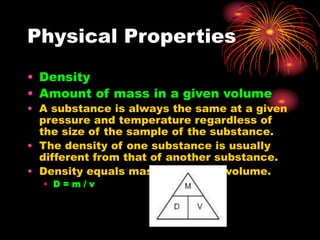
• Density
• Amount of mass in a given volume
• A substance is always the same at a given
pressure and temperature regardless of
the size of the sample of the substance.
• The density of one substance is usually
different from that of another substance.
• Density equals mass divided by volume.
• D = m / v
Practice
• A bar of copper has a mass of
216 g and a volume of 24 cmᴲ.
• What is the density of copper?
• The volume of a candy bar is 55
cmᴲ. The mass of the candy bar
is 70 g. What s the density of
the candy bar?
More Practice
• An ice cube has a volume of 36
cmᴲ. If the ice cube has a mass
of 33.2 g, what is the density of
the ice cube?
• What is the density of water?
Still More Practice
• At 4⁰C, pure water has a density
of 1 g/mL (1 g/cmᴲ). Suppose
that you have 2 liters of pure
water at this temperature.
What is the mass of this water?
What is the mass of ethyl alcohol
that
And Yet, Two More : )
• What is the mass of ethyl alcohol
that exactly fills a 200.0 mL
graduated cylinder. The density of
ethyl alcohol is 0.789 g/mL.
• What is the volume of a silver
metal that has a mass of 2500.0 g.
The density of silver is 10.5 g/cmᴲ
• Malleability
• The ability to be pounded into thin sheets.
• Example:
• Aluminum can be rolled or pounded into
sheets to make foil.
• Ductility
• The ability to be drawn or pulled into a wire
• Example
• Copper in wiring – soldering wires or joints
Physical Property
Physical Property
• Solubility
• The ability to dissolve in another
substance.
• Example:
• Sugar or salt dissolve in water
• Three ways to increase solubility
• Heat or make warmer
• Grind or smash
• Stir or mix
Physical Property
• State of Matter
• The physical form in which a
substance exists at room
temperature, such as:
• Solid – matter has a definite shape and
volume
• Liquid – matter takes the shape of its
container and has a definite volume
• Gas – matter changes in both shape and
volume
Physical Property
• Thermal Conductivity
• The ability to transfer thermal
energy from one area to another.
• Examples:
• Plastic foam is a poor conductor, so a
hot drink won’t burn your hand.
• The inside of the toaster (hot coils)
Chemical Property
• A property of matter that
describes a substance based on
its ability to change into a new
substance with different
properties.
• Combustibility
• Flammability
• Reactivity
• Acids
• Bases
• Oxidation
Chemical Properties
 Can be observed with your senses.
 Are Not as easy to observe as
physical properties
Example:
 Flammability – Only when wood
burns
 Combustibility – Only when
fireworks explode
 Reactivity – Only when iron
Oxidizes (rust)
Physical Change
• A change that affects one or more
physical properties of a
substance.
• Do Not form new substances.
• Can often be Undone
• Example Butter on counter can be
placed back in refrigerator.
• Change of State
•Solid to Liquid
•Liquid to Gas
Chemical Change
• A change that occurs when one or more
substances are changed into entirely new
substances with different properties.
• Can Not change back under normal
conditions (some can be changed back by
other chemical means)
• Common Examples:
• Reactivity – Oxidation (rust) on a bicycle
• pH (Acid / Base) – Effervescent tablets
• Flammability – Burnt wood
• Combustibility - Fireworks
5 Signs of a Chemical
Change
• The only sure way to know
there has been a chemical
change is the observance of a
new substance formed
• Sometimes that is hard to do, so
look for the signs…….
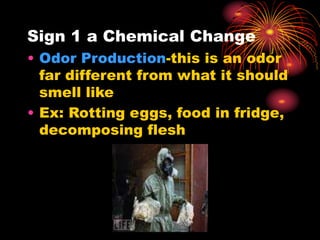
Sign 1 a Chemical Change
• Odor Production-this is an odor
far different from what it should
smell like
• Ex: Rotting eggs, food in fridge,
decomposing flesh
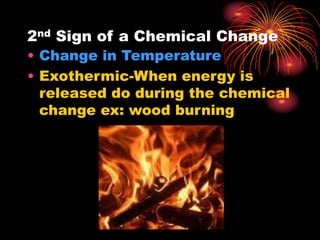
2nd Sign of a Chemical Change
• Change in Temperature
• Exothermic-When energy is
released do during the chemical
change ex: wood burning
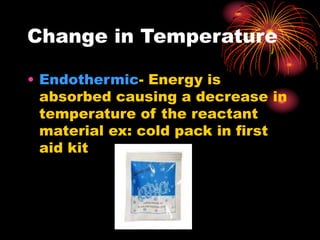
Change in Temperature
• Endothermic- Energy is
absorbed causing a decrease in
temperature of the reactant
material ex: cold pack in first
aid kit
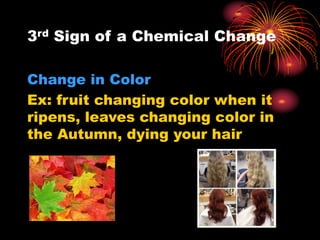
3rd Sign of a Chemical Change
Change in Color
Ex: fruit changing color when it
ripens, leaves changing color in
the Autumn, dying your hair
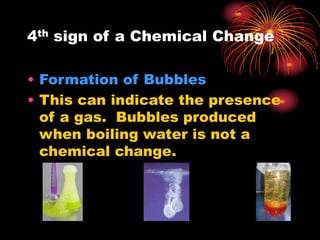
4th sign of a Chemical Change
• Formation of Bubbles
• This can indicate the presence
of a gas. Bubbles produced
when boiling water is not a
chemical change.
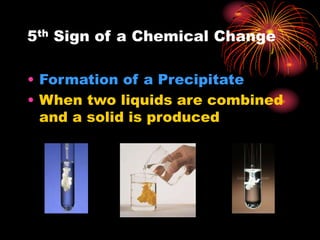
5th Sign of a Chemical Change
• Formation of a Precipitate
• When two liquids are combined
and a solid is produced

PROPERTIES_OF_MATTERPP2.ppt

  • 1.
  • 2.
    How would youdescribe yourself so that someone else could identify you? • On a separate sheet of paper, write as many physical descriptions of yourself as you can. Do not put your name on the paper.
  • 3.
    Physical Properties • Aproperty of matter that can be observed or measured without changing the identity of the matter. • Physical properties identify matter. • Examples include but are not limited to: • Density • Malleability • Ductility • Solubility • State • Thermal Conductivity
  • 4.
    Physical Properties • Density •Amount of mass in a given volume • A substance is always the same at a given pressure and temperature regardless of the size of the sample of the substance. • The density of one substance is usually different from that of another substance. • Density equals mass divided by volume. • D = m / v
  • 5.
    Practice • A barof copper has a mass of 216 g and a volume of 24 cmᴲ. • What is the density of copper? • The volume of a candy bar is 55 cmᴲ. The mass of the candy bar is 70 g. What s the density of the candy bar?
  • 6.
    More Practice • Anice cube has a volume of 36 cmᴲ. If the ice cube has a mass of 33.2 g, what is the density of the ice cube? • What is the density of water?
  • 7.
    Still More Practice •At 4⁰C, pure water has a density of 1 g/mL (1 g/cmᴲ). Suppose that you have 2 liters of pure water at this temperature. What is the mass of this water? What is the mass of ethyl alcohol that
  • 8.
    And Yet, TwoMore : ) • What is the mass of ethyl alcohol that exactly fills a 200.0 mL graduated cylinder. The density of ethyl alcohol is 0.789 g/mL. • What is the volume of a silver metal that has a mass of 2500.0 g. The density of silver is 10.5 g/cmᴲ
  • 9.
    • Malleability • Theability to be pounded into thin sheets. • Example: • Aluminum can be rolled or pounded into sheets to make foil. • Ductility • The ability to be drawn or pulled into a wire • Example • Copper in wiring – soldering wires or joints Physical Property
  • 10.
    Physical Property • Solubility •The ability to dissolve in another substance. • Example: • Sugar or salt dissolve in water • Three ways to increase solubility • Heat or make warmer • Grind or smash • Stir or mix
  • 11.
    Physical Property • Stateof Matter • The physical form in which a substance exists at room temperature, such as: • Solid – matter has a definite shape and volume • Liquid – matter takes the shape of its container and has a definite volume • Gas – matter changes in both shape and volume
  • 12.
    Physical Property • ThermalConductivity • The ability to transfer thermal energy from one area to another. • Examples: • Plastic foam is a poor conductor, so a hot drink won’t burn your hand. • The inside of the toaster (hot coils)
  • 13.
    Chemical Property • Aproperty of matter that describes a substance based on its ability to change into a new substance with different properties. • Combustibility • Flammability • Reactivity • Acids • Bases • Oxidation
  • 14.
    Chemical Properties  Canbe observed with your senses.  Are Not as easy to observe as physical properties Example:  Flammability – Only when wood burns  Combustibility – Only when fireworks explode  Reactivity – Only when iron Oxidizes (rust)
  • 15.
    Physical Change • Achange that affects one or more physical properties of a substance. • Do Not form new substances. • Can often be Undone • Example Butter on counter can be placed back in refrigerator. • Change of State •Solid to Liquid •Liquid to Gas
  • 16.
    Chemical Change • Achange that occurs when one or more substances are changed into entirely new substances with different properties. • Can Not change back under normal conditions (some can be changed back by other chemical means) • Common Examples: • Reactivity – Oxidation (rust) on a bicycle • pH (Acid / Base) – Effervescent tablets • Flammability – Burnt wood • Combustibility - Fireworks
  • 17.
    5 Signs ofa Chemical Change • The only sure way to know there has been a chemical change is the observance of a new substance formed • Sometimes that is hard to do, so look for the signs…….
  • 18.
    Sign 1 aChemical Change • Odor Production-this is an odor far different from what it should smell like • Ex: Rotting eggs, food in fridge, decomposing flesh
  • 19.
    2nd Sign ofa Chemical Change • Change in Temperature • Exothermic-When energy is released do during the chemical change ex: wood burning
  • 20.
    Change in Temperature •Endothermic- Energy is absorbed causing a decrease in temperature of the reactant material ex: cold pack in first aid kit
  • 21.
    3rd Sign ofa Chemical Change Change in Color Ex: fruit changing color when it ripens, leaves changing color in the Autumn, dying your hair
  • 22.
    4th sign ofa Chemical Change • Formation of Bubbles • This can indicate the presence of a gas. Bubbles produced when boiling water is not a chemical change.
  • 23.
    5th Sign ofa Chemical Change • Formation of a Precipitate • When two liquids are combined and a solid is produced