About Science Prof Online
PowerPoint Resources
• Science Prof Online (SPO) is a free science education website that provides fully-developed Virtual Science Classrooms,
science-related PowerPoints, articles and images. The site is designed to be a helpful resource for students, educators, and
anyone interested in learning about science.
• The SPO Virtual Classrooms offer many educational resources, including practice test questions, review questions, lecture
PowerPoints, video tutorials, sample assignments and course syllabi. New materials are continually being developed, so check
back frequently, or follow us on Facebook (Science Prof Online) or Twitter (ScienceProfSPO) for updates.
• Many SPO PowerPoints are available in a variety of formats, such as fully editable PowerPoint files, as well as uneditable
versions in smaller file sizes, such as PowerPoint Shows and Portable Document Format (.pdf), for ease of printing.
• Images used on this resource, and on the SPO website are, wherever possible, credited and linked to their source. Any
words underlined and appearing in blue are links that can be clicked on for more information. PowerPoints must be viewed in
slide show mode to use the hyperlinks directly.
• Several helpful links to fun and interactive learning tools are included throughout the PPT and on the Smart Links slide,
near the end of each presentation. You must be in slide show mode to utilize hyperlinks and animations.
•This digital resource is licensed under Creative Commons Attribution-ShareAlike 3.0:
http://creativecommons.org/licenses/by-sa/3.0/
Alicia Cepaitis, MS
Chief Creative Nerd
Science Prof Online
Online Education Resources, LLC
alicia@scienceprofonline.com
From the Virtual Cell Biology Classroom on ScienceProfOnline.com Image: Compound microscope objectives, T. Port
Tami Port, MS
Creator of Science Prof Online
Chief Executive Nerd
Science Prof Online
Online Education Resources, LLC
info@scienceprofonline.com
LYRICS
Photosynthesis
Photosynthesis
Photosynthesis
Photosynthesis does not involve a camera
Or a synthesizer
Although that's interesting too
Photosynthesis is how plants take in light
From the sun and turn it into energy
It's actually a thing on which most life depends
Here on the planet Earth
Photosynthesis X3
With plants
Chlorophyll cells take in carbon dioxide
Now that's the air that we breathe out
Combines it with water and exposes it to sunlight
And that's how plants can make their own food
Photosynthesis is why plants need light
And photosynthesis is why humans need plants
Because through photosynthesis plants make oxygen
And humans need oxygen to breathe
Photosynthesis x3
From the Virtual Cell Biology Classroom on ScienceProfOnline.com
“Photosynthesis”
a song by
They Might Be Giants
Image: Photosynthesis, Wikipedia
Watch the
“Photosynthesis”
music video!
From the Virtual Cell Biology Classroom on ScienceProfOnline.com
Images: Photosynthesis, Wikipedia; Thylakoid Membrane, Wiki
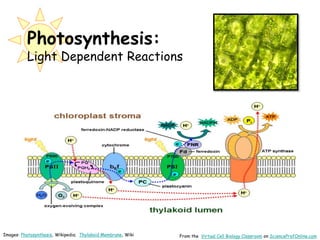
Photosynthesis:
Light Dependent Reactions
• The food chain begins with
autotrophs, organisms
that can make their own
food.
• Most of autotrophs capture
light energy from the sun
and use it, along with CO2
and H2O, to drive the
synthesis of glucose.
• Q: What is glucose?
• The oxygen we breathe is a
waste product of
photosynthesis.
From the Virtual Cell Biology Classroom on ScienceProfOnline.com
Photosynthesis
Image: Photosynthesis, Wikipedia
Images: Elodea plant cells, T. Port Chloroplast diagram, Wiki
From the Virtual Cell Biology Classroom on ScienceProfOnline.com
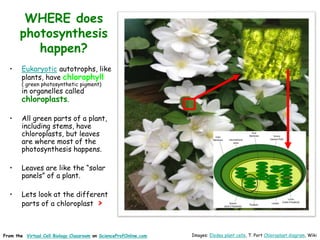
• Eukaryotic autotrophs, like
plants, have chlorophyll
( green photosynthetic pigment)
in organelles called
chloroplasts.
• All green parts of a plant,
including stems, have
chloroplasts, but leaves
are where most of the
photosynthesis happens.
• Leaves are like the “solar
panels” of a plant.
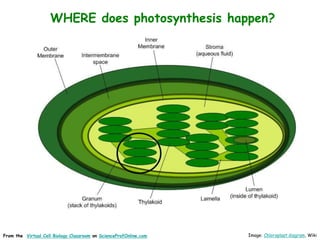
• Lets look at the different
parts of a chloroplast >
WHERE does
photosynthesis
happen?
Image: Chloroplast diagram, Wiki
From the Virtual Cell Biology Classroom on ScienceProfOnline.com
WHERE does photosynthesis happen?
HOW does
photosynthesis happen?
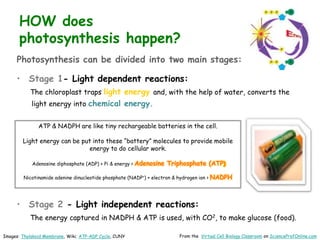
Photosynthesis can be divided into two main stages:
• Stage 1- Light dependent reactions:
The chloroplast traps light energy and, with the help of water, converts the
light energy into chemical energy.
ATP & NADPH are like tiny rechargeable batteries in the cell.
Light energy can be put into these “battery” molecules to provide mobile
energy to do cellular work.
Adenosine diphosphate (ADP) + Pi & energy > Adenosine Triphosphate (ATP)
Nicotinamide adenine dinucleotide phosphate (NADP+) + electron & hydrogen ion > NADPH
• Stage 2 - Light independent reactions:
The energy captured in NADPH & ATP is used, with CO2, to make glucose (food).
From the Virtual Cell Biology Classroom on ScienceProfOnline.com
Images: Thylakoid Membrane, Wiki; ATP-ADP Cycle, CUNY
Images: Chloroplast diagram, Wiki ; Thylakoid Membrane, Wiki From the Virtual Cell Biology Classroom on ScienceProfOnline.com
HOW does
photosynthesis happen?
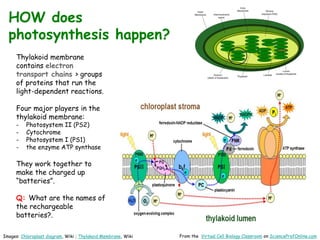
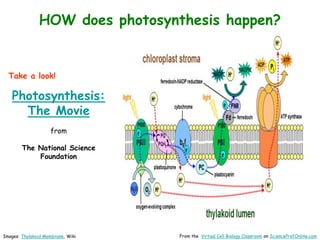
Thylakoid membrane
contains electron
transport chains > groups
of proteins that run the
light-dependent reactions.
Four major players in the
thylakoid membrane:
- Photosystem II (PS2)
- Cytochrome
- Photosystem I (PS1)
- the enzyme ATP synthase
They work together to
make the charged up
“batteries”.
Q: What are the names of
the rechargeable
batteries?.
Images: Thylakoid Membrane, Wiki From the Virtual Cell Biology Classroom on ScienceProfOnline.com
HOW does photosynthesis happen?
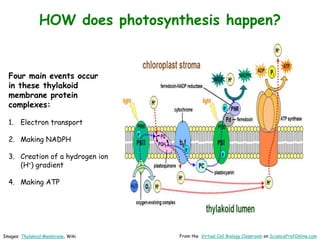
Four main events occur
in these thylakoid
membrane protein
complexes:
1. Electron transport
2. Making NADPH
3. Creation of a hydrogen ion
(H+) gradient
4. Making ATP
From the Virtual Cell Biology Classroom on ScienceProfOnline.com
HOW does
photosynthesis happen?
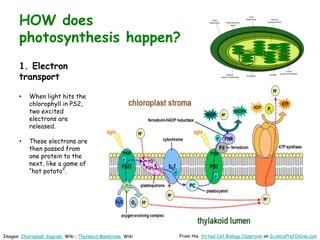
1. Electron
transport
• When light hits the
chlorophyll in PS2,
two excited
electrons are
released.
• These electrons are
then passed from
one protein to the
next, like a game of
“hot potato”.
Images: Chloroplast diagram, Wiki ; Thylakoid Membrane, Wiki
Images: Thylakoid Membrane, Wiki; Water molecule, Wiki From the Virtual Cell Biology Classroom on ScienceProfOnline.com
HOW does photosynthesis happen?
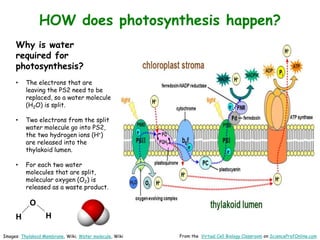
Why is water
required for
photosynthesis?
• The electrons that are
leaving the PS2 need to be
replaced, so a water molecule
(H2O) is split.
• Two electrons from the split
water molecule go into PS2,
the two hydrogen ions (H+)
are released into the
thylakoid lumen.
• For each two water
molecules that are split,
molecular oxygen (O2) is
released as a waste product.
O
H
H
Images: Thylakoid Membrane, Wiki From the Virtual Cell Biology Classroom on ScienceProfOnline.com
HOW does photosynthesis happen?
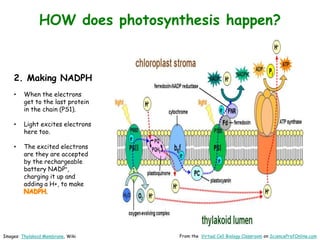
2. Making NADPH
• When the electrons
get to the last protein
in the chain (PS1).
• Light excites electrons
here too.
• The excited electrons
are they are accepted
by the rechargeable
battery NADP+,
charging it up and
adding a H+, to make
NADPH.
From the Virtual Cell Biology Classroom on ScienceProfOnline.com
HOW does
photosynthesis happen?
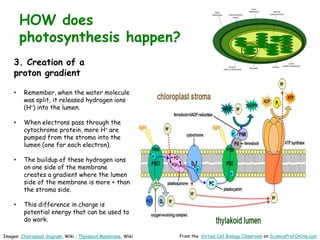
3. Creation of a
proton gradient
• Remember, when the water molecule
was split, it released hydrogen ions
(H+) into the lumen.
• When electrons pass through the
cytochrome protein, more H+ are
pumped from the stroma into the
lumen (one for each electron).
• The buildup of these hydrogen ions
on one side of the membrane
creates a gradient where the lumen
side of the membrane is more + than
the stroma side.
• This difference in charge is
potential energy that can be used to
do work.
Images: Chloroplast diagram, Wiki ; Thylakoid Membrane, Wiki
Images: Thylakoid Membrane, Wiki; ATP-ADP Cycle, CUNY From the Virtual Cell Biology Classroom on ScienceProfOnline.com
HOW does
photosynthesis happen?
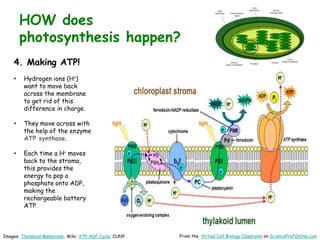
4. Making ATP!
• Hydrogen ions (H+)
want to move back
across the membrane
to get rid of this
difference in charge.
• They move across with
the help of the enzyme
ATP synthase.
• Each time a H+ moves
back to the stroma,
this provides the
energy to pop a
phosphate onto ADP,
making the
rechargeable battery
ATP.
Images: Thylakoid Membrane, Wiki From the Virtual Cell Biology Classroom on ScienceProfOnline.com
HOW does photosynthesis happen?
Take a look!
Photosynthesis:
The Movie
from
The National Science
Foundation
Are you feeling blinded by science?
Do yourself a favor. Use the…
Virtual Cell Biology
Classroom (VCBC) !
The VCBC is full of resources to help you succeed,
including:
• practice test questions
• review questions
• study guides and learning objectives
• PowerPoints on other topics
You can access the VCBC by going to the Science Prof Online website
www.ScienceProfOnline.com
Images: Blinded With Science album, Thomas Dolby; Endomembrane system, Mariana Ruiz, Wiki

Photosynthesis-Light-Dependent-Reactions-LITE (1).ppsx

  • 1.
    About Science ProfOnline PowerPoint Resources • Science Prof Online (SPO) is a free science education website that provides fully-developed Virtual Science Classrooms, science-related PowerPoints, articles and images. The site is designed to be a helpful resource for students, educators, and anyone interested in learning about science. • The SPO Virtual Classrooms offer many educational resources, including practice test questions, review questions, lecture PowerPoints, video tutorials, sample assignments and course syllabi. New materials are continually being developed, so check back frequently, or follow us on Facebook (Science Prof Online) or Twitter (ScienceProfSPO) for updates. • Many SPO PowerPoints are available in a variety of formats, such as fully editable PowerPoint files, as well as uneditable versions in smaller file sizes, such as PowerPoint Shows and Portable Document Format (.pdf), for ease of printing. • Images used on this resource, and on the SPO website are, wherever possible, credited and linked to their source. Any words underlined and appearing in blue are links that can be clicked on for more information. PowerPoints must be viewed in slide show mode to use the hyperlinks directly. • Several helpful links to fun and interactive learning tools are included throughout the PPT and on the Smart Links slide, near the end of each presentation. You must be in slide show mode to utilize hyperlinks and animations. •This digital resource is licensed under Creative Commons Attribution-ShareAlike 3.0: http://creativecommons.org/licenses/by-sa/3.0/ Alicia Cepaitis, MS Chief Creative Nerd Science Prof Online Online Education Resources, LLC alicia@scienceprofonline.com From the Virtual Cell Biology Classroom on ScienceProfOnline.com Image: Compound microscope objectives, T. Port Tami Port, MS Creator of Science Prof Online Chief Executive Nerd Science Prof Online Online Education Resources, LLC info@scienceprofonline.com
  • 2.
    LYRICS Photosynthesis Photosynthesis Photosynthesis Photosynthesis does notinvolve a camera Or a synthesizer Although that's interesting too Photosynthesis is how plants take in light From the sun and turn it into energy It's actually a thing on which most life depends Here on the planet Earth Photosynthesis X3 With plants Chlorophyll cells take in carbon dioxide Now that's the air that we breathe out Combines it with water and exposes it to sunlight And that's how plants can make their own food Photosynthesis is why plants need light And photosynthesis is why humans need plants Because through photosynthesis plants make oxygen And humans need oxygen to breathe Photosynthesis x3 From the Virtual Cell Biology Classroom on ScienceProfOnline.com “Photosynthesis” a song by They Might Be Giants Image: Photosynthesis, Wikipedia Watch the “Photosynthesis” music video!
  • 3.
    From the VirtualCell Biology Classroom on ScienceProfOnline.com Images: Photosynthesis, Wikipedia; Thylakoid Membrane, Wiki Photosynthesis: Light Dependent Reactions
  • 4.
    • The foodchain begins with autotrophs, organisms that can make their own food. • Most of autotrophs capture light energy from the sun and use it, along with CO2 and H2O, to drive the synthesis of glucose. • Q: What is glucose? • The oxygen we breathe is a waste product of photosynthesis. From the Virtual Cell Biology Classroom on ScienceProfOnline.com Photosynthesis Image: Photosynthesis, Wikipedia
  • 5.
    Images: Elodea plantcells, T. Port Chloroplast diagram, Wiki From the Virtual Cell Biology Classroom on ScienceProfOnline.com • Eukaryotic autotrophs, like plants, have chlorophyll ( green photosynthetic pigment) in organelles called chloroplasts. • All green parts of a plant, including stems, have chloroplasts, but leaves are where most of the photosynthesis happens. • Leaves are like the “solar panels” of a plant. • Lets look at the different parts of a chloroplast > WHERE does photosynthesis happen?
  • 6.
    Image: Chloroplast diagram,Wiki From the Virtual Cell Biology Classroom on ScienceProfOnline.com WHERE does photosynthesis happen?
  • 7.
    HOW does photosynthesis happen? Photosynthesiscan be divided into two main stages: • Stage 1- Light dependent reactions: The chloroplast traps light energy and, with the help of water, converts the light energy into chemical energy. ATP & NADPH are like tiny rechargeable batteries in the cell. Light energy can be put into these “battery” molecules to provide mobile energy to do cellular work. Adenosine diphosphate (ADP) + Pi & energy > Adenosine Triphosphate (ATP) Nicotinamide adenine dinucleotide phosphate (NADP+) + electron & hydrogen ion > NADPH • Stage 2 - Light independent reactions: The energy captured in NADPH & ATP is used, with CO2, to make glucose (food). From the Virtual Cell Biology Classroom on ScienceProfOnline.com Images: Thylakoid Membrane, Wiki; ATP-ADP Cycle, CUNY
  • 8.
    Images: Chloroplast diagram,Wiki ; Thylakoid Membrane, Wiki From the Virtual Cell Biology Classroom on ScienceProfOnline.com HOW does photosynthesis happen? Thylakoid membrane contains electron transport chains > groups of proteins that run the light-dependent reactions. Four major players in the thylakoid membrane: - Photosystem II (PS2) - Cytochrome - Photosystem I (PS1) - the enzyme ATP synthase They work together to make the charged up “batteries”. Q: What are the names of the rechargeable batteries?.
  • 9.
    Images: Thylakoid Membrane,Wiki From the Virtual Cell Biology Classroom on ScienceProfOnline.com HOW does photosynthesis happen? Four main events occur in these thylakoid membrane protein complexes: 1. Electron transport 2. Making NADPH 3. Creation of a hydrogen ion (H+) gradient 4. Making ATP
  • 10.
    From the VirtualCell Biology Classroom on ScienceProfOnline.com HOW does photosynthesis happen? 1. Electron transport • When light hits the chlorophyll in PS2, two excited electrons are released. • These electrons are then passed from one protein to the next, like a game of “hot potato”. Images: Chloroplast diagram, Wiki ; Thylakoid Membrane, Wiki
  • 11.
    Images: Thylakoid Membrane,Wiki; Water molecule, Wiki From the Virtual Cell Biology Classroom on ScienceProfOnline.com HOW does photosynthesis happen? Why is water required for photosynthesis? • The electrons that are leaving the PS2 need to be replaced, so a water molecule (H2O) is split. • Two electrons from the split water molecule go into PS2, the two hydrogen ions (H+) are released into the thylakoid lumen. • For each two water molecules that are split, molecular oxygen (O2) is released as a waste product. O H H
  • 12.
    Images: Thylakoid Membrane,Wiki From the Virtual Cell Biology Classroom on ScienceProfOnline.com HOW does photosynthesis happen? 2. Making NADPH • When the electrons get to the last protein in the chain (PS1). • Light excites electrons here too. • The excited electrons are they are accepted by the rechargeable battery NADP+, charging it up and adding a H+, to make NADPH.
  • 13.
    From the VirtualCell Biology Classroom on ScienceProfOnline.com HOW does photosynthesis happen? 3. Creation of a proton gradient • Remember, when the water molecule was split, it released hydrogen ions (H+) into the lumen. • When electrons pass through the cytochrome protein, more H+ are pumped from the stroma into the lumen (one for each electron). • The buildup of these hydrogen ions on one side of the membrane creates a gradient where the lumen side of the membrane is more + than the stroma side. • This difference in charge is potential energy that can be used to do work. Images: Chloroplast diagram, Wiki ; Thylakoid Membrane, Wiki
  • 14.
    Images: Thylakoid Membrane,Wiki; ATP-ADP Cycle, CUNY From the Virtual Cell Biology Classroom on ScienceProfOnline.com HOW does photosynthesis happen? 4. Making ATP! • Hydrogen ions (H+) want to move back across the membrane to get rid of this difference in charge. • They move across with the help of the enzyme ATP synthase. • Each time a H+ moves back to the stroma, this provides the energy to pop a phosphate onto ADP, making the rechargeable battery ATP.
  • 15.
    Images: Thylakoid Membrane,Wiki From the Virtual Cell Biology Classroom on ScienceProfOnline.com HOW does photosynthesis happen? Take a look! Photosynthesis: The Movie from The National Science Foundation
  • 16.
    Are you feelingblinded by science? Do yourself a favor. Use the… Virtual Cell Biology Classroom (VCBC) ! The VCBC is full of resources to help you succeed, including: • practice test questions • review questions • study guides and learning objectives • PowerPoints on other topics You can access the VCBC by going to the Science Prof Online website www.ScienceProfOnline.com Images: Blinded With Science album, Thomas Dolby; Endomembrane system, Mariana Ruiz, Wiki