Presented by: Yasir Mueen Gishkori
2015-uam-177
PLANT PATHOLOGIST
MNS UNIVERSITY OF AGRICULTURE
MULTAN
Photosynthesis
From sunlight to glucose
Photosynthesis
• A process used by plants, algae and certain
bacteria to change energy from sunlight to
chemical energy
• Light energy is captured and used to convert
water, C02 and minerals to oxygen and
glucose
• Energy produced by photosynthesis carried
out by plants millions of years ago is
responsible for the fossil fuels
Photosynthesis
• In past ages, green plants and small organisms
that fed on plants increased faster than they
were consumed, and their remains were
deposited in Earth’s crust by sedimentation
and other geological processes
• These organic remains were slowly converted
to fossil fuels
Development of the idea
• In 1771, Joseph Priestley had burned a candle in a
closed container until the air within the container
could no longer support combustion.
• He then placed a sprig of mintplant in the
container
• After several days the mint had produced some
substance (later recognized as oxygen) that
enabled the confined air to again support
combustion
Development of the idea
• In 1779 the Dutch physician Jan
Ingenhousz expanded upon Priestley’s work,
showing that the plant had to be exposed to
light if the combustible substance was to be
restored
• He also demonstrated that this process
required the presence of the green tissues of
the plant.
Development of the idea
• In 1782 it was demonstrated that the
combustion-supporting gas (oxygen) was formed
at the expense of another gas, or “fixed air,”
which had been identified the year before as
carbon dioxide
• Almost half a century passed before the concept
of chemical energy had developed sufficiently to
permit the discovery (in 1845) that light energy
from the sun is stored as chemical energy in
products formed during photosynthesis
PHOTOSYNTHESIS
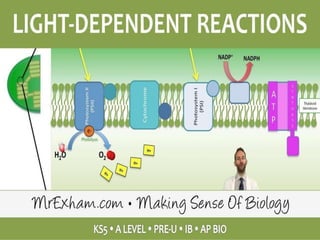
1. Light dependent stage ( occurs on thylakoid
membranes)
2. light independent stage ( occurs in the
stroma of chloroplast)
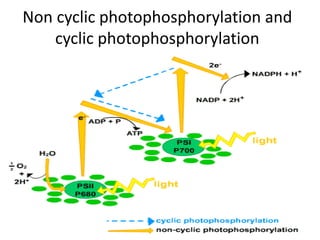
Non cyclic photophosphorylation and
cyclic photophosphorylation
Light dependent stage
• Maximum no of ATP are produced in cyclic
photophosphorylation
• Photolysis is not needed for cyclic
photophosphorylation
• Oxygen is produced during light dependent
stage
Light independent stage
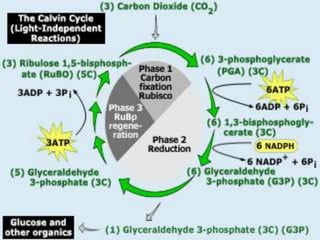
• ATP and NADPH produced in light reaction are
used in calvin cycle
• And carbon dioxide comes from outside
• The carbon dioxide molecules diffuse into the
cells through small holes in the underside of
the leaf. The first enzyme that picks them up is
called Rubisco.
Light independent stage
• Rubisco catalysis the connection of the small
molecule ribulose-1.5-bisphosphate
phosphate (RuBP) to carbon dioxide -
therefore fixing the inorganic CO2 as an
organic molecule
• RuBP contains 5 carbons as well as oxygen,
hydrogen and phosphate and it bonds to the
CO2 to create a 6 carbon molecule
Light independent stage
• This promptly splits into two small 3 carbon
molecules 3-phosphoglycerate
• It is then converted into G3P with the help of
reduction of ATP and NADPH
• 3 molecules of carbon dioxide produces 6
molecules of G3P
• G3P is actually the form of sugar that
produces in glycolysis
Photosynthesis
Photosynthesis
Photosynthesis

Photosynthesis

  • 2.
    Presented by: YasirMueen Gishkori 2015-uam-177 PLANT PATHOLOGIST MNS UNIVERSITY OF AGRICULTURE MULTAN
  • 3.
  • 4.
    Photosynthesis • A processused by plants, algae and certain bacteria to change energy from sunlight to chemical energy • Light energy is captured and used to convert water, C02 and minerals to oxygen and glucose • Energy produced by photosynthesis carried out by plants millions of years ago is responsible for the fossil fuels
  • 5.
    Photosynthesis • In pastages, green plants and small organisms that fed on plants increased faster than they were consumed, and their remains were deposited in Earth’s crust by sedimentation and other geological processes • These organic remains were slowly converted to fossil fuels
  • 6.
    Development of theidea • In 1771, Joseph Priestley had burned a candle in a closed container until the air within the container could no longer support combustion. • He then placed a sprig of mintplant in the container • After several days the mint had produced some substance (later recognized as oxygen) that enabled the confined air to again support combustion
  • 7.
    Development of theidea • In 1779 the Dutch physician Jan Ingenhousz expanded upon Priestley’s work, showing that the plant had to be exposed to light if the combustible substance was to be restored • He also demonstrated that this process required the presence of the green tissues of the plant.
  • 8.
    Development of theidea • In 1782 it was demonstrated that the combustion-supporting gas (oxygen) was formed at the expense of another gas, or “fixed air,” which had been identified the year before as carbon dioxide • Almost half a century passed before the concept of chemical energy had developed sufficiently to permit the discovery (in 1845) that light energy from the sun is stored as chemical energy in products formed during photosynthesis
  • 9.
    PHOTOSYNTHESIS 1. Light dependentstage ( occurs on thylakoid membranes) 2. light independent stage ( occurs in the stroma of chloroplast)
  • 11.
    Non cyclic photophosphorylationand cyclic photophosphorylation
  • 12.
    Light dependent stage •Maximum no of ATP are produced in cyclic photophosphorylation • Photolysis is not needed for cyclic photophosphorylation • Oxygen is produced during light dependent stage
  • 13.
    Light independent stage •ATP and NADPH produced in light reaction are used in calvin cycle • And carbon dioxide comes from outside • The carbon dioxide molecules diffuse into the cells through small holes in the underside of the leaf. The first enzyme that picks them up is called Rubisco.
  • 14.
    Light independent stage •Rubisco catalysis the connection of the small molecule ribulose-1.5-bisphosphate phosphate (RuBP) to carbon dioxide - therefore fixing the inorganic CO2 as an organic molecule • RuBP contains 5 carbons as well as oxygen, hydrogen and phosphate and it bonds to the CO2 to create a 6 carbon molecule
  • 15.
    Light independent stage •This promptly splits into two small 3 carbon molecules 3-phosphoglycerate • It is then converted into G3P with the help of reduction of ATP and NADPH • 3 molecules of carbon dioxide produces 6 molecules of G3P • G3P is actually the form of sugar that produces in glycolysis