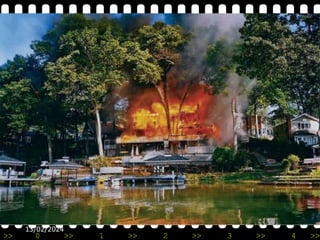
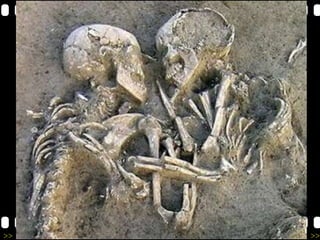
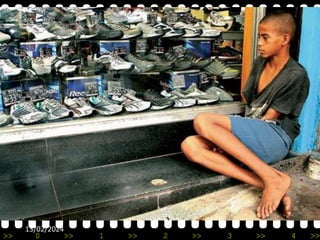
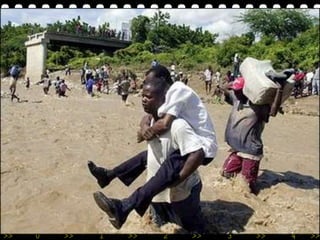
>> 0 >> 1 >> 2 >> 3 >> 4 >>
Photojournalism
Prepared by:
Mary Grace Y. Alumbro
Aires P. Salino
>> 0 >> 1 >> 2 >> 3 >> 4 >>
What is it?
Is it shooting and writing?
No.
It is telling a story using photos.
>> 0 >> 1 >> 2 >> 3 >> 4 >>
13/02/2024
Photojournalism
- is the art and technique of reporting
timely events to inform and entertain
by use of picture and words.
>> 0 >> 1 >> 2 >> 3 >> 4 >>
13/02/2024
What Pictures Bring to
Newspapers & Magazines
- Bring us closer to an event by enabling
us to see what the reporter has seen
- Somehow seem to be more truthful than
the printed word although pictures can
be faked just as well as the news stories
>> 0 >> 1 >> 2 >> 3 >> 4 >>
13/02/2024
What Pictures Bring to
Newspapers & Magazines
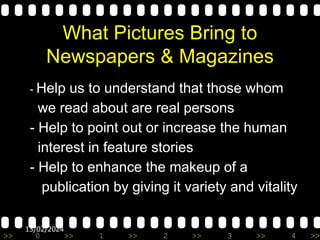
- Help us to understand that those whom
we read about are real persons
- Help to point out or increase the human
interest in feature stories
- Help to enhance the makeup of a
publication by giving it variety and vitality
>> 0 >> 1 >> 2 >> 3 >> 4 >>
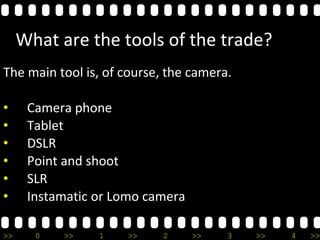
What are the tools of the trade?
The main tool is, of course, the camera.
• Camera phone
• Tablet
• DSLR
• Point and shoot
• SLR
• Instamatic or Lomo camera
>> 0 >> 1 >> 2 >> 3 >> 4 >>
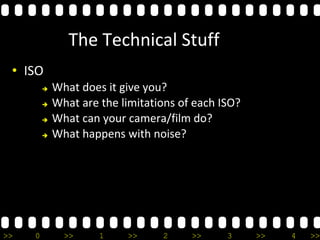
The Technical Stuff
• ISO
 What does it give you?
 What are the limitations of each ISO?
 What can your camera/film do?
 What happens with noise?
>> 0 >> 1 >> 2 >> 3 >> 4 >>
>> 0 >> 1 >> 2 >> 3 >> 4 >>
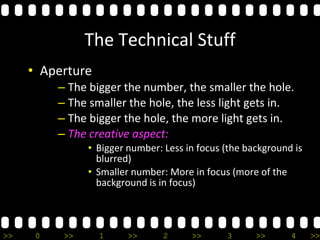
The Technical Stuff
• Aperture
– The bigger the number, the smaller the hole.
– The smaller the hole, the less light gets in.
– The bigger the hole, the more light gets in.
– The creative aspect:
• Bigger number: Less in focus (the background is
blurred)
• Smaller number: More in focus (more of the
background is in focus)
>> 0 >> 1 >> 2 >> 3 >> 4 >>
>> 0 >> 1 >> 2 >> 3 >> 4 >>
>> 0 >> 1 >> 2 >> 3 >> 4 >>
>> 0 >> 1 >> 2 >> 3 >> 4 >>
The Technical Stuff
• Shutter Speed
– There are two sets of numbers – on either
side of the number 1.
– Starting from the highest number, list down all
the numbers.
– Most of these numbers are fractions: E.g.,
“125” is actually 1/125 of a second.
– The creative aspect
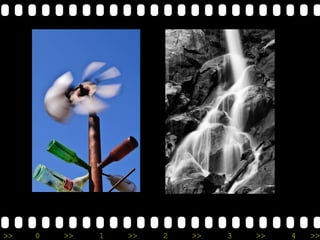
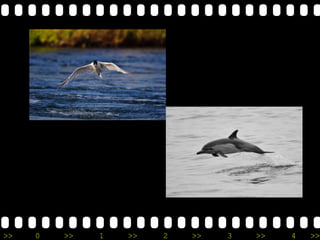
• Faster shutter speeds freeze motion.
• Slower shutter speeds blur motion.
>> 0 >> 1 >> 2 >> 3 >> 4 >>
>> 0 >> 1 >> 2 >> 3 >> 4 >>
>> 0 >> 1 >> 2 >> 3 >> 4 >>
But there are Automatic modes
• Don't the professionals also use these
automatic modes?
– Of course they do.
– But they do know when to use them and
when not to.
– They also know enough not to be slaves to
them.
>> 0 >> 1 >> 2 >> 3 >> 4 >>
Now the Real Meat
• Composition
–The idea is always to tell a story.
>> 0 >> 1 >> 2 >> 3 >> 4 >>
Now the Real Meat
• Composition
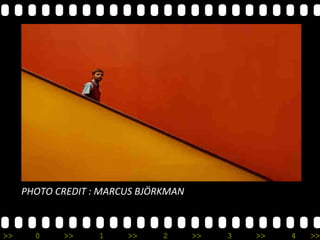
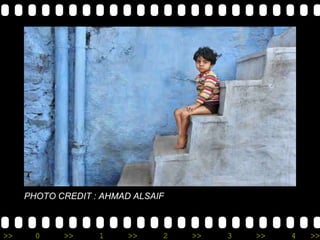
–Try to keep the frame very simple, this
helps the viewer to focus only on the
subject.
–Look for shapes, patterns, symmetries,
eye catching geometries, lines and
curves.
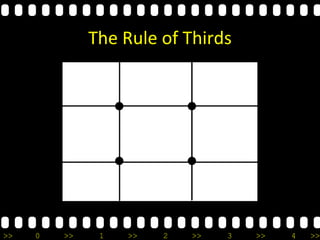
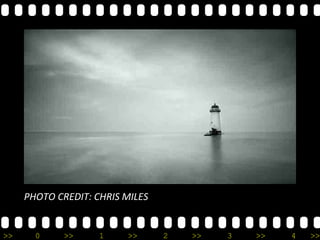
–Use the Rule of Thirds.
>> 0 >> 1 >> 2 >> 3 >> 4 >>
PHOTO CREDIT : MARCUS BJÖRKMAN
>> 0 >> 1 >> 2 >> 3 >> 4 >>
PHOTO CREDIT : AHMAD ALSAIF
>> 0 >> 1 >> 2 >> 3 >> 4 >>
Now the Real Meat
• Composition
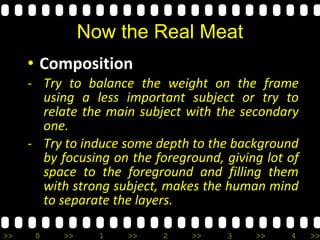
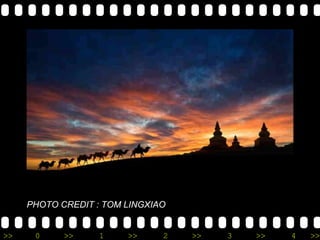
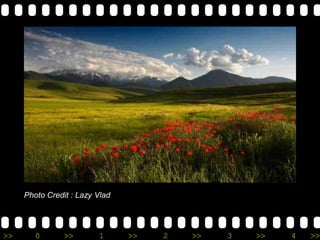
- Try to balance the weight on the frame
using a less important subject or try to
relate the main subject with the secondary
one.
- Try to induce some depth to the background
by focusing on the foreground, giving lot of
space to the foreground and filling them
with strong subject, makes the human mind
to separate the layers.
>> 0 >> 1 >> 2 >> 3 >> 4 >>
PHOTO CREDIT : TOM LINGXIAO
>> 0 >> 1 >> 2 >> 3 >> 4 >>
Photo Credit : Lazy Vlad
>> 0 >> 1 >> 2 >> 3 >> 4 >>
13/02/2024
Elements of Composition That Can
Control The Look of the Photograph
1. Rule of thirds
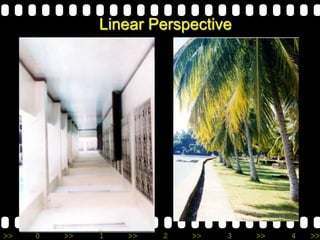
2. Linear perspective
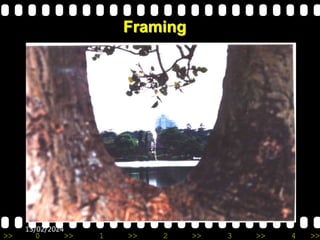
3. Framing
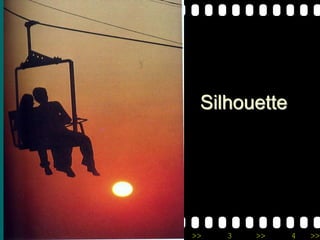
4. Silhouette
>> 0 >> 1 >> 2 >> 3 >> 4 >>
13/02/2024
Elements of Composition That Can
Control The Look of the Photograph
5. Selective focus
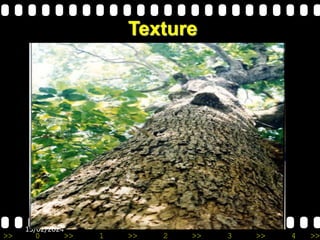
6. Texture
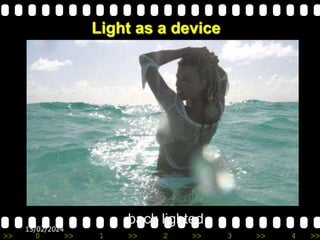
7. Lighting as a device
>> 0 >> 1 >> 2 >> 3 >> 4 >>
Elements
>> 0 >> 1 >> 2 >> 3 >> 4 >>
Elements
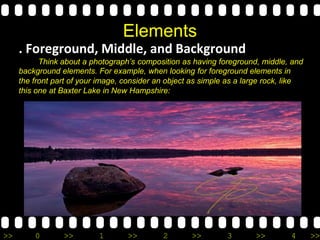
. Foreground, Middle, and Background
Think about a photograph’s composition as having foreground, middle, and
background elements. For example, when looking for foreground elements in
the front part of your image, consider an object as simple as a large rock, like
this one at Baxter Lake in New Hampshire:
>> 0 >> 1 >> 2 >> 3 >> 4 >>
Elements
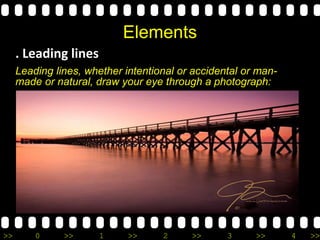
. Leading lines
Leading lines, whether intentional or accidental or man-
made or natural, draw your eye through a photograph:
>> 0 >> 1 >> 2 >> 3 >> 4 >>
The Rule of Thirds
>> 0 >> 1 >> 2 >> 3 >> 4 >>
PHOTO CREDIT: CHRIS MILES
>> 0 >> 1 >> 2 >> 3 >> 4 >>
13/02/2024
Linear Perspective
>> 0 >> 1 >> 2 >> 3 >> 4 >>
13/02/2024
Framing
>> 0 >> 1 >> 2 >> 3 >> 4 >>
13/02/2024
Silhouette
>> 0 >> 1 >> 2 >> 3 >> 4 >>
13/02/2024
Selective focus
>> 0 >> 1 >> 2 >> 3 >> 4 >>
13/02/2024
Texture
>> 0 >> 1 >> 2 >> 3 >> 4 >>
13/02/2024
back lighted
Light as a device
>> 0 >> 1 >> 2 >> 3 >> 4 >>
13/02/2024
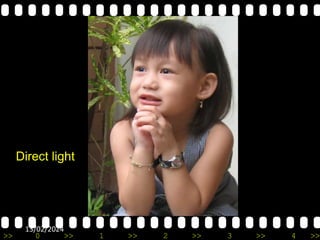
Direct light
>> 0 >> 1 >> 2 >> 3 >> 4 >>
13/02/2024
Combination of
direct, back, side
and ambient light
>> 0 >> 1 >> 2 >> 3 >> 4 >>
Sample Pictures
>> 0 >> 1 >> 2 >> 3 >> 4 >>
13/02/2024
>> 0 >> 1 >> 2 >> 3 >> 4 >>
13/02/2024
>> 0 >> 1 >> 2 >> 3 >> 4 >>
13/02/2024
>> 0 >> 1 >> 2 >> 3 >> 4 >>
13/02/2024
>> 0 >> 1 >> 2 >> 3 >> 4 >>
13/02/2024
>> 0 >> 1 >> 2 >> 3 >> 4 >>
13/02/2024
>> 0 >> 1 >> 2 >> 3 >> 4 >>
13/02/2024
>> 0 >> 1 >> 2 >> 3 >> 4 >>
13/02/2024
>> 0 >> 1 >> 2 >> 3 >> 4 >>
What is Visual Literacy?
- is the “ability to construct meaning from
visual images” (Giogis, Johnson, Bonomo,
Colbert, & al, 1999: 146).
- the ‘reader ‘ uses the critical skills of
exploration, critical skills and reflection
>> 0 >> 1 >> 2 >> 3 >> 4 >>
What is Visual Literacy?
- is about interpreting images of the
present and past and producing images
that effectively communicate the message
to an audience
>> 0 >> 1 >> 2 >> 3 >> 4 >>
What is Visual Literacy?
- It includes the ability to visualize internally,
communicate visually and read and
interpret visual images.
- It also involves making judgments of the
accuracy, validity and worth of images.
>> 0 >> 1 >> 2 >> 3 >> 4 >>
Elements of Photojournalism
. Action
- means there’s something happening, such as a
game, discussing, event, or movement.
. Energy
- means there’s visible force or power that can
tell the story.
>> 0 >> 1 >> 2 >> 3 >> 4 >>
Elements of Photojournalism
. Emotion
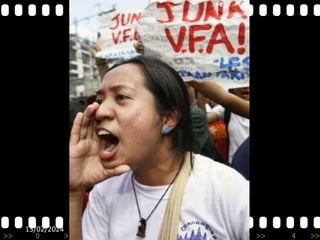
- means the photo captures the visible joy,
sorrow, anger, heartbreak, elation or other
powerful emotions.
. Reaction
- means the photo captures the response
to an action or emotion.
>> 0 >> 1 >> 2 >> 3 >> 4 >>
Elements
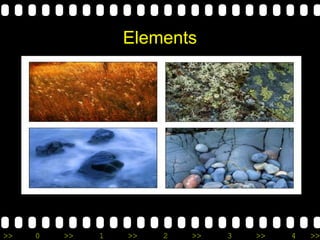
. Texture
- refers to the surface quality or "feel" of an
object - smooth, rough, soft, etc. Textures
may be actual (felt with touch - tactile) or
implied (suggested by the way an artist has
created the work of art -visual). Texture is
often emphasized in oblique lighting as it
strikes the objects from one side.
>> 0 >> 1 >> 2 >> 3 >> 4 >>
The Controversial Set Shot
• The Firing Squad
–Should you or shouldn't you?
–There will be times when you have
no choice but to do it.
–So, how do you do it?
>> 0 >> 1 >> 2 >> 3 >> 4 >>
13/02/2024
Tips for Aspiring Photojournalists
1. Know your Camera.
2. Take portraits of people doing their
thing.
3. Concentrate on facial expressions.
4. Look for focal point of interest.
>> 0 >> 1 >> 2 >> 3 >> 4 >>
13/02/2024
Tips for Aspiring Photojournalists
5. Take more than 1 shot of every
scene.
6. Be always at the look out to take
unusual pictures.
7. Read manuals of photographers.
>> 0 >> 1 >> 2 >> 3 >> 4 >>
13/02/2024
Tips for Aspiring Photojournalists
8. Prefer action and more interesting scenes
that shows:
a. struggle
b. Action
c. Emotion
d. Romance
e. Oddity
f. Beauty
g. Humor and others
>> 0 >> 1 >> 2 >> 3 >> 4 >>
TIPS
. Try squatting or kneeling down or standing on
your toes or on a chair when shooting
pictures.
. Take portraits of people doing their thing.
Candid shots and action pictures are the best.
. Do not hesitate to act the subject to do what you
believe will make the best shot.
-
>> 0 >> 1 >> 2 >> 3 >> 4 >>
TIPS
. Take more than one shot of every scene
to be assured of the best angle.
. Look for focal point of interest.
. Be always at the look out to take unusual
pictures.
>> 0 >> 1 >> 2 >> 3 >> 4 >>
TIPS
. Avoid:
a. Posed picture (firing squad picture)
b. Group picture that say nothing
c. Speaker whose face is hidden by the
microphone
. The most important thing to bring to your
work as a photojournalist is planning.
>> 0 >> 1 >> 2 >> 3 >> 4 >>
The Writer in You
• Captions
- is the text accompanying pictures,
artworks or illustrations
- is also called cutline or underline
- If it is placed like a title or explanatory
matter above the picture or illustrations, it
is called an overline
>> 0 >> 1 >> 2 >> 3 >> 4 >>
Parts of a Caption
1. Catchline
- a brief catchy title of the caption usually in
capital letters and bold face
2. Body
- explains or describes the picture or
illustration, in italics with font size bigger
than the text of the news story
3. Credit
- attributes the source of the picture
>> 0 >> 1 >> 2 >> 3 >> 4 >>
Tips for Writing Captions
or Cut lines
- Be brief and to the point, but do not make it
too short that it leaves readers wondering
about the situation involved.
- Use simple, short caption except for a
caption story – a series of picture with
minimum words like in “how to” articles.
- Supplement and explain the pictures, but do
not state what is obvious.
>> 0 >> 1 >> 2 >> 3 >> 4 >>
- Do not repeat lengthy facts from the
articles: if the story can be told through
the caption, omit the story.
- Do not omit words that are important
for smooth reading.
- Be accurate and careful with the
names of the persons concerned.
Tips for Writing Captions
or Cut lines
>> 0 >> 1 >> 2 >> 3 >> 4 >>
-Identify the people in the pictures. –
-Identify them from the left, followed by
their full names. In case of several rows,
begin with the front row. If the people
are in a circle, have the caption read
from left, clockwise.
-Check the number of persons against
the number in the caption.
Tips for Writing Captions
or Cut lines
>> 0 >> 1 >> 2 >> 3 >> 4 >>
-As much as possible, say when and
where the picture is taken, especially if
it is a news picture.
-Use present tense to describe action.
-A half-body picture without any
message at all except for identification
should bear his surname as caption.
Tips for Writing Captions
or Cut lines
>> 0 >> 1 >> 2 >> 3 >> 4 >>
-Vary your caption type from the body
type to achieve variety. Use italics, bold
face, or a larger size than the body type.
-A good caption fills nearly every line. –
-Caption in which the last line is only
one-third complete look less attractive
because they leave a gap of white space.
Tips for Writing Captions
or Cut lines
>> 0 >> 1 >> 2 >> 3 >> 4 >>
Other Sample Pictures
>> 0 >> 1 >> 2 >> 3 >> 4 >>
PRECISION. To make your job
perfectly done, you need to ascertain
that everything is in the right place.
>> 0 >> 1 >> 2 >> 3 >> 4 >>
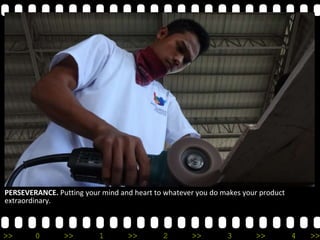
PERSEVERANCE. Putting your mind and heart to whatever you do makes your product
extraordinary.
>> 0 >> 1 >> 2 >> 3 >> 4 >>
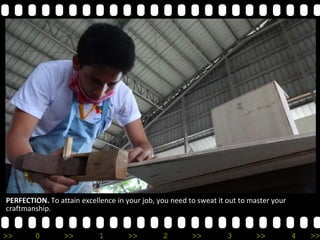
PERFECTION. To attain excellence in your job, you need to sweat it out to master your
craftmanship.
>> 0 >> 1 >> 2 >> 3 >> 4 >>
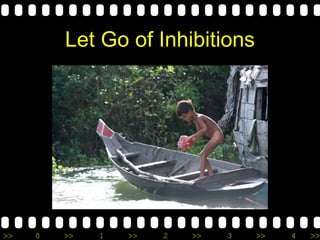
Let Go of Inhibitions
>> 0 >> 1 >> 2 >> 3 >> 4 >>
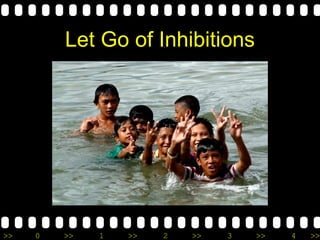
Let Go of Inhibitions
>> 0 >> 1 >> 2 >> 3 >> 4 >>
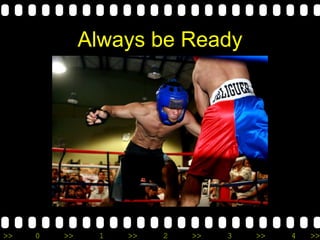
Always be Ready
>> 0 >> 1 >> 2 >> 3 >> 4 >>
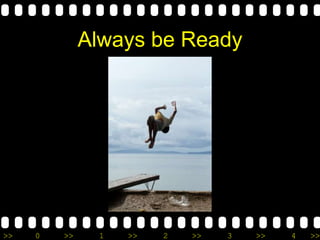
Always be Ready

PHOTOJOURNALISM(Campus Journalism)-2018.ppt

  • 1.
    >> 0 >>1 >> 2 >> 3 >> 4 >> Photojournalism Prepared by: Mary Grace Y. Alumbro Aires P. Salino
  • 2.
    >> 0 >>1 >> 2 >> 3 >> 4 >> What is it? Is it shooting and writing? No. It is telling a story using photos.
  • 3.
    >> 0 >>1 >> 2 >> 3 >> 4 >> 13/02/2024 Photojournalism - is the art and technique of reporting timely events to inform and entertain by use of picture and words.
  • 4.
    >> 0 >>1 >> 2 >> 3 >> 4 >> 13/02/2024 What Pictures Bring to Newspapers & Magazines - Bring us closer to an event by enabling us to see what the reporter has seen - Somehow seem to be more truthful than the printed word although pictures can be faked just as well as the news stories
  • 5.
    >> 0 >>1 >> 2 >> 3 >> 4 >> 13/02/2024 What Pictures Bring to Newspapers & Magazines - Help us to understand that those whom we read about are real persons - Help to point out or increase the human interest in feature stories - Help to enhance the makeup of a publication by giving it variety and vitality
  • 6.
    >> 0 >>1 >> 2 >> 3 >> 4 >> What are the tools of the trade? The main tool is, of course, the camera. • Camera phone • Tablet • DSLR • Point and shoot • SLR • Instamatic or Lomo camera
  • 7.
    >> 0 >>1 >> 2 >> 3 >> 4 >> The Technical Stuff • ISO  What does it give you?  What are the limitations of each ISO?  What can your camera/film do?  What happens with noise?
  • 8.
    >> 0 >>1 >> 2 >> 3 >> 4 >>
  • 9.
    >> 0 >>1 >> 2 >> 3 >> 4 >> The Technical Stuff • Aperture – The bigger the number, the smaller the hole. – The smaller the hole, the less light gets in. – The bigger the hole, the more light gets in. – The creative aspect: • Bigger number: Less in focus (the background is blurred) • Smaller number: More in focus (more of the background is in focus)
  • 10.
    >> 0 >>1 >> 2 >> 3 >> 4 >>
  • 11.
    >> 0 >>1 >> 2 >> 3 >> 4 >>
  • 12.
    >> 0 >>1 >> 2 >> 3 >> 4 >>
  • 13.
    >> 0 >>1 >> 2 >> 3 >> 4 >> The Technical Stuff • Shutter Speed – There are two sets of numbers – on either side of the number 1. – Starting from the highest number, list down all the numbers. – Most of these numbers are fractions: E.g., “125” is actually 1/125 of a second. – The creative aspect • Faster shutter speeds freeze motion. • Slower shutter speeds blur motion.
  • 14.
    >> 0 >>1 >> 2 >> 3 >> 4 >>
  • 15.
    >> 0 >>1 >> 2 >> 3 >> 4 >>
  • 16.
    >> 0 >>1 >> 2 >> 3 >> 4 >> But there are Automatic modes • Don't the professionals also use these automatic modes? – Of course they do. – But they do know when to use them and when not to. – They also know enough not to be slaves to them.
  • 17.
    >> 0 >>1 >> 2 >> 3 >> 4 >> Now the Real Meat • Composition –The idea is always to tell a story.
  • 18.
    >> 0 >>1 >> 2 >> 3 >> 4 >> Now the Real Meat • Composition –Try to keep the frame very simple, this helps the viewer to focus only on the subject. –Look for shapes, patterns, symmetries, eye catching geometries, lines and curves. –Use the Rule of Thirds.
  • 19.
    >> 0 >>1 >> 2 >> 3 >> 4 >> PHOTO CREDIT : MARCUS BJÖRKMAN
  • 20.
    >> 0 >>1 >> 2 >> 3 >> 4 >> PHOTO CREDIT : AHMAD ALSAIF
  • 21.
    >> 0 >>1 >> 2 >> 3 >> 4 >> Now the Real Meat • Composition - Try to balance the weight on the frame using a less important subject or try to relate the main subject with the secondary one. - Try to induce some depth to the background by focusing on the foreground, giving lot of space to the foreground and filling them with strong subject, makes the human mind to separate the layers.
  • 22.
    >> 0 >>1 >> 2 >> 3 >> 4 >> PHOTO CREDIT : TOM LINGXIAO
  • 23.
    >> 0 >>1 >> 2 >> 3 >> 4 >> Photo Credit : Lazy Vlad
  • 24.
    >> 0 >>1 >> 2 >> 3 >> 4 >> 13/02/2024 Elements of Composition That Can Control The Look of the Photograph 1. Rule of thirds 2. Linear perspective 3. Framing 4. Silhouette
  • 25.
    >> 0 >>1 >> 2 >> 3 >> 4 >> 13/02/2024 Elements of Composition That Can Control The Look of the Photograph 5. Selective focus 6. Texture 7. Lighting as a device
  • 26.
    >> 0 >>1 >> 2 >> 3 >> 4 >> Elements
  • 27.
    >> 0 >>1 >> 2 >> 3 >> 4 >> Elements . Foreground, Middle, and Background Think about a photograph’s composition as having foreground, middle, and background elements. For example, when looking for foreground elements in the front part of your image, consider an object as simple as a large rock, like this one at Baxter Lake in New Hampshire:
  • 28.
    >> 0 >>1 >> 2 >> 3 >> 4 >> Elements . Leading lines Leading lines, whether intentional or accidental or man- made or natural, draw your eye through a photograph:
  • 29.
    >> 0 >>1 >> 2 >> 3 >> 4 >> The Rule of Thirds
  • 30.
    >> 0 >>1 >> 2 >> 3 >> 4 >> PHOTO CREDIT: CHRIS MILES
  • 31.
    >> 0 >>1 >> 2 >> 3 >> 4 >> 13/02/2024 Linear Perspective
  • 32.
    >> 0 >>1 >> 2 >> 3 >> 4 >> 13/02/2024 Framing
  • 33.
    >> 0 >>1 >> 2 >> 3 >> 4 >> 13/02/2024 Silhouette
  • 34.
    >> 0 >>1 >> 2 >> 3 >> 4 >> 13/02/2024 Selective focus
  • 35.
    >> 0 >>1 >> 2 >> 3 >> 4 >> 13/02/2024 Texture
  • 36.
    >> 0 >>1 >> 2 >> 3 >> 4 >> 13/02/2024 back lighted Light as a device
  • 37.
    >> 0 >>1 >> 2 >> 3 >> 4 >> 13/02/2024 Direct light
  • 38.
    >> 0 >>1 >> 2 >> 3 >> 4 >> 13/02/2024 Combination of direct, back, side and ambient light
  • 39.
    >> 0 >>1 >> 2 >> 3 >> 4 >> Sample Pictures
  • 40.
    >> 0 >>1 >> 2 >> 3 >> 4 >> 13/02/2024
  • 41.
    >> 0 >>1 >> 2 >> 3 >> 4 >> 13/02/2024
  • 42.
    >> 0 >>1 >> 2 >> 3 >> 4 >> 13/02/2024
  • 43.
    >> 0 >>1 >> 2 >> 3 >> 4 >> 13/02/2024
  • 44.
    >> 0 >>1 >> 2 >> 3 >> 4 >> 13/02/2024
  • 45.
    >> 0 >>1 >> 2 >> 3 >> 4 >> 13/02/2024
  • 46.
    >> 0 >>1 >> 2 >> 3 >> 4 >> 13/02/2024
  • 47.
    >> 0 >>1 >> 2 >> 3 >> 4 >> 13/02/2024
  • 48.
    >> 0 >>1 >> 2 >> 3 >> 4 >> What is Visual Literacy? - is the “ability to construct meaning from visual images” (Giogis, Johnson, Bonomo, Colbert, & al, 1999: 146). - the ‘reader ‘ uses the critical skills of exploration, critical skills and reflection
  • 49.
    >> 0 >>1 >> 2 >> 3 >> 4 >> What is Visual Literacy? - is about interpreting images of the present and past and producing images that effectively communicate the message to an audience
  • 50.
    >> 0 >>1 >> 2 >> 3 >> 4 >> What is Visual Literacy? - It includes the ability to visualize internally, communicate visually and read and interpret visual images. - It also involves making judgments of the accuracy, validity and worth of images.
  • 51.
    >> 0 >>1 >> 2 >> 3 >> 4 >> Elements of Photojournalism . Action - means there’s something happening, such as a game, discussing, event, or movement. . Energy - means there’s visible force or power that can tell the story.
  • 52.
    >> 0 >>1 >> 2 >> 3 >> 4 >> Elements of Photojournalism . Emotion - means the photo captures the visible joy, sorrow, anger, heartbreak, elation or other powerful emotions. . Reaction - means the photo captures the response to an action or emotion.
  • 53.
    >> 0 >>1 >> 2 >> 3 >> 4 >> Elements . Texture - refers to the surface quality or "feel" of an object - smooth, rough, soft, etc. Textures may be actual (felt with touch - tactile) or implied (suggested by the way an artist has created the work of art -visual). Texture is often emphasized in oblique lighting as it strikes the objects from one side.
  • 54.
    >> 0 >>1 >> 2 >> 3 >> 4 >> The Controversial Set Shot • The Firing Squad –Should you or shouldn't you? –There will be times when you have no choice but to do it. –So, how do you do it?
  • 55.
    >> 0 >>1 >> 2 >> 3 >> 4 >> 13/02/2024 Tips for Aspiring Photojournalists 1. Know your Camera. 2. Take portraits of people doing their thing. 3. Concentrate on facial expressions. 4. Look for focal point of interest.
  • 56.
    >> 0 >>1 >> 2 >> 3 >> 4 >> 13/02/2024 Tips for Aspiring Photojournalists 5. Take more than 1 shot of every scene. 6. Be always at the look out to take unusual pictures. 7. Read manuals of photographers.
  • 57.
    >> 0 >>1 >> 2 >> 3 >> 4 >> 13/02/2024 Tips for Aspiring Photojournalists 8. Prefer action and more interesting scenes that shows: a. struggle b. Action c. Emotion d. Romance e. Oddity f. Beauty g. Humor and others
  • 58.
    >> 0 >>1 >> 2 >> 3 >> 4 >> TIPS . Try squatting or kneeling down or standing on your toes or on a chair when shooting pictures. . Take portraits of people doing their thing. Candid shots and action pictures are the best. . Do not hesitate to act the subject to do what you believe will make the best shot. -
  • 59.
    >> 0 >>1 >> 2 >> 3 >> 4 >> TIPS . Take more than one shot of every scene to be assured of the best angle. . Look for focal point of interest. . Be always at the look out to take unusual pictures.
  • 60.
    >> 0 >>1 >> 2 >> 3 >> 4 >> TIPS . Avoid: a. Posed picture (firing squad picture) b. Group picture that say nothing c. Speaker whose face is hidden by the microphone . The most important thing to bring to your work as a photojournalist is planning.
  • 61.
    >> 0 >>1 >> 2 >> 3 >> 4 >> The Writer in You • Captions - is the text accompanying pictures, artworks or illustrations - is also called cutline or underline - If it is placed like a title or explanatory matter above the picture or illustrations, it is called an overline
  • 62.
    >> 0 >>1 >> 2 >> 3 >> 4 >> Parts of a Caption 1. Catchline - a brief catchy title of the caption usually in capital letters and bold face 2. Body - explains or describes the picture or illustration, in italics with font size bigger than the text of the news story 3. Credit - attributes the source of the picture
  • 63.
    >> 0 >>1 >> 2 >> 3 >> 4 >> Tips for Writing Captions or Cut lines - Be brief and to the point, but do not make it too short that it leaves readers wondering about the situation involved. - Use simple, short caption except for a caption story – a series of picture with minimum words like in “how to” articles. - Supplement and explain the pictures, but do not state what is obvious.
  • 64.
    >> 0 >>1 >> 2 >> 3 >> 4 >> - Do not repeat lengthy facts from the articles: if the story can be told through the caption, omit the story. - Do not omit words that are important for smooth reading. - Be accurate and careful with the names of the persons concerned. Tips for Writing Captions or Cut lines
  • 65.
    >> 0 >>1 >> 2 >> 3 >> 4 >> -Identify the people in the pictures. – -Identify them from the left, followed by their full names. In case of several rows, begin with the front row. If the people are in a circle, have the caption read from left, clockwise. -Check the number of persons against the number in the caption. Tips for Writing Captions or Cut lines
  • 66.
    >> 0 >>1 >> 2 >> 3 >> 4 >> -As much as possible, say when and where the picture is taken, especially if it is a news picture. -Use present tense to describe action. -A half-body picture without any message at all except for identification should bear his surname as caption. Tips for Writing Captions or Cut lines
  • 67.
    >> 0 >>1 >> 2 >> 3 >> 4 >> -Vary your caption type from the body type to achieve variety. Use italics, bold face, or a larger size than the body type. -A good caption fills nearly every line. – -Caption in which the last line is only one-third complete look less attractive because they leave a gap of white space. Tips for Writing Captions or Cut lines
  • 68.
    >> 0 >>1 >> 2 >> 3 >> 4 >> Other Sample Pictures
  • 69.
    >> 0 >>1 >> 2 >> 3 >> 4 >> PRECISION. To make your job perfectly done, you need to ascertain that everything is in the right place.
  • 70.
    >> 0 >>1 >> 2 >> 3 >> 4 >> PERSEVERANCE. Putting your mind and heart to whatever you do makes your product extraordinary.
  • 71.
    >> 0 >>1 >> 2 >> 3 >> 4 >> PERFECTION. To attain excellence in your job, you need to sweat it out to master your craftmanship.
  • 72.
    >> 0 >>1 >> 2 >> 3 >> 4 >> Let Go of Inhibitions
  • 73.
    >> 0 >>1 >> 2 >> 3 >> 4 >> Let Go of Inhibitions
  • 74.
    >> 0 >>1 >> 2 >> 3 >> 4 >> Always be Ready
  • 75.
    >> 0 >>1 >> 2 >> 3 >> 4 >> Always be Ready