









Presented by Matet L. Norbe
   Let’s Level Off
    ◦ Skills
      Self-Taught- read books/articles on photography and
       practice hands-on
      Trained- participated in workshops and trainings
         Basic-Camera, Composition, Lighting
         Advanced- Specialization in Types of Photography
    ◦ Experiences
      To which purpose is your photography usually
       intended for?
         Personal
         Organizational (activities)
         Advocacy (informational, educational, campaign)
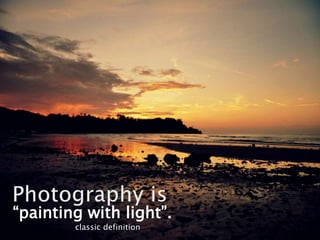
“painting with light”.
        classic definition
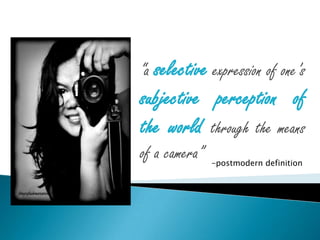
“a selective expression of one’s
subjective perception of
the world through the means
of a camera”   -postmodern definition
None of the two definitions require
Technical Perfection.

   There is no camera that will prevent its
   user from taking good pictures.

       You don’t need a good camera to take
       good pictures.
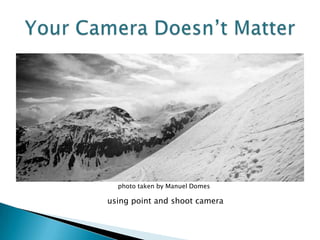
photo taken by Manuel Domes

using point and shoot camera
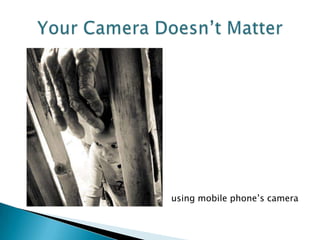
using mobile phone’s camera
   What is photographic composition?


    ◦the act of combining and forming relationships
     between things to create a whole shared by
     individual parts
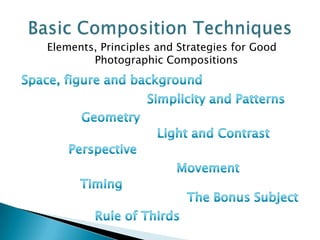
Elements, Principles and Strategies for Good
        Photographic Compositions
Principle:
 ◦Every element in the photographic space (i.e.
  the picture frame) should add to the picture
  & not distract from its meaning.
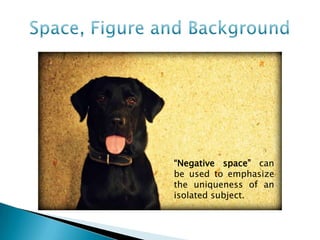
“Negative space” can
be used to emphasize
the uniqueness of an
isolated subject.
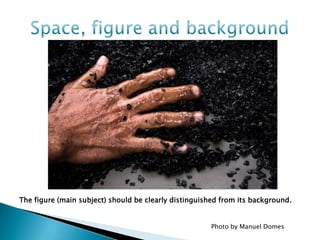
The figure (main subject) should be clearly distinguished from its background.


                                                      Photo by Manuel Domes
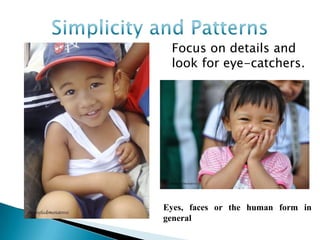
Focus on details and
 look for eye-catchers.


Eyes, faces or the human form in
general
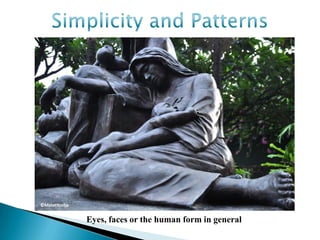
Eyes, faces or the human form in general
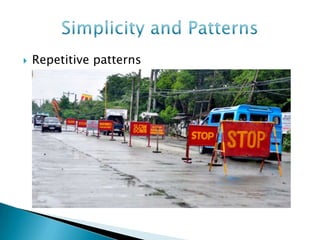
   Repetitive patterns
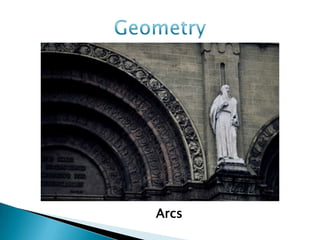
Geometric forms (lines,
 shapes, curves) can be
 subjects of their own
 or can emphasize the
 placement of a subject
 in the frame.
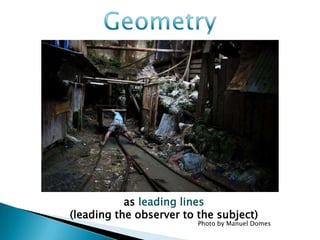
as leading lines
(leading the observer to the subject)
                         Photo by Manuel Domes
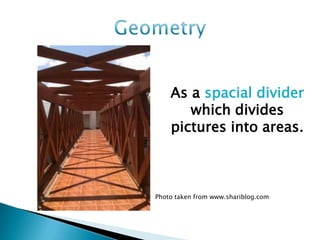
As a spacial divider
       which divides
    pictures into areas.


Photo taken from www.shariblog.com
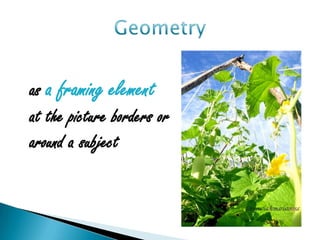
as a framing element
at the picture borders or
around a subject
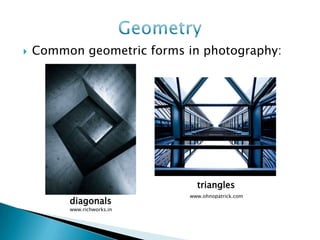
   Common geometric forms in photography:


                              triangles
                            www.ohnopatrick.com
         diagonals
         www.richworks.in
Arcs
Photography is
“

        50% photographer
        40% light and
        10% equipment.”
Direct/Harsh Light
                     shot at mid-day
Ambient/Diffused Light


    shot at early morning
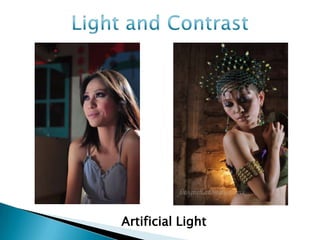
Available Light
Artificial Light
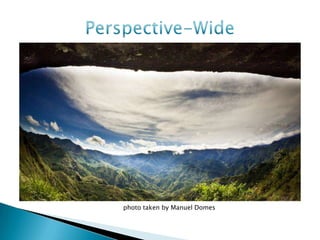
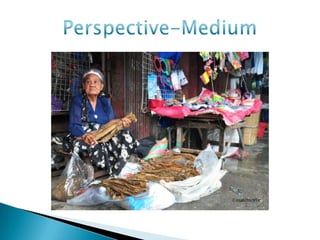
Wide, Medium, Close Perspectives
 serve to include different amounts of
    context in the surrounding of the
               main subject
             (a lot, some, none)
   Most environmental portraits are shot
      at wide to medium perspective
photo taken by Manuel Domes
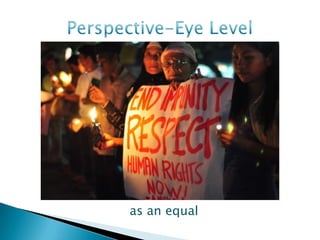
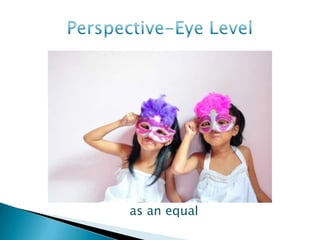
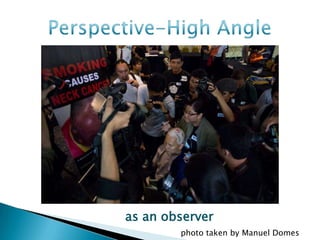
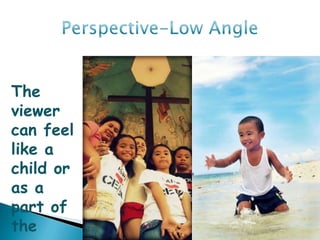
   Eye level, high angle, low angle shots

    ◦lead to different
     effects for the viewer
     of the picture
as an equal
as an equal
as an observer
        photo taken by Manuel Domes
The
viewer
can feel
like a
child or
as a
part of
the
 Since  photography is a static
 medium, photographers need to
 find a way to instill as sense of
 movement in their pictures.
       Visible movement can be caused by either:

               Camera movement
                       or
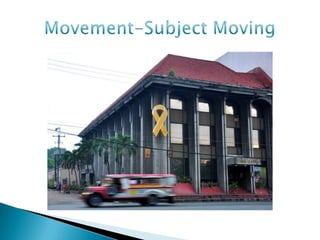
               Subject movement
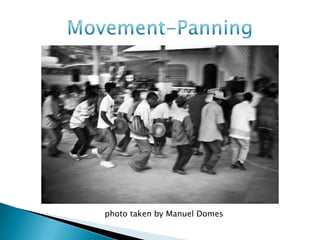
photo taken by Manuel Domes
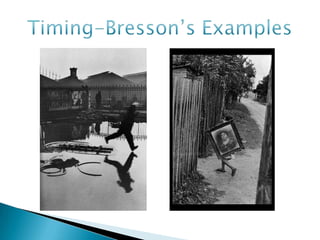
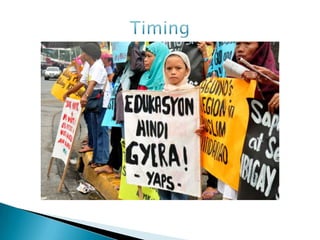
   Timing goes back to theory of Henri Cartier-
    Bresson who conceptualized the:

                   “Decisive Moment”

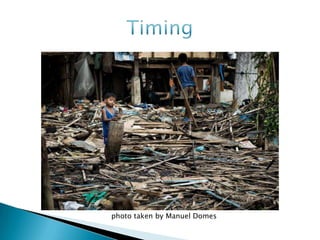
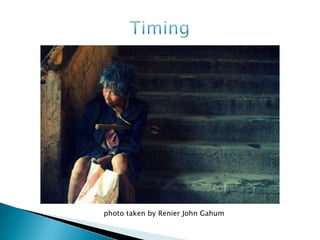
    refers to the coming together of the optimal composition
      with the optimal moment of action within the frame

    Typically, these moments can be looks, actions, or emotions
     of people, or something curious/unexpected happening.
photo taken by Manuel Domes
photo taken by Renier John Gahum
   An interesting and clearly identifiable subject
    should be the precondition to good
    photography.

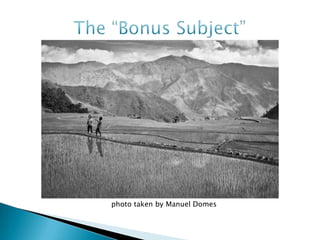
   Sometimes      static    photos   (especially
    landscape/street/architecture) gain by the
    inclusion of a human subject which provides
    a more interesting entry point
photo taken by Manuel Domes
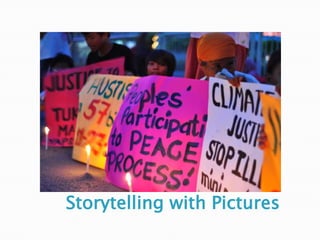
Storytelling with Pictures
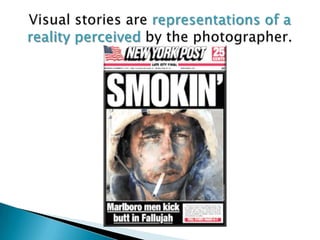
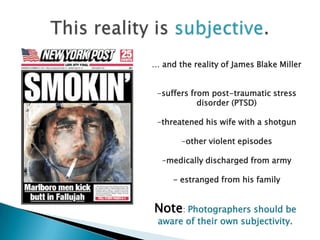
… and the reality of James Blake Miller


 -suffers from post-traumatic stress
            disorder (PTSD)

 -threatened his wife with a shotgun

       -other violent episodes

  -medically discharged from army

     - estranged from his family


Note: Photographers should be
 aware of their own subjectivity.
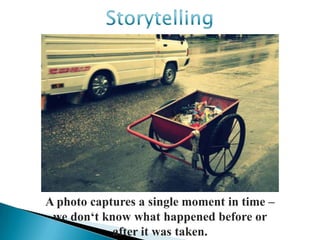
A photo captures a single moment in time –
 we don„t know what happened before or
            after it was taken.
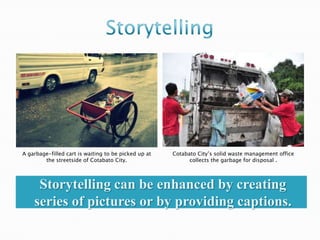
A garbage-filled cart is waiting to be picked up at   Cotabato City’s solid waste management office
        the streetside of Cotabato City.                    collects the garbage for disposal .


     Storytelling can be enhanced by creating
    series of pictures or by providing captions.
Photo Stories/ Series/ Essays
  telling a story through
 more than a single picture
Multimedia Story

supporting a photo through audio
           and video

 giving a “voice” to the subject
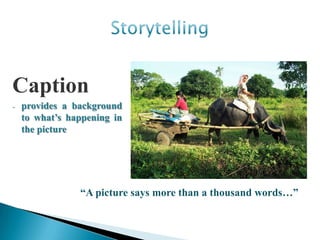
Caption
-   provides a background
    to what‟s happening in
    the picture


                “A picture says more than a thousand words…”
Ten-year old Inday rides the water buffalo cart with her younger sister, Nene
    to bring home food from the local market in Lebak, Sultan Kudarat.
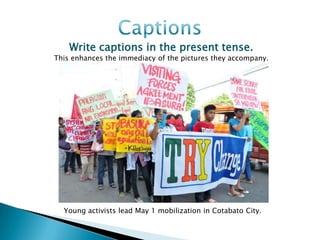
Write captions in the present tense.
This enhances the immediacy of the pictures they accompany.


  Young activists lead May 1 mobilization in Cotabato City.
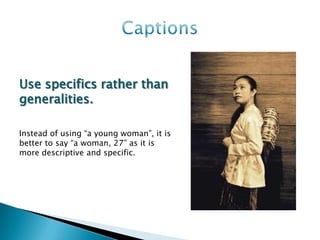
Use specifics rather than
generalities.

Instead of using “a young woman”, it is
better to say “a woman, 27” as it is
more descriptive and specific.
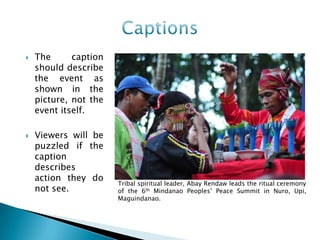
   The      caption
    should describe
    the event as
    shown in the
    picture, not the
    event itself.

   Viewers will be
    puzzled if the
    caption
    describes
    action they do
                       Tribal spiritual leader, Abay Rendaw leads the ritual ceremony
    not see.           of the 6th Mindanao Peoples’ Peace Summit in Nuro, Upi,
                       Maguindanao.
   Make sure the caption is accurate.                       Double-check the
    spelling of names and the factual information contained in the caption.

   Update the information.                    Because there is a lapse between
    the time a picture of an event is taken and the time a viewer sees the picture
    in the newspaper, care should be taken to update the information in the
    caption.

   Omit references to the photo.                        Because the readers
    know you are referring to the photograph, omit phrases such as “is
    pictured,” “is shown” and “the picture above shows.”
   Donʼt tell the obvious.                If the person in the picture is pretty or
    attractive, that fact will be obvious from the picture. The picture will tell
    whether a person is smiling. It may be necessary, however, to tell why he
    or she is smiling.

   Donʼt editorialize.           A writer doesn’t know whether someone is
    happy or troubled. The caption that described the judge as “weary but
    ready “when he arrived at court on the opening day of trial must have made
    readers wonder how the writer knew the judge was weary.

   Be exact.        In local pictures, the addresses of the persons shown may
    be helpful. If youngsters appear in the picture, they should be identified by
    names, ages, names of parents and addresses.
   Credit the photographer.                    If the picture is exceptional,
    credit may be given to the photographer in the caption, perhaps with a brief
    description of how he or she achieved the creation. On picture pages
    containing text matter, the photographer’s credit should be displayed as
    prominently as the writer’s.
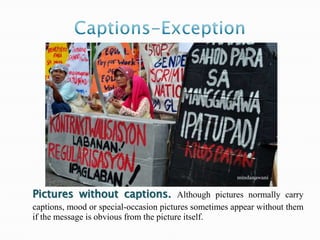
Pictures without captions. Although pictures normally carry
captions, mood or special-occasion pictures sometimes appear without them
if the message is obvious from the picture itself.
The National Press Photographers Association
     (NPPA) Sample Code of Ethics (Excerpt)
 Visual journalists and those who manage visual news productions are
 accountable for upholding the following standards in their daily work:


1.   Be accurate and comprehensive in the
     representation of subjects.

2.   Resist being manipulated by staged photo
     opportunities.
   3. Be complete and provide context when
    photographing or recording subjects. Avoid
    stereotyping   individuals    and groups.
    Recognize and work to avoid presenting
    one's own biases in the work.

   4. Treat all subjects with respect and
    dignity. Give special consideration to
    vulnerable subjects and compassion to
    victims of crime or tragedy.
   5. While photographing subjects do not
    intentionally contribute to, alter, or seek to
    alter or influence events.

   6. Editing should maintain the integrity of
    the photographic images' content and
    context. Do not manipulate images or add
    or alter sound in any way that can mislead
    viewers or misrepresent subjects.
   7. Do not pay sources or subjects or reward
    them     materially for   information    or
    participation.

   8. Do not accept gifts, favors, or
    compensation from those who might seek
    to influence coverage.

   9. Do not intentionally sabotage the efforts
    of other journalists.
Capture that story!

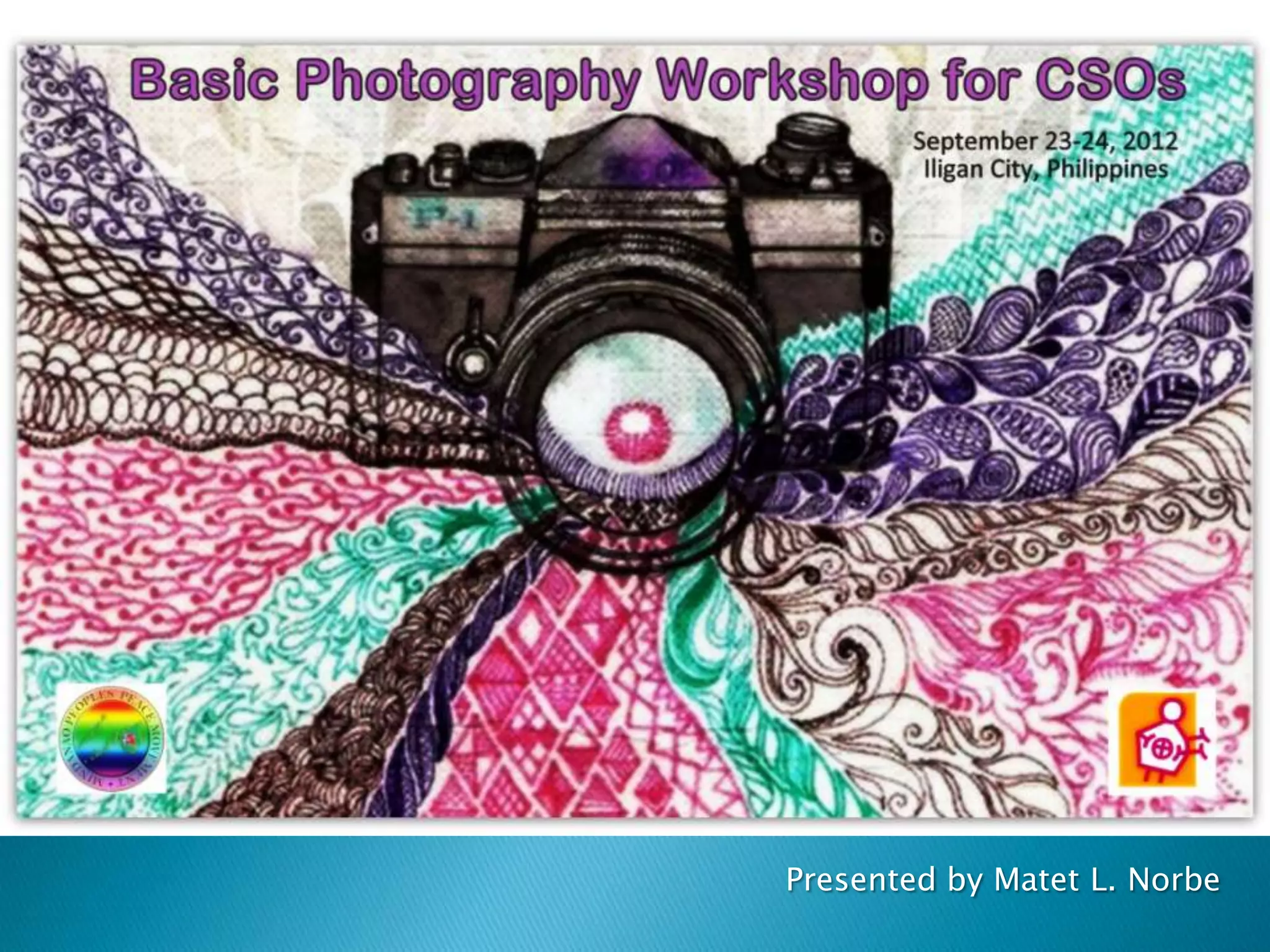
Basic Photography Workshop for CSOs

  • 1.
  • 2.
    Let’s Level Off ◦ Skills  Self-Taught- read books/articles on photography and practice hands-on  Trained- participated in workshops and trainings  Basic-Camera, Composition, Lighting  Advanced- Specialization in Types of Photography ◦ Experiences  To which purpose is your photography usually intended for?  Personal  Organizational (activities)  Advocacy (informational, educational, campaign)
  • 4.
    “painting with light”. classic definition
  • 5.
    “a selective expressionof one’s subjective perception of the world through the means of a camera” -postmodern definition
  • 6.
    None of thetwo definitions require Technical Perfection. There is no camera that will prevent its user from taking good pictures. You don’t need a good camera to take good pictures.
  • 7.
    photo taken byManuel Domes using point and shoot camera
  • 8.
  • 9.
    What is photographic composition? ◦the act of combining and forming relationships between things to create a whole shared by individual parts
  • 10.
    Elements, Principles andStrategies for Good Photographic Compositions
  • 11.
    Principle: ◦Every elementin the photographic space (i.e. the picture frame) should add to the picture & not distract from its meaning.
  • 12.
    “Negative space” can beused to emphasize the uniqueness of an isolated subject.
  • 13.
    The figure (mainsubject) should be clearly distinguished from its background. Photo by Manuel Domes
  • 14.
    Focus on detailsand look for eye-catchers. Eyes, faces or the human form in general
  • 15.
    Eyes, faces orthe human form in general
  • 17.
    Repetitive patterns
  • 18.
    Geometric forms (lines, shapes, curves) can be subjects of their own or can emphasize the placement of a subject in the frame.
  • 19.
    as leading lines (leadingthe observer to the subject) Photo by Manuel Domes
  • 20.
    As a spacialdivider which divides pictures into areas. Photo taken from www.shariblog.com
  • 21.
    as a framingelement at the picture borders or around a subject
  • 22.
    Common geometric forms in photography: triangles www.ohnopatrick.com diagonals www.richworks.in
  • 23.
  • 24.
    Photography is “ 50% photographer 40% light and 10% equipment.”
  • 25.
    Direct/Harsh Light shot at mid-day
  • 26.
    Ambient/Diffused Light shot at early morning
  • 27.
  • 28.
  • 29.
    Wide, Medium, ClosePerspectives  serve to include different amounts of context in the surrounding of the main subject (a lot, some, none)  Most environmental portraits are shot at wide to medium perspective
  • 30.
    photo taken byManuel Domes
  • 32.
    photo taken byManuel Domes
  • 34.
    Eye level, high angle, low angle shots ◦lead to different effects for the viewer of the picture
  • 35.
  • 36.
  • 37.
    as an observer photo taken by Manuel Domes
  • 38.
  • 39.
     Since photography is a static medium, photographers need to find a way to instill as sense of movement in their pictures. Visible movement can be caused by either: Camera movement or Subject movement
  • 40.
    photo taken byManuel Domes
  • 42.
    Timing goes back to theory of Henri Cartier- Bresson who conceptualized the: “Decisive Moment” refers to the coming together of the optimal composition with the optimal moment of action within the frame Typically, these moments can be looks, actions, or emotions of people, or something curious/unexpected happening.
  • 45.
    photo taken byManuel Domes
  • 46.
    photo taken byRenier John Gahum
  • 47.
    An interesting and clearly identifiable subject should be the precondition to good photography.  Sometimes static photos (especially landscape/street/architecture) gain by the inclusion of a human subject which provides a more interesting entry point
  • 49.
    photo taken byManuel Domes
  • 50.
  • 52.
    … and thereality of James Blake Miller -suffers from post-traumatic stress disorder (PTSD) -threatened his wife with a shotgun -other violent episodes -medically discharged from army - estranged from his family Note: Photographers should be aware of their own subjectivity.
  • 53.
    A photo capturesa single moment in time – we don„t know what happened before or after it was taken.
  • 54.
    A garbage-filled cartis waiting to be picked up at Cotabato City’s solid waste management office the streetside of Cotabato City. collects the garbage for disposal . Storytelling can be enhanced by creating series of pictures or by providing captions.
  • 55.
    Photo Stories/ Series/Essays telling a story through more than a single picture
  • 56.
    Multimedia Story supporting aphoto through audio and video giving a “voice” to the subject
  • 57.
    Caption - provides a background to what‟s happening in the picture “A picture says more than a thousand words…”
  • 58.
    Ten-year old Indayrides the water buffalo cart with her younger sister, Nene to bring home food from the local market in Lebak, Sultan Kudarat.
  • 59.
    Write captions inthe present tense. This enhances the immediacy of the pictures they accompany. Young activists lead May 1 mobilization in Cotabato City.
  • 60.
    Use specifics ratherthan generalities. Instead of using “a young woman”, it is better to say “a woman, 27” as it is more descriptive and specific.
  • 61.
    The caption should describe the event as shown in the picture, not the event itself.  Viewers will be puzzled if the caption describes action they do Tribal spiritual leader, Abay Rendaw leads the ritual ceremony not see. of the 6th Mindanao Peoples’ Peace Summit in Nuro, Upi, Maguindanao.
  • 62.
    Make sure the caption is accurate. Double-check the spelling of names and the factual information contained in the caption.  Update the information. Because there is a lapse between the time a picture of an event is taken and the time a viewer sees the picture in the newspaper, care should be taken to update the information in the caption.  Omit references to the photo. Because the readers know you are referring to the photograph, omit phrases such as “is pictured,” “is shown” and “the picture above shows.”
  • 63.
    Donʼt tell the obvious. If the person in the picture is pretty or attractive, that fact will be obvious from the picture. The picture will tell whether a person is smiling. It may be necessary, however, to tell why he or she is smiling.  Donʼt editorialize. A writer doesn’t know whether someone is happy or troubled. The caption that described the judge as “weary but ready “when he arrived at court on the opening day of trial must have made readers wonder how the writer knew the judge was weary.  Be exact. In local pictures, the addresses of the persons shown may be helpful. If youngsters appear in the picture, they should be identified by names, ages, names of parents and addresses.
  • 64.
    Credit the photographer. If the picture is exceptional, credit may be given to the photographer in the caption, perhaps with a brief description of how he or she achieved the creation. On picture pages containing text matter, the photographer’s credit should be displayed as prominently as the writer’s.
  • 65.
    Pictures without captions.Although pictures normally carry captions, mood or special-occasion pictures sometimes appear without them if the message is obvious from the picture itself.
  • 66.
    The National PressPhotographers Association (NPPA) Sample Code of Ethics (Excerpt) Visual journalists and those who manage visual news productions are accountable for upholding the following standards in their daily work: 1. Be accurate and comprehensive in the representation of subjects. 2. Resist being manipulated by staged photo opportunities.
  • 67.
    3. Be complete and provide context when photographing or recording subjects. Avoid stereotyping individuals and groups. Recognize and work to avoid presenting one's own biases in the work.  4. Treat all subjects with respect and dignity. Give special consideration to vulnerable subjects and compassion to victims of crime or tragedy.
  • 68.
    5. While photographing subjects do not intentionally contribute to, alter, or seek to alter or influence events.  6. Editing should maintain the integrity of the photographic images' content and context. Do not manipulate images or add or alter sound in any way that can mislead viewers or misrepresent subjects.
  • 69.
    7. Do not pay sources or subjects or reward them materially for information or participation.  8. Do not accept gifts, favors, or compensation from those who might seek to influence coverage.  9. Do not intentionally sabotage the efforts of other journalists.
  • 70.