•The water issuing from a hot spring is heated by geothermal heat, essentially heat from
the Earth's interior. In general, the temperature of rocks within the Earth increases with
depth. The rate of temperature increase with depth is known as the “geothermal
gradient”. If water percolates deeply enough into the crust, it will be heated as it comes
into contact with hot rocks. The water from hot springs in non-volcanic areas is heated in
this manner.
•In volcanic zones, such as Yellowstone National Park, water may be heated by coming
into contact with magma (molten rock). The high temperature gradient near magma
may cause water to be heated enough that it boils or becomes superheated. If the water
becomes so hot that it builds steam pressure and erupts in a jet above the surface of the
earth, it is called a geyser; if the water only reaches the surface in the form of steam, it is
called a fumarole; and if the water is mixed with mud and clay, it is called a mud pot.
There are no geysers, fumaroles, or mud pots at Hot Springs National Park.


           One thermophile, Pyrolobus fumarii, has been
           found at temperatures of
           113° C /235° F
Vocabulary words
aquifer - a water-bearing stratum of permeable rock, sand, or gravel

calcareous - resembling calcite or calcium carbonate especially in hardness; consisting of
or containing calcium

chert - rock resembling flint and consisting of quartz and amorphous silica

fault - a fracture in the crust of the Earth accompanied by a displacement of one side of
the fracture with respect to the other, usually in a direction parallel to the fracture

fissure - a narrow opening or crack of considerable length and depth usually occurring
from some breaking or parting

gradient - change in the value of a quantity (as temperature, pressure, or concentration)
with change in a given variable and especially per unit distance in a specified direction

hybrid    -    an     offspring     of    two   animals    or    plants       of   different
races, breeds, varieties,species, or genera

hydrothermal - of or relating to hot water

isotope - any of two or more atoms of a chemical element with the same atomic number
and nearly identical chemical behavior but with differing atomic mass or mass numberand
different physical properties
magma - molten rock material within the Earth from which igneous rock results by
cooling
meteorite - any of the small particles of matter in the solar system that are directly
observable only by their incandescence from frictional heating on entry into the
atmosphere
novaculite - a very hard fine-grained siliceous chert used for whetstones
percolate - to ooze or trickle through a permeable substance
protozoa - any of a phylum or subkingdom (Protozoa) of chiefly motile and
heterotrophic unicellular protists (as amoebas, trypanosomes, sporozoans, and
paramecia) that are represented in almost every kind of habitat
pseudopod - temporary protrusion or retractile process of the cytoplasm of a cell that
functions (as in an amoeba) especially in a locomotor or food gathering capacity
seismic - of, subject to, or caused by an earthquake; or relating to an earth vibration
siliceous - of, relating to, or containing silica
suspension - the state of a substance when its particles are mixed with but undissolved
in a fluid or solid
tufa - a porous rock formed as a deposit from springs or streams
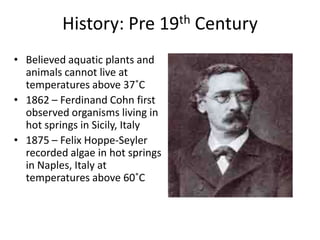
History: Pre 19th Century
• Believed aquatic plants and
  animals cannot live at
  temperatures above 37˚C
• 1862 – Ferdinand Cohn first
  observed organisms living in
  hot springs in Sicily, Italy
• 1875 – Felix Hoppe-Seyler
  recorded algae in hot springs
  in Naples, Italy at
  temperatures above 60˚C
History 1900 to Present
• 1903 – William Setchell observed
  algae in hot springs at ~ 75˚C and
  89˚C in Yellowstone National Park
• 1978 – Thomas Brock found
  cyanobacteria in hot springs at 75-
  77˚C, and observed growth at
  temperatures up to 95.5˚C
• Early 1990s –Thermus aquaticus
  discovered, utilized this
  organism’s thermotolerant
  polymerase (“Taq”) in PCR
  reactions
• Recently – discovery of
  archaea, bacteria and viruses in
  hot springs continue
General Hot Springs Ecology
• Photosynthetic
  microorganisms dominate,
  ranging from 102 to 108/ml,
  found mostly in euphotic
  surface layers or on rock
  surfaces
• Heterotrophic
  microorganisms are also
  found, but in lower
  concentrations (101 to
  106/ml), and consume DOM
  from terrestrial and
  biological sources (dead
  photosynthetic organisms)
Archaea
Most archaea grow at temperatures of 80-85ºC
• Methanogens (Methanobacterium thermophilicum)
• 2 distinct lineges present? in Yellowstone hot springs
  (small-subunit rRNA analysis)
• A little is known; research continues.


                           A microbiologist collecting
                           water sample at Yellowstone
                           hot spring.
Bacteria I

• Cyanobacteria (Synechococcus)
   – Thermophile photoynthetic
     autotrophs
   – Grow up to 74ºC.
   – “Algal mat” (Yellowstone)
      • Many distinct species living in
        vertically stratified mats based
        on 16S rRNA phylogenetic
        studies


                                           Algal mat in Yellowstone
Bacteria II
• Heterotrophic bacteria (thermophiles)
• Chemolithotrophs
   – H2S & sulfur oxidizers (e.g. Thiobacilus
     thiooxidans, Sulfolobus acidocaldarius: found in
     highly acidic hot springs)
   – Sulfate reducers (e.g. Desulfovibrio thermophilus)
   – Methane oxidizers (e.g. Methylococcus capsulatus)
Viruses

                                Electron micrographs of
                                viruses found in Little
                                Hot Creek, OR (Breibar
                                et al. 2004)


• Absence of eukaryotes… but viruses are there
• Thermophilic bacteriophages observed living at up to
  92ºC: extreme thermophiles
• Predators of bacteria
• “Microbial loop” in hot springs
ml TT media (ATCC medium 697

Photo hot spring

  • 4.
    •The water issuingfrom a hot spring is heated by geothermal heat, essentially heat from the Earth's interior. In general, the temperature of rocks within the Earth increases with depth. The rate of temperature increase with depth is known as the “geothermal gradient”. If water percolates deeply enough into the crust, it will be heated as it comes into contact with hot rocks. The water from hot springs in non-volcanic areas is heated in this manner. •In volcanic zones, such as Yellowstone National Park, water may be heated by coming into contact with magma (molten rock). The high temperature gradient near magma may cause water to be heated enough that it boils or becomes superheated. If the water becomes so hot that it builds steam pressure and erupts in a jet above the surface of the earth, it is called a geyser; if the water only reaches the surface in the form of steam, it is called a fumarole; and if the water is mixed with mud and clay, it is called a mud pot. There are no geysers, fumaroles, or mud pots at Hot Springs National Park. One thermophile, Pyrolobus fumarii, has been found at temperatures of 113° C /235° F
  • 6.
    Vocabulary words aquifer -a water-bearing stratum of permeable rock, sand, or gravel calcareous - resembling calcite or calcium carbonate especially in hardness; consisting of or containing calcium chert - rock resembling flint and consisting of quartz and amorphous silica fault - a fracture in the crust of the Earth accompanied by a displacement of one side of the fracture with respect to the other, usually in a direction parallel to the fracture fissure - a narrow opening or crack of considerable length and depth usually occurring from some breaking or parting gradient - change in the value of a quantity (as temperature, pressure, or concentration) with change in a given variable and especially per unit distance in a specified direction hybrid - an offspring of two animals or plants of different races, breeds, varieties,species, or genera hydrothermal - of or relating to hot water isotope - any of two or more atoms of a chemical element with the same atomic number and nearly identical chemical behavior but with differing atomic mass or mass numberand different physical properties
  • 7.
    magma - moltenrock material within the Earth from which igneous rock results by cooling meteorite - any of the small particles of matter in the solar system that are directly observable only by their incandescence from frictional heating on entry into the atmosphere novaculite - a very hard fine-grained siliceous chert used for whetstones percolate - to ooze or trickle through a permeable substance protozoa - any of a phylum or subkingdom (Protozoa) of chiefly motile and heterotrophic unicellular protists (as amoebas, trypanosomes, sporozoans, and paramecia) that are represented in almost every kind of habitat pseudopod - temporary protrusion or retractile process of the cytoplasm of a cell that functions (as in an amoeba) especially in a locomotor or food gathering capacity seismic - of, subject to, or caused by an earthquake; or relating to an earth vibration siliceous - of, relating to, or containing silica suspension - the state of a substance when its particles are mixed with but undissolved in a fluid or solid tufa - a porous rock formed as a deposit from springs or streams
  • 10.
    History: Pre 19thCentury • Believed aquatic plants and animals cannot live at temperatures above 37˚C • 1862 – Ferdinand Cohn first observed organisms living in hot springs in Sicily, Italy • 1875 – Felix Hoppe-Seyler recorded algae in hot springs in Naples, Italy at temperatures above 60˚C
  • 11.
    History 1900 toPresent • 1903 – William Setchell observed algae in hot springs at ~ 75˚C and 89˚C in Yellowstone National Park • 1978 – Thomas Brock found cyanobacteria in hot springs at 75- 77˚C, and observed growth at temperatures up to 95.5˚C • Early 1990s –Thermus aquaticus discovered, utilized this organism’s thermotolerant polymerase (“Taq”) in PCR reactions • Recently – discovery of archaea, bacteria and viruses in hot springs continue
  • 12.
    General Hot SpringsEcology • Photosynthetic microorganisms dominate, ranging from 102 to 108/ml, found mostly in euphotic surface layers or on rock surfaces • Heterotrophic microorganisms are also found, but in lower concentrations (101 to 106/ml), and consume DOM from terrestrial and biological sources (dead photosynthetic organisms)
  • 13.
    Archaea Most archaea growat temperatures of 80-85ºC • Methanogens (Methanobacterium thermophilicum) • 2 distinct lineges present? in Yellowstone hot springs (small-subunit rRNA analysis) • A little is known; research continues. A microbiologist collecting water sample at Yellowstone hot spring.
  • 14.
    Bacteria I • Cyanobacteria(Synechococcus) – Thermophile photoynthetic autotrophs – Grow up to 74ºC. – “Algal mat” (Yellowstone) • Many distinct species living in vertically stratified mats based on 16S rRNA phylogenetic studies Algal mat in Yellowstone
  • 15.
    Bacteria II • Heterotrophicbacteria (thermophiles) • Chemolithotrophs – H2S & sulfur oxidizers (e.g. Thiobacilus thiooxidans, Sulfolobus acidocaldarius: found in highly acidic hot springs) – Sulfate reducers (e.g. Desulfovibrio thermophilus) – Methane oxidizers (e.g. Methylococcus capsulatus)
  • 16.
    Viruses Electron micrographs of viruses found in Little Hot Creek, OR (Breibar et al. 2004) • Absence of eukaryotes… but viruses are there • Thermophilic bacteriophages observed living at up to 92ºC: extreme thermophiles • Predators of bacteria • “Microbial loop” in hot springs
  • 17.
    ml TT media(ATCC medium 697