Photo Chemistry 7  By: Kuba Kalecinski Miss. Wolfenden’s Grade 7 Science Class
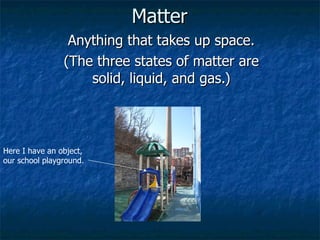
Matter   Anything that takes up space. ( The three states of matter are solid, liquid, and gas .) Here I have an object, our school playground.
Non Matter   A chemical, a substance, or an object that has no mass. This is a picture of the sunshine. Not really clear, but still non matter.
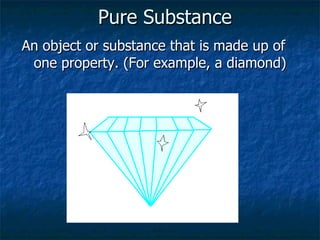
Pure Substance   An object or substance that is made up of one property. (For example, a diamond)
Element   A pure substance that cannot be broken into simpler substances.  (There were first thought to be only 18 elements, but after many years of study, scientists found 36 elements. The 36 elements are: Hydrogen, Helium, Lithium, Beryllium, Boron, Carbon, Nitrogen, Oxygen, Fluorine, Neon, Sodium, Magnesium, Aluminum, Silicon, Phosphorus, Sulfur, Chlorine, Argon, Potassium, Calcium, Scandium, Titanium, Vanadium, Chromium, Manganese, Iron, Cobalt, Nickel, Copper, Zinc, Gallium, Germanium, Arsenic, Selenium, Bromine, and Krypton, but there are many, many more in the world of chemistry.)
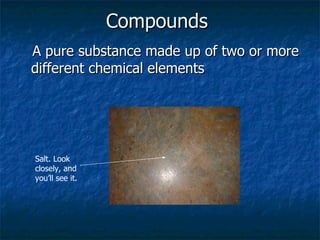
Compounds   A pure substance made up of two or more different chemical elements Salt. Look closely, and you’ll see it.
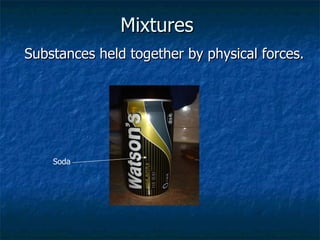
Mixtures   Substances held together by physical forces.   Soda
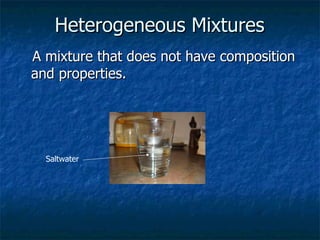
Heterogeneous Mixtures   A mixture that does not have  composition and properties.  Saltwater
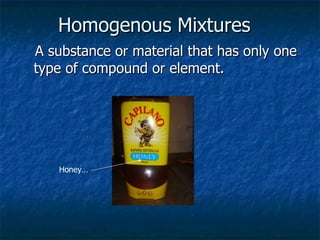
Homogenous Mixtures   A substance or material that has only one type of compound or element.  Honey…
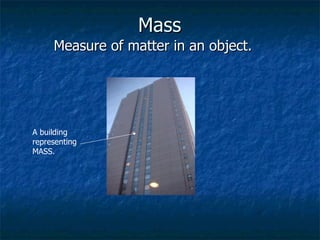
Mass   Measure of matter in an object. A building representing MASS.
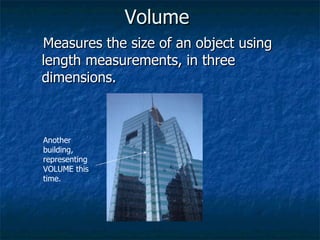
Volume   Measures the size of an object using length measurements, in three dimensions. Another building, representing VOLUME this time.
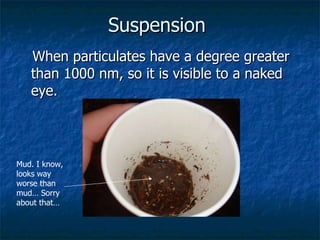
Suspension   When particulates have a degree greater than 1000 nm, so it is visible to a naked eye.   Mud. I know, looks way worse than mud… Sorry about that…
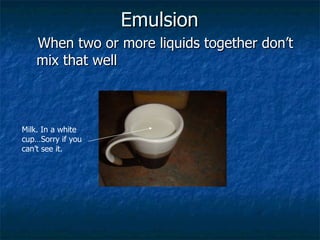
Emulsion   When two or more liquids together don’t mix that well Milk. In a white cup…Sorry if you can’t see it.
Mechanical Change   A change that you cannot see.
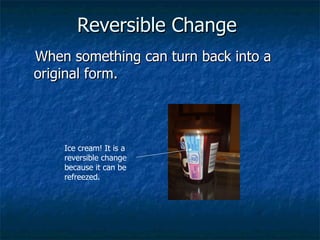
Reversible Change   When something can turn back into a original form. Ice cream! It is a reversible change because it can be refreezed.
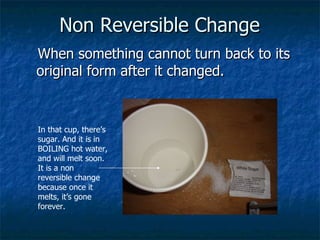
Non Reversible Change   When something cannot turn back to its original form after it changed.   In that cup, there’s sugar. And it is in BOILING hot water, and will melt soon. It is a non reversible change because once it melts, it’s gone forever.
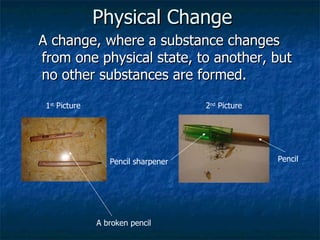
Physical Change   A change, where a substance changes from one physical state, to another, but no other substances are formed. 1 st  Picture 2 nd  Picture Pencil sharpener Pencil A broken pencil
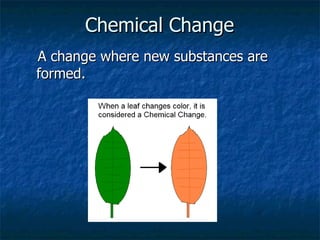
Chemical Change   A change where new substances are formed.
References A reference is when you show where you got your information from. Here are my source websites and other sources I used: - http://   chemicool.com/definition/ -http://ask.com -Science 7 (Textbook) -http://wikipedia.com -answers.yahoo.com http://users.rcn.com/jkimball.ma.ultranet/BiologyPages/M/Mixtures.html  -answers.google.com

Science chemistry (words,defs+pics)

  • 1.
    Photo Chemistry 7 By: Kuba Kalecinski Miss. Wolfenden’s Grade 7 Science Class
  • 2.
    Matter Anything that takes up space. ( The three states of matter are solid, liquid, and gas .) Here I have an object, our school playground.
  • 3.
    Non Matter A chemical, a substance, or an object that has no mass. This is a picture of the sunshine. Not really clear, but still non matter.
  • 4.
    Pure Substance An object or substance that is made up of one property. (For example, a diamond)
  • 5.
    Element A pure substance that cannot be broken into simpler substances. (There were first thought to be only 18 elements, but after many years of study, scientists found 36 elements. The 36 elements are: Hydrogen, Helium, Lithium, Beryllium, Boron, Carbon, Nitrogen, Oxygen, Fluorine, Neon, Sodium, Magnesium, Aluminum, Silicon, Phosphorus, Sulfur, Chlorine, Argon, Potassium, Calcium, Scandium, Titanium, Vanadium, Chromium, Manganese, Iron, Cobalt, Nickel, Copper, Zinc, Gallium, Germanium, Arsenic, Selenium, Bromine, and Krypton, but there are many, many more in the world of chemistry.)
  • 6.
    Compounds A pure substance made up of two or more different chemical elements Salt. Look closely, and you’ll see it.
  • 7.
    Mixtures Substances held together by physical forces. Soda
  • 8.
    Heterogeneous Mixtures A mixture that does not have composition and properties. Saltwater
  • 9.
    Homogenous Mixtures A substance or material that has only one type of compound or element. Honey…
  • 10.
    Mass Measure of matter in an object. A building representing MASS.
  • 11.
    Volume Measures the size of an object using length measurements, in three dimensions. Another building, representing VOLUME this time.
  • 12.
    Suspension When particulates have a degree greater than 1000 nm, so it is visible to a naked eye. Mud. I know, looks way worse than mud… Sorry about that…
  • 13.
    Emulsion When two or more liquids together don’t mix that well Milk. In a white cup…Sorry if you can’t see it.
  • 14.
    Mechanical Change A change that you cannot see.
  • 15.
    Reversible Change When something can turn back into a original form. Ice cream! It is a reversible change because it can be refreezed.
  • 16.
    Non Reversible Change When something cannot turn back to its original form after it changed. In that cup, there’s sugar. And it is in BOILING hot water, and will melt soon. It is a non reversible change because once it melts, it’s gone forever.
  • 17.
    Physical Change A change, where a substance changes from one physical state, to another, but no other substances are formed. 1 st Picture 2 nd Picture Pencil sharpener Pencil A broken pencil
  • 18.
    Chemical Change A change where new substances are formed.
  • 19.
    References A referenceis when you show where you got your information from. Here are my source websites and other sources I used: - http:// chemicool.com/definition/ -http://ask.com -Science 7 (Textbook) -http://wikipedia.com -answers.yahoo.com http://users.rcn.com/jkimball.ma.ultranet/BiologyPages/M/Mixtures.html -answers.google.com