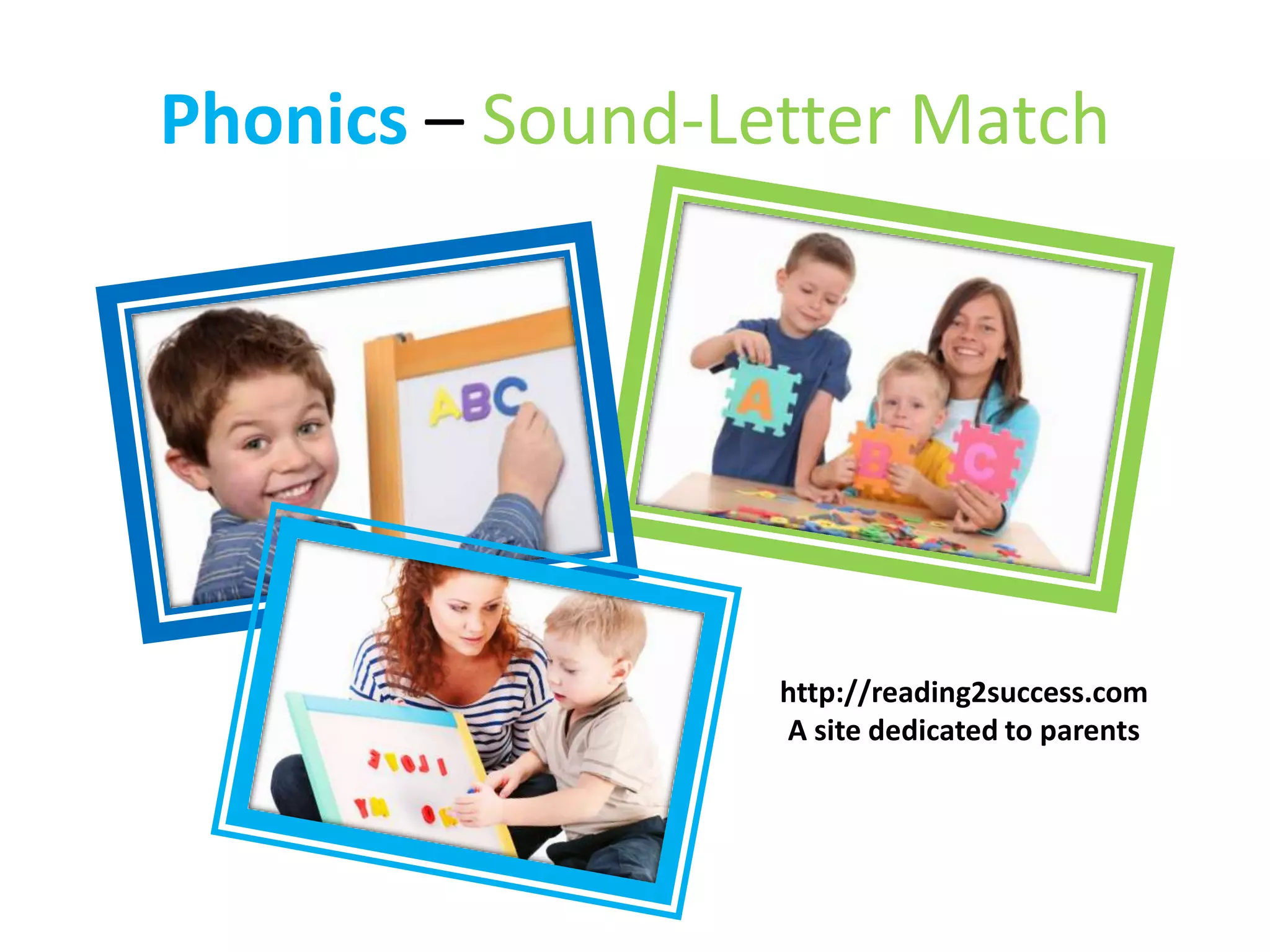
Phonics – Sound-Letter Match

http://reading2success.com
A site dedicated to parents
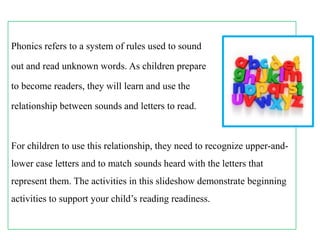
Phonics refers to a system of rules used to sound
out and read unknown words. As children prepare

to become readers, they will learn and use the
relationship between sounds and letters to read.

For children to use this relationship, they need to recognize upper-andlower case letters and to match sounds heard with the letters that
represent them. The activities in this slideshow demonstrate beginning

activities to support your child’s reading readiness.
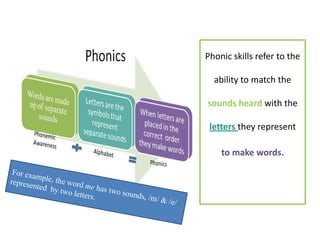
Phonic skills refer to the
ability to match the
sounds heard with the
letters they represent
to make words.
Letter Recognition
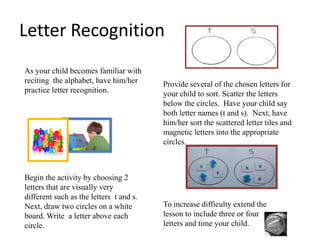
As your child becomes familiar with
reciting the alphabet, have him/her
practice letter recognition.

Begin the activity by choosing 2
letters that are visually very
different such as the letters t and s.
Next, draw two circles on a white
board. Write a letter above each
circle.

Provide several of the chosen letters for
your child to sort. Scatter the letters
below the circles. Have your child say
both letter names (t and s). Next, have
him/her sort the scattered letter tiles and
magnetic letters into the appropriate
circles.

To increase difficulty extend the
lesson to include three or four
letters and time your child.
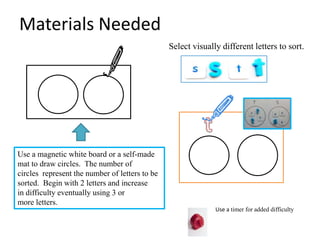
Materials Needed
Select visually different letters to sort.

Use a magnetic white board or a self-made
mat to draw circles. The number of
circles represent the number of letters to be
sorted. Begin with 2 letters and increase
in difficulty eventually using 3 or
more letters.
Use a timer for added difficulty
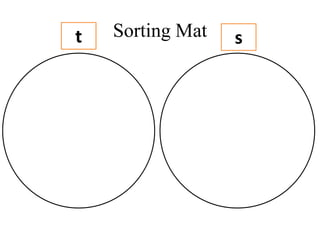
t

Sorting Mat

s
Sound-Letter Match
/a/
/b/
/c/

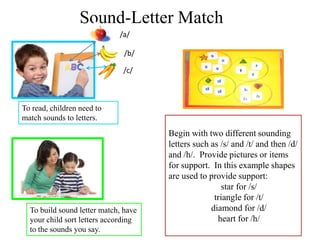
To read, children need to
match sounds to letters.

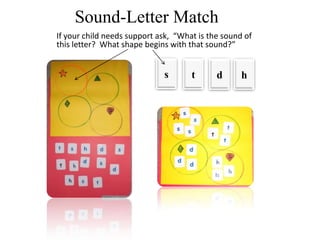
To build sound letter match, have
your child sort letters according
to the sounds you say.

Begin with two different sounding
letters such as /s/ and /t/ and then /d/
and /h/. Provide pictures or items
for support. In this example shapes
are used to provide support:
star for /s/
triangle for /t/
diamond for /d/
heart for /h/
Sound-Letter Match
If your child needs support ask, “What is the sound of
this letter? What shape begins with that sound?”

s

t

d

h
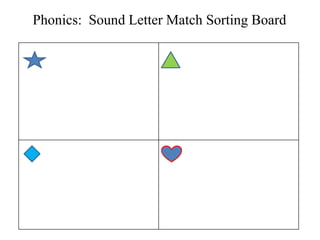
Phonics: Sound Letter Match Sorting Board
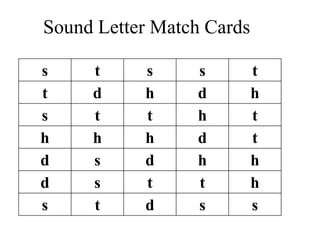
Sound Letter Match Cards
s
t
s
h
d
d
s

t
d
t
h
s
s
t

s
h
t
h
d
t
d

s
d
h
d
h
t
s

t
h
t
t
h
h
s
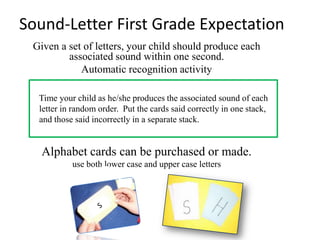
Sound-Letter First Grade Expectation
Given a set of letters, your child should produce each
associated sound within one second.
Automatic recognition activity
Time your child as he/she produces the associated sound of each
letter in random order. Put the cards said correctly in one stack,
and those said incorrectly in a separate stack.

Alphabet cards can be purchased or made.
use both lower case and upper case letters
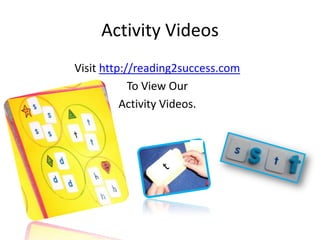
Activity Videos
Visit http://reading2success.com
To View Our
Activity Videos.

Phonics Sound - Letter Match

  • 1.
    Phonics – Sound-LetterMatch http://reading2success.com A site dedicated to parents
  • 2.
    Phonics refers toa system of rules used to sound out and read unknown words. As children prepare to become readers, they will learn and use the relationship between sounds and letters to read. For children to use this relationship, they need to recognize upper-andlower case letters and to match sounds heard with the letters that represent them. The activities in this slideshow demonstrate beginning activities to support your child’s reading readiness.
  • 3.
    Phonic skills referto the ability to match the sounds heard with the letters they represent to make words.
  • 4.
    Letter Recognition As yourchild becomes familiar with reciting the alphabet, have him/her practice letter recognition. Begin the activity by choosing 2 letters that are visually very different such as the letters t and s. Next, draw two circles on a white board. Write a letter above each circle. Provide several of the chosen letters for your child to sort. Scatter the letters below the circles. Have your child say both letter names (t and s). Next, have him/her sort the scattered letter tiles and magnetic letters into the appropriate circles. To increase difficulty extend the lesson to include three or four letters and time your child.
  • 5.
    Materials Needed Select visuallydifferent letters to sort. Use a magnetic white board or a self-made mat to draw circles. The number of circles represent the number of letters to be sorted. Begin with 2 letters and increase in difficulty eventually using 3 or more letters. Use a timer for added difficulty
  • 6.
  • 7.
    Sound-Letter Match /a/ /b/ /c/ To read,children need to match sounds to letters. To build sound letter match, have your child sort letters according to the sounds you say. Begin with two different sounding letters such as /s/ and /t/ and then /d/ and /h/. Provide pictures or items for support. In this example shapes are used to provide support: star for /s/ triangle for /t/ diamond for /d/ heart for /h/
  • 8.
    Sound-Letter Match If yourchild needs support ask, “What is the sound of this letter? What shape begins with that sound?” s t d h
  • 9.
    Phonics: Sound LetterMatch Sorting Board
  • 10.
    Sound Letter MatchCards s t s h d d s t d t h s s t s h t h d t d s d h d h t s t h t t h h s
  • 11.
    Sound-Letter First GradeExpectation Given a set of letters, your child should produce each associated sound within one second. Automatic recognition activity Time your child as he/she produces the associated sound of each letter in random order. Put the cards said correctly in one stack, and those said incorrectly in a separate stack. Alphabet cards can be purchased or made. use both lower case and upper case letters
  • 12.