Phonics
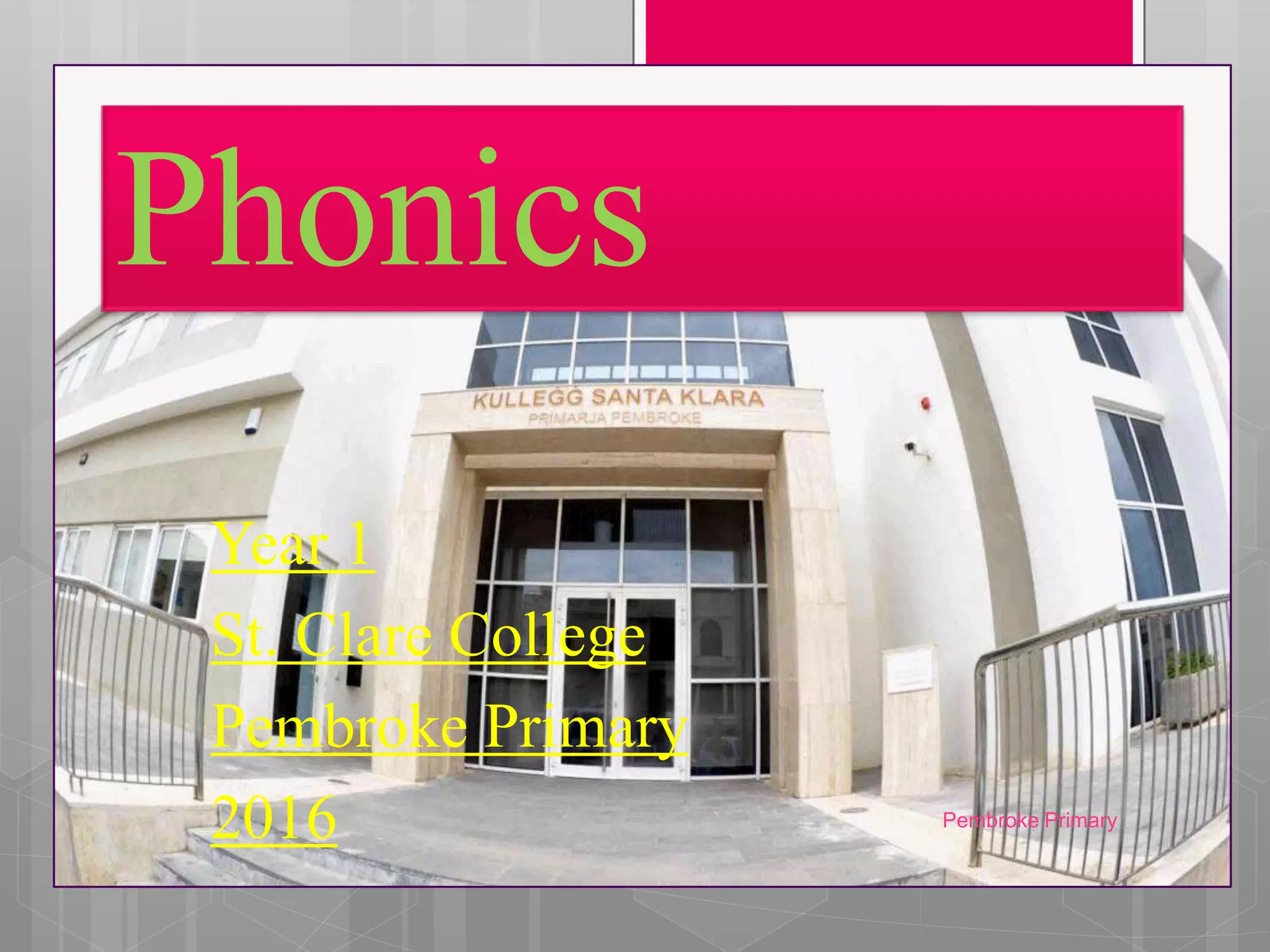
Year 1
St. Clare College
Pembroke Primary
2016 Pembroke Primary
What is Phonics?
 Phonics is a method for
teaching reading and writing the English
language.
 The goal of phonics is to enable beginning
readers to decode new written words by
sounding them out.
Pembroke Primary
The difference between:
- Letter names
Each letter has a name
This link will guide you with letter names:
https://www.youtube.com/watch?v=w_-lz2BI2Co
- Letter sounds
Each letter has a sound
This link will guide you with letter sounds
https://www.youtube.com/watch?v=pyKdUpJQBTY
Pembroke Primary
Learning the letter sounds – Term 2 – New
English Phonics Scheme – BIG CAT
Sounds that are going to be done in Term 2:
s, a, t, i ,p, n, c, k, ck, e, o, r, m, d, g, u, l, h, f,
b, ai , j, oa, ee
In the English alphabet there are 26 letters. From those only 7
letters have a new sound that students need to learn.
Besides these letters there are also phonemes such as ee - sheep
Pembroke Primary
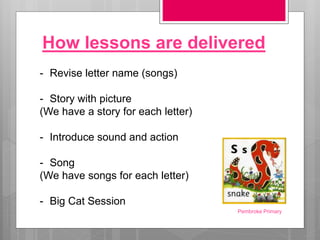
How lessons are delivered
- Revise letter name (songs)
- Story with picture
(We have a story for each letter)
- Introduce sound and action
- Song
(We have songs for each letter)
- Big Cat Session
Pembroke Primary
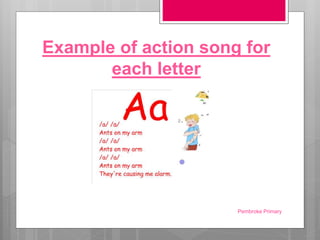
Example of action song for
each letter
Pembroke Primary
Letter formation
- Capital letters are being introduced in term 2.
We call them also – The Upper Case
- When using The Lower Case, PRECURSIVE
letters are used. That is letters that have ‘exit
strokes’ (flick) to encourage cursive writing at
later stages.
- However children are also exposed to PRINT
letters especially in books.
Pembroke Primary
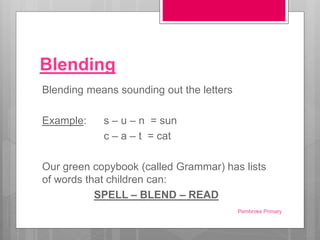
Blending
Blending means sounding out the letters
Example: s – u – n = sun
c – a – t = cat
Our green copybook (called Grammar) has lists
of words that children can:
SPELL – BLEND – READ
Pembroke Primary
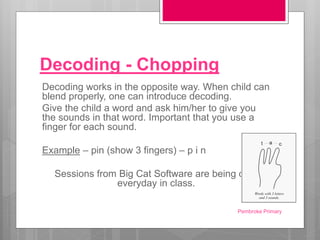
Decoding - Chopping
Decoding works in the opposite way. When child can
blend properly, one can introduce decoding.
Give the child a word and ask him/her to give you
the sounds in that word. Important that you use a
finger for each sound.
Example – pin (show 3 fingers) – p i n
Sessions from Big Cat Software are being done
everyday in class.
Pembroke Primary
Games and Activities that can
be done at home:
- I spy something beginning with ….
- Counting sounds in a word
- Rhyming words game (example: cat, rat, mat,
sat….
- Take away a sound (example: “van” -taking
away the “v” and replacing it with “f” is fan
Pembroke Primary
Tricky/Fast words
In year 1 we have 60 ‘irregular keywords’ called
‘tricky words’. We cannot spell and blend tricky
words. They have to be learnt by heart.
These are words which are frequently used in
books.
A sheet with these 60 words was given to all the
children in Year 1 and we are shading with a yellow
crayon all the new words that we do every week.
Pembroke Primary
3rd Term
During the 3rd term the children will be doing
other 20 sounds.
z, w, oo (as in wood), oo (as in cool), ie, v, y, ch,
sh, th (as in that), th (as in thank), ng, x, qu, ar,
er, ou, oi, ue and or.
Dictations and Creative Writing will follow during
the third term.
Pembroke Primary
Dictation
-After the Easter holidays we will be having
Spelling games/dictations in class.
-These are done every Monday morning.
Important that parents sign on the Dictation
copybook every week and that corrections have
to be done when necessary.
-Both Maltese and English dictations will be
given and words to be studied are to be given
in a form of list to all the children beforehand.
Pembroke Primary

Phonics presentation pembroke school 2016

  • 1.
    Phonics Year 1 St. ClareCollege Pembroke Primary 2016 Pembroke Primary
  • 2.
    What is Phonics? Phonics is a method for teaching reading and writing the English language.  The goal of phonics is to enable beginning readers to decode new written words by sounding them out. Pembroke Primary
  • 3.
    The difference between: -Letter names Each letter has a name This link will guide you with letter names: https://www.youtube.com/watch?v=w_-lz2BI2Co - Letter sounds Each letter has a sound This link will guide you with letter sounds https://www.youtube.com/watch?v=pyKdUpJQBTY Pembroke Primary
  • 4.
    Learning the lettersounds – Term 2 – New English Phonics Scheme – BIG CAT Sounds that are going to be done in Term 2: s, a, t, i ,p, n, c, k, ck, e, o, r, m, d, g, u, l, h, f, b, ai , j, oa, ee In the English alphabet there are 26 letters. From those only 7 letters have a new sound that students need to learn. Besides these letters there are also phonemes such as ee - sheep Pembroke Primary
  • 5.
    How lessons aredelivered - Revise letter name (songs) - Story with picture (We have a story for each letter) - Introduce sound and action - Song (We have songs for each letter) - Big Cat Session Pembroke Primary
  • 6.
    Example of actionsong for each letter Pembroke Primary
  • 7.
    Letter formation - Capitalletters are being introduced in term 2. We call them also – The Upper Case - When using The Lower Case, PRECURSIVE letters are used. That is letters that have ‘exit strokes’ (flick) to encourage cursive writing at later stages. - However children are also exposed to PRINT letters especially in books. Pembroke Primary
  • 8.
    Blending Blending means soundingout the letters Example: s – u – n = sun c – a – t = cat Our green copybook (called Grammar) has lists of words that children can: SPELL – BLEND – READ Pembroke Primary
  • 9.
    Decoding - Chopping Decodingworks in the opposite way. When child can blend properly, one can introduce decoding. Give the child a word and ask him/her to give you the sounds in that word. Important that you use a finger for each sound. Example – pin (show 3 fingers) – p i n Sessions from Big Cat Software are being done everyday in class. Pembroke Primary
  • 10.
    Games and Activitiesthat can be done at home: - I spy something beginning with …. - Counting sounds in a word - Rhyming words game (example: cat, rat, mat, sat…. - Take away a sound (example: “van” -taking away the “v” and replacing it with “f” is fan Pembroke Primary
  • 11.
    Tricky/Fast words In year1 we have 60 ‘irregular keywords’ called ‘tricky words’. We cannot spell and blend tricky words. They have to be learnt by heart. These are words which are frequently used in books. A sheet with these 60 words was given to all the children in Year 1 and we are shading with a yellow crayon all the new words that we do every week. Pembroke Primary
  • 12.
    3rd Term During the3rd term the children will be doing other 20 sounds. z, w, oo (as in wood), oo (as in cool), ie, v, y, ch, sh, th (as in that), th (as in thank), ng, x, qu, ar, er, ou, oi, ue and or. Dictations and Creative Writing will follow during the third term. Pembroke Primary
  • 13.
    Dictation -After the Easterholidays we will be having Spelling games/dictations in class. -These are done every Monday morning. Important that parents sign on the Dictation copybook every week and that corrections have to be done when necessary. -Both Maltese and English dictations will be given and words to be studied are to be given in a form of list to all the children beforehand. Pembroke Primary