Upper-
Intermediate
PRONUNCIATION
PRACTICE
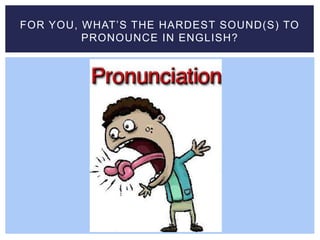
FOR YOU, WHAT’S THE HARDEST SOUND(S) TO
PRONOUNCE IN ENGLISH?
DO YOU RECALL A TIME WHEN YOU
MISHEARD SOMETHING IN ENGLISH?
DICTATION PRACTICE
You will hear a sentence 3 times.
- 1st = fast, normal pace
- 2nd = slow
- 3rd = very slow
Write down what you hear.
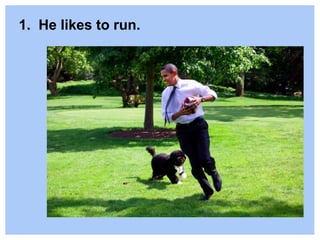
1. He likes to run.
1. She can sing very well.
2. Can you tell me what time it is?
3. Does our flight include a meal?
4. Where were you going last night
at 10.30?
5. Who told you that I was late to
work?
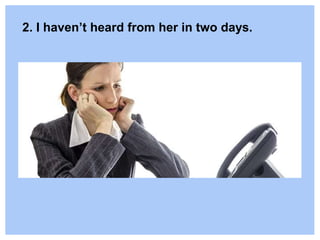
2. I haven’t heard from her in two days.
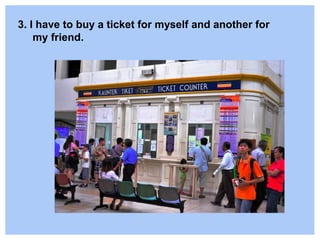
3. I have to buy a ticket for myself and another for
my friend.
4. Why doesn’t he want to go to the meeting with us?
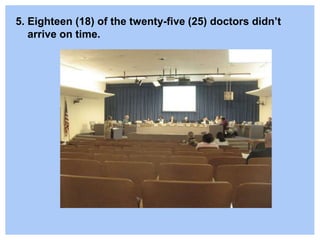
5. Eighteen (18) of the twenty-five (25) doctors didn’t
arrive on time.
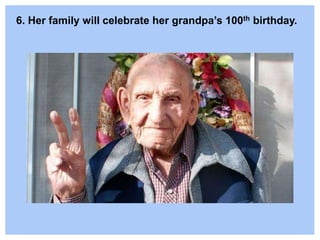
6. Her family will celebrate her grandpa’s 100th birthday.
7. Their new house has 3 bedrooms, 2 baths and a
huge kitchen
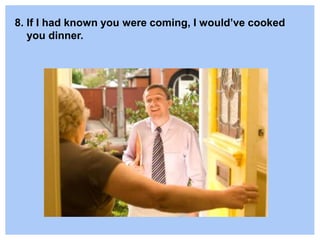
8. If I had known you were coming, I would’ve cooked
you dinner.
PRONUNCIATION PRACTICE
The following list of common pronunciation issues are
not just common for most English learners, but
especially for Vietnamese speakers.
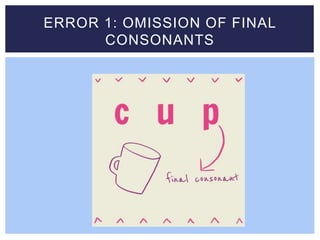
ERROR 1: OMISSION OF FINAL
CONSONANTS
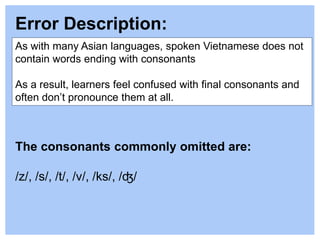
Error Description:
As with many Asian languages, spoken Vietnamese does not
contain words ending with consonants
As a result, learners feel confused with final consonants and
often don’t pronounce them at all.
The consonants commonly omitted are:
/z/, /s/, /t/, /v/, /ks/, /ʤ/
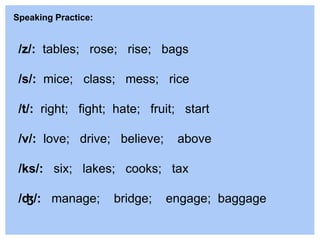
Speaking Practice:
/z/: tables; rose; rise; bags
/s/: mice; class; mess; rice
/t/: right; fight; hate; fruit; start
/v/: love; drive; believe; above
/ks/: six; lakes; cooks; tax
/ʤ/: manage; bridge; engage; baggage
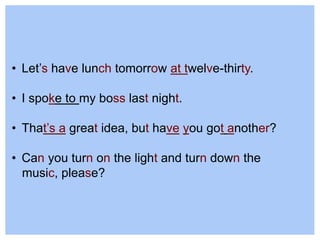
• Let’s have lunch tomorrow at twelve-thirty.
• I spoke to my boss last night.
• That’s a great idea, but have you got another?
• Can you turn on the light and turn down the
music, please?
ERROR 2: OMISSION OF MEDIAL
SOUNDS
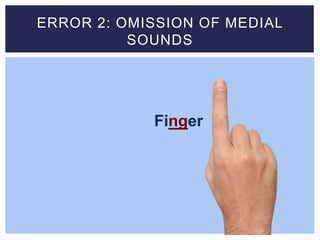
Finger
Error Description:
Some sounds occurring in the middle of words are also
commonly omitted by Vietnamese learners simply because
it’s an unfamiliar phonetic structure.
The consonants commonly omitted are:
/z/, /s/, /t/, /v/, /ks/, /ʤ/ (soft g / j sound)
Speaking Practice:
/z/: Wednesday; president; scissors, freezer
/s/: muscle; bracelet; pencil; Pasteur
/v/: severe; November; gloves; favorite
/ks/: mixed; excel; vaccine; backseat
/ʤ/: regional; soldier; budget; aged; subject
• I’d like to introduce you to my regional manager,
Steven.
• Seven of thirteen students arrived early for their course.
• Taking a driving test can be a difficult task.
• Every Friday, I watch a very funny program on television.
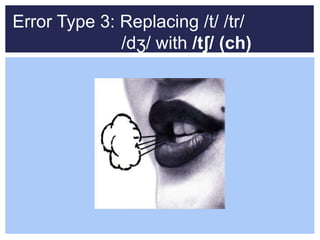
Error Type 3: Replacing /t/ /tr/
/dʒ/ with /tʃ/ (ch)
A significantly common error is to replace /t/ /tr/ & /ʤ/, with
/ʧ/ (ch-sound).
Error Description:
/t/: time; task; talented; potato
/tr/: trash; transit; tried; actress; attractive
/ʤ/: cage; change; strange; charge; gym
Speaking Practice
• Tomorrow, the team has a training workshop.
• Tom just tripped on some broken tile.
• They tried to charge me for a large tomato
juice, but I just drank a small orange juice.
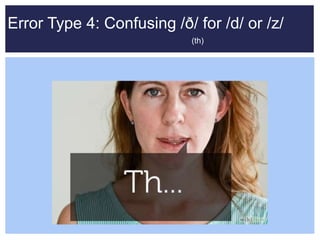
Error Type 4: Confusing /ð/ for /d/ or /z/
(th)
Most English learners find it difficult to place the tongue
tip between the teeth, so they use an easier solution by
touching the tip of the tongue to the back of the teeth,
sometimes creating the /d/ or /z/
sound.
Error Description:
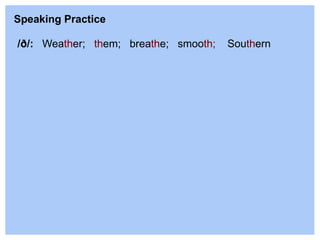
/ð/: Weather; them; breathe; smooth; Southern
Speaking Practice
• Don't bother your mother and father while they are
working.
• I thought their car was parked over there .
• This is theirs. That is ours.
• Those thoughtful teens talked about traditions during Tet.
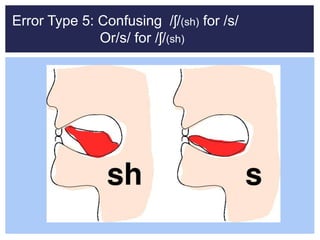
Error Type 5: Confusing /ʃ/(sh) for /s/
Or/s/ for /ʃ/(sh)
Vietnamese learners often use /s/ and /ʃ/ interchangeably; however,
/ʃ/ is more commonly confused for /s/ especially when it is the initial sound in a
word as in [shoe], which becomes [sue] and sometimes when it’s final as in
[cash] which becomes [Cass].
There are times when the opposite is true but more commonly when /s/ is
located in the middle of the word as in [castle] which sounds as [cashol].
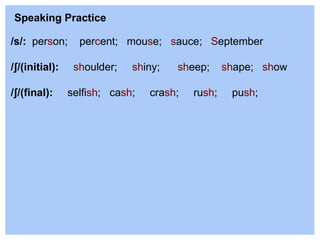
Error Description:
Speaking Practice
/s/: person; percent; mouse; sauce; September
/ʃ/(initial): shoulder; shiny; sheep; shape; show
/ʃ/(final): selfish; cash; crash; rush; push;
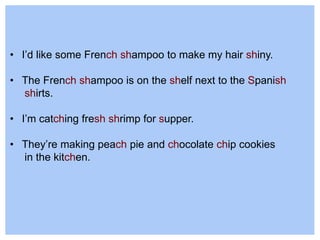
• I’d like some French shampoo to make my hair shiny.
• The French shampoo is on the shelf next to the Spanish
shirts.
• I’m catching fresh shrimp for supper.
• They’re making peach pie and chocolate chip cookies
in the kitchen.
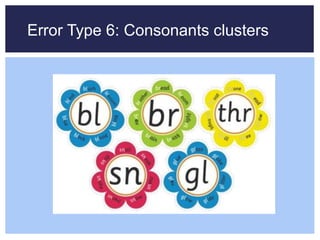
Error Type 6: Consonants clusters
As mentioned before, the consonants clusters are quite
unfamiliar to the Vietnamese language; thus, it can be easy to
mispronounce.
Error Description:
The most challenging consonant clusters
[pr] [pl] [tr] [kr] [kl] [fl] [ks] [sk] [st] [ts]
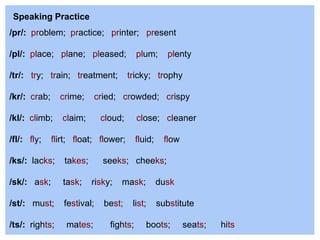
Speaking Practice
/pr/: problem; practice; printer; present
/pl/: place; plane; pleased; plum; plenty
/tr/: try; train; treatment; tricky; trophy
/kr/: crab; crime; cried; crowded; crispy
/kl/: climb; claim; cloud; close; cleaner
/fl/: fly; flirt; float; flower; fluid; flow
/ks/: lacks; takes; seeks; cheeks;
/sk/: ask; task; risky; mask; dusk
/st/: must; festival; best; list; substitute
/ts/: rights; mates; fights; boots; seats; hits
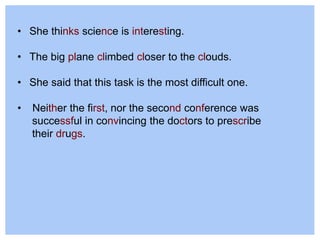
• She thinks science is interesting.
• The big plane climbed closer to the clouds.
• She said that this task is the most difficult one.
• Neither the first, nor the second conference was
successful in convincing the doctors to prescribe
their drugs.
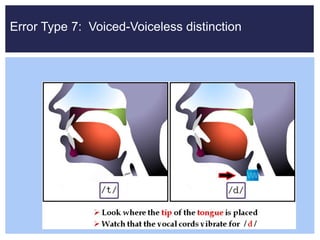
Error Type 7: Voiced-Voiceless distinction
In English, frequent shifts between voiced and voiceless
consonants are required to distinguish between certain
words.
Because this does not exist and is not required in
Vietnamese, this can be a pronunciation issue.
Error Description:
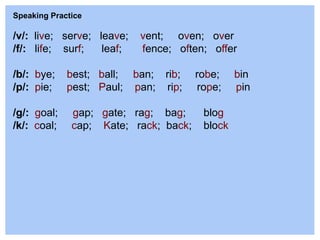
/v/: live; serve; leave; vent; oven; over
/f/: life; surf; leaf; fence; often; offer
/b/: bye; best; ball; ban; rib; robe; bin
/p/: pie; pest; Paul; pan; rip; rope; pin
/g/: goal; gap; gate; rag; bag; blog
/k/: coal; cap; Kate; rack; back; block
Speaking Practice
• The pretty black puppy barked.
• Bob should stop at the library.
• Pick a book and pack your bag.
• Friday was a very fun-filled vacation day.
• Can we go back one block to get my backpack?
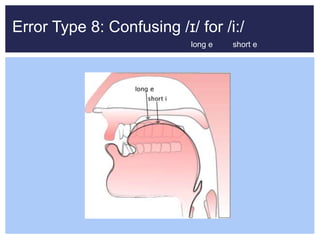
Error Type 8: Confusing /ɪ/ for /i:/
long e short e
This is another common mistake resulting of the
confusion between spelling and pronunciation.
Vowel /ɪ/ is quite frequently spelled as letter [i] in
English and since Vietnamese rely on spelling to
produce the English sounds, they confuse /ɪ/ for /i/.
Error Description:
Speaking Practice
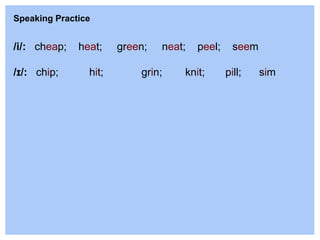
/i/: cheap; heat; green; neat; peel; seem
/ɪ/: chip; hit; grin; knit; pill; sim
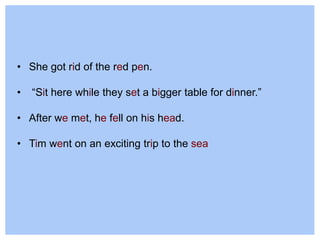
• She got rid of the red pen.
• “Sit here while they set a bigger table for dinner.”
• After we met, he fell on his head.
• Tim went on an exciting trip to the sea
INTONATION GAME
It’s not just how you pronounce a word, but the
way you say it that can change the meaning
of a sentence.
Practice changing the tone and intonation of
each sentence
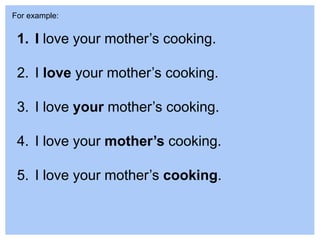
For example:
1. I love your mother’s cooking.
2. I love your mother’s cooking.
3. I love your mother’s cooking.
4. I love your mother’s cooking.
5. I love your mother’s cooking.
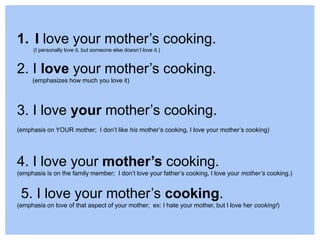
1. I love your mother’s cooking.
(I personally love it, but someone else doesn’t love it.)
2. I love your mother’s cooking.
(emphasizes how much you love it)
3. I love your mother’s cooking.
(emphasis on YOUR mother; I don’t like his mother’s cooking, I love your mother’s cooking)
4. I love your mother’s cooking.
(emphasis is on the family member; I don’t love your father’s cooking, I love your mother’s cooking.)
5. I love your mother’s cooking.
(emphasis on love of that aspect of your mother; ex: I hate your mother, but I love her cooking!)
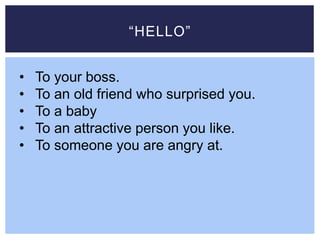
“HELLO”
• To your boss.
• To an old friend who surprised you.
• To a baby
• To an attractive person you like.
• To someone you are angry at.
I HAVE TO TELL YOU SOMETHING.
• You have happy/exciting news to share.
• You’ve got some bad news you must tell
• You’ve got some really good gossip you can’t
wait to tell your friend after work.
• You’re worried / nervous…
WHAT ARE YOU DOING HERE?
• You’re happily surprised to see a person here.
• You’re annoyed that this person is present.
• A person is doing something they shouldn’t be doing.
• A person shouldn’t be in this area/location, they should
be somewhere else.
“I LOVE YOU.”
• You don’t love anyone else. (I don’t love him, I love you!”)
• You like this person A LOT. (I don’t just like you, I love you.)
• You love someone, even though someone else may not
(he doesn’t love you, but I love you.)
MY SISTER BOUGHT A CAR.
• Your sister has no money, but she bought a car.
• Your brother didn’t buy a car… it was your sister who
bought a car.
• Your sister was going to buy a motorbike, but instead
bought a car.
• Your sister was going to rent a car, instead – she bought
one.
WHERE DID THEY GO?
• You can’t find them anywhere… you want to know where they went.
• They never go anywhere, it’s such a surprise they went somewhere.
• You’re excited/curious to hear about the place they went.
• You’re annoyed they’re gone… and want to know where they went.
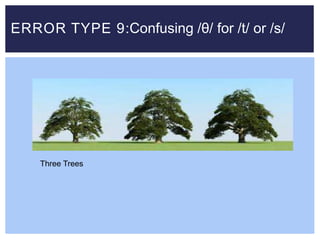
ERROR TYPE 9:Confusing /θ/ for /t/ or /s/
Three Trees
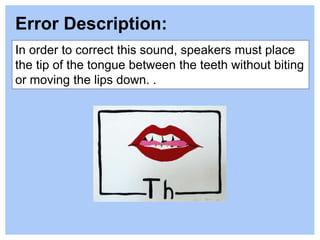
In order to correct this sound, speakers must place
the tip of the tongue between the teeth without biting
or moving the lips down. .
Error Description:
/θ/: both; Ruth; math; cloth; thick; thin; bath
/t/: boat; root; mat; clot; tick; tin; bat
/θ/: path; faith; thought; forth; growth; thank.
/s/: pass; face; sought; force; gross; sank.
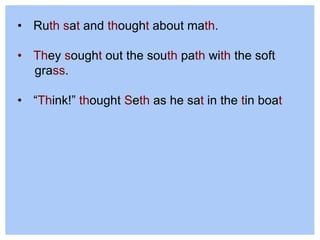
• Ruth sat and thought about math.
• They sought out the south path with the soft
grass.
• “Think!” thought Seth as he sat in the tin boat
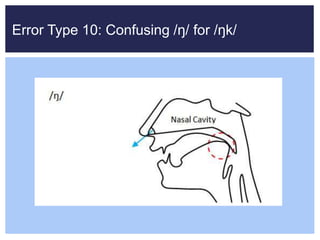
Error Type 10: Confusing /ŋ/ for /ŋk/
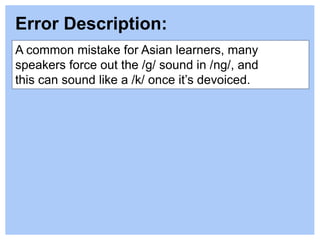
A common mistake for Asian learners, many
speakers force out the /g/ sound in /ng/, and
this can sound like a /k/ once it’s devoiced.
Error Description:
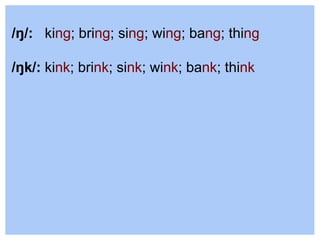
/ŋ/: king; bring; sing; wing; bang; thing
/ŋk/: kink; brink; sink; wink; bank; think
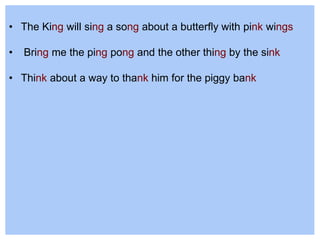
• The King will sing a song about a butterfly with pink wings
• Bring me the ping pong and the other thing by the sink
• Think about a way to thank him for the piggy bank
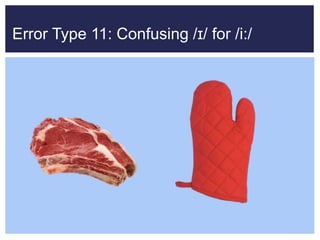
Error Type 11: Confusing /ɪ/ for /i:/
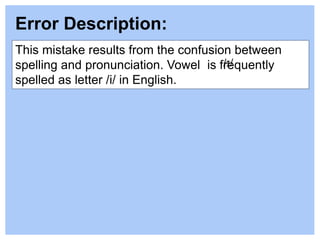
This mistake results from the confusion between
spelling and pronunciation. Vowel is frequently
spelled as letter /i/ in English.
Error Description:
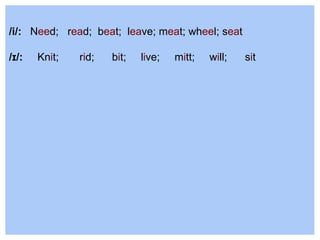
/ɪ/
/i/: Need; read; beat; leave; meat; wheel; seat
/ɪ/: Knit; rid; bit; live; mitt; will; sit
• I will fix your wheel if you just sit on this seat.
• I eat meat and drink milk, he eats wheat and
drinks beet juice.
• She needs to get rid of the knitting books she
reads and leave her house.
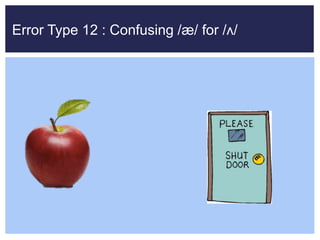
Error Type 12 : Confusing /æ/ for /ʌ/
Again, this error occurs due to the difference
between spelling and pronunciation. Vowel
is often spelled [a] which learners would read as
or /a/
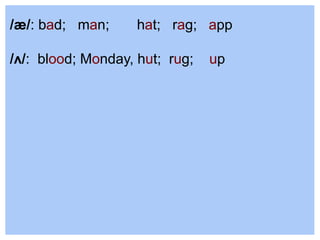
Error Description:
/æ/
/ʌ/
/æ/: bad; man; hat; rag; app
/ʌ/: blood; Monday, hut; rug; up
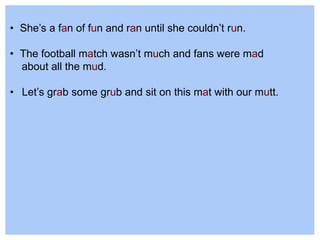
• She’s a fan of fun and ran until she couldn’t run.
• The football match wasn’t much and fans were mad
about all the mud.
• Let’s grab some grub and sit on this mat with our mutt.
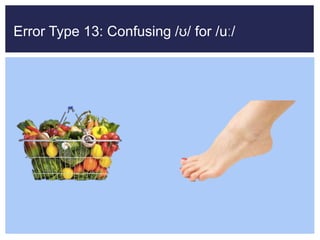
Error Type 13: Confusing /ʊ/ for /uː/
These two vowels are frequently spelt the same
therefore, they require practice and repetition
to create a habit.
Error Description:
/
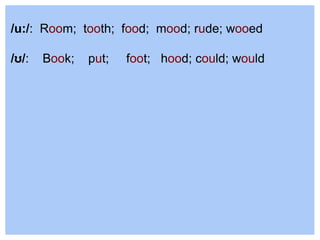
/u:/: Room; tooth; food; mood; rude; wooed
/ʊ/: Book; put; foot; hood; could; would
• Could you look at my foot and put on my shoe.
• Would you like a new suit to wear on Tuesday?
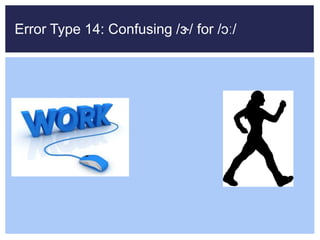
Error Type 14: Confusing /ɝ/ for /ɔː/
Error Description:
/
Vowel /ɝ/ is quite difficult for most English learners including
Vietnamese and is usually mispronounced as
/ɔː/ which could considerably affect the speech sound.
/ɝ/: First; sir; burn; curl; work; learn; worm
/ɔː/: Forced; soar; born; call; walk; lawn; warm
• She was born on a warm sunny day.
• He was forced to walk to work after his bike burned.
•
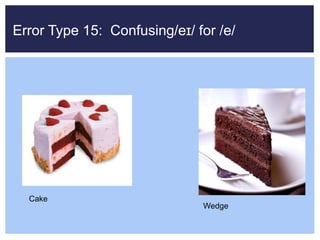
Error Type 15: Confusing/eɪ/ for /e/
Cake
Wedge
Error Description:
/
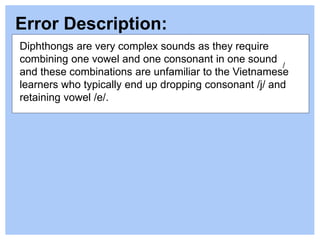
Diphthongs are very complex sounds as they require
combining one vowel and one consonant in one sound
and these combinations are unfamiliar to the Vietnamese
learners who typically end up dropping consonant /j/ and
retaining vowel /e/.
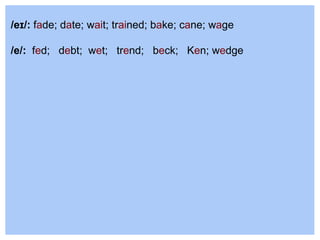
/eɪ/: fade; date; wait; trained; bake; cane; wage
/e/: fed; debt; wet; trend; beck; Ken; wedge
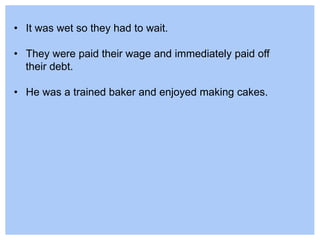
• It was wet so they had to wait.
• They were paid their wage and immediately paid off
their debt.
• He was a trained baker and enjoyed making cakes.
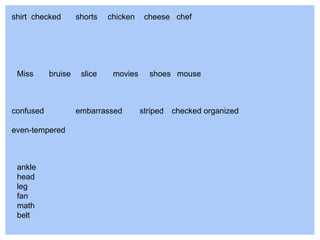
ankle
head
leg
fan
math
belt
Miss bruise slice movies shoes mouse
shirt checked shorts chicken cheese chef
confused embarrassed striped checked organized
even-tempered

English Pronunciation: Practice Set 2

  • 1.
  • 2.
    FOR YOU, WHAT’STHE HARDEST SOUND(S) TO PRONOUNCE IN ENGLISH?
  • 3.
    DO YOU RECALLA TIME WHEN YOU MISHEARD SOMETHING IN ENGLISH?
  • 4.
    DICTATION PRACTICE You willhear a sentence 3 times. - 1st = fast, normal pace - 2nd = slow - 3rd = very slow Write down what you hear.
  • 5.
    1. He likesto run.
  • 6.
    1. She cansing very well. 2. Can you tell me what time it is? 3. Does our flight include a meal? 4. Where were you going last night at 10.30? 5. Who told you that I was late to work?
  • 7.
    2. I haven’theard from her in two days.
  • 8.
    3. I haveto buy a ticket for myself and another for my friend.
  • 9.
    4. Why doesn’the want to go to the meeting with us?
  • 10.
    5. Eighteen (18)of the twenty-five (25) doctors didn’t arrive on time.
  • 11.
    6. Her familywill celebrate her grandpa’s 100th birthday.
  • 12.
    7. Their newhouse has 3 bedrooms, 2 baths and a huge kitchen
  • 13.
    8. If Ihad known you were coming, I would’ve cooked you dinner.
  • 14.
    PRONUNCIATION PRACTICE The followinglist of common pronunciation issues are not just common for most English learners, but especially for Vietnamese speakers.
  • 15.
    ERROR 1: OMISSIONOF FINAL CONSONANTS
  • 16.
    Error Description: As withmany Asian languages, spoken Vietnamese does not contain words ending with consonants As a result, learners feel confused with final consonants and often don’t pronounce them at all. The consonants commonly omitted are: /z/, /s/, /t/, /v/, /ks/, /ʤ/
  • 17.
    Speaking Practice: /z/: tables;rose; rise; bags /s/: mice; class; mess; rice /t/: right; fight; hate; fruit; start /v/: love; drive; believe; above /ks/: six; lakes; cooks; tax /ʤ/: manage; bridge; engage; baggage
  • 18.
    • Let’s havelunch tomorrow at twelve-thirty. • I spoke to my boss last night. • That’s a great idea, but have you got another? • Can you turn on the light and turn down the music, please?
  • 19.
    ERROR 2: OMISSIONOF MEDIAL SOUNDS Finger
  • 20.
    Error Description: Some soundsoccurring in the middle of words are also commonly omitted by Vietnamese learners simply because it’s an unfamiliar phonetic structure. The consonants commonly omitted are: /z/, /s/, /t/, /v/, /ks/, /ʤ/ (soft g / j sound)
  • 21.
    Speaking Practice: /z/: Wednesday;president; scissors, freezer /s/: muscle; bracelet; pencil; Pasteur /v/: severe; November; gloves; favorite /ks/: mixed; excel; vaccine; backseat /ʤ/: regional; soldier; budget; aged; subject
  • 22.
    • I’d liketo introduce you to my regional manager, Steven. • Seven of thirteen students arrived early for their course. • Taking a driving test can be a difficult task. • Every Friday, I watch a very funny program on television.
  • 23.
    Error Type 3:Replacing /t/ /tr/ /dʒ/ with /tʃ/ (ch)
  • 24.
    A significantly commonerror is to replace /t/ /tr/ & /ʤ/, with /ʧ/ (ch-sound). Error Description:
  • 25.
    /t/: time; task;talented; potato /tr/: trash; transit; tried; actress; attractive /ʤ/: cage; change; strange; charge; gym Speaking Practice
  • 26.
    • Tomorrow, theteam has a training workshop. • Tom just tripped on some broken tile. • They tried to charge me for a large tomato juice, but I just drank a small orange juice.
  • 27.
    Error Type 4:Confusing /ð/ for /d/ or /z/ (th)
  • 28.
    Most English learnersfind it difficult to place the tongue tip between the teeth, so they use an easier solution by touching the tip of the tongue to the back of the teeth, sometimes creating the /d/ or /z/ sound. Error Description:
  • 29.
    /ð/: Weather; them;breathe; smooth; Southern Speaking Practice
  • 30.
    • Don't botheryour mother and father while they are working. • I thought their car was parked over there . • This is theirs. That is ours. • Those thoughtful teens talked about traditions during Tet.
  • 31.
    Error Type 5:Confusing /ʃ/(sh) for /s/ Or/s/ for /ʃ/(sh)
  • 32.
    Vietnamese learners oftenuse /s/ and /ʃ/ interchangeably; however, /ʃ/ is more commonly confused for /s/ especially when it is the initial sound in a word as in [shoe], which becomes [sue] and sometimes when it’s final as in [cash] which becomes [Cass]. There are times when the opposite is true but more commonly when /s/ is located in the middle of the word as in [castle] which sounds as [cashol]. Error Description:
  • 33.
    Speaking Practice /s/: person;percent; mouse; sauce; September /ʃ/(initial): shoulder; shiny; sheep; shape; show /ʃ/(final): selfish; cash; crash; rush; push;
  • 34.
    • I’d likesome French shampoo to make my hair shiny. • The French shampoo is on the shelf next to the Spanish shirts. • I’m catching fresh shrimp for supper. • They’re making peach pie and chocolate chip cookies in the kitchen.
  • 35.
    Error Type 6:Consonants clusters
  • 36.
    As mentioned before,the consonants clusters are quite unfamiliar to the Vietnamese language; thus, it can be easy to mispronounce. Error Description: The most challenging consonant clusters [pr] [pl] [tr] [kr] [kl] [fl] [ks] [sk] [st] [ts]
  • 37.
    Speaking Practice /pr/: problem;practice; printer; present /pl/: place; plane; pleased; plum; plenty /tr/: try; train; treatment; tricky; trophy /kr/: crab; crime; cried; crowded; crispy /kl/: climb; claim; cloud; close; cleaner /fl/: fly; flirt; float; flower; fluid; flow /ks/: lacks; takes; seeks; cheeks; /sk/: ask; task; risky; mask; dusk /st/: must; festival; best; list; substitute /ts/: rights; mates; fights; boots; seats; hits
  • 38.
    • She thinksscience is interesting. • The big plane climbed closer to the clouds. • She said that this task is the most difficult one. • Neither the first, nor the second conference was successful in convincing the doctors to prescribe their drugs.
  • 39.
    Error Type 7:Voiced-Voiceless distinction
  • 40.
    In English, frequentshifts between voiced and voiceless consonants are required to distinguish between certain words. Because this does not exist and is not required in Vietnamese, this can be a pronunciation issue. Error Description:
  • 41.
    /v/: live; serve;leave; vent; oven; over /f/: life; surf; leaf; fence; often; offer /b/: bye; best; ball; ban; rib; robe; bin /p/: pie; pest; Paul; pan; rip; rope; pin /g/: goal; gap; gate; rag; bag; blog /k/: coal; cap; Kate; rack; back; block Speaking Practice
  • 42.
    • The prettyblack puppy barked. • Bob should stop at the library. • Pick a book and pack your bag. • Friday was a very fun-filled vacation day. • Can we go back one block to get my backpack?
  • 43.
    Error Type 8:Confusing /ɪ/ for /i:/ long e short e
  • 44.
    This is anothercommon mistake resulting of the confusion between spelling and pronunciation. Vowel /ɪ/ is quite frequently spelled as letter [i] in English and since Vietnamese rely on spelling to produce the English sounds, they confuse /ɪ/ for /i/. Error Description:
  • 45.
    Speaking Practice /i/: cheap;heat; green; neat; peel; seem /ɪ/: chip; hit; grin; knit; pill; sim
  • 46.
    • She gotrid of the red pen. • “Sit here while they set a bigger table for dinner.” • After we met, he fell on his head. • Tim went on an exciting trip to the sea
  • 47.
    INTONATION GAME It’s notjust how you pronounce a word, but the way you say it that can change the meaning of a sentence. Practice changing the tone and intonation of each sentence
  • 48.
    For example: 1. Ilove your mother’s cooking. 2. I love your mother’s cooking. 3. I love your mother’s cooking. 4. I love your mother’s cooking. 5. I love your mother’s cooking.
  • 49.
    1. I loveyour mother’s cooking. (I personally love it, but someone else doesn’t love it.) 2. I love your mother’s cooking. (emphasizes how much you love it) 3. I love your mother’s cooking. (emphasis on YOUR mother; I don’t like his mother’s cooking, I love your mother’s cooking) 4. I love your mother’s cooking. (emphasis is on the family member; I don’t love your father’s cooking, I love your mother’s cooking.) 5. I love your mother’s cooking. (emphasis on love of that aspect of your mother; ex: I hate your mother, but I love her cooking!)
  • 50.
    “HELLO” • To yourboss. • To an old friend who surprised you. • To a baby • To an attractive person you like. • To someone you are angry at.
  • 51.
    I HAVE TOTELL YOU SOMETHING. • You have happy/exciting news to share. • You’ve got some bad news you must tell • You’ve got some really good gossip you can’t wait to tell your friend after work. • You’re worried / nervous…
  • 52.
    WHAT ARE YOUDOING HERE? • You’re happily surprised to see a person here. • You’re annoyed that this person is present. • A person is doing something they shouldn’t be doing. • A person shouldn’t be in this area/location, they should be somewhere else.
  • 53.
    “I LOVE YOU.” •You don’t love anyone else. (I don’t love him, I love you!”) • You like this person A LOT. (I don’t just like you, I love you.) • You love someone, even though someone else may not (he doesn’t love you, but I love you.)
  • 54.
    MY SISTER BOUGHTA CAR. • Your sister has no money, but she bought a car. • Your brother didn’t buy a car… it was your sister who bought a car. • Your sister was going to buy a motorbike, but instead bought a car. • Your sister was going to rent a car, instead – she bought one.
  • 55.
    WHERE DID THEYGO? • You can’t find them anywhere… you want to know where they went. • They never go anywhere, it’s such a surprise they went somewhere. • You’re excited/curious to hear about the place they went. • You’re annoyed they’re gone… and want to know where they went.
  • 56.
    ERROR TYPE 9:Confusing/θ/ for /t/ or /s/ Three Trees
  • 57.
    In order tocorrect this sound, speakers must place the tip of the tongue between the teeth without biting or moving the lips down. . Error Description:
  • 58.
    /θ/: both; Ruth;math; cloth; thick; thin; bath /t/: boat; root; mat; clot; tick; tin; bat /θ/: path; faith; thought; forth; growth; thank. /s/: pass; face; sought; force; gross; sank.
  • 59.
    • Ruth satand thought about math. • They sought out the south path with the soft grass. • “Think!” thought Seth as he sat in the tin boat
  • 60.
    Error Type 10:Confusing /ŋ/ for /ŋk/
  • 61.
    A common mistakefor Asian learners, many speakers force out the /g/ sound in /ng/, and this can sound like a /k/ once it’s devoiced. Error Description:
  • 62.
    /ŋ/: king; bring;sing; wing; bang; thing /ŋk/: kink; brink; sink; wink; bank; think
  • 63.
    • The Kingwill sing a song about a butterfly with pink wings • Bring me the ping pong and the other thing by the sink • Think about a way to thank him for the piggy bank
  • 64.
    Error Type 11:Confusing /ɪ/ for /i:/
  • 65.
    This mistake resultsfrom the confusion between spelling and pronunciation. Vowel is frequently spelled as letter /i/ in English. Error Description: /ɪ/
  • 66.
    /i/: Need; read;beat; leave; meat; wheel; seat /ɪ/: Knit; rid; bit; live; mitt; will; sit
  • 67.
    • I willfix your wheel if you just sit on this seat. • I eat meat and drink milk, he eats wheat and drinks beet juice. • She needs to get rid of the knitting books she reads and leave her house.
  • 68.
    Error Type 12: Confusing /æ/ for /ʌ/
  • 69.
    Again, this erroroccurs due to the difference between spelling and pronunciation. Vowel is often spelled [a] which learners would read as or /a/ Error Description: /æ/ /ʌ/
  • 70.
    /æ/: bad; man;hat; rag; app /ʌ/: blood; Monday, hut; rug; up
  • 71.
    • She’s afan of fun and ran until she couldn’t run. • The football match wasn’t much and fans were mad about all the mud. • Let’s grab some grub and sit on this mat with our mutt.
  • 72.
    Error Type 13:Confusing /ʊ/ for /uː/
  • 73.
    These two vowelsare frequently spelt the same therefore, they require practice and repetition to create a habit. Error Description: /
  • 74.
    /u:/: Room; tooth;food; mood; rude; wooed /ʊ/: Book; put; foot; hood; could; would
  • 75.
    • Could youlook at my foot and put on my shoe. • Would you like a new suit to wear on Tuesday?
  • 76.
    Error Type 14:Confusing /ɝ/ for /ɔː/
  • 77.
    Error Description: / Vowel /ɝ/is quite difficult for most English learners including Vietnamese and is usually mispronounced as /ɔː/ which could considerably affect the speech sound.
  • 78.
    /ɝ/: First; sir;burn; curl; work; learn; worm /ɔː/: Forced; soar; born; call; walk; lawn; warm
  • 79.
    • She wasborn on a warm sunny day. • He was forced to walk to work after his bike burned. •
  • 80.
    Error Type 15:Confusing/eɪ/ for /e/ Cake Wedge
  • 81.
    Error Description: / Diphthongs arevery complex sounds as they require combining one vowel and one consonant in one sound and these combinations are unfamiliar to the Vietnamese learners who typically end up dropping consonant /j/ and retaining vowel /e/.
  • 82.
    /eɪ/: fade; date;wait; trained; bake; cane; wage /e/: fed; debt; wet; trend; beck; Ken; wedge
  • 83.
    • It waswet so they had to wait. • They were paid their wage and immediately paid off their debt. • He was a trained baker and enjoyed making cakes.
  • 84.
    ankle head leg fan math belt Miss bruise slicemovies shoes mouse shirt checked shorts chicken cheese chef confused embarrassed striped checked organized even-tempered