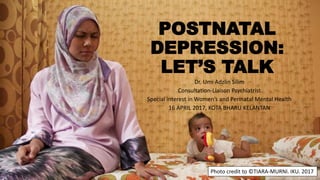
POSTNATAL
DEPRESSION:
LET’S TALK
Dr. Umi Adzlin Silim
Consultation-Liaison Psychiatrist
Special interest in Women’s and Perinatal Mental Health
16 APRIL 2017, KOTA BHARU KELANTAN
Photo credit to ©TIARA-MURNI. IKU. 2017
The Story of Marlia
• Marlia, 38 years old professional woman, just
delivered her 5th baby.
• When her new Indonesian maid ran away after a
month of her childbirth, she had to manage
everything on her own.
• She had 3 earlier confinement with her mother,
and the 4th one with another Indonesian maid -
Her husband was not used to provide her
support on childcare and homechores.
…Marlia
• The loss of sudden practical support overwhelmed her.
• She could not depend on her husband as he expected she should be
able to manage everything on her own because ‘this was already their
5th baby’.
• Marlia, being a professional woman, who always have things
organized and her to-do-list well done, found herself could not
manage everything alone with a baby who was always unpredictable.
…Marlia
• She was teary, feeling low almost everyday.
• She could not even make simple decisions like what it is for breakfast
or dinner, and could no more manage the morning rush preparing the
older children going to school…
• She could not stand seeing her laundry not done and her house in
mess but she was too exhausted to do everything, all she did was
lying besides her baby all day long, not knowing where and how to
start…
The Story of Zarina
• Zarina, 27 years old, always dream of a natural
childbirth, having a healthy baby whom she
would breastfeed exclusively until at least 2 years
• All her dreams shattered – she went into labour
but having poor progress and fetal distress,
ended up with a caeserian section.
…Zarina
• Just after discharged, her baby developed jaundice and required an
admission.
• She had a wound breakdown.
• Her baby was fed with formula milk when she was unable to provide
her breastmilk (bay was admitted in a private hospital)
…Zarina
• She found her baby was difficult to manage (? Having colic) and
frequently unwell
• She was always worried about her baby but has no one to refer to
• Her mother who was still working and very busy, could not provide
her the support she needed
• Her husband is trying to help, but they ended up quarelling as her
husband could not do things correctly most of the time
The Story of Wardina
• Wardina knew something was not right after her second childbirth
• She felt miserable, having frequent urges wanting to harm herself
• She was undergoing her confinement alone as her mother had to
accompany her father in oversea and her husband was frequently
outstation
• She does not feel supported, unlike after her first childbirth
…Wardina
• When she went for her postnatal appointment &her baby
vaccination – she wondered why nobody ever asked her how she was.
She desperately wished to have someone to talk to!
• She was so confused on why she was not feeling happy, and being an
avid reader she recalled that she read a lot on baby’s care, maternal
wellbeing and physical health – but she never came across into
reading on something related to emotional changes after childbirth.
…Wardina
More than baby blues..
Postpartum
Emotional Changes
Postpartum Blues
Postpartum Depression & Anxiety
Postpartum Psychosis
8 in 10 mothers
experience
postnatal blues
1 in 10 mothers
suffers from
postnatal depression
1 in 20 fathers
experience
postnatal depression too
1 in 1000 mothers
experience postpartum
psychosis
POSTNATAL
DEPRESSION
Photo credit to ©TIARA-MURNI. IKU. 2017
Recent Nationwide
Malaysian Data on
Postnatal Depression 2016
National Maternal & Child Health Survey 2016
Postnatal Depression Malaysia ASPIRE Project 2016
NHMS 2016
12.7% mothers 6-16 weeks had
postnatal depression based on a self-
reported questionnaire (EPDS)
EPDS: Edinburgh Postnatal Depression Scale
Prevalence of Possible
PND in NHMS 2016
• 1 in 6 Indian
• 1 in 4 Chinese
• 1 in 12 Malay
• Age 30-34
• Higher in lowest income group less
than RM1000 & highest income group
more than RM5000
• Highest in
• working women in private sector (18%)
• unemployed/housewife/student
• self-employed
• public sector (4.3%)
Postnatal Depression
ASPIRE Malaysia Project
Phase 1: Prevalence & Risk
Factors
PND ASPIRE 2016
4.4% mothers 6-16 weeks had
postnatal depression based on a self-
reported questionnaire (EPDS)
EPDS: Edinburg Postnatal Depression Scale
Prevalence of Possible PND in ASPIRE 2016
• Women with postnatal depression were from
• the younger age group,
• with young husbands,
• not married/without partner,
• low education level,
• unemployed/housewife
• low household income.
Significantly Associated Factors ASPIRE 2016
• 3x higher risk if no social support
• 5x higher risk if pregnancy is unwanted
• 10x higher risk in currently smoking women
• 10x higher risk in current intimate partner violence
Recognizing
Women at Risk
Are all women at
risk because it is
hormonal?
BIOMEDICAL MODEL
• The most popular theory: dramatic hormonal changes
are responsible for the mood changes during this time
of period
• No consistent linear relationship between estrogen
and/or progesterone hormones with the symptoms of
depression.
Ross LE, Toner B. Appylying a Biopsychosocial Model to Research on Maternal Health. Journal of the Association for Research on Mothering; 6(1):168-75.
BIOPSYCHOSOCIAL MODEL
• Even though there is strong relationship between certain biological
risk (eg: family psychiatric history) with symptoms of depression, once
the psychosocial variables were integrated into the model, the
biological variables were no longer become main predictors of
depression.
• Therefore, even though the biological variables (eg: hormonal
changes) are important in development of perinatal depression, it can
only be properly understood within the psychosocial context.
Ross LE, Toner B. Appylying a Biopsychosocial Model to Research on Maternal Health. Journal of the Association for Research on Mothering; 6(1):168-75.
RISK FACTORS (Meta-analysis)
• Life stress
• Childcare stress
• History of previous depression & Family history
• Prenatal depression & anxiety
• Unplanned pregnancy
• Low self-esteem
• Unfavorable socioeconomic status,
• Unfavourable marital status and relationship,
• Unfavourable social support
• Infant temperament
O'Hara MW, Swain AM. Rates and risk of postpartum depression— a meta-analysis. International Review of Psychiatry1996;8:37-54.
Life event & Stress
• Negative life events
(found in 84% of cases of
depression) including birth
complications, loss of
employment of partner,
health difficulties
• Stress, mainly in area of
infant care.
Paykel et al, 1980; O’hara et al 1982; Brown, 1993.
Family & Marital Difficulties
• Poor marital relationship • Woman-mother conflict
Paykel et al, 1980; Schweitzer et al 1992.
Perceived
husband’s
low support,
practical &
emotional
High
control,
low level
of care
Declined
marital
satisfaction
after
childbirth
Balinger et 1979; Kumar & Robson 1978.
Inadequate Level of Perceived Social Support
• Poor Family Support & Social Isolation
Taylor, 1989; Cutrona 1984.
Mood during pregnancy
• Antenatal anxiety • Antenatal Depression
Dennerstein et al, 1986; Hopkins et al, 1984
Personal or family history of depression
• Previous episode of PND or
major depression
O’hara et al, 1991; O’hara & Swain, 1996.
Early experiences
• Difficult relationship with own
mother
• History of sexual abuse
Infant temperament;
mother infant-difficulties
• Infant difficult temperament
• Mothers of babies who cry or
vomit more than average more
likely to be depressed
• Depressed mom perceived infants
are more demanding
Mayberry & Alfonso, 1993; Milgrom & McCloud, 1996
Personality, attitudes, skills
• Low self esteem • Poor social skills
• Poor parenting
self efficacy is
partly a function
of poor social skill
& child rearing skills
Paykel et al, 1980; Lewinsohn, 1974.
Personality, attitude & skills
• Cognitive styles such as external
locus of control* & negative
attitude towards child rearing
*believes the have little or no control
over events in their life
Hayworth et al, 1980; Davids & Holden 1970.
Personality, attitude, skills
• Personality factors including strong need for order,
control and perfectionism
Social expectations of joy of motherhood
• Myth of serenity after childbirth • Cultural influences
Unrealistic expectation may cause sense of failure
The truth of motherhood
• Complexities in life with baby
• Transition to motherhood
• Huge physical, emotional, social
changes
• Physical stress – breastfeeding,
constant demand of caring
• Frustration of unable to complete
other activities
• Revive stress of family of origin
IMPORTANT MODIFYING FACTORS
• Mothers who received social support in perinatal period were
significantly less likely to experience postpartum depression.
• Social support: a focus as both a risk factor associated with
postpartum depression and a target of psychosocial interventions.
Liabsuetrakul T, Vittayanont A, Pitanupong J. Clinical applications of anxiety, social support, stressors, and self-esteem measured during pregnancy and postpartum for screening postpartum
depression in Thai women. J Obstet Gynaecol Res 2007;33(3):333-40.
Warner E, Miller M, Osborne LM, Kuzava S, Monk C. Preventing postpatum depression: review and recommendations. Arch Womens Ment Health 2015;18:41-60.
Leigh B, Milgrom J. Risk factors for antenatal depression, postnatal depresssion and parenting stress. BMC Psychiatry 2008;8:24.
Halbreich U. The association between pregnancy processes, preterm delivery, low birth weight, and postpartum depressions -- the need for interdisciplinary integration. Am J Obstet Gynecol
2005; 193:1312-22.
Diagnosing
Diagnosis
• Diagnostic and Statistical Manual of Mental Disorders DSM-V: Postpartum depression is a
major depressive disorder (present of depressive symptoms for at least 2 weeks) with
postpartum onset with depressive symptoms begin within 4 weeks postpartum
• International Statistical Classification of Diseases and Related Health Problems ICD-10:
postpartum depression is a mental and behavioural disorder commencing within 6 weeks
of delivery.
Diagnosis of PND,
simplified
• PND is a debilitating illness of clinical
depression that occur after childbirth, sudden
or gradual within weeks-months, up to 1 year
• Mild, moderate, severe
• Affect mothers, and fathers!
Clinical Depression,
DSM V
• FEELING DEPRESSED for more than 2
weeks; OR
• LOSS OF INTEREST for more than 2 weeks
• ASSOCIATED WITH
• Reduced/increased weight or appetite
• Reduced sleep/increased sleep
• Psychomotor retardation/agitation
• Fatigue
• Reduced ability to think, concentrate,
make decision
• Feeling worthless or excessive guilt
• Recurrent suicidal thoughts
• IMPAIRED FUNCTIONING
Themes In PND
• Low confidence / self esteem (‘bad mother’)
• Difficulty coping with childcare
• Difficulty bonding
• Extreme anxiety about health of baby
• Overconcern about feeding / sleeping regime
• Odd / overvalued ideas
• Physical anxiety symptoms / panic attacks
• Suicidal thoughts
• Infanticidal thoughts
• Relationship difficulties / conflict
Diagnosis, the challenges
• The diagnosis of postpartum depression is
• Often goes unrecognized
• Overlapping symptoms: many of the symptoms such as changes in sleep
patterns; changes in appetite and excessive fatigue may be attributed to
postpartum changes.
• Depressive women are less likely or reluctant to report the changes in their
mood to the clinicians
American College of Obstetricians and Gynecologists. Committee opinion 630. Screening for Perinatal Depression. Obstet Gynecol 2015;125:1268-71.
Screening
Increasing help seeking
• Normalising the possibility of
PND
• Early identification through
awareness of healthcare team
• Close attention to women at risk
• Routine screening
Screening is
the way to go…
• EPDS (Cox et al, 1987)
• Translated > 15 languages
• Used both antenatally &
postnatally
• Validated Malay version is available
with cut off 11/12 for caseness (Wan
Rushidi, 2003)
• In practical term 6 out of 10
women who scores positive on the
EPDS will meet diagnostic criteria
for MDD and others will meet the
criteria for minor depression,
adjustment disorder & postnatal
distress
MANAGEMENT OF PND
Photo credit to ©TIARA-MURNI. IKU. 2017
Treatment of PND
Mild Psychological interventions: Counselling, Cognitive
Behavioral Therapy (CBT)
Moderate Risk-Benefit Analysis for Antidepressant therapy,
Counselling, CBT
Severe Antidepressant therapy, CBT, Community Mental
Health Treatment, Electroconvulsive therapy (ECT)
All Levels Address Mother-Baby Interaction
Level of Care
Source Beyond Blue National PND Initiative, National Action Plan Full Report 2008-2010
NICE Guidelines on Perinatal Mental Health
Perinatal Women
Anxiety/Depression
(High Prevalence)
Drug Addiction
Severe Mental
Illness-New/Old
(Low Prevalence)
Consultation-Liaison between
Mental Health & Maternity Services
PSYCHIATRY
• Low Prevalence illnesses
• Consultation-liaison & ‘case
management’ approaches
• Training
Perinatal
Community
Services
• High Prevalence illnesses
• Psychological interventions
• Research, development &
training
Perinatal
Mental
Health Team
• Inpatient services for parent
& baby
Parent-
Infant Unit
MCH
Screening
• Trained &
Enhanced
Maternal & Child
Health Nurse
• Case
Management,
support & care
• Seek consultation
& make referral
A Round Table With Policy Makers / Key Stakeholders
COMMITMENT TO WORK ON INTEGRATING
PERINATAL MENTAL HEALTH SERVICES INTO MATERNAL & CHILD SERVICES
THE PLAN
The stakeholders (policy makers) in the MOH are committed
towards integrating perinatal mental health services to
maternal & child health program in Malaysia based on the
research findings
RESEARCH TO INFORM POLICY MAKERS
National Maternal & Child Health Survey 2016
ASPIRE Postnatal Depression Research 2016
PHARMACOLOGICAL RX
Consideration for Antidepressant
• Balancing risk and benefit
Antidepressants & Breastfeeding
• Most SSRIs is safe in lactation
• Limited data for newer antidepressants eg Agomelatine (Valdoxan), Venlafaxine &
Mirtazipine. Risk benefit analysis i.e. benefit of breastfeeding vs benefit of
therapy is required.
• Discarding of breast milk or timing feeding around medication will NOT make a
big difference to the dose received by the infant.
• All breastfeeding infants to mothers taking psychotropics must be monitored for
sedation, manifested with poor feeding.
• Short acting Benzodiazepine is preferred if indicated
SSRI Antidepressant in Breastfeeding
• Low levels excreted for most SSRIs.
• Relative infant doses: a relative infant dose of lower than 10% of the
weight adjusted maternal dose is considered to be safe for breastfeeding.
• Relative Infant Doses:
• Sertraline 2.2%,
• Escitalopram 3.6%,
• Paroxetine 2.1%,
• Fluvoxamine 1.3%,
• Fluoxetine 6.8%.
• Some concern with Fluoxetine given its long half life and the risk of accumulation in the infant
Psychotropic Medication in Pregnancy/Lactation. 2nd Edition. Mercy Hospital For Women. 2008
The Risks of Untreated Depression
• Short-term
• Seriously interfere with the adjustment to motherhood
• Seriously interfere to the care of the newborn baby as well as older children.
• Longterm
• Lasting effects on maternal self-esteem
• Lasting effects partner relationship
• Lasting effects on family relationships
• The mental health and social adjustment of the child.
PSYCHOLOGICAL RX
Psychological & Psychosocial Interventions
• Psychoeducation
• Counselling
• Mobilizing Psychosocial Support
• Cognitive Behaviour Therapy (CBT)
• Interventions to address mother & baby interaction
Training on CBT
TIARA-MURNI
for nurses
27-28th February 2017
CBT TIARA-MURNI
• Session 1: Education on PND
• Session 2: Relaxation & Behavioral Rx
• Session 3: Thinking Style
• Session 4: Marital Relationship
• Session 5: Mother-Baby Interaction
• Session 6: Conclusion & Relapse Prevention
Authors: Umi Adzlin Silim, Noor Ani Ahmad, Firdaus Mukhtar,
Aida Farhana Suhaimi, Arlina Nuruddin, Salmi Razali, Sumeet
Kaur, Baizury Bashah, Muslimah Yusof
MOTHER-BABY INTERACTION
TAKE HOME
MESSAGE
• Postnatal Depression is a highly prevalent
mental health issue after childbirth with great
impact to women, children & family
• PND is commonly underdiagnosed: screening by
EPDS will identify high risk women; followed by
further diagnostic assessment based on DSM-V
or ICD 10 criteria
• Treatment is available & effective:
pharmacological, psychological intervention &
addressing mother-baby interaction
THANK YOU
Maternal Health Determines the Wellbeing of Future Generation
“Listening” (by Sherri Hardy, Melbourne)
On the outside looking in
You see a smile and all is well
Yet if you look a little closer
You’d see the pain in which I dwell
On the inside looking out
I saw the joys in other’s lives
I wonder where my joy has gone
The absence hurts my eyes
Through the haze I see the days go by
And I watch my child grow
I fear my acts will scare her
Or she is just too young to know
I don’t know why I get so angry
When her cry are just her speech
She does not even deserve my anger
Or my attitude of defeat
You’ll tell me she’s a good baby
Don’t you think I already know?
Your words just drive the pain harder
When all I want is to let go
It is the illness that I suffer
A bad person I am not
As a mother I do my very best
I give it everything I’ve got

Postnatal Depression: Let’s Talk

  • 1.
    POSTNATAL DEPRESSION: LET’S TALK Dr. UmiAdzlin Silim Consultation-Liaison Psychiatrist Special interest in Women’s and Perinatal Mental Health 16 APRIL 2017, KOTA BHARU KELANTAN Photo credit to ©TIARA-MURNI. IKU. 2017
  • 2.
    The Story ofMarlia • Marlia, 38 years old professional woman, just delivered her 5th baby. • When her new Indonesian maid ran away after a month of her childbirth, she had to manage everything on her own. • She had 3 earlier confinement with her mother, and the 4th one with another Indonesian maid - Her husband was not used to provide her support on childcare and homechores.
  • 3.
    …Marlia • The lossof sudden practical support overwhelmed her. • She could not depend on her husband as he expected she should be able to manage everything on her own because ‘this was already their 5th baby’. • Marlia, being a professional woman, who always have things organized and her to-do-list well done, found herself could not manage everything alone with a baby who was always unpredictable.
  • 4.
    …Marlia • She wasteary, feeling low almost everyday. • She could not even make simple decisions like what it is for breakfast or dinner, and could no more manage the morning rush preparing the older children going to school… • She could not stand seeing her laundry not done and her house in mess but she was too exhausted to do everything, all she did was lying besides her baby all day long, not knowing where and how to start…
  • 5.
    The Story ofZarina • Zarina, 27 years old, always dream of a natural childbirth, having a healthy baby whom she would breastfeed exclusively until at least 2 years • All her dreams shattered – she went into labour but having poor progress and fetal distress, ended up with a caeserian section.
  • 6.
    …Zarina • Just afterdischarged, her baby developed jaundice and required an admission. • She had a wound breakdown. • Her baby was fed with formula milk when she was unable to provide her breastmilk (bay was admitted in a private hospital)
  • 7.
    …Zarina • She foundher baby was difficult to manage (? Having colic) and frequently unwell • She was always worried about her baby but has no one to refer to • Her mother who was still working and very busy, could not provide her the support she needed • Her husband is trying to help, but they ended up quarelling as her husband could not do things correctly most of the time
  • 8.
    The Story ofWardina • Wardina knew something was not right after her second childbirth • She felt miserable, having frequent urges wanting to harm herself • She was undergoing her confinement alone as her mother had to accompany her father in oversea and her husband was frequently outstation • She does not feel supported, unlike after her first childbirth
  • 9.
    …Wardina • When shewent for her postnatal appointment &her baby vaccination – she wondered why nobody ever asked her how she was. She desperately wished to have someone to talk to! • She was so confused on why she was not feeling happy, and being an avid reader she recalled that she read a lot on baby’s care, maternal wellbeing and physical health – but she never came across into reading on something related to emotional changes after childbirth.
  • 10.
  • 11.
  • 12.
    Postpartum Emotional Changes Postpartum Blues PostpartumDepression & Anxiety Postpartum Psychosis
  • 13.
    8 in 10mothers experience postnatal blues
  • 14.
    1 in 10mothers suffers from postnatal depression
  • 15.
    1 in 20fathers experience postnatal depression too
  • 16.
    1 in 1000mothers experience postpartum psychosis
  • 17.
    POSTNATAL DEPRESSION Photo credit to©TIARA-MURNI. IKU. 2017
  • 18.
    Recent Nationwide Malaysian Dataon Postnatal Depression 2016 National Maternal & Child Health Survey 2016 Postnatal Depression Malaysia ASPIRE Project 2016
  • 20.
    NHMS 2016 12.7% mothers6-16 weeks had postnatal depression based on a self- reported questionnaire (EPDS) EPDS: Edinburgh Postnatal Depression Scale
  • 21.
    Prevalence of Possible PNDin NHMS 2016 • 1 in 6 Indian • 1 in 4 Chinese • 1 in 12 Malay • Age 30-34 • Higher in lowest income group less than RM1000 & highest income group more than RM5000 • Highest in • working women in private sector (18%) • unemployed/housewife/student • self-employed • public sector (4.3%)
  • 22.
    Postnatal Depression ASPIRE MalaysiaProject Phase 1: Prevalence & Risk Factors
  • 23.
    PND ASPIRE 2016 4.4%mothers 6-16 weeks had postnatal depression based on a self- reported questionnaire (EPDS) EPDS: Edinburg Postnatal Depression Scale
  • 24.
    Prevalence of PossiblePND in ASPIRE 2016 • Women with postnatal depression were from • the younger age group, • with young husbands, • not married/without partner, • low education level, • unemployed/housewife • low household income.
  • 25.
    Significantly Associated FactorsASPIRE 2016 • 3x higher risk if no social support • 5x higher risk if pregnancy is unwanted • 10x higher risk in currently smoking women • 10x higher risk in current intimate partner violence
  • 26.
  • 27.
    Are all womenat risk because it is hormonal?
  • 28.
    BIOMEDICAL MODEL • Themost popular theory: dramatic hormonal changes are responsible for the mood changes during this time of period • No consistent linear relationship between estrogen and/or progesterone hormones with the symptoms of depression. Ross LE, Toner B. Appylying a Biopsychosocial Model to Research on Maternal Health. Journal of the Association for Research on Mothering; 6(1):168-75.
  • 29.
    BIOPSYCHOSOCIAL MODEL • Eventhough there is strong relationship between certain biological risk (eg: family psychiatric history) with symptoms of depression, once the psychosocial variables were integrated into the model, the biological variables were no longer become main predictors of depression. • Therefore, even though the biological variables (eg: hormonal changes) are important in development of perinatal depression, it can only be properly understood within the psychosocial context. Ross LE, Toner B. Appylying a Biopsychosocial Model to Research on Maternal Health. Journal of the Association for Research on Mothering; 6(1):168-75.
  • 30.
    RISK FACTORS (Meta-analysis) •Life stress • Childcare stress • History of previous depression & Family history • Prenatal depression & anxiety • Unplanned pregnancy • Low self-esteem • Unfavorable socioeconomic status, • Unfavourable marital status and relationship, • Unfavourable social support • Infant temperament O'Hara MW, Swain AM. Rates and risk of postpartum depression— a meta-analysis. International Review of Psychiatry1996;8:37-54.
  • 31.
    Life event &Stress • Negative life events (found in 84% of cases of depression) including birth complications, loss of employment of partner, health difficulties • Stress, mainly in area of infant care. Paykel et al, 1980; O’hara et al 1982; Brown, 1993.
  • 32.
    Family & MaritalDifficulties • Poor marital relationship • Woman-mother conflict Paykel et al, 1980; Schweitzer et al 1992. Perceived husband’s low support, practical & emotional High control, low level of care Declined marital satisfaction after childbirth Balinger et 1979; Kumar & Robson 1978.
  • 33.
    Inadequate Level ofPerceived Social Support • Poor Family Support & Social Isolation Taylor, 1989; Cutrona 1984.
  • 34.
    Mood during pregnancy •Antenatal anxiety • Antenatal Depression Dennerstein et al, 1986; Hopkins et al, 1984
  • 35.
    Personal or familyhistory of depression • Previous episode of PND or major depression O’hara et al, 1991; O’hara & Swain, 1996.
  • 36.
    Early experiences • Difficultrelationship with own mother • History of sexual abuse
  • 37.
    Infant temperament; mother infant-difficulties •Infant difficult temperament • Mothers of babies who cry or vomit more than average more likely to be depressed • Depressed mom perceived infants are more demanding Mayberry & Alfonso, 1993; Milgrom & McCloud, 1996
  • 38.
    Personality, attitudes, skills •Low self esteem • Poor social skills • Poor parenting self efficacy is partly a function of poor social skill & child rearing skills Paykel et al, 1980; Lewinsohn, 1974.
  • 39.
    Personality, attitude &skills • Cognitive styles such as external locus of control* & negative attitude towards child rearing *believes the have little or no control over events in their life Hayworth et al, 1980; Davids & Holden 1970.
  • 40.
    Personality, attitude, skills •Personality factors including strong need for order, control and perfectionism
  • 41.
    Social expectations ofjoy of motherhood • Myth of serenity after childbirth • Cultural influences Unrealistic expectation may cause sense of failure
  • 42.
    The truth ofmotherhood • Complexities in life with baby • Transition to motherhood • Huge physical, emotional, social changes • Physical stress – breastfeeding, constant demand of caring • Frustration of unable to complete other activities • Revive stress of family of origin
  • 43.
    IMPORTANT MODIFYING FACTORS •Mothers who received social support in perinatal period were significantly less likely to experience postpartum depression. • Social support: a focus as both a risk factor associated with postpartum depression and a target of psychosocial interventions. Liabsuetrakul T, Vittayanont A, Pitanupong J. Clinical applications of anxiety, social support, stressors, and self-esteem measured during pregnancy and postpartum for screening postpartum depression in Thai women. J Obstet Gynaecol Res 2007;33(3):333-40. Warner E, Miller M, Osborne LM, Kuzava S, Monk C. Preventing postpatum depression: review and recommendations. Arch Womens Ment Health 2015;18:41-60. Leigh B, Milgrom J. Risk factors for antenatal depression, postnatal depresssion and parenting stress. BMC Psychiatry 2008;8:24. Halbreich U. The association between pregnancy processes, preterm delivery, low birth weight, and postpartum depressions -- the need for interdisciplinary integration. Am J Obstet Gynecol 2005; 193:1312-22.
  • 44.
  • 45.
    Diagnosis • Diagnostic andStatistical Manual of Mental Disorders DSM-V: Postpartum depression is a major depressive disorder (present of depressive symptoms for at least 2 weeks) with postpartum onset with depressive symptoms begin within 4 weeks postpartum • International Statistical Classification of Diseases and Related Health Problems ICD-10: postpartum depression is a mental and behavioural disorder commencing within 6 weeks of delivery.
  • 46.
    Diagnosis of PND, simplified •PND is a debilitating illness of clinical depression that occur after childbirth, sudden or gradual within weeks-months, up to 1 year • Mild, moderate, severe • Affect mothers, and fathers!
  • 47.
    Clinical Depression, DSM V •FEELING DEPRESSED for more than 2 weeks; OR • LOSS OF INTEREST for more than 2 weeks • ASSOCIATED WITH • Reduced/increased weight or appetite • Reduced sleep/increased sleep • Psychomotor retardation/agitation • Fatigue • Reduced ability to think, concentrate, make decision • Feeling worthless or excessive guilt • Recurrent suicidal thoughts • IMPAIRED FUNCTIONING
  • 48.
    Themes In PND •Low confidence / self esteem (‘bad mother’) • Difficulty coping with childcare • Difficulty bonding • Extreme anxiety about health of baby • Overconcern about feeding / sleeping regime • Odd / overvalued ideas • Physical anxiety symptoms / panic attacks • Suicidal thoughts • Infanticidal thoughts • Relationship difficulties / conflict
  • 49.
    Diagnosis, the challenges •The diagnosis of postpartum depression is • Often goes unrecognized • Overlapping symptoms: many of the symptoms such as changes in sleep patterns; changes in appetite and excessive fatigue may be attributed to postpartum changes. • Depressive women are less likely or reluctant to report the changes in their mood to the clinicians American College of Obstetricians and Gynecologists. Committee opinion 630. Screening for Perinatal Depression. Obstet Gynecol 2015;125:1268-71.
  • 50.
  • 51.
    Increasing help seeking •Normalising the possibility of PND • Early identification through awareness of healthcare team • Close attention to women at risk • Routine screening
  • 52.
    Screening is the wayto go… • EPDS (Cox et al, 1987) • Translated > 15 languages • Used both antenatally & postnatally • Validated Malay version is available with cut off 11/12 for caseness (Wan Rushidi, 2003) • In practical term 6 out of 10 women who scores positive on the EPDS will meet diagnostic criteria for MDD and others will meet the criteria for minor depression, adjustment disorder & postnatal distress
  • 53.
    MANAGEMENT OF PND Photocredit to ©TIARA-MURNI. IKU. 2017
  • 54.
    Treatment of PND MildPsychological interventions: Counselling, Cognitive Behavioral Therapy (CBT) Moderate Risk-Benefit Analysis for Antidepressant therapy, Counselling, CBT Severe Antidepressant therapy, CBT, Community Mental Health Treatment, Electroconvulsive therapy (ECT) All Levels Address Mother-Baby Interaction
  • 55.
    Level of Care SourceBeyond Blue National PND Initiative, National Action Plan Full Report 2008-2010
  • 56.
    NICE Guidelines onPerinatal Mental Health Perinatal Women Anxiety/Depression (High Prevalence) Drug Addiction Severe Mental Illness-New/Old (Low Prevalence)
  • 57.
    Consultation-Liaison between Mental Health& Maternity Services PSYCHIATRY • Low Prevalence illnesses • Consultation-liaison & ‘case management’ approaches • Training Perinatal Community Services • High Prevalence illnesses • Psychological interventions • Research, development & training Perinatal Mental Health Team • Inpatient services for parent & baby Parent- Infant Unit MCH Screening • Trained & Enhanced Maternal & Child Health Nurse • Case Management, support & care • Seek consultation & make referral
  • 58.
    A Round TableWith Policy Makers / Key Stakeholders COMMITMENT TO WORK ON INTEGRATING PERINATAL MENTAL HEALTH SERVICES INTO MATERNAL & CHILD SERVICES
  • 59.
    THE PLAN The stakeholders(policy makers) in the MOH are committed towards integrating perinatal mental health services to maternal & child health program in Malaysia based on the research findings RESEARCH TO INFORM POLICY MAKERS National Maternal & Child Health Survey 2016 ASPIRE Postnatal Depression Research 2016
  • 60.
  • 61.
    Consideration for Antidepressant •Balancing risk and benefit
  • 62.
    Antidepressants & Breastfeeding •Most SSRIs is safe in lactation • Limited data for newer antidepressants eg Agomelatine (Valdoxan), Venlafaxine & Mirtazipine. Risk benefit analysis i.e. benefit of breastfeeding vs benefit of therapy is required. • Discarding of breast milk or timing feeding around medication will NOT make a big difference to the dose received by the infant. • All breastfeeding infants to mothers taking psychotropics must be monitored for sedation, manifested with poor feeding. • Short acting Benzodiazepine is preferred if indicated
  • 63.
    SSRI Antidepressant inBreastfeeding • Low levels excreted for most SSRIs. • Relative infant doses: a relative infant dose of lower than 10% of the weight adjusted maternal dose is considered to be safe for breastfeeding. • Relative Infant Doses: • Sertraline 2.2%, • Escitalopram 3.6%, • Paroxetine 2.1%, • Fluvoxamine 1.3%, • Fluoxetine 6.8%. • Some concern with Fluoxetine given its long half life and the risk of accumulation in the infant Psychotropic Medication in Pregnancy/Lactation. 2nd Edition. Mercy Hospital For Women. 2008
  • 64.
    The Risks ofUntreated Depression • Short-term • Seriously interfere with the adjustment to motherhood • Seriously interfere to the care of the newborn baby as well as older children. • Longterm • Lasting effects on maternal self-esteem • Lasting effects partner relationship • Lasting effects on family relationships • The mental health and social adjustment of the child.
  • 65.
  • 66.
    Psychological & PsychosocialInterventions • Psychoeducation • Counselling • Mobilizing Psychosocial Support • Cognitive Behaviour Therapy (CBT) • Interventions to address mother & baby interaction
  • 67.
    Training on CBT TIARA-MURNI fornurses 27-28th February 2017
  • 68.
    CBT TIARA-MURNI • Session1: Education on PND • Session 2: Relaxation & Behavioral Rx • Session 3: Thinking Style • Session 4: Marital Relationship • Session 5: Mother-Baby Interaction • Session 6: Conclusion & Relapse Prevention Authors: Umi Adzlin Silim, Noor Ani Ahmad, Firdaus Mukhtar, Aida Farhana Suhaimi, Arlina Nuruddin, Salmi Razali, Sumeet Kaur, Baizury Bashah, Muslimah Yusof
  • 69.
  • 72.
    TAKE HOME MESSAGE • PostnatalDepression is a highly prevalent mental health issue after childbirth with great impact to women, children & family • PND is commonly underdiagnosed: screening by EPDS will identify high risk women; followed by further diagnostic assessment based on DSM-V or ICD 10 criteria • Treatment is available & effective: pharmacological, psychological intervention & addressing mother-baby interaction
  • 73.
    THANK YOU Maternal HealthDetermines the Wellbeing of Future Generation
  • 74.
    “Listening” (by SherriHardy, Melbourne) On the outside looking in You see a smile and all is well Yet if you look a little closer You’d see the pain in which I dwell On the inside looking out I saw the joys in other’s lives I wonder where my joy has gone The absence hurts my eyes
  • 75.
    Through the hazeI see the days go by And I watch my child grow I fear my acts will scare her Or she is just too young to know I don’t know why I get so angry When her cry are just her speech She does not even deserve my anger Or my attitude of defeat
  • 76.
    You’ll tell meshe’s a good baby Don’t you think I already know? Your words just drive the pain harder When all I want is to let go It is the illness that I suffer A bad person I am not As a mother I do my very best I give it everything I’ve got

Editor's Notes

  • #24 A total of 5727 respondents completed the EPDS (86% response rate) and a total of 4.4% screened positive with a score of 12 or more, or item number 10 score of more than 0.
  • #59 A meeting within MOH chaired by National Institute of Health’s Director, attended by stakeholders from MOH (Maternal & Child Health & Primary Care of Family Health Div, Mental Health Div and Psychiatric Services) in April 2015