Philosophy and
its Scope
Philosophy.
Philosophy is the systematic study
of the foundation of human
knowledge with an emphasis of its
validity and finding answers to
ultimate questions.
The term philosophy is taken
from the Greek word ‘Phylos’
meaning ‘to love’ or ‘to
befriend’ and ‘sophie’ meaning
‘wisdom’
Philosophy is the study of the
nature and meaning of the
universe and of human life.
(Advanced Learner’s
Dictionary)
Goals of Philosophy:
1. Wisdom is the main goal of
philosophy.
2. Discovering the nature of truth
and knowledge.
3. Basic values and importance of
life.
4. To examine the relationship
between individuals and society.
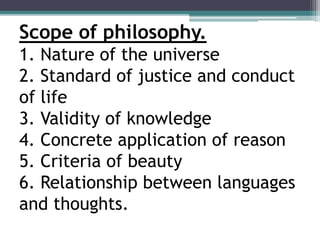
Scope of philosophy.
1. Nature of the universe
2. Standard of justice and conduct
of life
3. Validity of knowledge
4. Concrete application of reason
5. Criteria of beauty
6. Relationship between languages
and thoughts.
Idealism.
Idealism is basically the
unrealistic beliefs in or pursuit
of perfection.
It is a philosophical orientation
emphasizing mind or the spirit
as the pre-eminent feature of
life.
IDEALISM
1. First established by Plato
2. Matter doesn’t exist
3. External world-construction of
mind.
4. Reality consists exclusively of
‘ideas’
5. Rejects the idea that objects are
independent of our minds.
Realism
It is basically the attitude or practice of
accepting a situation as it is and being
prepared to ideal with it accordingly.
The quality of fact of representing a
person or thing in a way that is
accurate and true to the life.
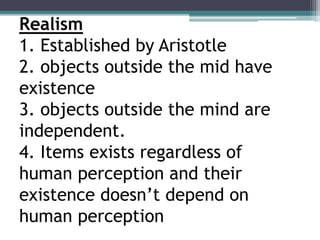
Realism
1. Established by Aristotle
2. objects outside the mid have
existence
3. objects outside the mind are
independent.
4. Items exists regardless of
human perception and their
existence doesn’t depend on
human perception
5. Musical world alone is objective
6. knowledge acquired through
senses is real only
7. universe is independent of the
ideas
8. things exists whether or not the
human mind perceives them
Thank You

Philosophy

  • 1.
  • 2.
    Philosophy. Philosophy is thesystematic study of the foundation of human knowledge with an emphasis of its validity and finding answers to ultimate questions.
  • 3.
    The term philosophyis taken from the Greek word ‘Phylos’ meaning ‘to love’ or ‘to befriend’ and ‘sophie’ meaning ‘wisdom’
  • 4.
    Philosophy is thestudy of the nature and meaning of the universe and of human life. (Advanced Learner’s Dictionary)
  • 5.
    Goals of Philosophy: 1.Wisdom is the main goal of philosophy. 2. Discovering the nature of truth and knowledge. 3. Basic values and importance of life. 4. To examine the relationship between individuals and society.
  • 6.
    Scope of philosophy. 1.Nature of the universe 2. Standard of justice and conduct of life 3. Validity of knowledge 4. Concrete application of reason 5. Criteria of beauty 6. Relationship between languages and thoughts.
  • 7.
    Idealism. Idealism is basicallythe unrealistic beliefs in or pursuit of perfection. It is a philosophical orientation emphasizing mind or the spirit as the pre-eminent feature of life.
  • 8.
    IDEALISM 1. First establishedby Plato 2. Matter doesn’t exist 3. External world-construction of mind. 4. Reality consists exclusively of ‘ideas’ 5. Rejects the idea that objects are independent of our minds.
  • 9.
    Realism It is basicallythe attitude or practice of accepting a situation as it is and being prepared to ideal with it accordingly. The quality of fact of representing a person or thing in a way that is accurate and true to the life.
  • 10.
    Realism 1. Established byAristotle 2. objects outside the mid have existence 3. objects outside the mind are independent. 4. Items exists regardless of human perception and their existence doesn’t depend on human perception
  • 11.
    5. Musical worldalone is objective 6. knowledge acquired through senses is real only 7. universe is independent of the ideas 8. things exists whether or not the human mind perceives them
  • 12.