
Goals
G1. Eradicate Extreme
Poverty & Hunger

Presented by

:

Phileman Ochan Owiti

IDNO. 013/06
Dept. Development management
Hawassa University
Junuary 2014
Millennium Development Goals
“Our world is one in which 1.5 billion people live in
extreme poverty, 9 million children die every year, and 75
million more are denied primary education. Our world is
still plighted by disease like HIV/AIDS that together kill
2 million people every year, a world where women are in
which often relegated to second rank and one in which
the conditions of life for future generations are being
undermine”
UN Millennium Development Goals: A challenge for
Today’s youth)
Eight MDGS
1.

2.
3.
4.

5.
6.
7.
8.

Eradicate extreme poverty and hunger
Achieve universal primary education
Promote gender equality and women
empowerment
Reduce child mortality
Improve maternal health
Combat HIV/AIDS, malaria and other
diseases
Ensure environmental stability
Create global partnership for
development
Eradicate Extreme Poverty and
Hunger
. To eradicate extreme poverty and hunger is one of the
most essential components of MDGs in the declaration
adopted by 186 heads of governments at the millennium
summit of the United Nations in September 2000.
As a part of global and national initiative/ program
Ethiopia’s government together with her development
partners has been putting development with aim of achieving
a broad based, sustained economic growth and reducing the
dept and extent of chronic poverty in country’s policy
agenda.
CONTEXTUAL DEFINITION OF
POVERTY (ETHIOPIA)
A family, and every individual in it, is considered
poor when the family's total income is less than
$1.25 a day.
In Ethiopia poverty means
high number of infant deaths,
hunger;
lack of shelter,
lack access to formal education ;
begging;
involve in commercial sex (prostitute);
unemployment, etc.
Ethiopia as ing country shares
common characteristics of ing
countries
Low Level of Living
Low productivity
High Rate of Population Growth and
Dependency Burden
Substantial Dependence on Agriculture
Production
Prevalence of Imperfect Markets and
Incomplete Information
Dependence and Vulnerability in
International Relation
Poor Utilization of the Natural Resources
Vicious circle/traps of low saving, low
capital formation and low investment
Low level of Industrialization and Lack of
Urbanity/Urbanism
Fiscal and Monetary un progressiveness
Backwash effect of international Trade
Development of infrastructure Facilities not
being
Commensurate with the requirements of
the direct productive activities of the material
sector.
Waste of human Resources/Manpower
CAUSE OF POVERTY IN
ETHIOPIA
1. Drought: Ethiopia agriculture is rain feed
agriculture while 85% popun dependent on it
2. Flood
3. fluctuation in the amount and distribution of
rainfall
4. Small scale agriculture with primitive technology
5. Undeveloped technology & communication
system
6. Small number workers & more dependent
unemployment etc.
IMPACT OF
POVERTY
Health
Hunger
Under nutrition during pregnancy
Limited health care access
2. Productivity
Delayed cognitive development and under
achievement
Limited access to leisure
3. Physical Environment
Home: water leaking, overcrowding,
unclean,
Neighborhood: safely concern, lack of
community support and desirable role model
1.
IMPACT cont………………..
4. Emotional Well- Being

Increased stress
Low self esteem
5. Family Interaction
•Inconsistent, unresponsive parenting
•Marital conflict over money, increased sibling
responsibility
THE PROGRESS OF ETHIOPIA TO
ACHIEVE THE ERADICATION OF
EXTREME POVERTY AND HUNGER

According to Millennium Development Goals
Report 2012:- the world has met some important targets—
ahead of the deadline.

1. Extreme poverty is falling in every region
The proportion of people living on less than $1.25 a
day fell from 47 % in 1990 to 24 % in 2008—a
reduction from over 2 billion to less than 1.4
billion.
2. The world has met the target of halving
the proportion of people without access to
improved sources of water

Proportion of people using an
improved water source rising from 76
per cent in 1990 to 89 per cent in
2010.
Between 1990 and 2010, over two
billion people gained access to
improved drinking water sources,
such as piped supplies and protected
wells.
According to an Interim Report on Poverty
Analysis Study (2010/11),
The ratio of poor people in Ethiopia is
estimated to be 29.6% in 2010/11.
In 2010/11, the proportion of the population
below the poverty line stood at 30.4% in rural
areas, and 25.7% in urban areas.
Between 2004/05 and 2010/11, income
inequality measured by Gini -Coefficient has
shown a small decline from 0.3 in 2004/05 to
0.298 in 2010/11.
Development Plans of
Ethiopia
1.
2.

3.
4.

ADLI
PRSP/SDPRP 2002-2004
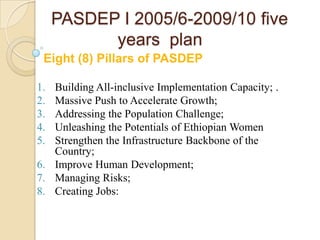
PASDEP I 2005/6-2009/10 five years plan
GTP 2010/11-2014/15
Agricultural Development Led
Industrialization (ADLI) long term
Strategy
•ADLI is a strategy in which agriculture
and industry are brought into a single
framework, wherein the development of
agriculture is viewed as an important
vehicle for industrialization by providing
raw material, a market base, surplus labor
and capital accumulation.
PASDEP I 2005/6-2009/10 five
years plan
Eight (8) Pillars of PASDEP
1.
2.
3.
4.
5.

Building All-inclusive Implementation Capacity; .
Massive Push to Accelerate Growth;
Addressing the Population Challenge;
Unleashing the Potentials of Ethiopian Women
Strengthen the Infrastructure Backbone of the
Country;
6. Improve Human Development;
7. Managing Risks;
8. Creating Jobs:
GTP (2010/11-2014/15)

The main agenda of the plan is to
sustain broad-based, rapid and
equitable economic growth to
reduce and ultimately eradicate
poverty.
Objectives of the GTP
1. Maintain at least an average real GDP growth
rate of 11% and attain MDGs
2. Expand and ensure the qualities of education
and health services and achieve MDGs in the
social sector
3. Establish suitable conditions for sustainable
nation building through the creation of stable
democratic and developmental state
4. Ensure the sustainability of growth by realizing
all the above objectives within stable
macroeconomic framework
According to Ethiopia: 2010 Millennium Development Goals
Report

Ethiopia achieved pro poor economic growth
by
spending more than 60 percent of
government expenditure on poverty oriented
sectors such as

agriculture,
education,
health,
water, and
roads development during last
decade
During this period

The hydroelectric power generation capacity has
increased the coverage to 41% in 2009/10 from 16% in
2004/05;
Telecommunication service coverage has reached 50%
within a 5 km radius.
The expansion of road network has increased the road
density from 29km/1000 km2 in 2000/01 to
44.5km/1000km2 in 2009/10. The aver-age time taken to
reach all weather roads has also been reduced to 3.7 hours
in 2009/10 from about 7 hours in early 2000.
The population living below the poverty line has declined
to 29% as of 2009/10.
Challenges To Eradicate Extreme
Poverty and Hunger in Ethiopia
1. Climate change: Climate change extreme affect the
Ethiopian economy and social being.
Agriculture, primarily rain-fed and highly sensitive to
fluctuations in rainfall, forms the basis of the economy
providing approximately 46% of GDP and jobs for 80% of
the working population.
 Chronic food insecurity affects 10% of the population and
even in average rainfall years these households cannot meet
their food needs and they rely partly on food assistance.
Droughts can result in sharp reductions in agricultural output
and related productive activity and employment, with
multiplier effects on the monetary economy. Floods regularly
cause crop and infrastructure damage and widespread
suffering and hardship, E.g. in 2010 in Afar & Amhara
regions 10,000 people being displaced and over 10,000 ha of
cropland flooded.
Climate change…….
Damage transportation infrastructure
Soil erosion
Drought
Flood etc
2.Global prices of export and import change

Due to the deteriorating trade of coffee on the
world market coffee in total export revenues has
declined significantly from above 70 percent of
export earnings to roughly 45 percent in 2003
Rise in food and oil prices which have affected
the effort the country to reduce poverty.
3. Increase Urban Population & Poverty
CONCLUSION
From the above, I concluded here, that even though, there are
so many challenges to eradicate chronic poverty and hunger
in the country, Ethiopia made un deniable progress to bring

sustain broad-based, rapid and equitable economic growth to
reduce and ultimately eradicate poverty.
In another word, Ethiopia on right truck to meet MDGS
in 2015
“the most killer disease in Africa
neither HIV/AIDS nor Malaria, it is
poverty the most killer”.
MELES ZENAWI
አአአአአአ
አአ

Millennium Development Goals

  • 1.
    Goals G1. Eradicate Extreme Poverty& Hunger Presented by : Phileman Ochan Owiti IDNO. 013/06 Dept. Development management Hawassa University Junuary 2014
  • 2.
    Millennium Development Goals “Ourworld is one in which 1.5 billion people live in extreme poverty, 9 million children die every year, and 75 million more are denied primary education. Our world is still plighted by disease like HIV/AIDS that together kill 2 million people every year, a world where women are in which often relegated to second rank and one in which the conditions of life for future generations are being undermine” UN Millennium Development Goals: A challenge for Today’s youth)
  • 3.
    Eight MDGS 1. 2. 3. 4. 5. 6. 7. 8. Eradicate extremepoverty and hunger Achieve universal primary education Promote gender equality and women empowerment Reduce child mortality Improve maternal health Combat HIV/AIDS, malaria and other diseases Ensure environmental stability Create global partnership for development
  • 4.
    Eradicate Extreme Povertyand Hunger . To eradicate extreme poverty and hunger is one of the most essential components of MDGs in the declaration adopted by 186 heads of governments at the millennium summit of the United Nations in September 2000. As a part of global and national initiative/ program Ethiopia’s government together with her development partners has been putting development with aim of achieving a broad based, sustained economic growth and reducing the dept and extent of chronic poverty in country’s policy agenda.
  • 5.
    CONTEXTUAL DEFINITION OF POVERTY(ETHIOPIA) A family, and every individual in it, is considered poor when the family's total income is less than $1.25 a day. In Ethiopia poverty means high number of infant deaths, hunger; lack of shelter, lack access to formal education ; begging; involve in commercial sex (prostitute); unemployment, etc.
  • 6.
    Ethiopia as ingcountry shares common characteristics of ing countries Low Level of Living Low productivity High Rate of Population Growth and Dependency Burden Substantial Dependence on Agriculture Production Prevalence of Imperfect Markets and Incomplete Information Dependence and Vulnerability in International Relation
  • 7.
    Poor Utilization ofthe Natural Resources Vicious circle/traps of low saving, low capital formation and low investment Low level of Industrialization and Lack of Urbanity/Urbanism Fiscal and Monetary un progressiveness Backwash effect of international Trade Development of infrastructure Facilities not being Commensurate with the requirements of the direct productive activities of the material sector. Waste of human Resources/Manpower
  • 8.
    CAUSE OF POVERTYIN ETHIOPIA 1. Drought: Ethiopia agriculture is rain feed agriculture while 85% popun dependent on it 2. Flood 3. fluctuation in the amount and distribution of rainfall 4. Small scale agriculture with primitive technology 5. Undeveloped technology & communication system 6. Small number workers & more dependent unemployment etc.
  • 9.
    IMPACT OF POVERTY Health Hunger Under nutritionduring pregnancy Limited health care access 2. Productivity Delayed cognitive development and under achievement Limited access to leisure 3. Physical Environment Home: water leaking, overcrowding, unclean, Neighborhood: safely concern, lack of community support and desirable role model 1.
  • 10.
    IMPACT cont……………….. 4. EmotionalWell- Being Increased stress Low self esteem 5. Family Interaction •Inconsistent, unresponsive parenting •Marital conflict over money, increased sibling responsibility
  • 11.
    THE PROGRESS OFETHIOPIA TO ACHIEVE THE ERADICATION OF EXTREME POVERTY AND HUNGER According to Millennium Development Goals Report 2012:- the world has met some important targets— ahead of the deadline. 1. Extreme poverty is falling in every region The proportion of people living on less than $1.25 a day fell from 47 % in 1990 to 24 % in 2008—a reduction from over 2 billion to less than 1.4 billion.
  • 12.
    2. The worldhas met the target of halving the proportion of people without access to improved sources of water Proportion of people using an improved water source rising from 76 per cent in 1990 to 89 per cent in 2010. Between 1990 and 2010, over two billion people gained access to improved drinking water sources, such as piped supplies and protected wells.
  • 13.
    According to anInterim Report on Poverty Analysis Study (2010/11), The ratio of poor people in Ethiopia is estimated to be 29.6% in 2010/11. In 2010/11, the proportion of the population below the poverty line stood at 30.4% in rural areas, and 25.7% in urban areas. Between 2004/05 and 2010/11, income inequality measured by Gini -Coefficient has shown a small decline from 0.3 in 2004/05 to 0.298 in 2010/11.
  • 14.
    Development Plans of Ethiopia 1. 2. 3. 4. ADLI PRSP/SDPRP2002-2004 PASDEP I 2005/6-2009/10 five years plan GTP 2010/11-2014/15
  • 15.
    Agricultural Development Led Industrialization(ADLI) long term Strategy •ADLI is a strategy in which agriculture and industry are brought into a single framework, wherein the development of agriculture is viewed as an important vehicle for industrialization by providing raw material, a market base, surplus labor and capital accumulation.
  • 16.
    PASDEP I 2005/6-2009/10five years plan Eight (8) Pillars of PASDEP 1. 2. 3. 4. 5. Building All-inclusive Implementation Capacity; . Massive Push to Accelerate Growth; Addressing the Population Challenge; Unleashing the Potentials of Ethiopian Women Strengthen the Infrastructure Backbone of the Country; 6. Improve Human Development; 7. Managing Risks; 8. Creating Jobs:
  • 17.
    GTP (2010/11-2014/15) The mainagenda of the plan is to sustain broad-based, rapid and equitable economic growth to reduce and ultimately eradicate poverty.
  • 18.
    Objectives of theGTP 1. Maintain at least an average real GDP growth rate of 11% and attain MDGs 2. Expand and ensure the qualities of education and health services and achieve MDGs in the social sector 3. Establish suitable conditions for sustainable nation building through the creation of stable democratic and developmental state 4. Ensure the sustainability of growth by realizing all the above objectives within stable macroeconomic framework
  • 19.
    According to Ethiopia:2010 Millennium Development Goals Report Ethiopia achieved pro poor economic growth by spending more than 60 percent of government expenditure on poverty oriented sectors such as agriculture, education, health, water, and roads development during last decade
  • 20.
    During this period Thehydroelectric power generation capacity has increased the coverage to 41% in 2009/10 from 16% in 2004/05; Telecommunication service coverage has reached 50% within a 5 km radius. The expansion of road network has increased the road density from 29km/1000 km2 in 2000/01 to 44.5km/1000km2 in 2009/10. The aver-age time taken to reach all weather roads has also been reduced to 3.7 hours in 2009/10 from about 7 hours in early 2000. The population living below the poverty line has declined to 29% as of 2009/10.
  • 21.
    Challenges To EradicateExtreme Poverty and Hunger in Ethiopia 1. Climate change: Climate change extreme affect the Ethiopian economy and social being. Agriculture, primarily rain-fed and highly sensitive to fluctuations in rainfall, forms the basis of the economy providing approximately 46% of GDP and jobs for 80% of the working population.  Chronic food insecurity affects 10% of the population and even in average rainfall years these households cannot meet their food needs and they rely partly on food assistance. Droughts can result in sharp reductions in agricultural output and related productive activity and employment, with multiplier effects on the monetary economy. Floods regularly cause crop and infrastructure damage and widespread suffering and hardship, E.g. in 2010 in Afar & Amhara regions 10,000 people being displaced and over 10,000 ha of cropland flooded.
  • 22.
    Climate change……. Damage transportationinfrastructure Soil erosion Drought Flood etc 2.Global prices of export and import change Due to the deteriorating trade of coffee on the world market coffee in total export revenues has declined significantly from above 70 percent of export earnings to roughly 45 percent in 2003 Rise in food and oil prices which have affected the effort the country to reduce poverty.
  • 23.
    3. Increase UrbanPopulation & Poverty CONCLUSION From the above, I concluded here, that even though, there are so many challenges to eradicate chronic poverty and hunger in the country, Ethiopia made un deniable progress to bring sustain broad-based, rapid and equitable economic growth to reduce and ultimately eradicate poverty. In another word, Ethiopia on right truck to meet MDGS in 2015
  • 24.
    “the most killerdisease in Africa neither HIV/AIDS nor Malaria, it is poverty the most killer”. MELES ZENAWI
  • 25.