PHILIP K DICK
Persico Francesco e Capano Tommaso
INDEX
 Personal life
 Career
 Themes
 Influence and legacy
 Do the androids dream of electric sheeps?
 Plot
 Main themes
PHILIP K DICK
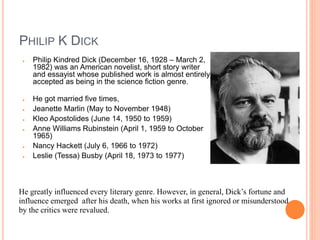
● Philip Kindred Dick (December 16, 1928 – March 2,
1982) was an American novelist, short story writer
and essayist whose published work is almost entirely
accepted as being in the science fiction genre.
● He got married five times,
● Jeanette Marlin (May to November 1948)
● Kleo Apostolides (June 14, 1950 to 1959)
● Anne Williams Rubinstein (April 1, 1959 to October
1965)
● Nancy Hackett (July 6, 1966 to 1972)
● Leslie (Tessa) Busby (April 18, 1973 to 1977)
He greatly influenced every literary genre. However, in general, Dick’s fortune and
influence emerged after his death, when his works at first ignored or misunderstood
by the critics were revalued.
PERSONAL LIFE: CHILDHOOD AND STUDIES
● His intense political activity influenced his
career: in 50s he joined an anti-vietnam
war.
● He briefly attended University of
California, Berkely, but he was not a
brilliant student.
PERSONAL LIFE - 50S
● Even at that time he showed his opposition to
American Government: he likes to tell how
he became a close friend of two FBI agents
who controlled him so assiduously.
● 1952 he sold his first story: "The little
Movement”.
After the sale of this tale he decided to
become a full-time writer
● In 1955 he published “Solar lottery”.
PERSONAL LIFE – 60S AND 70S
● New intimate writing style
● Period of intense activity
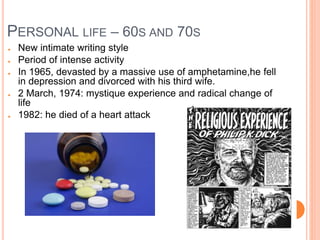
● In 1965, devasted by a massive use of amphetamine,he fell
in depression and divorced with his third wife.
● 2 March, 1974: mystique experience and radical change of
life
● 1982: he died of a heart attack
7
CARRER
1960s
• “The Man in the High Castle”
• 1962
• dystopian world dominated
by the Nazism and the
Japanese imperialism
• Hugo Award
in 1963
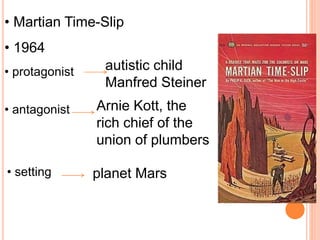
• Martian Time-Slip
• 1964
autistic child
Manfred Steiner
Arnie Kott, the
rich chief of the
union of plumbers
planet Mars
• protagonist
• antagonist
• setting
• The Simulacra
• 1964
• sociopolitical allegory
• Democratic and
Republican Party
• United states of Europe
•and America (USEA)
• The Three Stigmata of Palmer
Eldritch
(1965)
• dystopian novel
• Nebula Award in 1965
• several layers of reality
and unreality
• religious themes
21st century
Colonization of the
planets and moons i
the solar system
 Do Androids Dream
of Electric Sheeps? (1968)
 film “Blade Runner”
of Ridley Scott
• Ubik (1969)
• dystopian novel
• "North American
Confederation" of 1992
1970s
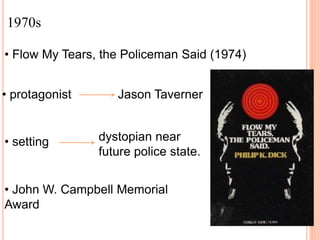
Jason Taverner
dystopian near
future police state.
• John W. Campbell Memorial
Award
• Flow My Tears, the Policeman Said (1974)
• protagonist
• setting
• British Science Fiction Association
Award (1978)
• Graouilly d'Or (1979).
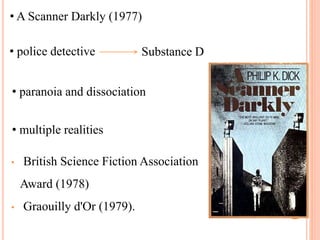
• A Scanner Darkly (1977)
Substance D• police detective
• paranoia and dissociation
• multiple realities
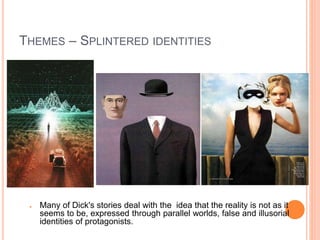
THEMES – SPLINTERED IDENTITIES
● Many of Dick's stories deal with the idea that the reality is not as it
seems to be, expressed through parallel worlds, false and illusorial
identities of protagonists.
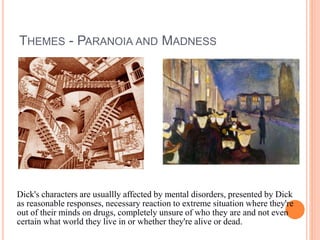
THEMES - PARANOIA AND MADNESS
Dick's characters are usuallly affected by mental disorders, presented by Dick
as reasonable responses, necessary reaction to extreme situation where they're
out of their minds on drugs, completely unsure of who they are and not even
certain what world they live in or whether they're alive or dead.
THEMES – POLICE AND WAR
Dick's political ideas are often expressed is an overwhelming dread of
the effects of war. The fear of destruction, after all, is a fear of death
and annihilation at the hands of abusive authority, that often comes in
the guise of an intense antipathy toward the police.
THEMES – ROBOT AND HUMANS
Dicks likes to present the image of a
robot that is indistinguishable from
human being.
Androids are able to feel emotions,
pain, even memories, but they're
infinitely reproducible; this is an
essential difference that makes robots
different from men, thus creating
considerable problems in defining the
concept of life.
• “Blade Runner” (1982)
directed Ridley Scott
• cinematographic adaptations
Influence and legacy
• “Do Androids Dream of Electric
Sheeps?” (1968)
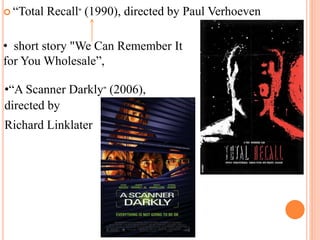
 “Total Recall” (1990), directed by Paul Verhoeven
• short story "We Can Remember It
for You Wholesale”,
•“A Scanner Darkly” (2006),
directed by
Richard Linklater
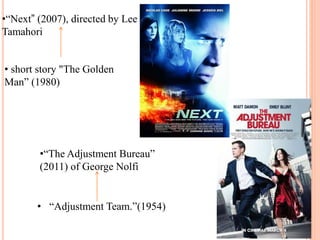
•“Next” (2007), directed by Lee
Tamahori
•“The Adjustment Bureau”
(2011) of George Nolfi
• “Adjustment Team.”(1954)
• short story "The Golden
Man” (1980)
 cyberpunk, (cyber fantasy)
 Ucronìa (The Man in the High Castle)
Influences in the postmodern
literature
technology
robotic
the Historical Course represented is
different than the real one.
 The Terminator (1984)
 The Truman Show (1998)
Influences in the cinema
killer androids confound
themselves between the human
beings
Screamers
pseudo-reality
Time Out of Joint
 the trilogy of Matrix (1999-2003)
 Inception(2010)
• alienation
• the existence of several sides of reality
• superior entity
•Valis
•Ubik
•The Man in the
High Castle
• "Journey into the Subconscious"
• "Oneiric Architecture"
Ubik
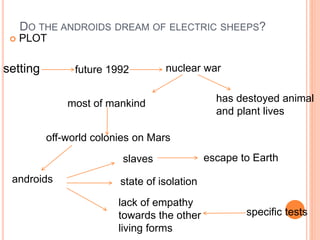
DO THE ANDROIDS DREAM OF ELECTRIC SHEEPS?
 PLOT
setting future 1992 nuclear war
most of mankind
escape to Earth
off-world colonies on Mars
has destoyed animal
and plant lives
androids
slaves
state of isolation
specific tests
lack of empathy
towards the other
living forms
THE PROTAGONIST
Who: Rick Deckard, a Bounty hunter
When: 1992
Where: S.Francico
What: the task to find six replicants
escaped from a colony and “retire” them.
Why: to give a meaning to his life and fight the boredom of
his existence
and to overcome the social stigma that afflicts him
Deckard’s wife
• Rachael Rosen
apparently
unaware
loving relationship
her feelings are false
ends his mission
fist android
known
Rick Deckard
retiring all the androids escaped
• conclusion
electrical
insects
artificial toad
found in the desert
by Deckard
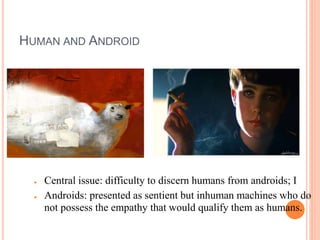
HUMAN AND ANDROID
● Central issue: difficulty to discern humans from androids; I
● Androids: presented as sentient but inhuman machines who do
not possess the empathy that would qualify them as humans.
THE ONLY SUBJECT
Ego cogito.
Ergo sum?
The novel lives of another great contrast, the
religious and epistemological shifted in the struggle
between Deckard and the androids.
If an android isn’t conscious to be android and a
man isn’t conscious to be human, how can you
discern real true from false? Dick affirms it’s
impossible.
BIBLIOGRAPHY
 http://it.wikipedia.org/wiki/Philip_K._Dick
 http://en.wikipedia.org/wiki/Philip_K._Dick7
 http://en.wikipedia.org/wiki/Philip_K._Dick_bibliography
 http://biografieonline.it/biografia.htm?BioID=372&biografia=Philip+K.+Dick
 http://www.philipkdickfans.com/
 Philip K. Dick Fan site: www.philipkdickfans.com
 http://en.wikipedia.org/wiki/The_Man_in_the_High_Castle
 http://en.wikipedia.org/wiki/Martian_Time-Slip
 http://en.wikipedia.org/wiki/The_Simulacra
 http://en.wikipedia.org/wiki/The_Three_Stigmata_of_Palmer_Eldritch
 http://en.wikipedia.org/wiki/Do_Androids_Dream_of_Electric_Sheep%3F
 http://en.wikipedia.org/wiki/Ubik
 http://en.wikipedia.org/wiki/Flow_My_Tears,_the_Policeman_Said
 http://en.wikipedia.org/wiki/A_Scanner_Darkly
 http://pkdreligion.blogspot.it/2011/10/quick-thoughts-on-undermining-ontology.html
 http://www.avclub.com/article/ema-scanner-darklyem-philip-k-dicks-thematic-obses-42528

Philip k Dick

  • 1.
    PHILIP K DICK PersicoFrancesco e Capano Tommaso
  • 2.
    INDEX  Personal life Career  Themes  Influence and legacy  Do the androids dream of electric sheeps?  Plot  Main themes
  • 3.
    PHILIP K DICK ●Philip Kindred Dick (December 16, 1928 – March 2, 1982) was an American novelist, short story writer and essayist whose published work is almost entirely accepted as being in the science fiction genre. ● He got married five times, ● Jeanette Marlin (May to November 1948) ● Kleo Apostolides (June 14, 1950 to 1959) ● Anne Williams Rubinstein (April 1, 1959 to October 1965) ● Nancy Hackett (July 6, 1966 to 1972) ● Leslie (Tessa) Busby (April 18, 1973 to 1977) He greatly influenced every literary genre. However, in general, Dick’s fortune and influence emerged after his death, when his works at first ignored or misunderstood by the critics were revalued.
  • 4.
    PERSONAL LIFE: CHILDHOODAND STUDIES ● His intense political activity influenced his career: in 50s he joined an anti-vietnam war. ● He briefly attended University of California, Berkely, but he was not a brilliant student.
  • 5.
    PERSONAL LIFE -50S ● Even at that time he showed his opposition to American Government: he likes to tell how he became a close friend of two FBI agents who controlled him so assiduously. ● 1952 he sold his first story: "The little Movement”. After the sale of this tale he decided to become a full-time writer ● In 1955 he published “Solar lottery”.
  • 6.
    PERSONAL LIFE –60S AND 70S ● New intimate writing style ● Period of intense activity ● In 1965, devasted by a massive use of amphetamine,he fell in depression and divorced with his third wife. ● 2 March, 1974: mystique experience and radical change of life ● 1982: he died of a heart attack 7
  • 7.
    CARRER 1960s • “The Manin the High Castle” • 1962 • dystopian world dominated by the Nazism and the Japanese imperialism • Hugo Award in 1963
  • 8.
    • Martian Time-Slip •1964 autistic child Manfred Steiner Arnie Kott, the rich chief of the union of plumbers planet Mars • protagonist • antagonist • setting
  • 9.
    • The Simulacra •1964 • sociopolitical allegory • Democratic and Republican Party • United states of Europe •and America (USEA)
  • 10.
    • The ThreeStigmata of Palmer Eldritch (1965) • dystopian novel • Nebula Award in 1965 • several layers of reality and unreality • religious themes 21st century Colonization of the planets and moons i the solar system
  • 11.
     Do AndroidsDream of Electric Sheeps? (1968)  film “Blade Runner” of Ridley Scott • Ubik (1969) • dystopian novel • "North American Confederation" of 1992
  • 12.
    1970s Jason Taverner dystopian near futurepolice state. • John W. Campbell Memorial Award • Flow My Tears, the Policeman Said (1974) • protagonist • setting
  • 13.
    • British ScienceFiction Association Award (1978) • Graouilly d'Or (1979). • A Scanner Darkly (1977) Substance D• police detective • paranoia and dissociation • multiple realities
  • 14.
    THEMES – SPLINTEREDIDENTITIES ● Many of Dick's stories deal with the idea that the reality is not as it seems to be, expressed through parallel worlds, false and illusorial identities of protagonists.
  • 15.
    THEMES - PARANOIAAND MADNESS Dick's characters are usuallly affected by mental disorders, presented by Dick as reasonable responses, necessary reaction to extreme situation where they're out of their minds on drugs, completely unsure of who they are and not even certain what world they live in or whether they're alive or dead.
  • 16.
    THEMES – POLICEAND WAR Dick's political ideas are often expressed is an overwhelming dread of the effects of war. The fear of destruction, after all, is a fear of death and annihilation at the hands of abusive authority, that often comes in the guise of an intense antipathy toward the police.
  • 17.
    THEMES – ROBOTAND HUMANS Dicks likes to present the image of a robot that is indistinguishable from human being. Androids are able to feel emotions, pain, even memories, but they're infinitely reproducible; this is an essential difference that makes robots different from men, thus creating considerable problems in defining the concept of life.
  • 18.
    • “Blade Runner”(1982) directed Ridley Scott • cinematographic adaptations Influence and legacy • “Do Androids Dream of Electric Sheeps?” (1968)
  • 19.
     “Total Recall”(1990), directed by Paul Verhoeven • short story "We Can Remember It for You Wholesale”, •“A Scanner Darkly” (2006), directed by Richard Linklater
  • 20.
    •“Next” (2007), directedby Lee Tamahori •“The Adjustment Bureau” (2011) of George Nolfi • “Adjustment Team.”(1954) • short story "The Golden Man” (1980)
  • 21.
     cyberpunk, (cyberfantasy)  Ucronìa (The Man in the High Castle) Influences in the postmodern literature technology robotic the Historical Course represented is different than the real one.
  • 22.
     The Terminator(1984)  The Truman Show (1998) Influences in the cinema killer androids confound themselves between the human beings Screamers pseudo-reality Time Out of Joint
  • 23.
     the trilogyof Matrix (1999-2003)  Inception(2010) • alienation • the existence of several sides of reality • superior entity •Valis •Ubik •The Man in the High Castle • "Journey into the Subconscious" • "Oneiric Architecture" Ubik
  • 24.
    DO THE ANDROIDSDREAM OF ELECTRIC SHEEPS?  PLOT setting future 1992 nuclear war most of mankind escape to Earth off-world colonies on Mars has destoyed animal and plant lives androids slaves state of isolation specific tests lack of empathy towards the other living forms
  • 25.
    THE PROTAGONIST Who: RickDeckard, a Bounty hunter When: 1992 Where: S.Francico What: the task to find six replicants escaped from a colony and “retire” them. Why: to give a meaning to his life and fight the boredom of his existence and to overcome the social stigma that afflicts him
  • 26.
    Deckard’s wife • RachaelRosen apparently unaware loving relationship her feelings are false ends his mission fist android known Rick Deckard retiring all the androids escaped • conclusion electrical insects artificial toad found in the desert by Deckard
  • 27.
    HUMAN AND ANDROID ●Central issue: difficulty to discern humans from androids; I ● Androids: presented as sentient but inhuman machines who do not possess the empathy that would qualify them as humans.
  • 28.
    THE ONLY SUBJECT Egocogito. Ergo sum? The novel lives of another great contrast, the religious and epistemological shifted in the struggle between Deckard and the androids. If an android isn’t conscious to be android and a man isn’t conscious to be human, how can you discern real true from false? Dick affirms it’s impossible.
  • 29.
    BIBLIOGRAPHY  http://it.wikipedia.org/wiki/Philip_K._Dick  http://en.wikipedia.org/wiki/Philip_K._Dick7 http://en.wikipedia.org/wiki/Philip_K._Dick_bibliography  http://biografieonline.it/biografia.htm?BioID=372&biografia=Philip+K.+Dick  http://www.philipkdickfans.com/  Philip K. Dick Fan site: www.philipkdickfans.com  http://en.wikipedia.org/wiki/The_Man_in_the_High_Castle  http://en.wikipedia.org/wiki/Martian_Time-Slip  http://en.wikipedia.org/wiki/The_Simulacra  http://en.wikipedia.org/wiki/The_Three_Stigmata_of_Palmer_Eldritch  http://en.wikipedia.org/wiki/Do_Androids_Dream_of_Electric_Sheep%3F  http://en.wikipedia.org/wiki/Ubik  http://en.wikipedia.org/wiki/Flow_My_Tears,_the_Policeman_Said  http://en.wikipedia.org/wiki/A_Scanner_Darkly  http://pkdreligion.blogspot.it/2011/10/quick-thoughts-on-undermining-ontology.html  http://www.avclub.com/article/ema-scanner-darklyem-philip-k-dicks-thematic-obses-42528