
Blade Runner
Identity, Memory
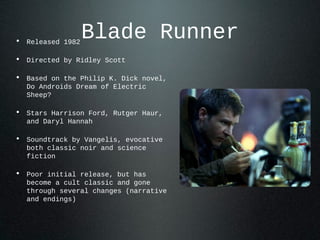
Blade Runner• Released 1982
• Directed by Ridley Scott
• Based on the Philip K. Dick novel,
Do Androids Dream of Electric
Sheep?
• Stars Harrison Ford, Rutger Haur,
and Daryl Hannah
• Soundtrack by Vangelis, evocative
both classic noir and science
fiction
• Poor initial release, but has
become a cult classic and gone
through several changes (narrative
and endings)
Setting
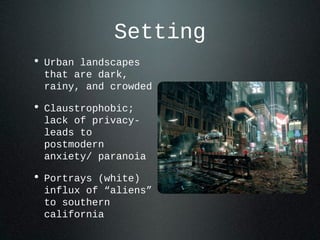
• Urban landscapes
that are dark,
rainy, and crowded
• Claustrophobic;
lack of privacy-
leads to
postmodern
anxiety/ paranoia
• Portrays (white)
influx of “aliens”
to southern
california
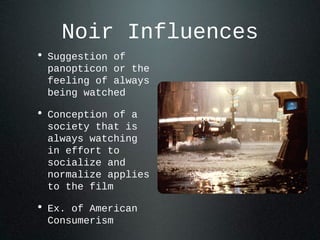
Noir Influences
• Suggestion of
panopticon or the
feeling of always
being watched
• Conception of a
society that is
always watching
in effort to
socialize and
normalize applies
to the film
• Ex. of American
Consumerism
Narration
• Use of voice over in
theatrical release (taken out
in director cut)
• Faithful to noir but does not
work in this film
• Put in film to help audience
understand
• Indicative of how neo-noir can
create its own niche.
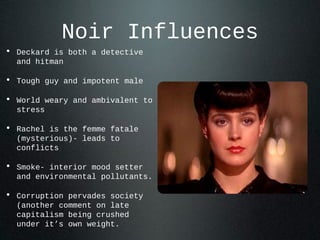
Noir Influences
• Deckard is both a detective
and hitman
• Tough guy and impotent male
• World weary and ambivalent to
stress
• Rachel is the femme fatale
(mysterious)- leads to
conflicts
• Smoke- interior mood setter
and environmental pollutants.
• Corruption pervades society
(another comment on late
capitalism being crushed
under it’s own weight.
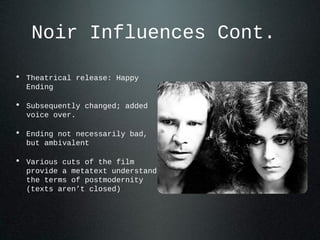
Noir Influences Cont.
• Theatrical release: Happy
Ending
• Subsequently changed; added
voice over.
• Ending not necessarily bad,
but ambivalent
• Various cuts of the film
provide a metatext understand
the terms of postmodernity
(texts aren’t closed)
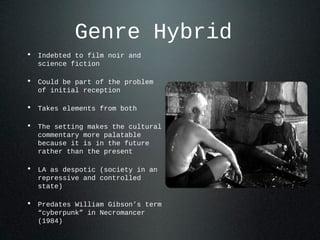
Genre Hybrid
• Indebted to film noir and
science fiction
• Could be part of the problem
of initial reception
• Takes elements from both
• The setting makes the cultural
commentary more palatable
because it is in the future
rather than the present
• LA as despotic (society in an
repressive and controlled
state)
• Predates William Gibson’s term
“cyberpunk” in Necromancer
(1984)
Memory
• City of L.A represents a
vastly different from the LA
we know; more like NY or Tokyo
• Plays with our memory or
concept of what L.A.
represents
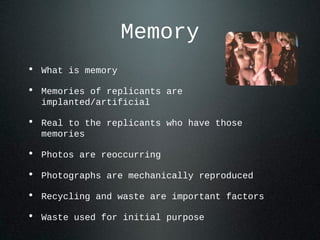
Memory
• What is memory
• Memories of replicants are
implanted/artificial
• Real to the replicants who have those
memories
• Photos are reoccurring
• Photographs are mechanically reproduced
• Recycling and waste are important factors
• Waste used for initial purpose
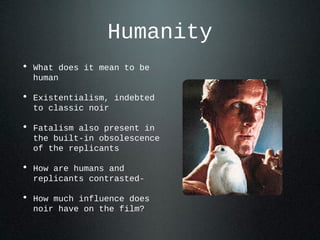
Humanity
• What does it mean to be
human
• Existentialism, indebted
to classic noir
• Fatalism also present in
the built-in obsolescence
of the replicants
• How are humans and
replicants contrasted-
• How much influence does
noir have on the film?
Blade Runner
People, Landscapes, Influences
Influences
• Edward Hopper’s Nighthawks (1942)-Conveys mood
of the film
• Fritz Lanes “Metropolis”- set design, class
structure, lighting
• Jean Giraud “Moebius” (1938) Heavy Metal
• Phillip K. Dick- Do Androids Dream of Electric
sheep= Loose adaptation
• Use of Drugs and Mood Enhancers
• Visual Futurist- Syd mead tried to implement
“retrofitting”
• Heavy Asian influence
Location
• Release in Japan two weeks later July
1o, 1982
• Multiple Magazine Articles and Reviews
• Poor critical reception
• Japan’s Bubble Era (1980-1989) Late
capitalist consumerism
• Ranked 27th in Kineman Junpo’s Best
films (E.T #1)
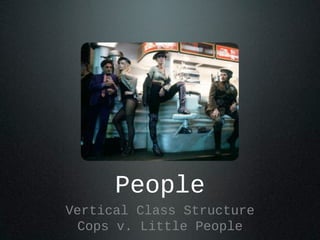
People
Vertical Class Structure
Cops v. Little People
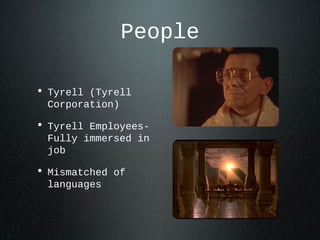
People
• Tyrell (Tyrell
Corporation)
• Tyrell Employees-
Fully immersed in
job
• Mismatched of
languages
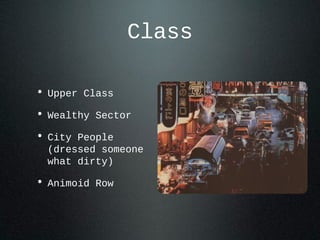
Class
• Upper Class
• Wealthy Sector
• City People
(dressed someone
what dirty)
• Animoid Row
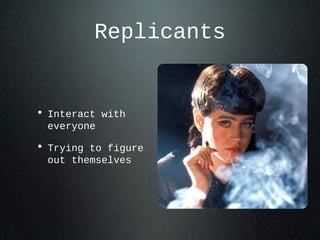
Replicants
• Interact with
everyone
• Trying to figure
out themselves
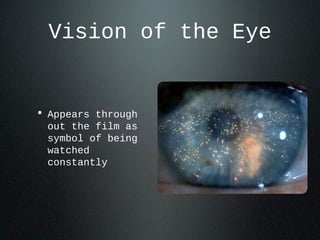
Vision of the Eye
• Appears through
out the film as
symbol of being
watched
constantly

Blade Runner: Identity, Memory, Influences

  • 1.
  • 2.
    Blade Runner• Released1982 • Directed by Ridley Scott • Based on the Philip K. Dick novel, Do Androids Dream of Electric Sheep? • Stars Harrison Ford, Rutger Haur, and Daryl Hannah • Soundtrack by Vangelis, evocative both classic noir and science fiction • Poor initial release, but has become a cult classic and gone through several changes (narrative and endings)
  • 3.
    Setting • Urban landscapes thatare dark, rainy, and crowded • Claustrophobic; lack of privacy- leads to postmodern anxiety/ paranoia • Portrays (white) influx of “aliens” to southern california
  • 4.
    Noir Influences • Suggestionof panopticon or the feeling of always being watched • Conception of a society that is always watching in effort to socialize and normalize applies to the film • Ex. of American Consumerism
  • 5.
    Narration • Use ofvoice over in theatrical release (taken out in director cut) • Faithful to noir but does not work in this film • Put in film to help audience understand • Indicative of how neo-noir can create its own niche.
  • 6.
    Noir Influences • Deckardis both a detective and hitman • Tough guy and impotent male • World weary and ambivalent to stress • Rachel is the femme fatale (mysterious)- leads to conflicts • Smoke- interior mood setter and environmental pollutants. • Corruption pervades society (another comment on late capitalism being crushed under it’s own weight.
  • 7.
    Noir Influences Cont. •Theatrical release: Happy Ending • Subsequently changed; added voice over. • Ending not necessarily bad, but ambivalent • Various cuts of the film provide a metatext understand the terms of postmodernity (texts aren’t closed)
  • 8.
    Genre Hybrid • Indebtedto film noir and science fiction • Could be part of the problem of initial reception • Takes elements from both • The setting makes the cultural commentary more palatable because it is in the future rather than the present • LA as despotic (society in an repressive and controlled state) • Predates William Gibson’s term “cyberpunk” in Necromancer (1984)
  • 9.
    Memory • City ofL.A represents a vastly different from the LA we know; more like NY or Tokyo • Plays with our memory or concept of what L.A. represents
  • 10.
    Memory • What ismemory • Memories of replicants are implanted/artificial • Real to the replicants who have those memories • Photos are reoccurring • Photographs are mechanically reproduced • Recycling and waste are important factors • Waste used for initial purpose
  • 11.
    Humanity • What doesit mean to be human • Existentialism, indebted to classic noir • Fatalism also present in the built-in obsolescence of the replicants • How are humans and replicants contrasted- • How much influence does noir have on the film?
  • 12.
  • 13.
    Influences • Edward Hopper’sNighthawks (1942)-Conveys mood of the film • Fritz Lanes “Metropolis”- set design, class structure, lighting • Jean Giraud “Moebius” (1938) Heavy Metal • Phillip K. Dick- Do Androids Dream of Electric sheep= Loose adaptation • Use of Drugs and Mood Enhancers • Visual Futurist- Syd mead tried to implement “retrofitting” • Heavy Asian influence
  • 14.
    Location • Release inJapan two weeks later July 1o, 1982 • Multiple Magazine Articles and Reviews • Poor critical reception • Japan’s Bubble Era (1980-1989) Late capitalist consumerism • Ranked 27th in Kineman Junpo’s Best films (E.T #1)
  • 15.
  • 16.
    People • Tyrell (Tyrell Corporation) •Tyrell Employees- Fully immersed in job • Mismatched of languages
  • 17.
    Class • Upper Class •Wealthy Sector • City People (dressed someone what dirty) • Animoid Row
  • 18.
    Replicants • Interact with everyone •Trying to figure out themselves
  • 19.
    Vision of theEye • Appears through out the film as symbol of being watched constantly