‘Bringing Obesity Up the National
Agenda’
W Philip T James
London School of Hygiene and Tropical Medicine
Recent President, World Obesity Federation
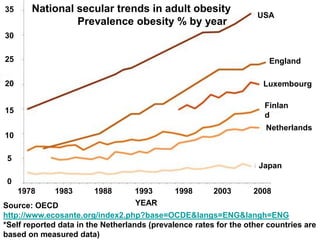
Source: OECD
http://www.ecosante.org/index2.php?base=OCDE&langs=ENG&langh=ENG
*Self reported data in the Netherlands (prevalence rates for the other countries are
based on measured data)
National secular trends in adult obesity
Prevalence obesity % by year
USA
England
Luxembourg
Finlan
d
Netherlands
Japan
35
30
25
20
15
10
5
0
1978 1983 1988 1993 1998 2003 2008
YEAR
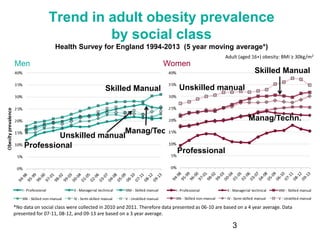
Trend in adult obesity prevalence
by social class
Health Survey for England 1994-2013 (5 year moving average*)
3
Adult (aged 16+) obesity: BMI ≥ 30kg/m2
0%
5%
10%
15%
20%
25%
30%
35%
40%
94-98 95-99 96-00 97-01 98-02 99-03 00-04 01-05 02-06 03-07 04-
Obesityprevalence
I- Professional II - Managerial technical IIIM - Skilled manual
IIIN - Skilled non-manual IV - Semi-skilled manual V - Unskilled manual
0%
5%
10%
15%
20%
25%
30%
94-98 95-99 96-00 97-01 98-02 99-03 00-04 01-05 02-06 03-07 04-08 05-09
I- Professional II - Managerial technical IIIM - Skilled manual
IIIN - Skilled non-manual IV - Semi-skilled manual V - Unskilled manual
Men Women
*No data on social class were collected in 2010 and 2011. Therefore data presented as 06-10 are based on a 4 year average. Data
presented for 07-11, 08-12, and 09-13 are based on a 3 year average.
Skilled Manual
Unskilled manual
Manag/Tech
Professional
Professional
Manag/Techn.
Unskilled manual
Skilled Manual
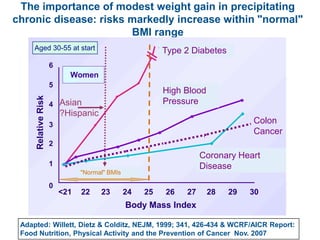
The importance of modest weight gain in precipitating
chronic disease: risks markedly increase within "normal"
BMI range
Adapted: Willett, Dietz & Colditz, NEJM, 1999; 341, 426-434 & WCRF/AICR Report:
Food Nutrition, Physical Activity and the Prevention of Cancer Nov. 2007
Body Mass Index
RelativeRisk
Women
1
2
3
4
5
6
0
<21 22 23 24 25 26 27 28 29 30
Type 2 diabetes
Coronary Heart Disease
Hypertension
Aged 30-55 at start
"Normal" BMIs
Colon
Cancer
Type 2 Diabetes
High Blood
Pressure
Coronary Heart
Disease
Asian
?Hispanic
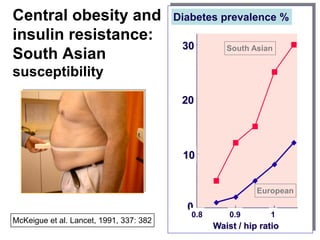
Central obesity and
insulin resistance:
South Asian
susceptibility
McKeigue et al. Lancet, 1991, 337: 382
0.8 0.9 1
0
10
20
30
40
50
2h insulin (mU/l)
Waist / hip ratio
0.8 0.9 1
0
10
20
30
Diabetes prevalence (%)
Waist / hip ratio
6 7
ose
opean
From Mckeigue et al. Lancet, 1991, 337: 382
South Asian
European
Diabetes prevalence %
Waist / hip ratio
30
20
10
0
0.8 0.9 1
CVD
DMCVD
DM
Cancers
Musc-Skel.
CancersCVD
Public Health England: From evidence into action:
Opportunities to protect and improve the nation’s health. 2014
DM
(Murray et al. Lancet 2013;381:997–1020)
Dietary risks
Tobacco smoking
High Blood Pressure
High BMI
Phys.Inactiv.
Alcohol
High Cholesterol
High fasting glucose
Drug use
Occupationa
l Air
pollution
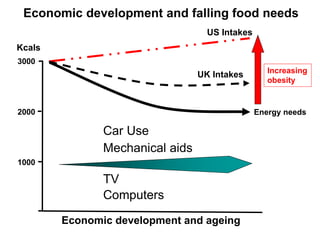
Economic development and falling food needs
3000
2000
1000
Kcals
Car Use
Mechanical aids
TV
Computers
Energy needs
US Intakes
UK Intakes Increasing
obesity
Economic development and ageing
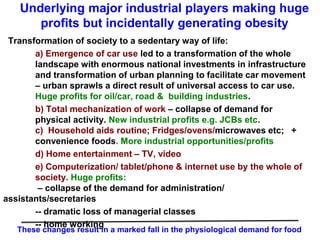
Underlying major industrial players making huge
profits but incidentally generating obesity
Transformation of society to a sedentary way of life:
a) Emergence of car use led to a transformation of the whole
landscape with enormous national investments in infrastructure
and transformation of urban planning to facilitate car movement
– urban sprawls a direct result of universal access to car use.
Huge profits for oil/car, road & building industries.
b) Total mechanization of work – collapse of demand for
physical activity. New industrial profits e.g. JCBs etc.
c) Household aids routine; Fridges/ovens/microwaves etc; +
convenience foods. More industrial opportunities/profits
d) Home entertainment – TV, video
e) Computerization/ tablet/phone & internet use by the whole of
society. Huge profits:
– collapse of the demand for administration/
assistants/secretaries
-- dramatic loss of managerial classes
-- home working
These changes result in a marked fall in the physiological demand for food
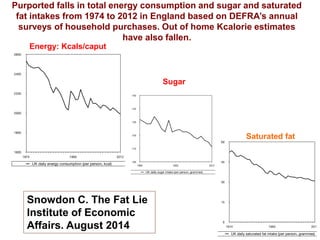
Purported falls in total energy consumption and sugar and saturated
fat intakes from 1974 to 2012 in England based on DEFRA’s annual
surveys of household purchases. Out of home Kcalorie estimates
have also fallen.
Energy: Kcals/caput
Sugar
Saturated fat
Snowdon C. The Fat Lie
Institute of Economic
Affairs. August 2014
Environmental factors increasing food intake
• Likelihood of overeating increased by :
– a) ready availability of food
– b) variety
– c) palatability
– d) key ingredients e.g. sugar, caffeine, oils: recently
developed additives selected for their olfactory
receptor patterning & induction of
neurophysiological reward stimulation
– e) increased portion size/bigger plates
– f) energy dense foods
– g) emotional cues
• Easy access to appealing food requires frequent,
repeated conscious as well as automatic brain
processes to inhibit food intake when confronted with
similar foods when not actually hungry
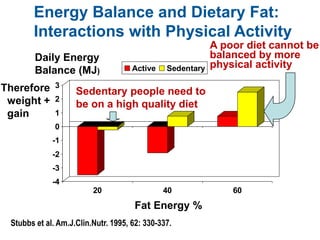
Energy Balance and Dietary Fat:
Interactions with Physical Activity
Fat Energy %
Stubbs et al. Am.J.Clin.Nutr. 1995, 62: 330-337.
Daily Energy
Balance (MJ)
-4
-3
-2
-1
0
1
2
3
20 40 60
Active Sedentary
Therefore
weight +
gain
A poor diet cannot be
balanced by more
physical activity
Sedentary people need to
be on a high quality diet
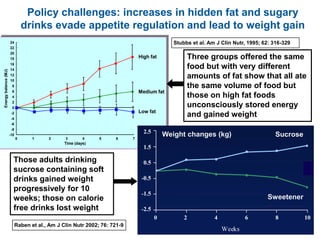
al. Am. J. Clin. Nutr. 1995; 62: 316-29.
Effect of covert manipulation of fat content of ad libitum diets
on energy balance
0 1 2 3 4 5 6 7
-10
-8
-6
-4
-2
0
2
4
6
8
10
12
14
16
18
20
22
24
Time (days)
Energybalance(MJ)
High fat
Medium fat
Low fat
2.5
1.5
0.5
-0.5
-1.5
-2.5
The importance of the non-fat componentThe importance of the non-fat component
Sugar-rich beverages increase body weightSugar-rich beverages increase body weight
Raben et al. Am J Clin
Weeks
Weight changes (kg)
0 2 4 6 8 10
Sw
Su
Stubbs et al. Am J Clin Nutr, 1995; 62: 316-329
Policy challenges: increases in hidden fat and sugary
drinks evade appetite regulation and lead to weight gain
Raben et al., Am J Clin Nutr 2002; 76: 721-9
Sucrose
Sweetener
Weight changes (kg)
Three groups offered the same
food but with very different
amounts of fat show that all ate
the same volume of food but
those on high fat foods
unconsciously stored energy
and gained weight
Those adults drinking
sucrose containing soft
drinks gained weight
progressively for 10
weeks; those on calorie
free drinks lost weight
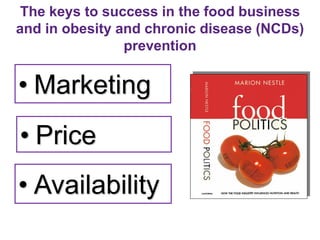
The keys to success in the food business
and in obesity and chronic disease (NCDs)
prevention
• Price
• Availability
• Marketing
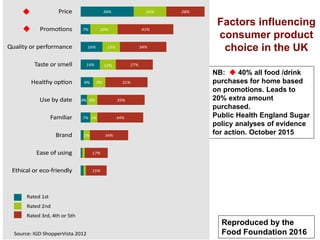
Factors influencing
consumer product
choice in the UK
Reproduced by the
Food Foundation 2016
NB:  40% all food /drink
purchases for home based
on promotions. Leads to
20% extra amount
purchased.
Public Health England Sugar
policy analyses of evidence
for action. October 2015


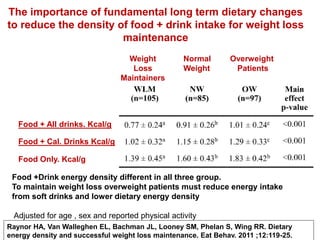
The importance of fundamental long term dietary changes
to reduce the density of food + drink intake for weight loss
maintenance
Food + All drinks. Kcal/g
Food + Cal. Drinks Kcal/g
Food Only. Kcal/g
Normal
Weight
Overweight
Patients
Weight
Loss
Maintainers
Raynor HA, Van Walleghen EL, Bachman JL, Looney SM, Phelan S, Wing RR. Dietary
energy density and successful weight loss maintenance. Eat Behav. 2011 ;12:119-25.
Food +Drink energy density different in all three group.
To maintain weight loss overweight patients must reduce energy intake
from soft drinks and lower dietary energy density
Adjusted for age , sex and reported physical activity
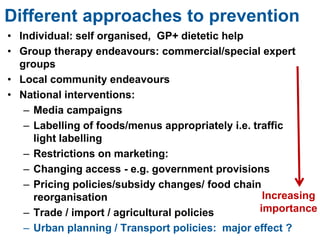
Different approaches to prevention
• Individual: self organised, GP+ dietetic help
• Group therapy endeavours: commercial/special expert
groups
• Local community endeavours
• National interventions:
– Media campaigns
– Labelling of foods/menus appropriately i.e. traffic
light labelling
– Restrictions on marketing:
– Changing access - e.g. government provisions
– Pricing policies/subsidy changes/ food chain
reorganisation
– Trade / import / agricultural policies
– Urban planning / Transport policies: major effect ?
Increasing
importance
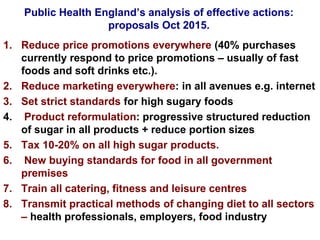
Public Health England’s analysis of effective actions:
proposals Oct 2015.
1. Reduce price promotions everywhere (40% purchases
currently respond to price promotions – usually of fast
foods and soft drinks etc.).
2. Reduce marketing everywhere: in all avenues e.g. internet
3. Set strict standards for high sugary foods
4. Product reformulation: progressive structured reduction
of sugar in all products + reduce portion sizes
5. Tax 10-20% on all high sugar products.
6. New buying standards for food in all government
premises
7. Train all catering, fitness and leisure centres
8. Transmit practical methods of changing diet to all sectors
– health professionals, employers, food industry
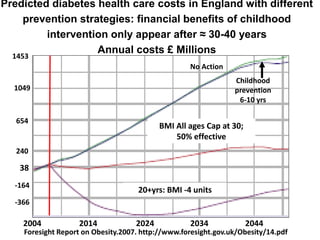
Predicted diabetes health care costs in England with different
prevention strategies: financial benefits of childhood
intervention only appear after ≈ 30-40 years
Annual costs £ Millions
BMI All ages Cap at 30;
50% effective
20+yrs: BMI -4 units
No Action
Childhood
prevention
6-10 yrs
2004 2014 2024 2034 2044
1049
654
240
-164
-366
38
1453
Foresight Report on Obesity.2007. http://www.foresight.gov.uk/Obesity/14.pdf
The Neuberger
Report
The aim of much government policy is to
bring about changes in people’s
behaviour and so a government’s
success will often depend on their ability
to implement effective behaviour change
interventions whilst, at the same time,
avoiding significant harmful side effects.
Our central finding is that non-
regulatory measures used in isolation,
including “nudges”, are less likely to
be effective. Effective policies often
use a range of interventions.
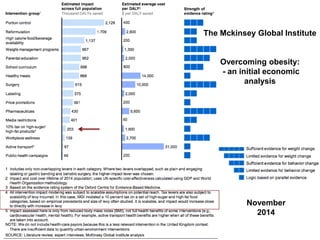
The Mckinsey Global Institute
Overcoming obesity:
- an initial economic
analysis
November
2014
Addition of Xenical to lifestyle changes further
reduces the risk of developing type 2 diabetes
Cumulativeincidenceofdiabetes(%)
0.0 0.5 1.0 1.5 2.0 2.5 3.0 3.5 4.0 Year
0
40
10
20
30
Placebo
Metformin
DPP lifestyle
Xenical + lifestyle
Placebo + lifestyle
XENDOS - IGT at baseline patients
RR* -52%
* Reduction in risk of progressing to type 2 diabetes versus placebo + lifestyle
XENDOS data on file. Adapted from Knowler et al. N Engl J Med 2002; 346: 393-403
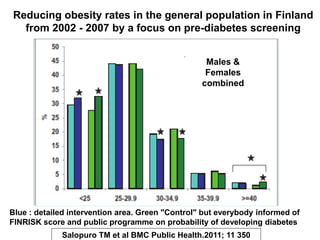
Reducing obesity rates in the general population in Finland
from 2002 - 2007 by a focus on pre-diabetes screening
Blue : detailed intervention area. Green "Control" but everybody informed of
FINRISK score and public programme on probability of developing diabetes
Salopuro TM et al BMC Public Health.2011; 11 350
Males &
Females
combined
GDS_0316732B_Trofimuk_v2 621/8/2007
Institute of Metabolic Science
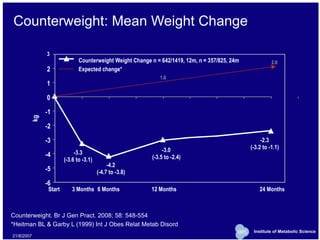
Counterweight: Mean Weight Change
Counterweight. Br J Gen Pract. 2008; 58: 548-554
*Heitman BL & Garby L (1999) Int J Obes Relat Metab Disord
-6
-5
-4
-3
-2
-1
0
1
2
3
Start 3 Months 6 Months 12 Months 24 Months
kg
-2.3
(-3.2 to -1.1)
-4.2
(-4.7 to -3.8)
-3.3
(-3.6 to -3.1)
-3.0
(-3.5 to -2.4)
Counterweight Weight Change n = 642/1419, 12m, n = 357/825, 24m 2.0
1.0
Expected change*
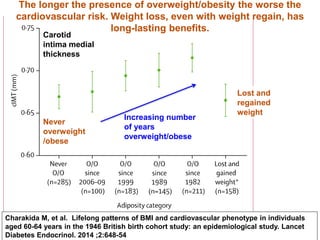
Charakida M, et al. Lifelong patterns of BMI and cardiovascular phenotype in individuals
aged 60-64 years in the 1946 British birth cohort study: an epidemiological study. Lancet
Diabetes Endocrinol. 2014 ;2:648-54
The longer the presence of overweight/obesity the worse the
cardiovascular risk. Weight loss, even with weight regain, has
long-lasting benefits.
Never
overweight
/obese
Increasing number
of years
overweight/obese
Lost and
regained
weight
Carotid
intima medial
thickness
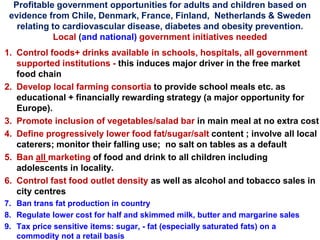
Profitable government opportunities for adults and children based on
evidence from Chile, Denmark, France, Finland, Netherlands & Sweden
relating to cardiovascular disease, diabetes and obesity prevention.
Local (and national) government initiatives needed
1. Control foods+ drinks available in schools, hospitals, all government
supported institutions - this induces major driver in the free market
food chain
2. Develop local farming consortia to provide school meals etc. as
educational + financially rewarding strategy (a major opportunity for
Europe).
3. Promote inclusion of vegetables/salad bar in main meal at no extra cost
4. Define progressively lower food fat/sugar/salt content ; involve all local
caterers; monitor their falling use; no salt on tables as a default
5. Ban all marketing of food and drink to all children including
adolescents in locality.
6. Control fast food outlet density as well as alcohol and tobacco sales in
city centres
7. Ban trans fat production in country
8. Regulate lower cost for half and skimmed milk, butter and margarine sales
9. Tax price sensitive items: sugar, - fat (especially saturated fats) on a
commodity not a retail basis
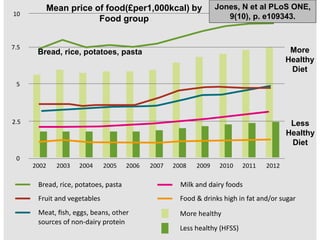
Mean price of food(£per1,000kcal) by
Food group
More
Healthy
Diet
Less
Healthy
Diet
Jones, N et al PLoS ONE,
9(10), p. e109343.
Bread, rice, potatoes, pasta
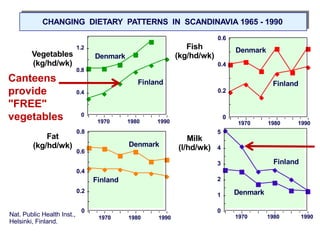
CHANGING DIETARY PATTERNS IN SCANDINAVIA 1965 - 1990
Vegetables
(kg/hd/wk)
Fat
(kg/hd/wk)
0
0.2
0.4
0.6
0.8
1970 1980 1990
Denmark
Finland
0
0.4
0.8
1.2
1970 1980 1990
Denmark
Finland
Fish
(kg/hd/wk)
0
0.2
0.4
0.6
1970 1980 1990
Denmark
Finland
Milk
(l/hd/wk)
0
1
2
3
4
5
1970 1980 1990
Denmark
Finland
Nat. Public Health Inst.,
Helsinki, Finland.
Canteens
provide
"FREE"
vegetables
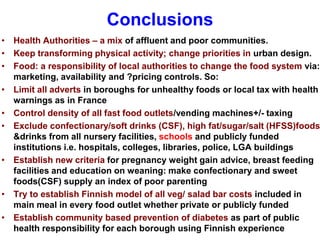
Conclusions
• Health Authorities – a mix of affluent and poor communities.
• Keep transforming physical activity; change priorities in urban design.
• Food: a responsibility of local authorities to change the food system via:
marketing, availability and ?pricing controls. So:
• Limit all adverts in boroughs for unhealthy foods or local tax with health
warnings as in France
• Control density of all fast food outlets/vending machines+/- taxing
• Exclude confectionary/soft drinks (CSF), high fat/sugar/salt (HFSS)foods
&drinks from all nursery facilities, schools and publicly funded
institutions i.e. hospitals, colleges, libraries, police, LGA buildings
• Establish new criteria for pregnancy weight gain advice, breast feeding
facilities and education on weaning: make confectionary and sweet
foods(CSF) supply an index of poor parenting
• Try to establish Finnish model of all veg/ salad bar costs included in
main meal in every food outlet whether private or publicly funded
• Establish community based prevention of diabetes as part of public
health responsibility for each borough using Finnish experience

Philip James

  • 1.
    ‘Bringing Obesity Upthe National Agenda’ W Philip T James London School of Hygiene and Tropical Medicine Recent President, World Obesity Federation
  • 2.
    Source: OECD http://www.ecosante.org/index2.php?base=OCDE&langs=ENG&langh=ENG *Self reporteddata in the Netherlands (prevalence rates for the other countries are based on measured data) National secular trends in adult obesity Prevalence obesity % by year USA England Luxembourg Finlan d Netherlands Japan 35 30 25 20 15 10 5 0 1978 1983 1988 1993 1998 2003 2008 YEAR
  • 3.
    Trend in adultobesity prevalence by social class Health Survey for England 1994-2013 (5 year moving average*) 3 Adult (aged 16+) obesity: BMI ≥ 30kg/m2 0% 5% 10% 15% 20% 25% 30% 35% 40% 94-98 95-99 96-00 97-01 98-02 99-03 00-04 01-05 02-06 03-07 04- Obesityprevalence I- Professional II - Managerial technical IIIM - Skilled manual IIIN - Skilled non-manual IV - Semi-skilled manual V - Unskilled manual 0% 5% 10% 15% 20% 25% 30% 94-98 95-99 96-00 97-01 98-02 99-03 00-04 01-05 02-06 03-07 04-08 05-09 I- Professional II - Managerial technical IIIM - Skilled manual IIIN - Skilled non-manual IV - Semi-skilled manual V - Unskilled manual Men Women *No data on social class were collected in 2010 and 2011. Therefore data presented as 06-10 are based on a 4 year average. Data presented for 07-11, 08-12, and 09-13 are based on a 3 year average. Skilled Manual Unskilled manual Manag/Tech Professional Professional Manag/Techn. Unskilled manual Skilled Manual
  • 4.
    The importance ofmodest weight gain in precipitating chronic disease: risks markedly increase within "normal" BMI range Adapted: Willett, Dietz & Colditz, NEJM, 1999; 341, 426-434 & WCRF/AICR Report: Food Nutrition, Physical Activity and the Prevention of Cancer Nov. 2007 Body Mass Index RelativeRisk Women 1 2 3 4 5 6 0 <21 22 23 24 25 26 27 28 29 30 Type 2 diabetes Coronary Heart Disease Hypertension Aged 30-55 at start "Normal" BMIs Colon Cancer Type 2 Diabetes High Blood Pressure Coronary Heart Disease Asian ?Hispanic
  • 5.
    Central obesity and insulinresistance: South Asian susceptibility McKeigue et al. Lancet, 1991, 337: 382 0.8 0.9 1 0 10 20 30 40 50 2h insulin (mU/l) Waist / hip ratio 0.8 0.9 1 0 10 20 30 Diabetes prevalence (%) Waist / hip ratio 6 7 ose opean From Mckeigue et al. Lancet, 1991, 337: 382 South Asian European Diabetes prevalence % Waist / hip ratio 30 20 10 0 0.8 0.9 1
  • 6.
    CVD DMCVD DM Cancers Musc-Skel. CancersCVD Public Health England:From evidence into action: Opportunities to protect and improve the nation’s health. 2014 DM (Murray et al. Lancet 2013;381:997–1020) Dietary risks Tobacco smoking High Blood Pressure High BMI Phys.Inactiv. Alcohol High Cholesterol High fasting glucose Drug use Occupationa l Air pollution
  • 7.
    Economic development andfalling food needs 3000 2000 1000 Kcals Car Use Mechanical aids TV Computers Energy needs US Intakes UK Intakes Increasing obesity Economic development and ageing
  • 8.
    Underlying major industrialplayers making huge profits but incidentally generating obesity Transformation of society to a sedentary way of life: a) Emergence of car use led to a transformation of the whole landscape with enormous national investments in infrastructure and transformation of urban planning to facilitate car movement – urban sprawls a direct result of universal access to car use. Huge profits for oil/car, road & building industries. b) Total mechanization of work – collapse of demand for physical activity. New industrial profits e.g. JCBs etc. c) Household aids routine; Fridges/ovens/microwaves etc; + convenience foods. More industrial opportunities/profits d) Home entertainment – TV, video e) Computerization/ tablet/phone & internet use by the whole of society. Huge profits: – collapse of the demand for administration/ assistants/secretaries -- dramatic loss of managerial classes -- home working These changes result in a marked fall in the physiological demand for food
  • 9.
    Purported falls intotal energy consumption and sugar and saturated fat intakes from 1974 to 2012 in England based on DEFRA’s annual surveys of household purchases. Out of home Kcalorie estimates have also fallen. Energy: Kcals/caput Sugar Saturated fat Snowdon C. The Fat Lie Institute of Economic Affairs. August 2014
  • 10.
    Environmental factors increasingfood intake • Likelihood of overeating increased by : – a) ready availability of food – b) variety – c) palatability – d) key ingredients e.g. sugar, caffeine, oils: recently developed additives selected for their olfactory receptor patterning & induction of neurophysiological reward stimulation – e) increased portion size/bigger plates – f) energy dense foods – g) emotional cues • Easy access to appealing food requires frequent, repeated conscious as well as automatic brain processes to inhibit food intake when confronted with similar foods when not actually hungry
  • 11.
    Energy Balance andDietary Fat: Interactions with Physical Activity Fat Energy % Stubbs et al. Am.J.Clin.Nutr. 1995, 62: 330-337. Daily Energy Balance (MJ) -4 -3 -2 -1 0 1 2 3 20 40 60 Active Sedentary Therefore weight + gain A poor diet cannot be balanced by more physical activity Sedentary people need to be on a high quality diet
  • 12.
    al. Am. J.Clin. Nutr. 1995; 62: 316-29. Effect of covert manipulation of fat content of ad libitum diets on energy balance 0 1 2 3 4 5 6 7 -10 -8 -6 -4 -2 0 2 4 6 8 10 12 14 16 18 20 22 24 Time (days) Energybalance(MJ) High fat Medium fat Low fat 2.5 1.5 0.5 -0.5 -1.5 -2.5 The importance of the non-fat componentThe importance of the non-fat component Sugar-rich beverages increase body weightSugar-rich beverages increase body weight Raben et al. Am J Clin Weeks Weight changes (kg) 0 2 4 6 8 10 Sw Su Stubbs et al. Am J Clin Nutr, 1995; 62: 316-329 Policy challenges: increases in hidden fat and sugary drinks evade appetite regulation and lead to weight gain Raben et al., Am J Clin Nutr 2002; 76: 721-9 Sucrose Sweetener Weight changes (kg) Three groups offered the same food but with very different amounts of fat show that all ate the same volume of food but those on high fat foods unconsciously stored energy and gained weight Those adults drinking sucrose containing soft drinks gained weight progressively for 10 weeks; those on calorie free drinks lost weight
  • 13.
    The keys tosuccess in the food business and in obesity and chronic disease (NCDs) prevention • Price • Availability • Marketing
  • 14.
    Factors influencing consumer product choicein the UK Reproduced by the Food Foundation 2016 NB:  40% all food /drink purchases for home based on promotions. Leads to 20% extra amount purchased. Public Health England Sugar policy analyses of evidence for action. October 2015  
  • 15.
    The importance offundamental long term dietary changes to reduce the density of food + drink intake for weight loss maintenance Food + All drinks. Kcal/g Food + Cal. Drinks Kcal/g Food Only. Kcal/g Normal Weight Overweight Patients Weight Loss Maintainers Raynor HA, Van Walleghen EL, Bachman JL, Looney SM, Phelan S, Wing RR. Dietary energy density and successful weight loss maintenance. Eat Behav. 2011 ;12:119-25. Food +Drink energy density different in all three group. To maintain weight loss overweight patients must reduce energy intake from soft drinks and lower dietary energy density Adjusted for age , sex and reported physical activity
  • 16.
    Different approaches toprevention • Individual: self organised, GP+ dietetic help • Group therapy endeavours: commercial/special expert groups • Local community endeavours • National interventions: – Media campaigns – Labelling of foods/menus appropriately i.e. traffic light labelling – Restrictions on marketing: – Changing access - e.g. government provisions – Pricing policies/subsidy changes/ food chain reorganisation – Trade / import / agricultural policies – Urban planning / Transport policies: major effect ? Increasing importance
  • 17.
    Public Health England’sanalysis of effective actions: proposals Oct 2015. 1. Reduce price promotions everywhere (40% purchases currently respond to price promotions – usually of fast foods and soft drinks etc.). 2. Reduce marketing everywhere: in all avenues e.g. internet 3. Set strict standards for high sugary foods 4. Product reformulation: progressive structured reduction of sugar in all products + reduce portion sizes 5. Tax 10-20% on all high sugar products. 6. New buying standards for food in all government premises 7. Train all catering, fitness and leisure centres 8. Transmit practical methods of changing diet to all sectors – health professionals, employers, food industry
  • 18.
    Predicted diabetes healthcare costs in England with different prevention strategies: financial benefits of childhood intervention only appear after ≈ 30-40 years Annual costs £ Millions BMI All ages Cap at 30; 50% effective 20+yrs: BMI -4 units No Action Childhood prevention 6-10 yrs 2004 2014 2024 2034 2044 1049 654 240 -164 -366 38 1453 Foresight Report on Obesity.2007. http://www.foresight.gov.uk/Obesity/14.pdf
  • 19.
    The Neuberger Report The aimof much government policy is to bring about changes in people’s behaviour and so a government’s success will often depend on their ability to implement effective behaviour change interventions whilst, at the same time, avoiding significant harmful side effects. Our central finding is that non- regulatory measures used in isolation, including “nudges”, are less likely to be effective. Effective policies often use a range of interventions.
  • 20.
    The Mckinsey GlobalInstitute Overcoming obesity: - an initial economic analysis November 2014
  • 21.
    Addition of Xenicalto lifestyle changes further reduces the risk of developing type 2 diabetes Cumulativeincidenceofdiabetes(%) 0.0 0.5 1.0 1.5 2.0 2.5 3.0 3.5 4.0 Year 0 40 10 20 30 Placebo Metformin DPP lifestyle Xenical + lifestyle Placebo + lifestyle XENDOS - IGT at baseline patients RR* -52% * Reduction in risk of progressing to type 2 diabetes versus placebo + lifestyle XENDOS data on file. Adapted from Knowler et al. N Engl J Med 2002; 346: 393-403
  • 22.
    Reducing obesity ratesin the general population in Finland from 2002 - 2007 by a focus on pre-diabetes screening Blue : detailed intervention area. Green "Control" but everybody informed of FINRISK score and public programme on probability of developing diabetes Salopuro TM et al BMC Public Health.2011; 11 350 Males & Females combined
  • 23.
    GDS_0316732B_Trofimuk_v2 621/8/2007 Institute ofMetabolic Science Counterweight: Mean Weight Change Counterweight. Br J Gen Pract. 2008; 58: 548-554 *Heitman BL & Garby L (1999) Int J Obes Relat Metab Disord -6 -5 -4 -3 -2 -1 0 1 2 3 Start 3 Months 6 Months 12 Months 24 Months kg -2.3 (-3.2 to -1.1) -4.2 (-4.7 to -3.8) -3.3 (-3.6 to -3.1) -3.0 (-3.5 to -2.4) Counterweight Weight Change n = 642/1419, 12m, n = 357/825, 24m 2.0 1.0 Expected change*
  • 24.
    Charakida M, etal. Lifelong patterns of BMI and cardiovascular phenotype in individuals aged 60-64 years in the 1946 British birth cohort study: an epidemiological study. Lancet Diabetes Endocrinol. 2014 ;2:648-54 The longer the presence of overweight/obesity the worse the cardiovascular risk. Weight loss, even with weight regain, has long-lasting benefits. Never overweight /obese Increasing number of years overweight/obese Lost and regained weight Carotid intima medial thickness
  • 25.
    Profitable government opportunitiesfor adults and children based on evidence from Chile, Denmark, France, Finland, Netherlands & Sweden relating to cardiovascular disease, diabetes and obesity prevention. Local (and national) government initiatives needed 1. Control foods+ drinks available in schools, hospitals, all government supported institutions - this induces major driver in the free market food chain 2. Develop local farming consortia to provide school meals etc. as educational + financially rewarding strategy (a major opportunity for Europe). 3. Promote inclusion of vegetables/salad bar in main meal at no extra cost 4. Define progressively lower food fat/sugar/salt content ; involve all local caterers; monitor their falling use; no salt on tables as a default 5. Ban all marketing of food and drink to all children including adolescents in locality. 6. Control fast food outlet density as well as alcohol and tobacco sales in city centres 7. Ban trans fat production in country 8. Regulate lower cost for half and skimmed milk, butter and margarine sales 9. Tax price sensitive items: sugar, - fat (especially saturated fats) on a commodity not a retail basis
  • 26.
    Mean price offood(£per1,000kcal) by Food group More Healthy Diet Less Healthy Diet Jones, N et al PLoS ONE, 9(10), p. e109343. Bread, rice, potatoes, pasta
  • 27.
    CHANGING DIETARY PATTERNSIN SCANDINAVIA 1965 - 1990 Vegetables (kg/hd/wk) Fat (kg/hd/wk) 0 0.2 0.4 0.6 0.8 1970 1980 1990 Denmark Finland 0 0.4 0.8 1.2 1970 1980 1990 Denmark Finland Fish (kg/hd/wk) 0 0.2 0.4 0.6 1970 1980 1990 Denmark Finland Milk (l/hd/wk) 0 1 2 3 4 5 1970 1980 1990 Denmark Finland Nat. Public Health Inst., Helsinki, Finland. Canteens provide "FREE" vegetables
  • 28.
    Conclusions • Health Authorities– a mix of affluent and poor communities. • Keep transforming physical activity; change priorities in urban design. • Food: a responsibility of local authorities to change the food system via: marketing, availability and ?pricing controls. So: • Limit all adverts in boroughs for unhealthy foods or local tax with health warnings as in France • Control density of all fast food outlets/vending machines+/- taxing • Exclude confectionary/soft drinks (CSF), high fat/sugar/salt (HFSS)foods &drinks from all nursery facilities, schools and publicly funded institutions i.e. hospitals, colleges, libraries, police, LGA buildings • Establish new criteria for pregnancy weight gain advice, breast feeding facilities and education on weaning: make confectionary and sweet foods(CSF) supply an index of poor parenting • Try to establish Finnish model of all veg/ salad bar costs included in main meal in every food outlet whether private or publicly funded • Establish community based prevention of diabetes as part of public health responsibility for each borough using Finnish experience