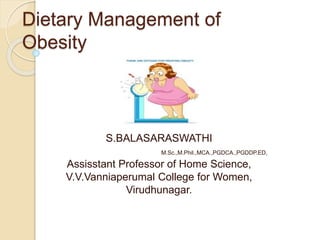
Dietary Management of
Obesity
S.BALASARASWATHI
M.Sc.,M.Phil.,MCA.,PGDCA.,PGDDP.ED,
Assisstant Professor of Home Science,
V.V.Vanniaperumal College for Women,
Virudhunagar.
Definition
Overweight- It is a condition where the body
weight is 10-20 per cent greater than the mean
standard weight for age, height and sex.
Obesity-It is generalised accumulation of
excess adipose tissue in the body leading to
more than 20 per cent of the desirable weight.
Aetiology of Obesity
 Genetic Factors
 Age and Sex
 Eating Habits
 Physical Activity
 Stress
 Endocrine Factors
 Trauma
 Prosperity and Civilisation
Genetic Factors
 Genetic inheritance probably influences 50-70 per
cent a person’s chance of becoming fat more than
any other factors.
 Within the families the chances is 80 per cent if both
parents are obese and 50 per cent if one parent is
obese.
 Many genes play a role in
• Energy Homeostasis-UCP1,UCP2,UCP3
• Food Intake requlation-MC3R,MC4R,CCKAR
• Appetite-NPYRS and
• Ultimately obesity-ASIP,CPE,LEP,LEPR,TUB,POMC
in mammals.
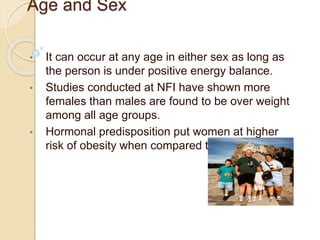
Age and Sex
• It can occur at any age in either sex as long as
the person is under positive energy balance.
• Studies conducted at NFI have shown more
females than males are found to be over weight
among all age groups.
• Hormonal predisposition put women at higher
risk of obesity when compared to men.
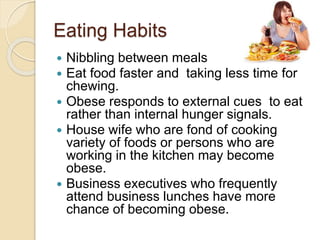
Eating Habits
 Nibbling between meals
 Eat food faster and taking less time for
chewing.
 Obese responds to external cues to eat
rather than internal hunger signals.
 House wife who are fond of cooking
variety of foods or persons who are
working in the kitchen may become
obese.
 Business executives who frequently
attend business lunches have more
chance of becoming obese.
Cont….
 Housewives who do not want leftover
foods to be thrown out may consume
forcibly and put on weight.
 People who eat outside home more
frequently are prone to obesity.
 People who eat more junk food may
become obese.
 Certain cultural practices like making and
distributing sweets on festive occasions
contribute to increased calorie
consumption.
Cont….
 Non-inclusion of fruits and vegetables
and non-vegetarian favour weight gain.
 People who like to eat processed,
concentrated and high fat food are
susceptible to obesity.
 Some may eat more food when they are
unhappy as a compensation mechanism.
 Consumption of sugar added beverages
may contribute to weight gain.
 Personnel who work in different shifts,
whose body clock is disturbed, may over
eat.
Physical Activity
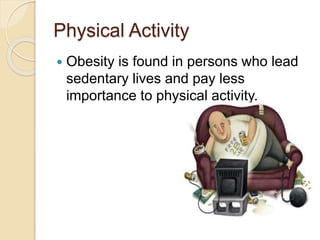
 Obesity is found in persons who lead
sedentary lives and pay less
importance to physical activity.
Stress
 Food is one of the many stimulant of
endorphin, ‘feel good’ nerotransmitter.
 Self gratification, self punishment,
depression, anxiety and stress may
lead to excess calorie intake.
Endocrine Factors
 Hypothyroidism
 Hypogonodism and cushing’s
syndrome.
 Puberty
 Pregnancy
 Menopuse
Trauma
 Obesity may fellow due to
hypothalamus after head injury
because it is not able to requlate
appetite or satiety
Prosperity and Civilisation
 Obesity is common in prosperous
countries like UK,USSR and USA and
among people from higher
socioeconomic status of developing
countries, since they have the
purchasing power and availability of
surplus food.
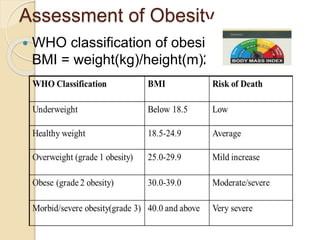
Assessment of Obesity
 WHO classification of obesity
BMI = weight(kg)/height(m)2
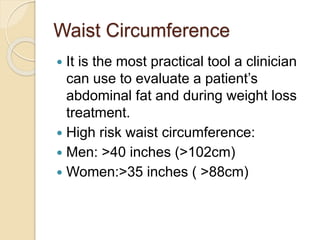
Waist Circumference
 It is the most practical tool a clinician
can use to evaluate a patient’s
abdominal fat and during weight loss
treatment.
 High risk waist circumference:
 Men: >40 inches (>102cm)
 Women:>35 inches ( >88cm)
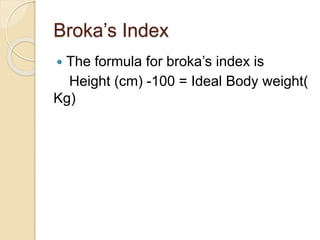
Broka’s Index
 The formula for broka’s index is
Height (cm) -100 = Ideal Body weight(
Kg)
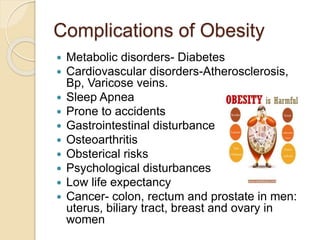
Complications of Obesity
 Metabolic disorders- Diabetes
 Cardiovascular disorders-Atherosclerosis,
Bp, Varicose veins.
 Sleep Apnea
 Prone to accidents
 Gastrointestinal disturbance
 Osteoarthritis
 Obsterical risks
 Psychological disturbances
 Low life expectancy
 Cancer- colon, rectum and prostate in men:
uterus, biliary tract, breast and ovary in
women
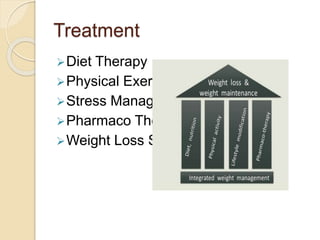
Treatment
Diet Therapy
Physical Exercise
Stress Management
Pharmaco Therapy
Weight Loss Surgery
Principle of dietetic
Management
Low calorie
Normal Protein, Vitamins and Minerals
(except sodium)
Restricted carbohydrates and fat
Liberal fluid
High fibre
Energy
 To loose weight, energy output must
exceed energy output. The person has to
be in negative energy balance.
 Sedentary worker-20 kcal/kg IBW
 Moderately active worker-25/kg IBW
 Heavy worker- 30/kg IBW
RDA for Normal Men
Women
SW 2320 Kcal 1900Kcal
MW 2730 Kcal 2230Kcal
HW 3490 Kcal 2850Kcal
Protein
 0.8-1 g of protein/ kg of body weight is
prescribed for tissue repair and for
specific dynamic action.
Carbohydrates
 Determine the number of grams of carbs
one need each day by calculating 45 to
65 percent of your total calorie intake,
and dividing by 4.
 For example, if one eat a 2,000-calorie
diet, shoot for 225 to 325 grams of carbs
per day.
 One eat 2,500 calories a day, aim for
281 to 406 grams of carbs.
 Adults who drop their intake to 1,200
calories a day for weight loss need about
50 percent of their calories from carbs, or
150 grams per day.
Fat
 10 percent of calories from fat, with most
fats coming from sources of
polyunsaturated and monounsaturated
fatty acids, such as fish, nuts, and
vegetable oils.
 When selecting and preparing meat,
poultry, dry beans, and milk or milk
products, make choices that are lean,
low-fat, or fat-free.
 Limit intake of fats and oils high in
saturated and/or trans fatty acids, and
choose products low in such fats and
Vitamins
 With prolonged restriction of fats,
there is to be a restriction of fat
soluble vitamins and D which may be
supplemented.
Minerals
 Restriction of sodium as common salt
is helpful in weight reducing diet as
excess sodium predisposes to
retention of fluid.
Fluid
 Fluid can be taken liberally as extra
fluids are excreted by healthy kidneys.
 A glass of water before meals helps to
cut down food intake.
Fiber
High fiber diet advantages
 Low in calorie density
 Provides more vitamins and minerals
 Give satiety
 Help in regulating bowel movement
 Reduce blood cholesterol
 Promote chewing and decrease rate
of ingestion.
DIETARY GUIDELINES
 Modification of normal diet is the best way of
reducing weight.
 The diet should consist of all 5 food groups.
 Water can be consumed in unlimited
quantity.
 Carbonated and sweetened beverages
should be avoided.
 Unsweetened beverages like buttermilk can
potentiate the satiating property, supress
appetite and control food intake.
 Foods giving empty calories should be
avoided.
Cont…
Red meat should be avoided. Fish can
be included in the diet. Restricted
amount of eggs can be included.
Skimmed milk should be used in the diet,
Cheese can be sparingly used.
Colourful fruits and vegetables and
green leafy vegetables should be
included in the diet.
Diet should be rich in fibre. Diet should
include whole grains, sprouted
grams, unprocessed foods, and natural
foods in raw form.
Cont…
The diet should be low in fat. No
saturated and Trans fatty acids
should be included in the diet.
Junk foods like pizzas, chips and
French fries should be strictly
avoided.
Foods naturally rich in oils like nuts
should be taken in restricted
amounts.
The diet should be low in sugar.
Sweets, cakes and chocolates
Cont….
Methods of cooking should be modified.
Boiling, steaming, pressure cooking
and simmering with no additional fat
should be the methods of cooking.
To reduce the intake of food, serving size
can be reduced. Small size plates
and ladles can be used.
Meals should not be skipped. Feasting
should be avoided.
Small frequent feedings are
recommended.
Even low calorie foods should not be
taken in unlimited amounts.
Conclusion
“Obesity cannot be prevented or
managed solely by diet alone. Behavioral
changes, physical exercise, stress
management must be practiced together
so that the person is less conducive to
weight gain”
Obesity

Obesity

  • 1.
    Dietary Management of Obesity S.BALASARASWATHI M.Sc.,M.Phil.,MCA.,PGDCA.,PGDDP.ED, AssisstantProfessor of Home Science, V.V.Vanniaperumal College for Women, Virudhunagar.
  • 2.
    Definition Overweight- It isa condition where the body weight is 10-20 per cent greater than the mean standard weight for age, height and sex. Obesity-It is generalised accumulation of excess adipose tissue in the body leading to more than 20 per cent of the desirable weight.
  • 3.
    Aetiology of Obesity Genetic Factors  Age and Sex  Eating Habits  Physical Activity  Stress  Endocrine Factors  Trauma  Prosperity and Civilisation
  • 4.
    Genetic Factors  Geneticinheritance probably influences 50-70 per cent a person’s chance of becoming fat more than any other factors.  Within the families the chances is 80 per cent if both parents are obese and 50 per cent if one parent is obese.  Many genes play a role in • Energy Homeostasis-UCP1,UCP2,UCP3 • Food Intake requlation-MC3R,MC4R,CCKAR • Appetite-NPYRS and • Ultimately obesity-ASIP,CPE,LEP,LEPR,TUB,POMC in mammals.
  • 5.
    Age and Sex •It can occur at any age in either sex as long as the person is under positive energy balance. • Studies conducted at NFI have shown more females than males are found to be over weight among all age groups. • Hormonal predisposition put women at higher risk of obesity when compared to men.
  • 6.
    Eating Habits  Nibblingbetween meals  Eat food faster and taking less time for chewing.  Obese responds to external cues to eat rather than internal hunger signals.  House wife who are fond of cooking variety of foods or persons who are working in the kitchen may become obese.  Business executives who frequently attend business lunches have more chance of becoming obese.
  • 7.
    Cont….  Housewives whodo not want leftover foods to be thrown out may consume forcibly and put on weight.  People who eat outside home more frequently are prone to obesity.  People who eat more junk food may become obese.  Certain cultural practices like making and distributing sweets on festive occasions contribute to increased calorie consumption.
  • 8.
    Cont….  Non-inclusion offruits and vegetables and non-vegetarian favour weight gain.  People who like to eat processed, concentrated and high fat food are susceptible to obesity.  Some may eat more food when they are unhappy as a compensation mechanism.  Consumption of sugar added beverages may contribute to weight gain.  Personnel who work in different shifts, whose body clock is disturbed, may over eat.
  • 9.
    Physical Activity  Obesityis found in persons who lead sedentary lives and pay less importance to physical activity.
  • 10.
    Stress  Food isone of the many stimulant of endorphin, ‘feel good’ nerotransmitter.  Self gratification, self punishment, depression, anxiety and stress may lead to excess calorie intake.
  • 11.
    Endocrine Factors  Hypothyroidism Hypogonodism and cushing’s syndrome.  Puberty  Pregnancy  Menopuse
  • 12.
    Trauma  Obesity mayfellow due to hypothalamus after head injury because it is not able to requlate appetite or satiety
  • 13.
    Prosperity and Civilisation Obesity is common in prosperous countries like UK,USSR and USA and among people from higher socioeconomic status of developing countries, since they have the purchasing power and availability of surplus food.
  • 14.
    Assessment of Obesity WHO classification of obesity BMI = weight(kg)/height(m)2
  • 15.
    Waist Circumference  Itis the most practical tool a clinician can use to evaluate a patient’s abdominal fat and during weight loss treatment.  High risk waist circumference:  Men: >40 inches (>102cm)  Women:>35 inches ( >88cm)
  • 16.
    Broka’s Index  Theformula for broka’s index is Height (cm) -100 = Ideal Body weight( Kg)
  • 17.
    Complications of Obesity Metabolic disorders- Diabetes  Cardiovascular disorders-Atherosclerosis, Bp, Varicose veins.  Sleep Apnea  Prone to accidents  Gastrointestinal disturbance  Osteoarthritis  Obsterical risks  Psychological disturbances  Low life expectancy  Cancer- colon, rectum and prostate in men: uterus, biliary tract, breast and ovary in women
  • 18.
    Treatment Diet Therapy Physical Exercise StressManagement Pharmaco Therapy Weight Loss Surgery
  • 19.
    Principle of dietetic Management Lowcalorie Normal Protein, Vitamins and Minerals (except sodium) Restricted carbohydrates and fat Liberal fluid High fibre
  • 20.
    Energy  To looseweight, energy output must exceed energy output. The person has to be in negative energy balance.  Sedentary worker-20 kcal/kg IBW  Moderately active worker-25/kg IBW  Heavy worker- 30/kg IBW RDA for Normal Men Women SW 2320 Kcal 1900Kcal MW 2730 Kcal 2230Kcal HW 3490 Kcal 2850Kcal
  • 21.
    Protein  0.8-1 gof protein/ kg of body weight is prescribed for tissue repair and for specific dynamic action.
  • 22.
    Carbohydrates  Determine thenumber of grams of carbs one need each day by calculating 45 to 65 percent of your total calorie intake, and dividing by 4.  For example, if one eat a 2,000-calorie diet, shoot for 225 to 325 grams of carbs per day.  One eat 2,500 calories a day, aim for 281 to 406 grams of carbs.  Adults who drop their intake to 1,200 calories a day for weight loss need about 50 percent of their calories from carbs, or 150 grams per day.
  • 23.
    Fat  10 percentof calories from fat, with most fats coming from sources of polyunsaturated and monounsaturated fatty acids, such as fish, nuts, and vegetable oils.  When selecting and preparing meat, poultry, dry beans, and milk or milk products, make choices that are lean, low-fat, or fat-free.  Limit intake of fats and oils high in saturated and/or trans fatty acids, and choose products low in such fats and
  • 24.
    Vitamins  With prolongedrestriction of fats, there is to be a restriction of fat soluble vitamins and D which may be supplemented.
  • 25.
    Minerals  Restriction ofsodium as common salt is helpful in weight reducing diet as excess sodium predisposes to retention of fluid.
  • 26.
    Fluid  Fluid canbe taken liberally as extra fluids are excreted by healthy kidneys.  A glass of water before meals helps to cut down food intake.
  • 27.
    Fiber High fiber dietadvantages  Low in calorie density  Provides more vitamins and minerals  Give satiety  Help in regulating bowel movement  Reduce blood cholesterol  Promote chewing and decrease rate of ingestion.
  • 28.
    DIETARY GUIDELINES  Modificationof normal diet is the best way of reducing weight.  The diet should consist of all 5 food groups.  Water can be consumed in unlimited quantity.  Carbonated and sweetened beverages should be avoided.  Unsweetened beverages like buttermilk can potentiate the satiating property, supress appetite and control food intake.  Foods giving empty calories should be avoided.
  • 29.
    Cont… Red meat shouldbe avoided. Fish can be included in the diet. Restricted amount of eggs can be included. Skimmed milk should be used in the diet, Cheese can be sparingly used. Colourful fruits and vegetables and green leafy vegetables should be included in the diet. Diet should be rich in fibre. Diet should include whole grains, sprouted grams, unprocessed foods, and natural foods in raw form.
  • 30.
    Cont… The diet shouldbe low in fat. No saturated and Trans fatty acids should be included in the diet. Junk foods like pizzas, chips and French fries should be strictly avoided. Foods naturally rich in oils like nuts should be taken in restricted amounts. The diet should be low in sugar. Sweets, cakes and chocolates
  • 31.
    Cont…. Methods of cookingshould be modified. Boiling, steaming, pressure cooking and simmering with no additional fat should be the methods of cooking. To reduce the intake of food, serving size can be reduced. Small size plates and ladles can be used. Meals should not be skipped. Feasting should be avoided. Small frequent feedings are recommended. Even low calorie foods should not be taken in unlimited amounts.
  • 32.
    Conclusion “Obesity cannot beprevented or managed solely by diet alone. Behavioral changes, physical exercise, stress management must be practiced together so that the person is less conducive to weight gain”