EVALUATION OF WATER
QUALITY IN THE TIGRIS
RIVER WITHIN BAGHDAD,
IRAQ USING MULTIVARIATE
STATISTICAL TECHNIQUES
• Ajay Malik
• 2K22/ENE/502
• Seminar ENE-5201
1
Introduction
• The Tigris River in Iraq faces water quality deterioration from industrial
and agricultural activities, notably wastewater discharge. To navigate
this complexity, continuous monitoring and multivariate methods like
PCA, MLR, CA, and DA are essential. These advanced analyses provide
decision makers with crucial insights for effective water management
and environmental preservation.
Presentation title 2
MATERIALS AND METHOD
Presentation title 3
The Search Space
Data Pretreatment and Analysis
Principal Component Analyses
Discriminant Analysis
Multiple Linear Regression Analysis
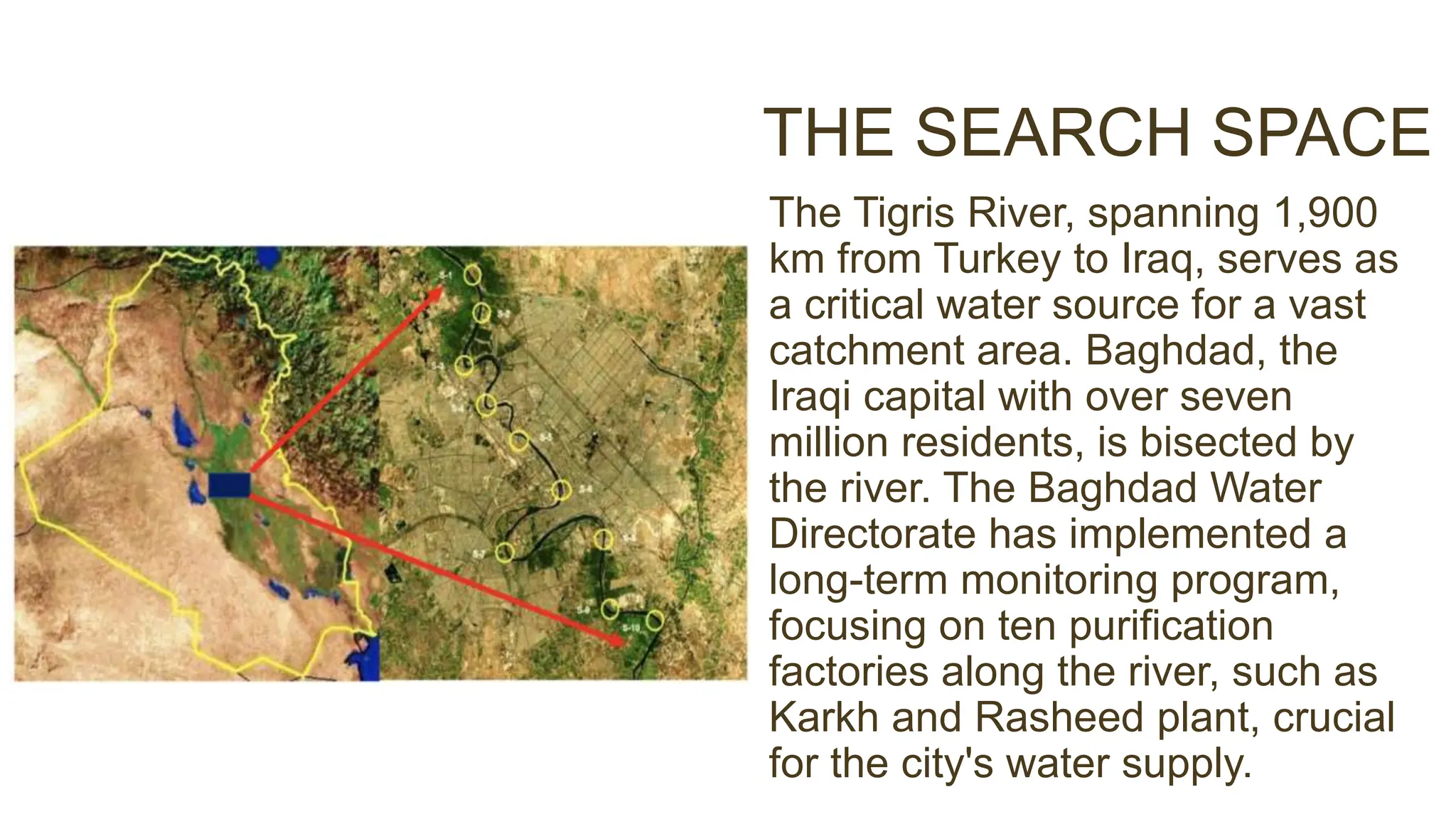
THE SEARCH SPACE
The Tigris River, spanning 1,900
km from Turkey to Iraq, serves as
a critical water source for a vast
catchment area. Baghdad, the
Iraqi capital with over seven
million residents, is bisected by
the river. The Baghdad Water
Directorate has implemented a
long-term monitoring program,
focusing on ten purification
factories along the river, such as
Karkh and Rasheed plant, crucial
for the city's water supply.
DATA PRETREATMENT AND
ANALYSIS
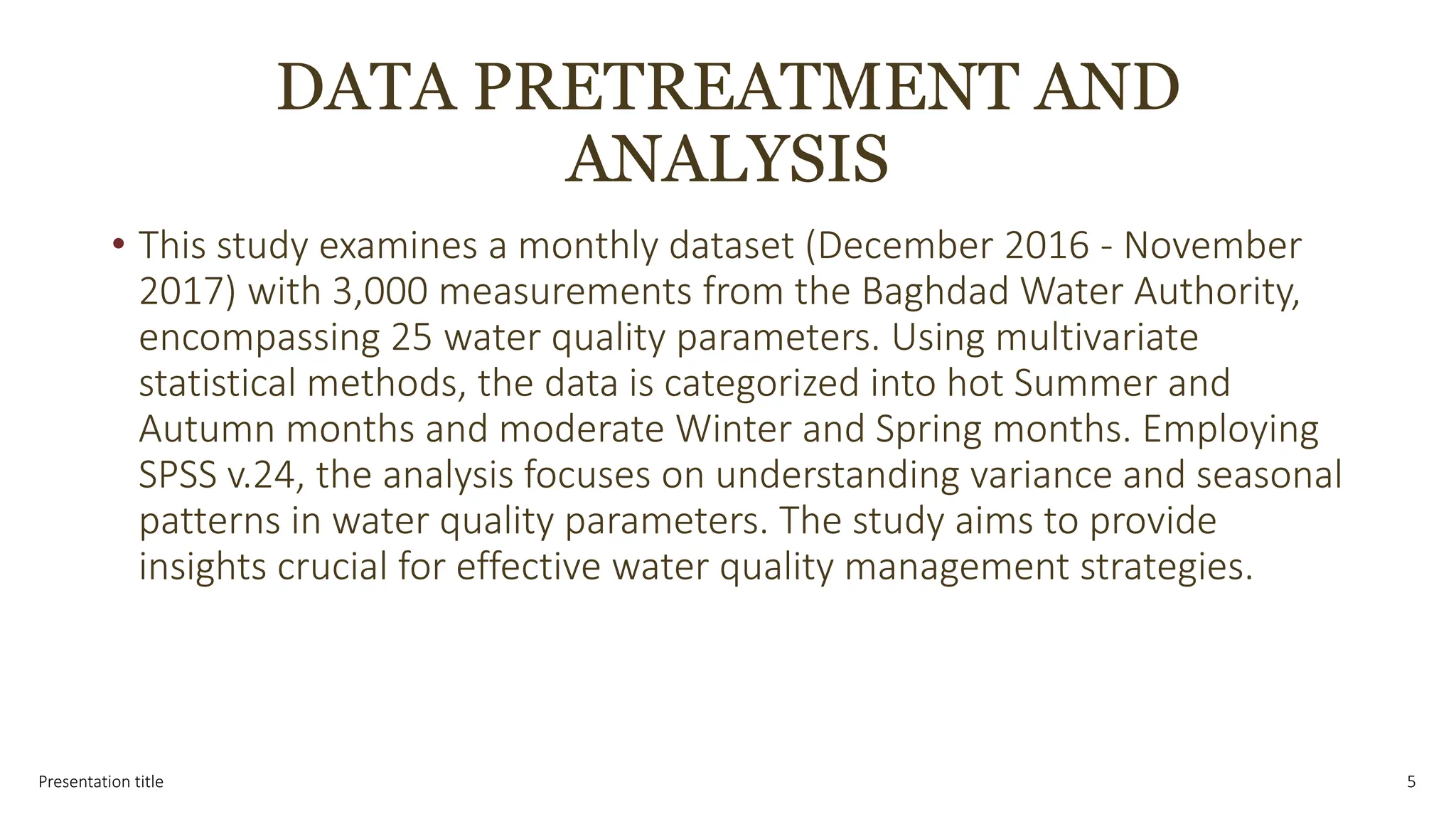
• This study examines a monthly dataset (December 2016 - November
2017) with 3,000 measurements from the Baghdad Water Authority,
encompassing 25 water quality parameters. Using multivariate
statistical methods, the data is categorized into hot Summer and
Autumn months and moderate Winter and Spring months. Employing
SPSS v.24, the analysis focuses on understanding variance and seasonal
patterns in water quality parameters. The study aims to provide
insights crucial for effective water quality management strategies.
Presentation title 5
PRINCIPAL COMPONENT ANALYSIS
(PCA)
Presentation title 6
- PCA simplifies large datasets by creating uncorrelated variables (principal components).
- It maximizes variance, adapting to various data types.
- Identifies and counts factors crucial for explaining dataset differences.
- Applies varimax turnover to normalize variables and assesses their impact.
- Provides insights into key parameters characterizing datasets.
DISCRIMINANT ANALYSIS (DA)
Presentation title 7
Classification Technique: Discriminant Analysis (DA) classifies data by determining group membership using
using metric predictors and creating discriminant functions.
Linear or Quadratic Functions: DA employs linear or quadratic functions to establish discriminant functions,
functions, aiding in the assignment of observations to specific groups.
Effective Grouping: DA groups samples with similar properties without altering the original variables, ensuring
ensuring effective classification.
Correlation Forecasting: The technique is capable of forecasting correlations between different groups, providing
providing insights into relationships within the dataset.
Linear Combinations: DA derives linear combinations of independent variables to form discriminant functions,
functions, transforming original measurements into discriminant scores for efficient sample classification.
classification.
MULTIPLE LINEAR REGRESSION
ANALYSIS (MLRA)
Presentation title 8
Prediction Technique: MLR predicts a variable using two or more others.
Variables: Dependent (predicted) and independent (predictors).
Linearity: Can establish linear or non-linear relationships.
Assumption Testing: Ensures linearity, normality, and other conditions.
Water Quality Focus: Applied to predict water COD for monitoring pollution.
Results and Discussion
• The general situation of river water
• Principal Component Analysis
• Discriminant Analysis
• Multiple Linear Regression Analysis
Presentation title 9
THE GENERAL SITUATION OF RIVER
WATER
ROI
• Envision multimedia-based expertise and cross-media growth
strategies
• Visualize quality intellectual capital
• Engage worldwide methodologies with web-enabled technologies
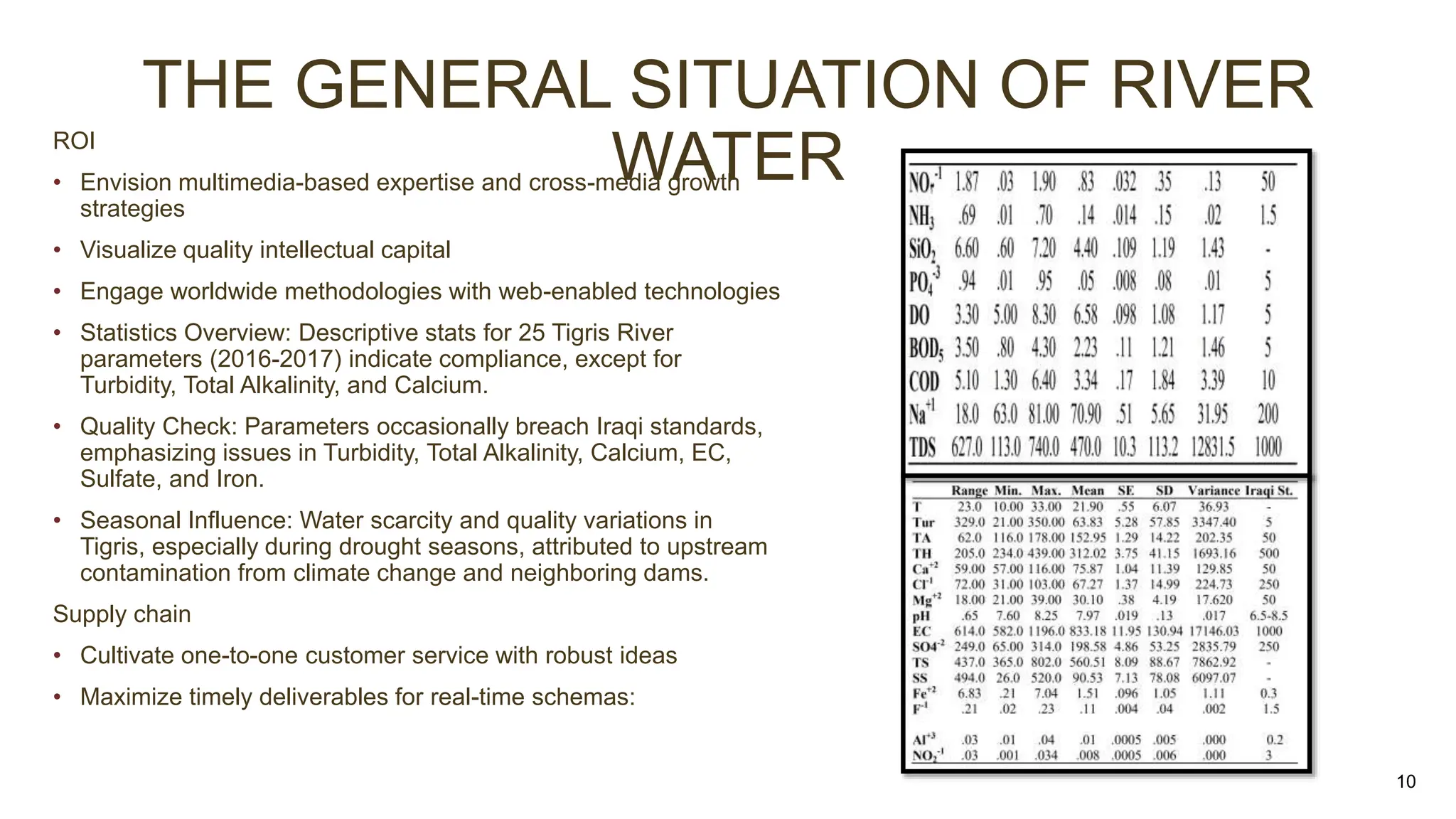
• Statistics Overview: Descriptive stats for 25 Tigris River
parameters (2016-2017) indicate compliance, except for
Turbidity, Total Alkalinity, and Calcium.
• Quality Check: Parameters occasionally breach Iraqi standards,
emphasizing issues in Turbidity, Total Alkalinity, Calcium, EC,
Sulfate, and Iron.
• Seasonal Influence: Water scarcity and quality variations in
Tigris, especially during drought seasons, attributed to upstream
contamination from climate change and neighboring dams.
Supply chain
• Cultivate one-to-one customer service with robust ideas
• Maximize timely deliverables for real-time schemas:
10
PRINCIPAL COMPONENT ANALYSIS
(PCA)
• ROI
• Envision multimedia-based expertise and cross-media growth strategies
• Visualize quality intellectual capital
• Engage worldwide methodologies with web-enabled technologies.
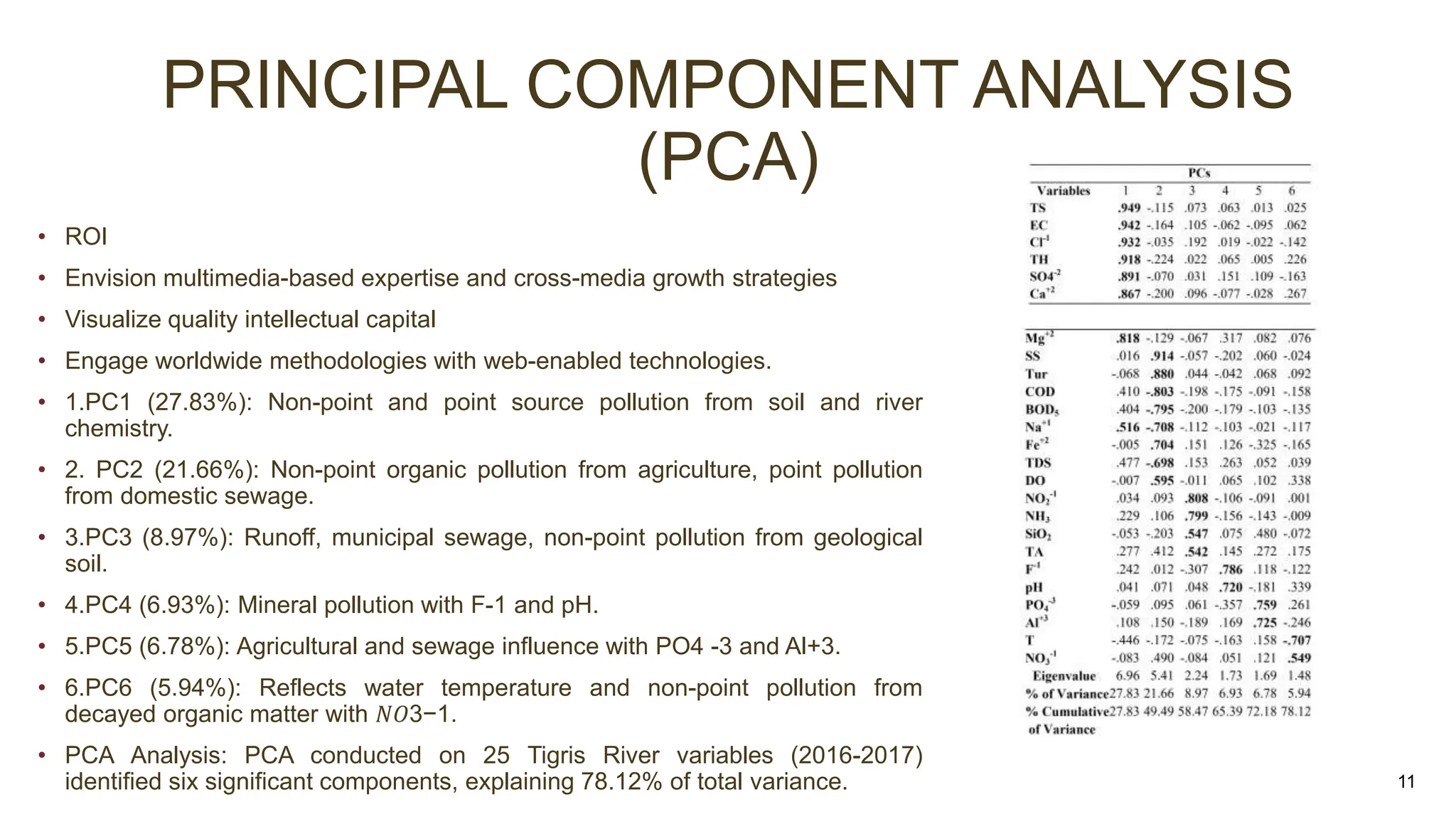
• 1.PC1 (27.83%): Non-point and point source pollution from soil and river
chemistry.
• 2. PC2 (21.66%): Non-point organic pollution from agriculture, point pollution
from domestic sewage.
• 3.PC3 (8.97%): Runoff, municipal sewage, non-point pollution from geological
soil.
• 4.PC4 (6.93%): Mineral pollution with F-1 and pH.
• 5.PC5 (6.78%): Agricultural and sewage influence with PO4 -3 and Al+3.
• 6.PC6 (5.94%): Reflects water temperature and non-point pollution from
decayed organic matter with 𝑁𝑂3−1.
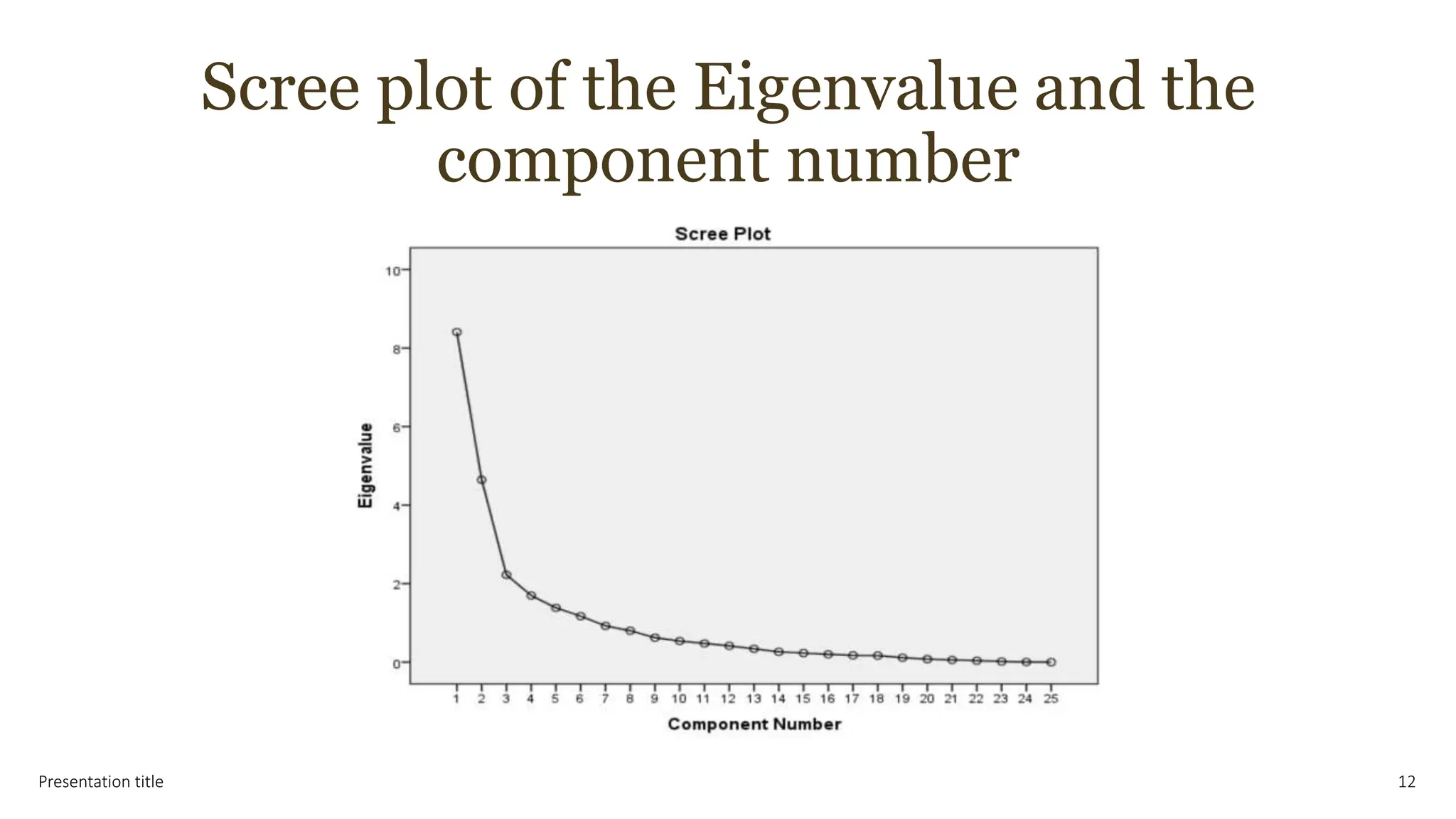
• PCA Analysis: PCA conducted on 25 Tigris River variables (2016-2017)
identified six significant components, explaining 78.12% of total variance. 11
Scree plot of the Eigenvalue and the
component number
Presentation title 12
MULTIPLE LINEAR REGRESSION
ANALYSIS (MLRA)
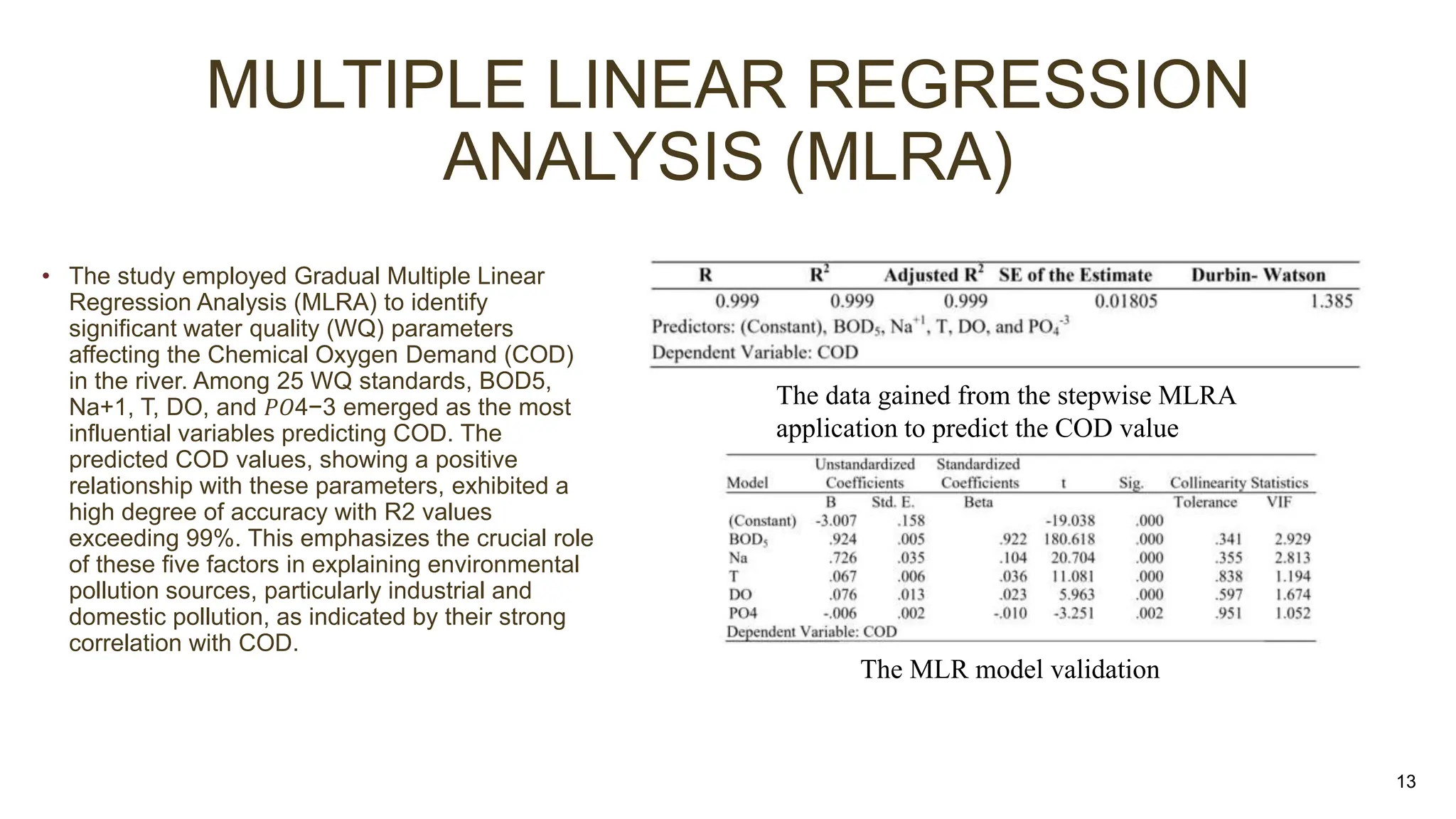
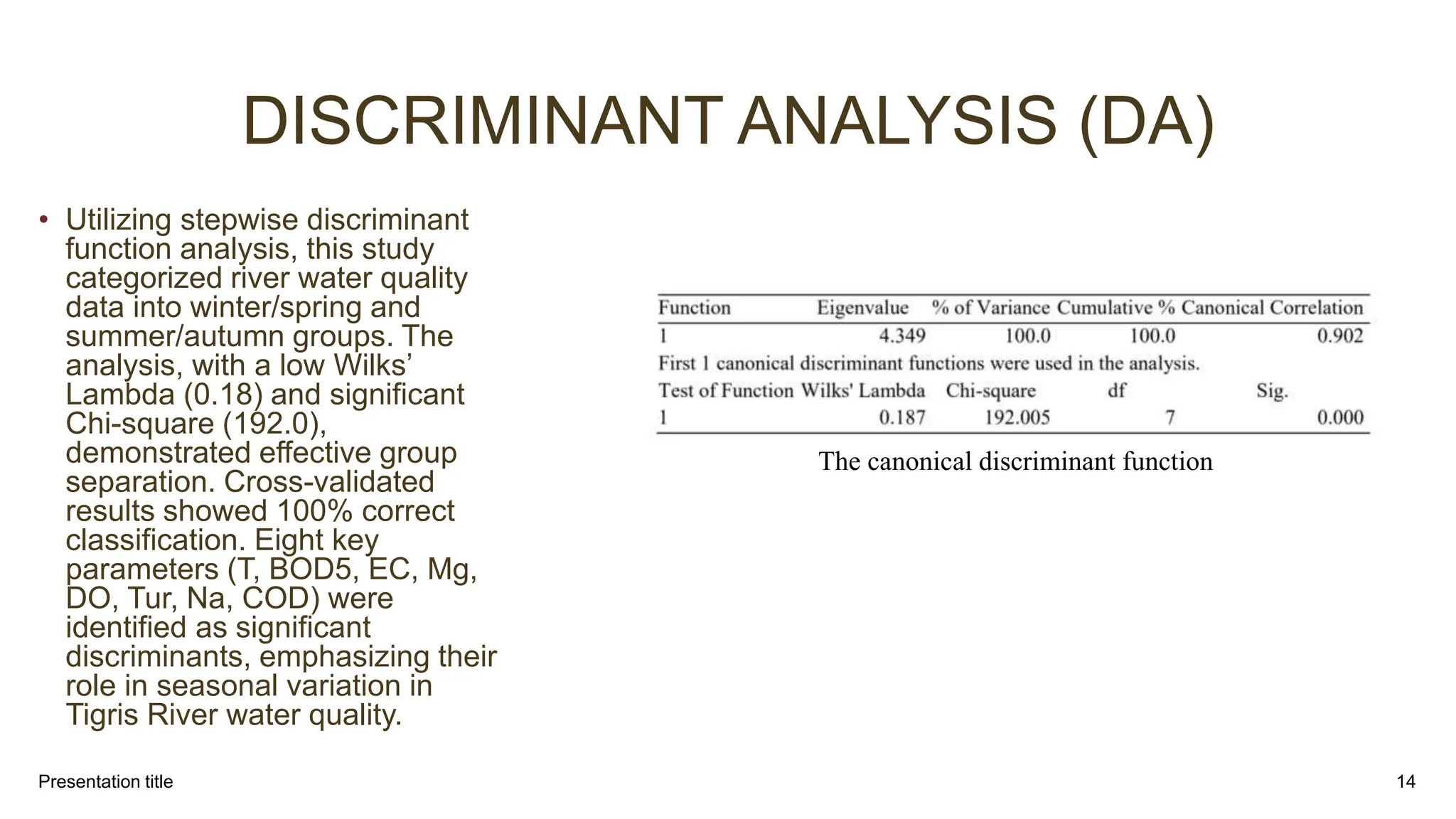
• The study employed Gradual Multiple Linear
Regression Analysis (MLRA) to identify
significant water quality (WQ) parameters
affecting the Chemical Oxygen Demand (COD)
in the river. Among 25 WQ standards, BOD5,
Na+1, T, DO, and 𝑃𝑂4−3 emerged as the most
influential variables predicting COD. The
predicted COD values, showing a positive
relationship with these parameters, exhibited a
high degree of accuracy with R2 values
exceeding 99%. This emphasizes the crucial role
of these five factors in explaining environmental
pollution sources, particularly industrial and
domestic pollution, as indicated by their strong
correlation with COD.
13
The data gained from the stepwise MLRA
application to predict the COD value
The MLR model validation
DISCRIMINANT ANALYSIS (DA)
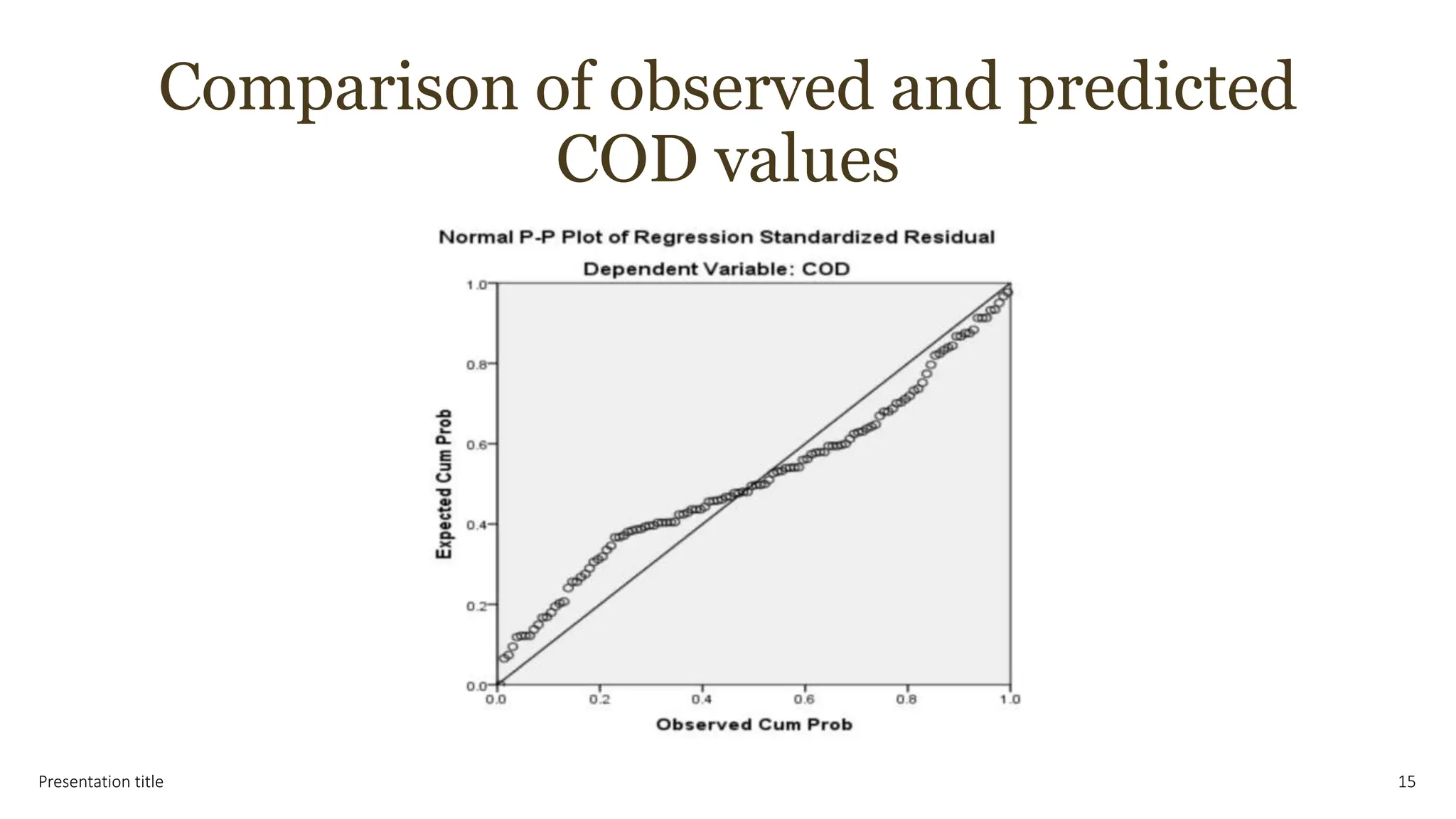
• Utilizing stepwise discriminant
function analysis, this study
categorized river water quality
data into winter/spring and
summer/autumn groups. The
analysis, with a low Wilks’
Lambda (0.18) and significant
Chi-square (192.0),
demonstrated effective group
separation. Cross-validated
results showed 100% correct
classification. Eight key
parameters (T, BOD5, EC, Mg,
DO, Tur, Na, COD) were
identified as significant
discriminants, emphasizing their
role in seasonal variation in
Tigris River water quality.
Presentation title 14
The canonical discriminant function
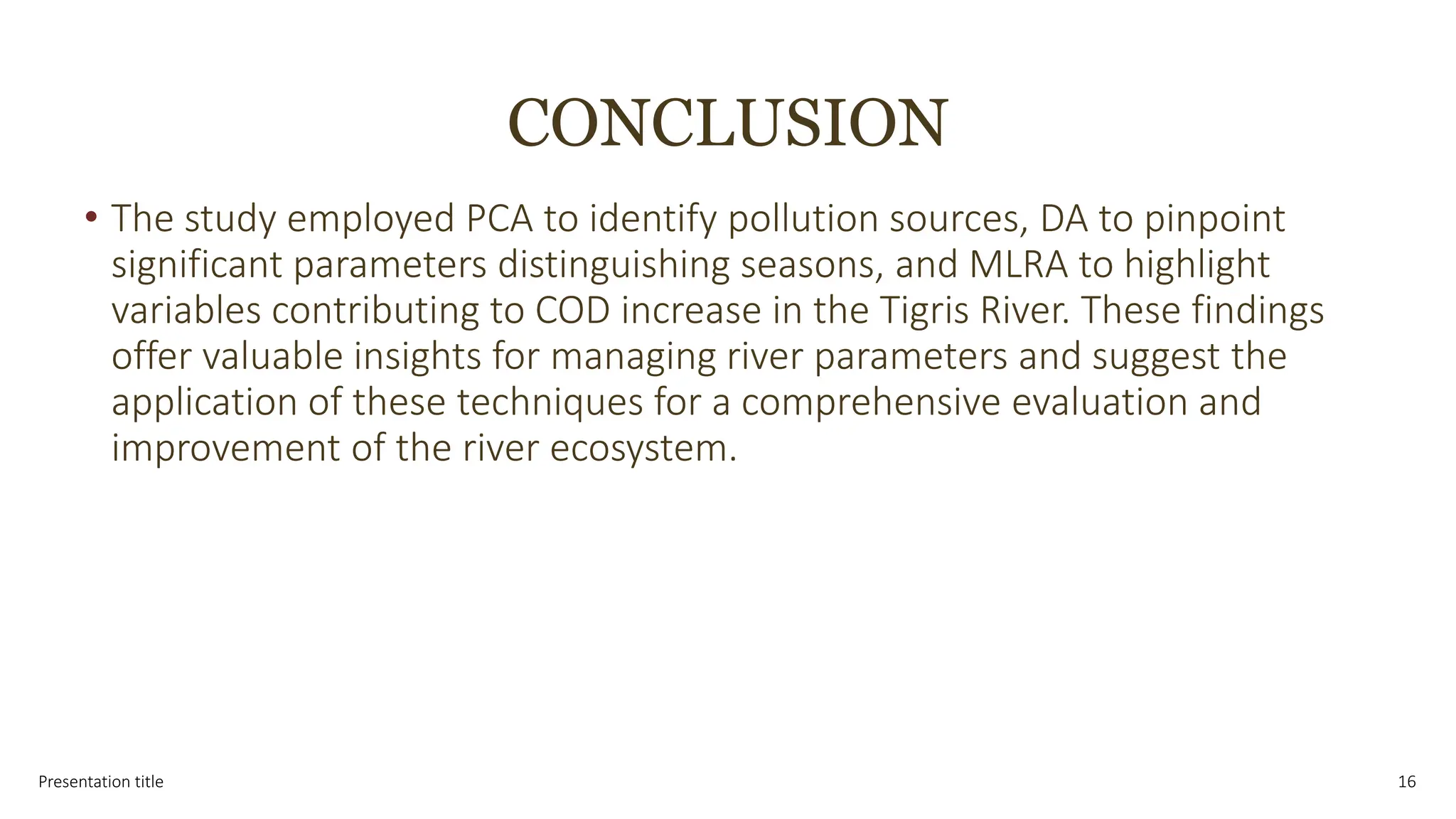
Comparison of observed and predicted
COD values
Presentation title 15
CONCLUSION
• The study employed PCA to identify pollution sources, DA to pinpoint
significant parameters distinguishing seasons, and MLRA to highlight
variables contributing to COD increase in the Tigris River. These findings
offer valuable insights for managing river parameters and suggest the
application of these techniques for a comprehensive evaluation and
improvement of the river ecosystem.
Presentation title 16
Thank you

ENE ppt on river data and analysis of the river

  • 1.
    EVALUATION OF WATER QUALITYIN THE TIGRIS RIVER WITHIN BAGHDAD, IRAQ USING MULTIVARIATE STATISTICAL TECHNIQUES • Ajay Malik • 2K22/ENE/502 • Seminar ENE-5201 1
  • 2.
    Introduction • The TigrisRiver in Iraq faces water quality deterioration from industrial and agricultural activities, notably wastewater discharge. To navigate this complexity, continuous monitoring and multivariate methods like PCA, MLR, CA, and DA are essential. These advanced analyses provide decision makers with crucial insights for effective water management and environmental preservation. Presentation title 2
  • 3.
    MATERIALS AND METHOD Presentationtitle 3 The Search Space Data Pretreatment and Analysis Principal Component Analyses Discriminant Analysis Multiple Linear Regression Analysis
  • 4.
    THE SEARCH SPACE TheTigris River, spanning 1,900 km from Turkey to Iraq, serves as a critical water source for a vast catchment area. Baghdad, the Iraqi capital with over seven million residents, is bisected by the river. The Baghdad Water Directorate has implemented a long-term monitoring program, focusing on ten purification factories along the river, such as Karkh and Rasheed plant, crucial for the city's water supply.
  • 5.
    DATA PRETREATMENT AND ANALYSIS •This study examines a monthly dataset (December 2016 - November 2017) with 3,000 measurements from the Baghdad Water Authority, encompassing 25 water quality parameters. Using multivariate statistical methods, the data is categorized into hot Summer and Autumn months and moderate Winter and Spring months. Employing SPSS v.24, the analysis focuses on understanding variance and seasonal patterns in water quality parameters. The study aims to provide insights crucial for effective water quality management strategies. Presentation title 5
  • 6.
    PRINCIPAL COMPONENT ANALYSIS (PCA) Presentationtitle 6 - PCA simplifies large datasets by creating uncorrelated variables (principal components). - It maximizes variance, adapting to various data types. - Identifies and counts factors crucial for explaining dataset differences. - Applies varimax turnover to normalize variables and assesses their impact. - Provides insights into key parameters characterizing datasets.
  • 7.
    DISCRIMINANT ANALYSIS (DA) Presentationtitle 7 Classification Technique: Discriminant Analysis (DA) classifies data by determining group membership using using metric predictors and creating discriminant functions. Linear or Quadratic Functions: DA employs linear or quadratic functions to establish discriminant functions, functions, aiding in the assignment of observations to specific groups. Effective Grouping: DA groups samples with similar properties without altering the original variables, ensuring ensuring effective classification. Correlation Forecasting: The technique is capable of forecasting correlations between different groups, providing providing insights into relationships within the dataset. Linear Combinations: DA derives linear combinations of independent variables to form discriminant functions, functions, transforming original measurements into discriminant scores for efficient sample classification. classification.
  • 8.
    MULTIPLE LINEAR REGRESSION ANALYSIS(MLRA) Presentation title 8 Prediction Technique: MLR predicts a variable using two or more others. Variables: Dependent (predicted) and independent (predictors). Linearity: Can establish linear or non-linear relationships. Assumption Testing: Ensures linearity, normality, and other conditions. Water Quality Focus: Applied to predict water COD for monitoring pollution.
  • 9.
    Results and Discussion •The general situation of river water • Principal Component Analysis • Discriminant Analysis • Multiple Linear Regression Analysis Presentation title 9
  • 10.
    THE GENERAL SITUATIONOF RIVER WATER ROI • Envision multimedia-based expertise and cross-media growth strategies • Visualize quality intellectual capital • Engage worldwide methodologies with web-enabled technologies • Statistics Overview: Descriptive stats for 25 Tigris River parameters (2016-2017) indicate compliance, except for Turbidity, Total Alkalinity, and Calcium. • Quality Check: Parameters occasionally breach Iraqi standards, emphasizing issues in Turbidity, Total Alkalinity, Calcium, EC, Sulfate, and Iron. • Seasonal Influence: Water scarcity and quality variations in Tigris, especially during drought seasons, attributed to upstream contamination from climate change and neighboring dams. Supply chain • Cultivate one-to-one customer service with robust ideas • Maximize timely deliverables for real-time schemas: 10
  • 11.
    PRINCIPAL COMPONENT ANALYSIS (PCA) •ROI • Envision multimedia-based expertise and cross-media growth strategies • Visualize quality intellectual capital • Engage worldwide methodologies with web-enabled technologies. • 1.PC1 (27.83%): Non-point and point source pollution from soil and river chemistry. • 2. PC2 (21.66%): Non-point organic pollution from agriculture, point pollution from domestic sewage. • 3.PC3 (8.97%): Runoff, municipal sewage, non-point pollution from geological soil. • 4.PC4 (6.93%): Mineral pollution with F-1 and pH. • 5.PC5 (6.78%): Agricultural and sewage influence with PO4 -3 and Al+3. • 6.PC6 (5.94%): Reflects water temperature and non-point pollution from decayed organic matter with 𝑁𝑂3−1. • PCA Analysis: PCA conducted on 25 Tigris River variables (2016-2017) identified six significant components, explaining 78.12% of total variance. 11
  • 12.
    Scree plot ofthe Eigenvalue and the component number Presentation title 12
  • 13.
    MULTIPLE LINEAR REGRESSION ANALYSIS(MLRA) • The study employed Gradual Multiple Linear Regression Analysis (MLRA) to identify significant water quality (WQ) parameters affecting the Chemical Oxygen Demand (COD) in the river. Among 25 WQ standards, BOD5, Na+1, T, DO, and 𝑃𝑂4−3 emerged as the most influential variables predicting COD. The predicted COD values, showing a positive relationship with these parameters, exhibited a high degree of accuracy with R2 values exceeding 99%. This emphasizes the crucial role of these five factors in explaining environmental pollution sources, particularly industrial and domestic pollution, as indicated by their strong correlation with COD. 13 The data gained from the stepwise MLRA application to predict the COD value The MLR model validation
  • 14.
    DISCRIMINANT ANALYSIS (DA) •Utilizing stepwise discriminant function analysis, this study categorized river water quality data into winter/spring and summer/autumn groups. The analysis, with a low Wilks’ Lambda (0.18) and significant Chi-square (192.0), demonstrated effective group separation. Cross-validated results showed 100% correct classification. Eight key parameters (T, BOD5, EC, Mg, DO, Tur, Na, COD) were identified as significant discriminants, emphasizing their role in seasonal variation in Tigris River water quality. Presentation title 14 The canonical discriminant function
  • 15.
    Comparison of observedand predicted COD values Presentation title 15
  • 16.
    CONCLUSION • The studyemployed PCA to identify pollution sources, DA to pinpoint significant parameters distinguishing seasons, and MLRA to highlight variables contributing to COD increase in the Tigris River. These findings offer valuable insights for managing river parameters and suggest the application of these techniques for a comprehensive evaluation and improvement of the river ecosystem. Presentation title 16
  • 17.