TOPIC : phase change material
Presented to : Mr. varun dutta
Presented by : junaid bhat
content
 Introduction
 Characteristics of PCM
 Why PCM
 Classification
 Comparison of organic and inorganic PCMs
 Problems
 Solution
 Conclusion
 References
INTRODUCTION
 At present two concepts regarding energy politics are
important.
 First is utilization of renewable energy sources.
 Second is increased energy efficiency.
 These concepts serve to make environment green plus
divert the focus from fossil fuels
Continued…
 Renewable resources implies less pollution
 Less utilization of fossil fuels implies green environment
problems
 Renewable energy is often available at times when there
is no need.
 Example sun shines during day and no energy is available
during night, wind energy is the other case.
 Thus we conclude energy availability is not equal to
energy utilization
solution
 Energy storage
 It implies wherever energy is available it can be stored .
 Conventional energy storing systems being less efficient
and less economical, are now been replaced with new
energy storing systems involving phase change materials
PCM
 Materials that can store or release large amount of
energy upon melting or freezing. This type of energy
storage is known as latent heat storage.
 Two types of PCM exist
 Organic and inorganic
 Organic PCMs include paraffin's wax, fatty acids, alcohols
etc
 Inorganic PCMs include salt hydrates ,alloys , metallic's
etc
Characteristics
 High heat storage density
 Negligible temperature change
 Very small volume change
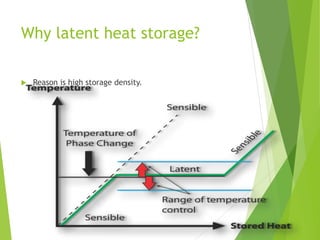
 Latent storage systems store 5-12 times the energy
stored by sensible heat storage systems
Why latent heat storage?
 Reason is high storage density.
Comparison
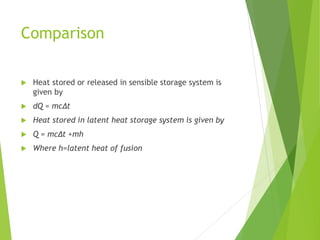
 Heat stored or released in sensible storage system is
given by
 dQ = mcΔt
 Heat stored in latent heat storage system is given by
 Q = mcΔt +mh
 Where h=latent heat of fusion
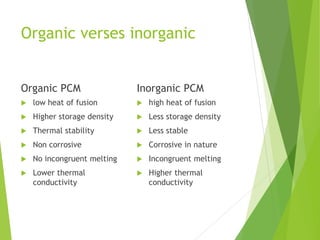
Organic verses inorganic
Organic PCM
 low heat of fusion
 Higher storage density
 Thermal stability
 Non corrosive
 No incongruent melting
 Lower thermal
conductivity
Inorganic PCM
 high heat of fusion
 Less storage density
 Less stable
 Corrosive in nature
 Incongruent melting
 Higher thermal
conductivity
Main problems with organic
PCM
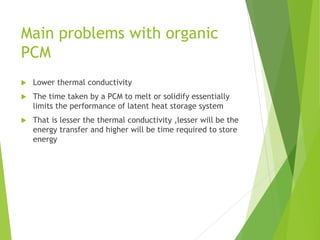
 Lower thermal conductivity
 The time taken by a PCM to melt or solidify essentially
limits the performance of latent heat storage system
 That is lesser the thermal conductivity ,lesser will be the
energy transfer and higher will be time required to store
energy
solution
 Varying the composition of PCM by incorporating other
materials like embedded aluminum powder into paraffin
wax reduced the charging time by 60%[1] .
 Embedding Xgnp [graphite nano particles] up to 7% into
paraffin increased, thermal conductivity from 0.2 to
0.8W/MK
continued
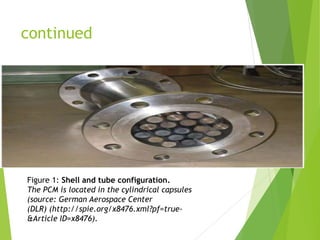
 Next approach to solve thermal conductivity problem is
to vary the design of storage tank.
 So for shell and tube type design is most analyzed.
 Its established by various research works the most
suitable configuration is to have heat transfer fluid
within the tube and PCM around it within the shell [2,3]
continued
Figure 1: Shell and tube configuration.
The PCM is located in the cylindrical capsules
(source: German Aerospace Center
(DLR) (http://spie.org/x8476.xml?pf=true-
&Article ID=x8476).
conclusion
PCMs have two favorable properties
1 . They store and release energy at constant temperature
2 . High storage density
These two properties make PCM alternative to many heat
storage systems
References
[1] A. Sharma et al.: Review on thermal energy storage
with phase change materials and applications.
Renewable and Sustainable Energy Reviews,
vol.13, 2009, pp. 318-345.
[2] S. Kim, L.T. Drzal: High latent heat storage and high
thermal conductive phase change materials
using exfoliated graphite nano platelets. Solar
Energy Materials & Solar Cells, vol. 93,2009,
pp. 136-142.
[3] Thomas Hasenöhrl: An Introduction to Phase Change
Materials as Heat Storage Mediums Project
Report 2009 MVK 160 Heat and Mass Transport
May 09, 2009, Lund, Sweden.

introduction to pcm

  • 1.
    TOPIC : phasechange material Presented to : Mr. varun dutta Presented by : junaid bhat
  • 2.
    content  Introduction  Characteristicsof PCM  Why PCM  Classification  Comparison of organic and inorganic PCMs  Problems  Solution  Conclusion  References
  • 3.
    INTRODUCTION  At presenttwo concepts regarding energy politics are important.  First is utilization of renewable energy sources.  Second is increased energy efficiency.  These concepts serve to make environment green plus divert the focus from fossil fuels
  • 4.
    Continued…  Renewable resourcesimplies less pollution  Less utilization of fossil fuels implies green environment
  • 5.
    problems  Renewable energyis often available at times when there is no need.  Example sun shines during day and no energy is available during night, wind energy is the other case.  Thus we conclude energy availability is not equal to energy utilization
  • 6.
    solution  Energy storage It implies wherever energy is available it can be stored .  Conventional energy storing systems being less efficient and less economical, are now been replaced with new energy storing systems involving phase change materials
  • 7.
    PCM  Materials thatcan store or release large amount of energy upon melting or freezing. This type of energy storage is known as latent heat storage.  Two types of PCM exist  Organic and inorganic  Organic PCMs include paraffin's wax, fatty acids, alcohols etc  Inorganic PCMs include salt hydrates ,alloys , metallic's etc
  • 8.
    Characteristics  High heatstorage density  Negligible temperature change  Very small volume change  Latent storage systems store 5-12 times the energy stored by sensible heat storage systems
  • 9.
    Why latent heatstorage?  Reason is high storage density.
  • 10.
    Comparison  Heat storedor released in sensible storage system is given by  dQ = mcΔt  Heat stored in latent heat storage system is given by  Q = mcΔt +mh  Where h=latent heat of fusion
  • 11.
    Organic verses inorganic OrganicPCM  low heat of fusion  Higher storage density  Thermal stability  Non corrosive  No incongruent melting  Lower thermal conductivity Inorganic PCM  high heat of fusion  Less storage density  Less stable  Corrosive in nature  Incongruent melting  Higher thermal conductivity
  • 12.
    Main problems withorganic PCM  Lower thermal conductivity  The time taken by a PCM to melt or solidify essentially limits the performance of latent heat storage system  That is lesser the thermal conductivity ,lesser will be the energy transfer and higher will be time required to store energy
  • 13.
    solution  Varying thecomposition of PCM by incorporating other materials like embedded aluminum powder into paraffin wax reduced the charging time by 60%[1] .  Embedding Xgnp [graphite nano particles] up to 7% into paraffin increased, thermal conductivity from 0.2 to 0.8W/MK
  • 14.
    continued  Next approachto solve thermal conductivity problem is to vary the design of storage tank.  So for shell and tube type design is most analyzed.  Its established by various research works the most suitable configuration is to have heat transfer fluid within the tube and PCM around it within the shell [2,3]
  • 15.
    continued Figure 1: Shelland tube configuration. The PCM is located in the cylindrical capsules (source: German Aerospace Center (DLR) (http://spie.org/x8476.xml?pf=true- &Article ID=x8476).
  • 16.
    conclusion PCMs have twofavorable properties 1 . They store and release energy at constant temperature 2 . High storage density These two properties make PCM alternative to many heat storage systems
  • 17.
    References [1] A. Sharmaet al.: Review on thermal energy storage with phase change materials and applications. Renewable and Sustainable Energy Reviews, vol.13, 2009, pp. 318-345. [2] S. Kim, L.T. Drzal: High latent heat storage and high thermal conductive phase change materials using exfoliated graphite nano platelets. Solar Energy Materials & Solar Cells, vol. 93,2009, pp. 136-142. [3] Thomas Hasenöhrl: An Introduction to Phase Change Materials as Heat Storage Mediums Project Report 2009 MVK 160 Heat and Mass Transport May 09, 2009, Lund, Sweden.