PHASE CHANGE MATERIALS
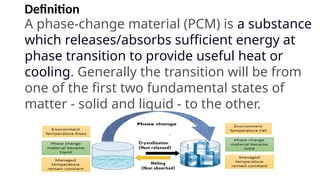
A phase-change material (PCM) is a substance
which releases/absorbs sufficient energy at
phase transition to provide useful heat or
cooling. Generally the transition will be from
one of the first two fundamental states of
matter - solid and liquid - to the other.
Definition
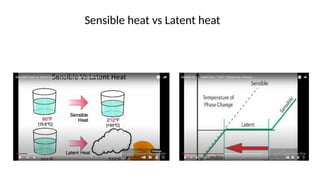
Sensible heat vs Latent heat
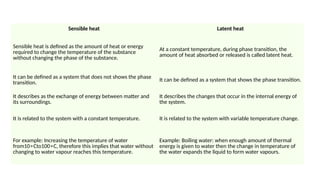
Sensible heat Latent heat
Sensible heat is defined as the amount of heat or energy
required to change the temperature of the substance
without changing the phase of the substance.
At a constant temperature, during phase transition, the
amount of heat absorbed or released is called latent heat.
It can be defined as a system that does not shows the phase
transition. It can be defined as a system that shows the phase transition.
It describes as the exchange of energy between matter and
its surroundings.
It describes the changes that occur in the internal energy of
the system.
It is related to the system with a constant temperature. It is related to the system with variable temperature change.
For example: Increasing the temperature of water
from10 Cto100 C, therefore this implies that water without
∘ ∘
changing to water vapour reaches this temperature.
Example: Boiling water: when enough amount of thermal
energy is given to water then the change in temperature of
the water expands the liquid to form water vapours.
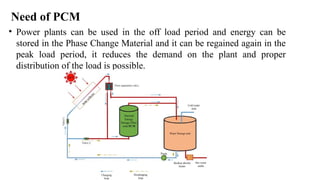
Need of PCM
• Power plants can be used in the off load period and energy can be
stored in the Phase Change Material and it can be regained again in the
peak load period, it reduces the demand on the plant and proper
distribution of the load is possible.
Cooling of Building
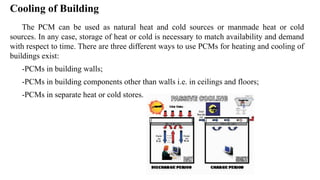
The PCM can be used as natural heat and cold sources or manmade heat or cold
sources. In any case, storage of heat or cold is necessary to match availability and demand
with respect to time. There are three different ways to use PCMs for heating and cooling of
buildings exist:
-PCMs in building walls;
-PCMs in building components other than walls i.e. in ceilings and floors;
-PCMs in separate heat or cold stores.
Properties of PCM
Latent heat storage materials also called phase change materials (PCMs)
should involve the following desirable thermo physical, kinetics, and chemical
properties
• Appropriate phase change temperature
Appropriate phase change temperature is necessary according to the need
of application.
• High latent heat of fusion
Material having high latent heat of fusion absorbs the max energy hence
high latent heat of fusion is desirable.
• High thermal conductivity
• Low viscosity of the fluid phase
Low viscosity fluid needs less energy to flow due to less shear resistance.
• Favorable phase equilibrium
• High density
•Melting temperature range between approx. –4 °C and 100 °C
TYPES OF PCM
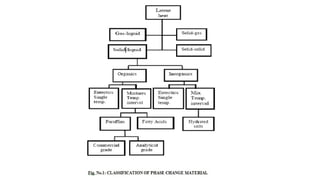
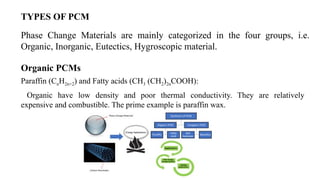
Phase Change Materials are mainly categorized in the four groups, i.e.
Organic, Inorganic, Eutectics, Hygroscopic material.
Organic PCMs
Paraffin (CnH2n+2) and Fatty acids (CH3 (CH2)2nCOOH):
Organic have low density and poor thermal conductivity. They are relatively
expensive and combustible. The prime example is paraffin wax.
Organic PCMs
Advantages
1. Freeze without much super cooling
2. Ability to melt congruently
3. Self nucleating properties
4. Compatibility with conventional materials of construction
Disadvantages
5. Low thermal conductivity in their solid state. High heat transfer rate is required during
the freezing cycle
6. Volumetric latent heat storage capacity is low
7. Flammable. This can be easily alleviated by a proper container
8. To obtain reliable phase change points, most manufacturers use technical grade
paraffin’s which are essentially paraffin mixture(s) and are completely refined of oil
resulting in high cost
Inorganic PCMs
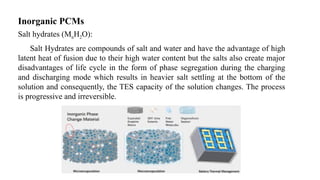
Salt hydrates (MnH2O):
Salt Hydrates are compounds of salt and water and have the advantage of high
latent heat of fusion due to their high water content but the salts also create major
disadvantages of life cycle in the form of phase segregation during the charging
and discharging mode which results in heavier salt settling at the bottom of the
solution and consequently, the TES capacity of the solution changes. The process
is progressive and irreversible.
Inorganic PCMs
Advantages
1.High volumetric latent heat storage capacity
2.Low cost and easy availability
3.Sharp melting point
4.High thermal conductivity
5.High heat of fusion
6.Non-flammable
Disadvantages
1.Change of volume is very high
2.Super cooling is major problem in solid-liquid transition
3.Nucleating agents are needed and they often become inoperative after
repeated cycling
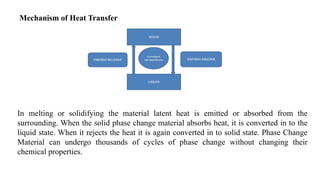
Mechanism of Heat Transfer
In melting or solidifying the material latent heat is emitted or absorbed from the
surrounding. When the solid phase change material absorbs heat, it is converted in to the
liquid state. When it rejects the heat it is again converted in to solid state. Phase Change
Material can undergo thousands of cycles of phase change without changing their
chemical properties.
Selection Criterion
Thermodynamic properties :
1.Melting temperature in the desired operating temperature range
2.High latent heat of fusion per unit volume
Kinetic properties :
1. High nucleation rate to avoid super cooling of the liquid phase
2. High rate of crystal growth, so that the system can meet demands of heat recovery
from the storage system
Chemical properties :
3. Chemical stability
4. Complete reversible freeze/melt cycle
5. Non-corrosiveness, non-toxic, non-flammable and non-explosive materials
Applications
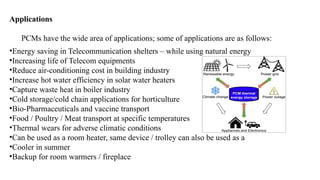
PCMs have the wide area of applications; some of applications are as follows:
•Energy saving in Telecommunication shelters – while using natural energy
•Increasing life of Telecom equipments
•Reduce air-conditioning cost in building industry
•Increase hot water efficiency in solar water heaters
•Capture waste heat in boiler industry
•Cold storage/cold chain applications for horticulture
•Bio-Pharmaceuticals and vaccine transport
•Food / Poultry / Meat transport at specific temperatures
•Thermal wears for adverse climatic conditions
•Can be used as a room heater, same device / trolley can also be used as a
•Cooler in summer
•Backup for room warmers / fireplace

phase change material_ full details.pptx

  • 1.
  • 2.
    A phase-change material(PCM) is a substance which releases/absorbs sufficient energy at phase transition to provide useful heat or cooling. Generally the transition will be from one of the first two fundamental states of matter - solid and liquid - to the other. Definition
  • 4.
    Sensible heat vsLatent heat
  • 5.
    Sensible heat Latentheat Sensible heat is defined as the amount of heat or energy required to change the temperature of the substance without changing the phase of the substance. At a constant temperature, during phase transition, the amount of heat absorbed or released is called latent heat. It can be defined as a system that does not shows the phase transition. It can be defined as a system that shows the phase transition. It describes as the exchange of energy between matter and its surroundings. It describes the changes that occur in the internal energy of the system. It is related to the system with a constant temperature. It is related to the system with variable temperature change. For example: Increasing the temperature of water from10 Cto100 C, therefore this implies that water without ∘ ∘ changing to water vapour reaches this temperature. Example: Boiling water: when enough amount of thermal energy is given to water then the change in temperature of the water expands the liquid to form water vapours.
  • 6.
    Need of PCM •Power plants can be used in the off load period and energy can be stored in the Phase Change Material and it can be regained again in the peak load period, it reduces the demand on the plant and proper distribution of the load is possible.
  • 8.
    Cooling of Building ThePCM can be used as natural heat and cold sources or manmade heat or cold sources. In any case, storage of heat or cold is necessary to match availability and demand with respect to time. There are three different ways to use PCMs for heating and cooling of buildings exist: -PCMs in building walls; -PCMs in building components other than walls i.e. in ceilings and floors; -PCMs in separate heat or cold stores.
  • 9.
    Properties of PCM Latentheat storage materials also called phase change materials (PCMs) should involve the following desirable thermo physical, kinetics, and chemical properties • Appropriate phase change temperature Appropriate phase change temperature is necessary according to the need of application. • High latent heat of fusion Material having high latent heat of fusion absorbs the max energy hence high latent heat of fusion is desirable. • High thermal conductivity • Low viscosity of the fluid phase Low viscosity fluid needs less energy to flow due to less shear resistance. • Favorable phase equilibrium • High density •Melting temperature range between approx. –4 °C and 100 °C
  • 10.
    TYPES OF PCM PhaseChange Materials are mainly categorized in the four groups, i.e. Organic, Inorganic, Eutectics, Hygroscopic material. Organic PCMs Paraffin (CnH2n+2) and Fatty acids (CH3 (CH2)2nCOOH): Organic have low density and poor thermal conductivity. They are relatively expensive and combustible. The prime example is paraffin wax.
  • 11.
    Organic PCMs Advantages 1. Freezewithout much super cooling 2. Ability to melt congruently 3. Self nucleating properties 4. Compatibility with conventional materials of construction Disadvantages 5. Low thermal conductivity in their solid state. High heat transfer rate is required during the freezing cycle 6. Volumetric latent heat storage capacity is low 7. Flammable. This can be easily alleviated by a proper container 8. To obtain reliable phase change points, most manufacturers use technical grade paraffin’s which are essentially paraffin mixture(s) and are completely refined of oil resulting in high cost
  • 12.
    Inorganic PCMs Salt hydrates(MnH2O): Salt Hydrates are compounds of salt and water and have the advantage of high latent heat of fusion due to their high water content but the salts also create major disadvantages of life cycle in the form of phase segregation during the charging and discharging mode which results in heavier salt settling at the bottom of the solution and consequently, the TES capacity of the solution changes. The process is progressive and irreversible.
  • 13.
    Inorganic PCMs Advantages 1.High volumetriclatent heat storage capacity 2.Low cost and easy availability 3.Sharp melting point 4.High thermal conductivity 5.High heat of fusion 6.Non-flammable Disadvantages 1.Change of volume is very high 2.Super cooling is major problem in solid-liquid transition 3.Nucleating agents are needed and they often become inoperative after repeated cycling
  • 14.
    Mechanism of HeatTransfer In melting or solidifying the material latent heat is emitted or absorbed from the surrounding. When the solid phase change material absorbs heat, it is converted in to the liquid state. When it rejects the heat it is again converted in to solid state. Phase Change Material can undergo thousands of cycles of phase change without changing their chemical properties.
  • 15.
    Selection Criterion Thermodynamic properties: 1.Melting temperature in the desired operating temperature range 2.High latent heat of fusion per unit volume Kinetic properties : 1. High nucleation rate to avoid super cooling of the liquid phase 2. High rate of crystal growth, so that the system can meet demands of heat recovery from the storage system Chemical properties : 3. Chemical stability 4. Complete reversible freeze/melt cycle 5. Non-corrosiveness, non-toxic, non-flammable and non-explosive materials
  • 16.
    Applications PCMs have thewide area of applications; some of applications are as follows: •Energy saving in Telecommunication shelters – while using natural energy •Increasing life of Telecom equipments •Reduce air-conditioning cost in building industry •Increase hot water efficiency in solar water heaters •Capture waste heat in boiler industry •Cold storage/cold chain applications for horticulture •Bio-Pharmaceuticals and vaccine transport •Food / Poultry / Meat transport at specific temperatures •Thermal wears for adverse climatic conditions •Can be used as a room heater, same device / trolley can also be used as a •Cooler in summer •Backup for room warmers / fireplace