Drugstoremanagementandinventorycontrol
DR. SUBHASH R. YENDE
ASST PROFESSOR,
GURUNANAK COLLEGE OF PHARMACY,
NAGPUR
DR. SUBHASH R. YENDE, GNCP NAGPUR 1
PHARMACY PRACTICE
Organization of drug store
The pharmacist after attaining the required qualification, having an aptitude for
business and also willing to invest money in business can open a retail or wholesale
drug store.
Drug store is most essential for the proper functioning of the hospital.
It is sub-organization in any hospital where drugs are held till approval and then
stocked
DR. SUBHASH R. YENDE, GNCP NAGPUR 2
Objectives of drug store-
To stock all drugs and accessories required in hospital
To procure drug from different sources
To supply drug to consuming department
To store drugs require in research work
To preserve certain category of drug
To maintain record of drug and issue of drugs
DR. SUBHASH R. YENDE, GNCP NAGPUR 3
Success of a drug store is depends on factors such as-
Its location and proper layout design
Financial management
Qualified and experience staff
Honesty, sincerity and hard work
Behavior among staff member and with customer
DR. SUBHASH R. YENDE, GNCP NAGPUR 4
Selection of suitable site is depend on
Population Density
Number of physicians
Proximity of physicians & health care centres
Number of already existing drug store
Nearness to market
Nearness To A Packing Facility
Income group of people in the area
Age group of people in the area
Scope for expansion
Economic Factor
DR. SUBHASH R. YENDE, GNCP NAGPUR 5
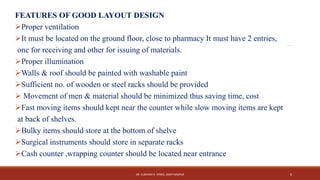
FEATURES OF GOOD LAYOUT DESIGN
Proper ventilation
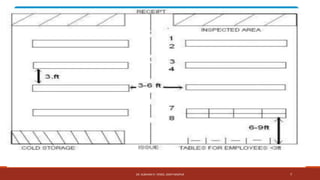
It must be located on the ground floor, close to pharmacy It must have 2 entries,
one for receiving and other for issuing of materials.
Proper illumination
Walls & roof should be painted with washable paint
Sufficient no. of wooden or steel racks should be provided
 Movement of men & material should be minimized thus saving time, cost
Fast moving items should kept near the counter while slow moving items are kept
at back of shelves.
Bulky items should store at the bottom of shelve
Surgical instruments should store in separate racks
Cash counter ,wrapping counter should be located near entrance
DR. SUBHASH R. YENDE, GNCP NAGPUR 6
DR. SUBHASH R. YENDE, GNCP NAGPUR 7
DR. SUBHASH R. YENDE, GNCP NAGPUR 8
Types of material stocked
Sufficient number od racks should be provide
Fire extinguishers should be provide at strategic points along with fire buckets
Material stocked are
Capsules, tablets, liquid dosage form and injections
Biological and antibiotics should store in refrigerator
Schedule X drugs, Narcotic and psychotropic substances should store under lock
and key
Poisons are store in separate rack, labeled as POISON
Stock of Alcohol and alcohol containing preparation should maintain in register
Large bulk items should be on bottom
DR. SUBHASH R. YENDE, GNCP NAGPUR 9
Storage condition
Cold storage (20-80C)
List A – Sera, vaccine, Whole human blood, plasma, concentrated RBC, thrombin,
insulin preparation, oxytocin inj., vasopressin inj., snake antidots etc
Cool temp (80-250C)
List B- Antibiotics, blood preparations (dried plasma, fibrinogens, thrombin),
hormone preparation (corticotropins, oxytocin tablets), vitamin preparations (Vit
A, B1, B2, B6, C, D, B complex, K), dextran inj., dextrose inj., halothane, ergot
liq extract
Room temp (250-300C)
Warm temp (300-400C)
Excessive heat (above 400C)
DR. SUBHASH R. YENDE, GNCP NAGPUR 10
Inventory Control
DR. SUBHASH R. YENDE, GNCP NAGPUR 11
Inventory control is a scientific system which indicates as to what to order, when to
order, how much to order, and how much to stock so that purchasing costs and storing
costs are kept as low as possible.
Inventory Control is the process by which inventory is measured and regulated
according to predetermined norms such as economic lot size for order or production,
safety stock, minimum level, maximum level, order level etc.
Inventory control is the technique of maintaining the size of inventory at some desire
level keeping in view the best economic interest of an organization.
DR. SUBHASH R. YENDE, GNCP NAGPUR 12
Objectives of Inventory Control
To supply the materials in time.
To give maximum clients service by meeting their requirement timely, effectively,
smoothly and satisfactorily
To reduce or minimize idle time by avoiding stock out and shortages
To reduce loss due to changes in prices of inventory items
To avoid shortage of stock
To meet future demand
To average out demand fluctuations
DR. SUBHASH R. YENDE, GNCP NAGPUR 13
Functions of Inventory Control
To carry adequate stock to avoid stock-outs
To order sufficient quantity per order to reduce order cost
To stock just sufficient quantity to minimize inventory carrying cost
To make judicial selection of limiting the quantity of perishable items and costly
materials
To take advantage of seasonal cyclic variation on availability of materials to order the
right quantity at the right time.
To provide safety stock to take care of fluctuation in demand/ consumption during lead
time.
To ensure optimum level of inventory holding to minimize the total inventory cost.
DR. SUBHASH R. YENDE, GNCP NAGPUR 14
Purchasing is basic function in inventory management
The basic purpose of purchasing is to ensure continuous flow of raw material of
right quality, right quantity, and right price from right source at right time.
With an objective of avoidance of duplication and wastage with respect to
various items purchase
DR. SUBHASH R. YENDE, GNCP NAGPUR 15
Purchase Procedure
It involve different steps for procurement of goods
1. Determination of requirements
◦ Through purchase requisition prepared by departmental head including types of
material, time and quantity required
2. Sources of supply
◦ Medical store depot
◦ DGS&D
◦ From wholesaler or manufacturer
◦ By inviting tenders
◦ Emergency drug from local market
DR. SUBHASH R. YENDE, GNCP NAGPUR 16
3. Purchase order
It is a contract between buyer and supplier
4. Receipt of acknowledgement
5. Receipt of drug
6. Distribution of drug to wards
DR. SUBHASH R. YENDE, GNCP NAGPUR 17
Inventory Analysis
Three level of analysis-
Overall analysis,
Category analysis
 Individual item analysis
Economic order Quantity (EOQ)
Economic Order Quantity or Fixed Order Quantity system is the technique of
ordering materials whenever stock reaches the reorder point.
It includes ordering cost and carrying cost
DR. SUBHASH R. YENDE, GNCP NAGPUR 18
Ordering Costs-It is the cost of ordering the item and securing its supply.
It Includes Expenses from raising the indent, Purchase requisition by user
department till the execution of order, Receipt and inspection of material
Inventory Carrying Costs- Costs incurred for holding the volume of inventory and
measured as a percentage of unit cost of an item
It includes Capital cost, Deterioration cost, Taxes on inventory, Insurance cost,
Storage & handling cost
Can be calculate by tabular method,
graphical method or algebraic formula
DR. SUBHASH R. YENDE, GNCP NAGPUR 19
Techniques or methods of inventory analysis
1. Always Better Control (ABC) Analysis
This technique divides inventory into three categories A, B & C based on cost of
material and annual consumption value.
A item- 10% of total items (costly) which have the highest rupee percentages
(aprrox. 70%). Require proper storage and handling, over stocking should be
avoided.
B item - 20% of all items (neither costly nor cheaper) with the next highest rupee
percentages (20%).
C item- 70% of all items (cheaper) with the lowest rupee percentages (10 %)
DR. SUBHASH R. YENDE, GNCP NAGPUR 20
Advantages of ABC Analysis
Gives rewarding results quickly
Helps to point out obsolete stocks easily
In case of “A” items careful attention can be paid at every step such as estimate of
requirements, purchase, safety stock, receipts, inspections, issues, etc. & close
control is maintained
Helps better planning of inventory control
Provides sound basis for allocation of funds & human resources
Disadvantages of ABC Analysis
Proper standardization & codification of inventory items needed
Considers only money value of items & neglects the importance of items for the
production process or assembly or functioning
DR. SUBHASH R. YENDE, GNCP NAGPUR 21
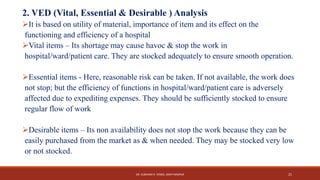
2. VED (Vital, Essential & Desirable ) Analysis
It is based on utility of material, importance of item and its effect on the
functioning and efficiency of a hospital
Vital items – Its shortage may cause havoc & stop the work in
hospital/ward/patient care. They are stocked adequately to ensure smooth operation.
Essential items - Here, reasonable risk can be taken. If not available, the work does
not stop; but the efficiency of functions in hospital/ward/patient care is adversely
affected due to expediting expenses. They should be sufficiently stocked to ensure
regular flow of work
Desirable items – Its non availability does not stop the work because they can be
easily purchased from the market as & when needed. They may be stocked very low
or not stocked.
DR. SUBHASH R. YENDE, GNCP NAGPUR 22
3. FSN (Fast moving, slow moving & non moving) Analysis
Classification is based on the pattern of issues from stores & is useful in controlling
obsolescence
Date of receipt or last date of issue, whichever is later, is taken to determine the no. of
months which have lapsed since the last transaction
It helps to avoid investments in non moving or slow items.
N item- If there are no issues of an item during the period (1 – 2 yr)
S item- up to certain limit, say 10-15 issues in the period
F items- The items exceeding limit of no. of issues during the period
The period of consideration & the limiting number of issues vary from organization to
organization.
DR. SUBHASH R. YENDE, GNCP NAGPUR 23
4. Perpetual Inventory System
Recording of store balance after receipt and issue of item to facilitate regular
checking
After every receipt or issue the entry is made in bin card and balance is adjusted
Bin card is a document maintained by store keeper to keep record of all items
Bin card is used for each material
Each receipt, issue or returns are recorded on bin card in chronological order and
latest balance is maintained
Reference
AB Budhrani, R. Usman, M Sharma, P Kumar. Concise Course in
Pharmacy Practice. S. Vikas and Company.
https://www.slideshare.net/gayathrijayakumar4/drug-store
https://www.slideshare.net/friendsalways0102/cdocuments-
and-settingscromamy-documentssem-ivpminventory-control
DR. SUBHASH R. YENDE, GNCP NAGPUR 24

Pharmacy store .pdf

  • 1.
    Drugstoremanagementandinventorycontrol DR. SUBHASH R.YENDE ASST PROFESSOR, GURUNANAK COLLEGE OF PHARMACY, NAGPUR DR. SUBHASH R. YENDE, GNCP NAGPUR 1 PHARMACY PRACTICE
  • 2.
    Organization of drugstore The pharmacist after attaining the required qualification, having an aptitude for business and also willing to invest money in business can open a retail or wholesale drug store. Drug store is most essential for the proper functioning of the hospital. It is sub-organization in any hospital where drugs are held till approval and then stocked DR. SUBHASH R. YENDE, GNCP NAGPUR 2
  • 3.
    Objectives of drugstore- To stock all drugs and accessories required in hospital To procure drug from different sources To supply drug to consuming department To store drugs require in research work To preserve certain category of drug To maintain record of drug and issue of drugs DR. SUBHASH R. YENDE, GNCP NAGPUR 3
  • 4.
    Success of adrug store is depends on factors such as- Its location and proper layout design Financial management Qualified and experience staff Honesty, sincerity and hard work Behavior among staff member and with customer DR. SUBHASH R. YENDE, GNCP NAGPUR 4
  • 5.
    Selection of suitablesite is depend on Population Density Number of physicians Proximity of physicians & health care centres Number of already existing drug store Nearness to market Nearness To A Packing Facility Income group of people in the area Age group of people in the area Scope for expansion Economic Factor DR. SUBHASH R. YENDE, GNCP NAGPUR 5
  • 6.
    FEATURES OF GOODLAYOUT DESIGN Proper ventilation It must be located on the ground floor, close to pharmacy It must have 2 entries, one for receiving and other for issuing of materials. Proper illumination Walls & roof should be painted with washable paint Sufficient no. of wooden or steel racks should be provided  Movement of men & material should be minimized thus saving time, cost Fast moving items should kept near the counter while slow moving items are kept at back of shelves. Bulky items should store at the bottom of shelve Surgical instruments should store in separate racks Cash counter ,wrapping counter should be located near entrance DR. SUBHASH R. YENDE, GNCP NAGPUR 6
  • 7.
    DR. SUBHASH R.YENDE, GNCP NAGPUR 7
  • 8.
    DR. SUBHASH R.YENDE, GNCP NAGPUR 8 Types of material stocked Sufficient number od racks should be provide Fire extinguishers should be provide at strategic points along with fire buckets Material stocked are Capsules, tablets, liquid dosage form and injections Biological and antibiotics should store in refrigerator Schedule X drugs, Narcotic and psychotropic substances should store under lock and key Poisons are store in separate rack, labeled as POISON Stock of Alcohol and alcohol containing preparation should maintain in register Large bulk items should be on bottom
  • 9.
    DR. SUBHASH R.YENDE, GNCP NAGPUR 9 Storage condition Cold storage (20-80C) List A – Sera, vaccine, Whole human blood, plasma, concentrated RBC, thrombin, insulin preparation, oxytocin inj., vasopressin inj., snake antidots etc Cool temp (80-250C) List B- Antibiotics, blood preparations (dried plasma, fibrinogens, thrombin), hormone preparation (corticotropins, oxytocin tablets), vitamin preparations (Vit A, B1, B2, B6, C, D, B complex, K), dextran inj., dextrose inj., halothane, ergot liq extract Room temp (250-300C) Warm temp (300-400C) Excessive heat (above 400C)
  • 10.
    DR. SUBHASH R.YENDE, GNCP NAGPUR 10 Inventory Control
  • 11.
    DR. SUBHASH R.YENDE, GNCP NAGPUR 11 Inventory control is a scientific system which indicates as to what to order, when to order, how much to order, and how much to stock so that purchasing costs and storing costs are kept as low as possible. Inventory Control is the process by which inventory is measured and regulated according to predetermined norms such as economic lot size for order or production, safety stock, minimum level, maximum level, order level etc. Inventory control is the technique of maintaining the size of inventory at some desire level keeping in view the best economic interest of an organization.
  • 12.
    DR. SUBHASH R.YENDE, GNCP NAGPUR 12 Objectives of Inventory Control To supply the materials in time. To give maximum clients service by meeting their requirement timely, effectively, smoothly and satisfactorily To reduce or minimize idle time by avoiding stock out and shortages To reduce loss due to changes in prices of inventory items To avoid shortage of stock To meet future demand To average out demand fluctuations
  • 13.
    DR. SUBHASH R.YENDE, GNCP NAGPUR 13 Functions of Inventory Control To carry adequate stock to avoid stock-outs To order sufficient quantity per order to reduce order cost To stock just sufficient quantity to minimize inventory carrying cost To make judicial selection of limiting the quantity of perishable items and costly materials To take advantage of seasonal cyclic variation on availability of materials to order the right quantity at the right time. To provide safety stock to take care of fluctuation in demand/ consumption during lead time. To ensure optimum level of inventory holding to minimize the total inventory cost.
  • 14.
    DR. SUBHASH R.YENDE, GNCP NAGPUR 14 Purchasing is basic function in inventory management The basic purpose of purchasing is to ensure continuous flow of raw material of right quality, right quantity, and right price from right source at right time. With an objective of avoidance of duplication and wastage with respect to various items purchase
  • 15.
    DR. SUBHASH R.YENDE, GNCP NAGPUR 15 Purchase Procedure It involve different steps for procurement of goods 1. Determination of requirements ◦ Through purchase requisition prepared by departmental head including types of material, time and quantity required 2. Sources of supply ◦ Medical store depot ◦ DGS&D ◦ From wholesaler or manufacturer ◦ By inviting tenders ◦ Emergency drug from local market
  • 16.
    DR. SUBHASH R.YENDE, GNCP NAGPUR 16 3. Purchase order It is a contract between buyer and supplier 4. Receipt of acknowledgement 5. Receipt of drug 6. Distribution of drug to wards
  • 17.
    DR. SUBHASH R.YENDE, GNCP NAGPUR 17 Inventory Analysis Three level of analysis- Overall analysis, Category analysis  Individual item analysis Economic order Quantity (EOQ) Economic Order Quantity or Fixed Order Quantity system is the technique of ordering materials whenever stock reaches the reorder point. It includes ordering cost and carrying cost
  • 18.
    DR. SUBHASH R.YENDE, GNCP NAGPUR 18 Ordering Costs-It is the cost of ordering the item and securing its supply. It Includes Expenses from raising the indent, Purchase requisition by user department till the execution of order, Receipt and inspection of material Inventory Carrying Costs- Costs incurred for holding the volume of inventory and measured as a percentage of unit cost of an item It includes Capital cost, Deterioration cost, Taxes on inventory, Insurance cost, Storage & handling cost Can be calculate by tabular method, graphical method or algebraic formula
  • 19.
    DR. SUBHASH R.YENDE, GNCP NAGPUR 19 Techniques or methods of inventory analysis 1. Always Better Control (ABC) Analysis This technique divides inventory into three categories A, B & C based on cost of material and annual consumption value. A item- 10% of total items (costly) which have the highest rupee percentages (aprrox. 70%). Require proper storage and handling, over stocking should be avoided. B item - 20% of all items (neither costly nor cheaper) with the next highest rupee percentages (20%). C item- 70% of all items (cheaper) with the lowest rupee percentages (10 %)
  • 20.
    DR. SUBHASH R.YENDE, GNCP NAGPUR 20 Advantages of ABC Analysis Gives rewarding results quickly Helps to point out obsolete stocks easily In case of “A” items careful attention can be paid at every step such as estimate of requirements, purchase, safety stock, receipts, inspections, issues, etc. & close control is maintained Helps better planning of inventory control Provides sound basis for allocation of funds & human resources Disadvantages of ABC Analysis Proper standardization & codification of inventory items needed Considers only money value of items & neglects the importance of items for the production process or assembly or functioning
  • 21.
    DR. SUBHASH R.YENDE, GNCP NAGPUR 21 2. VED (Vital, Essential & Desirable ) Analysis It is based on utility of material, importance of item and its effect on the functioning and efficiency of a hospital Vital items – Its shortage may cause havoc & stop the work in hospital/ward/patient care. They are stocked adequately to ensure smooth operation. Essential items - Here, reasonable risk can be taken. If not available, the work does not stop; but the efficiency of functions in hospital/ward/patient care is adversely affected due to expediting expenses. They should be sufficiently stocked to ensure regular flow of work Desirable items – Its non availability does not stop the work because they can be easily purchased from the market as & when needed. They may be stocked very low or not stocked.
  • 22.
    DR. SUBHASH R.YENDE, GNCP NAGPUR 22 3. FSN (Fast moving, slow moving & non moving) Analysis Classification is based on the pattern of issues from stores & is useful in controlling obsolescence Date of receipt or last date of issue, whichever is later, is taken to determine the no. of months which have lapsed since the last transaction It helps to avoid investments in non moving or slow items. N item- If there are no issues of an item during the period (1 – 2 yr) S item- up to certain limit, say 10-15 issues in the period F items- The items exceeding limit of no. of issues during the period The period of consideration & the limiting number of issues vary from organization to organization.
  • 23.
    DR. SUBHASH R.YENDE, GNCP NAGPUR 23 4. Perpetual Inventory System Recording of store balance after receipt and issue of item to facilitate regular checking After every receipt or issue the entry is made in bin card and balance is adjusted Bin card is a document maintained by store keeper to keep record of all items Bin card is used for each material Each receipt, issue or returns are recorded on bin card in chronological order and latest balance is maintained
  • 24.
    Reference AB Budhrani, R.Usman, M Sharma, P Kumar. Concise Course in Pharmacy Practice. S. Vikas and Company. https://www.slideshare.net/gayathrijayakumar4/drug-store https://www.slideshare.net/friendsalways0102/cdocuments- and-settingscromamy-documentssem-ivpminventory-control DR. SUBHASH R. YENDE, GNCP NAGPUR 24