PHARMACY CAREERS &
PHARMACIST PRACTICE
SETTINGS
22 types of pharmacist jobs and careers.
Introduction
Pharmacy is an evolving profession. Over the years pharmacists
have found new ways to leverage their status as experts in
medication therapy to create new pharmacy careers that have
significantly improved patient care and advanced the pharmacy
profession. Here is a brief description of 22 jobs and careers for
pharmacists and links for current job openings.
1. Ambulatory Care Pharmacist
Job description: Direct patient care and management of medications
for ambulatory patients; manage ambulatory clinics
Requirement: Doctor of Pharmacy (PharmD), Bachelor of Science
(BS) in Pharmacy; ambulatory care pharmacy residency and board
certification in ambulatory care pharmacy are preferred. Certification
in the management of chronic conditions or therapies such as
diabetes, asthma, anticoagulation is desirable.
Advantages: Provide direct patient care in a clinic setting
Practice site: Outpatient hospital or community clinics
2. Academic Pharmacist
Job description: Conduct research, publish articles, teach and
mentor tomorrow's pharmacist. Some also practice pharmacy in the
community, hospital, or ambulatory settings.
Requirement: Doctor of Pharmacy (PharmD), Bachelor of Science
(BS) in Pharmacy, some also have Ph.D. degrees; one-year
residency, and/or fellowship.
Other Skills: Need excellent writing and speaking skills, interest in
research
Advantages: Flexible schedule, work in an office, opportunity to
shape the future of pharmacy, pharmacy license may not be required
Practice site: universities, schools of pharmacy and medicine, local,
state, national, and international organizations
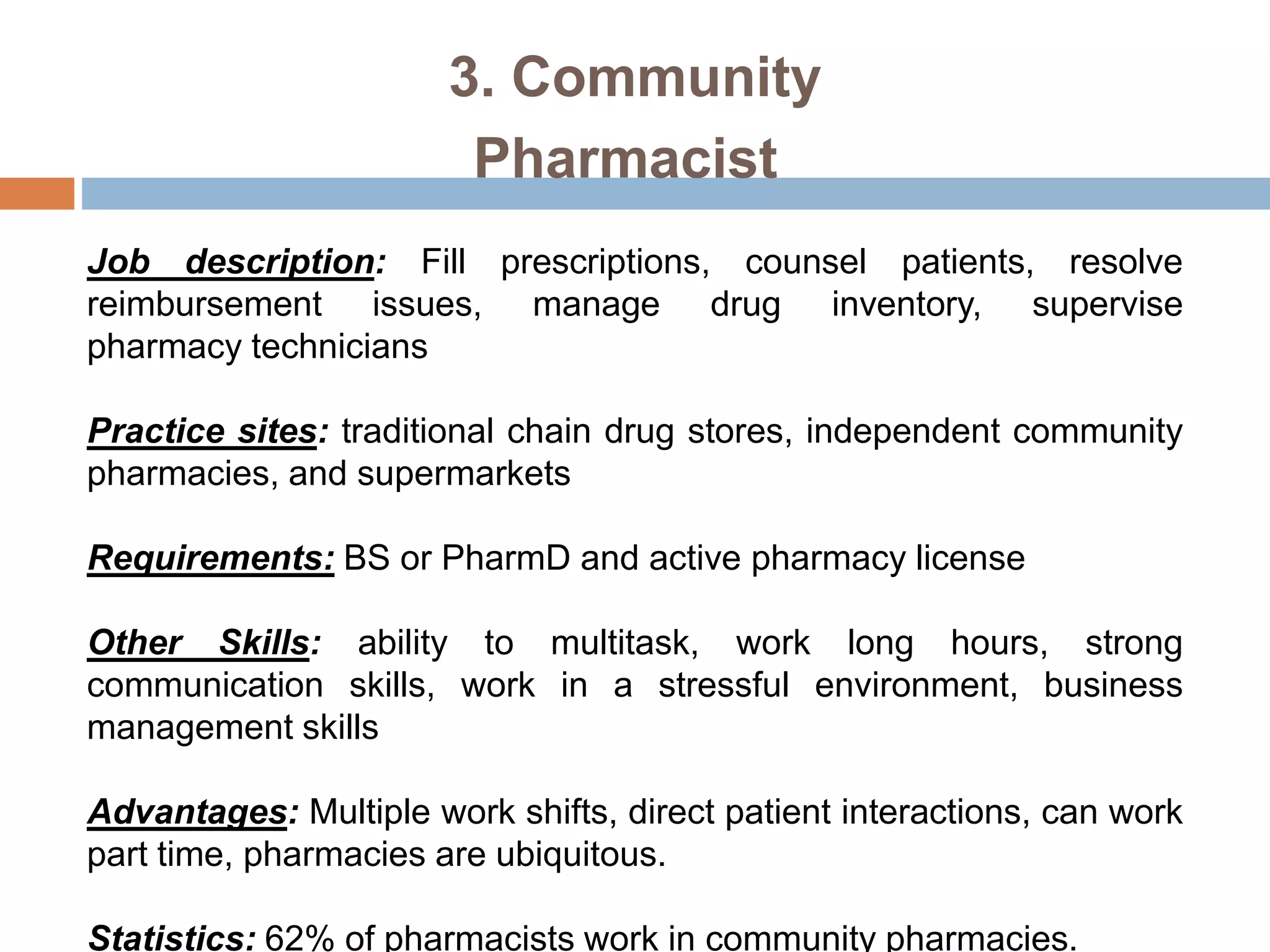
3. Community
Pharmacist
Job description: Fill prescriptions, counsel patients, resolve
reimbursement issues, manage drug inventory, supervise
pharmacy technicians
Practice sites: traditional chain drug stores, independent community
pharmacies, and supermarkets
Requirements: BS or PharmD and active pharmacy license
Other Skills: ability to multitask, work long hours, strong
communication skills, work in a stressful environment, business
management skills
Advantages: Multiple work shifts, direct patient interactions, can work
part time, pharmacies are ubiquitous.
Statistics: 62% of pharmacists work in community pharmacies.
4. Compounding
Pharmacist
Job description: Compound drugs for individual prescriptions to
meet patient needs. Counsel patients and collaborate with healthcare
providers.
Requirement: PharmD or BS degree, active pharmacy license,
compounding course
Practice sites: Compounding pharmacies, community pharmacies,
hospitals, universities
5. Hospice Pharmacist
Job description: provide compassionate care to hospice patient,
work with a health care team of nurses, doctors, social
workers, and counselor.
Requirement: Pharmacy license, residency in hospice may be
preferred.
Other Skills: comfortable with end of life discussions, understand
pain management.
Practice sites: care medicine, hospices, patients’ homes.
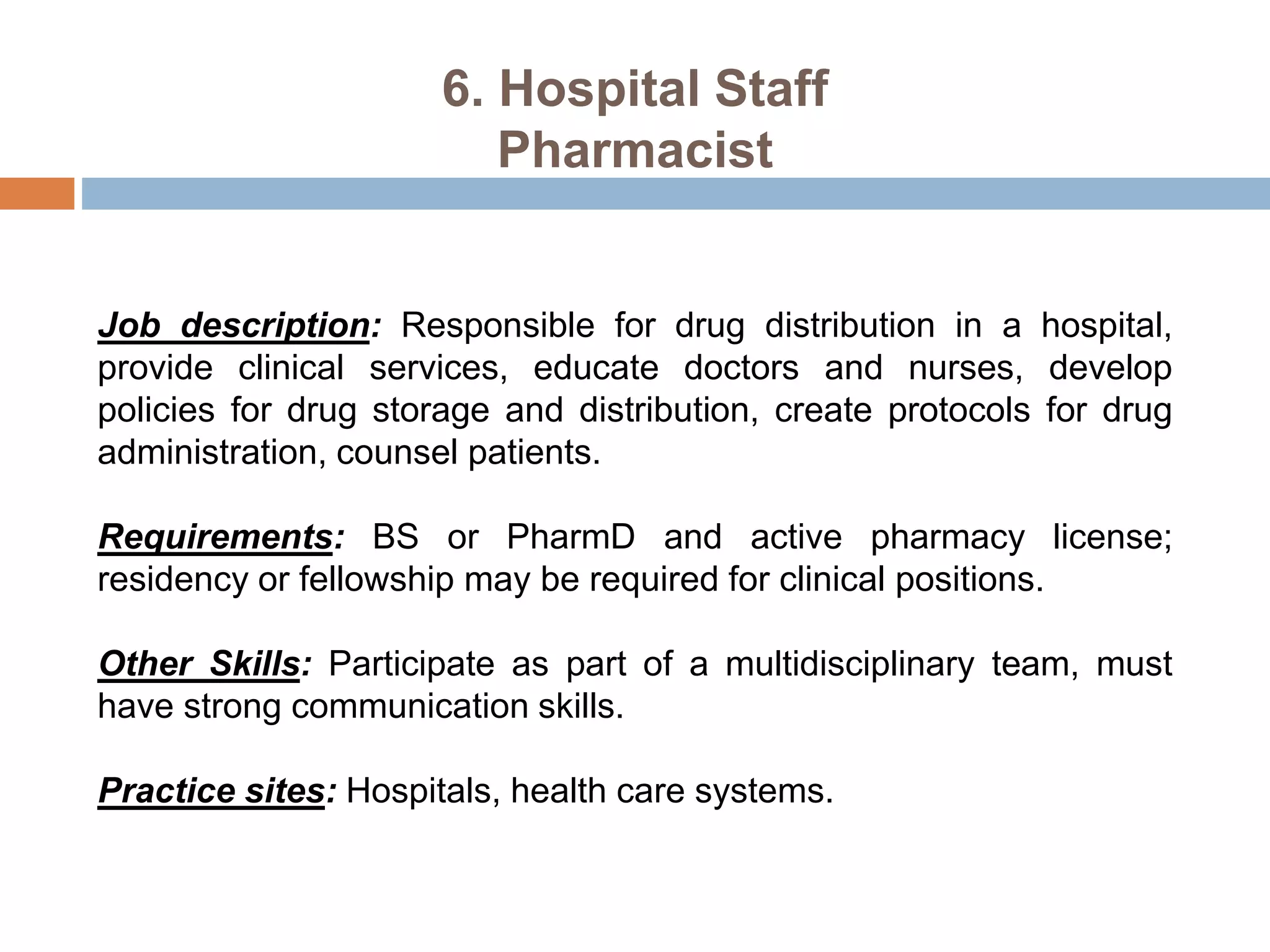
6. Hospital Staff
Pharmacist
Job description: Responsible for drug distribution in a hospital,
provide clinical services, educate doctors and nurses, develop
policies for drug storage and distribution, create protocols for drug
administration, counsel patients.
Requirements: BS or PharmD and active pharmacy license;
residency or fellowship may be required for clinical positions.
Other Skills: Participate as part of a multidisciplinary team, must
have strong communication skills.
Practice sites: Hospitals, health care systems.
7. Infectious disease pharmacist
Job description: Assist in the selection, monitoring, and
administration of antimicrobials; evaluate antimicrobial drug use and
create policies.
Requirements: PharmD, active pharmacy license; residency or
fellowship in infectious disease; strong knowledge of antimicrobial
pharmacology and guidelines.
Other Skills: Participate as part of a multidisciplinary team, must
have strong communication skills.
Advantages: Direct patient care, teaching, clinical pharmacy
practice.
8. Long-term Care or Consultant
Pharmacist
Job description: Provide clinical pharmacy services to the geriatric
population. Review drug regimens and provide recommendations to
providers.
Requirement: PharmD, BS, active license; certification in geriatric
pharmacy is preferred, one-year residency in geriatric pharmacy and
clerkships in long-term care may be helpful.
Other Skills: Great communication skills and ability to interact well
with people, ability to work as part of a healthcare team, must enjoy
working with a geriatric community.
Advantages: Predictable schedule. Often can work independently
as a consultant.
Practice sites: Nursing homes, hospitals, assisted-living facilities,
psychiatric hospitals, home care, sub-acute care facilities.
9. Managed Care
Pharmacist
Job description: Collaborate with physicians, case managers,
and caregivers to provide pharmacy services in a managed care
setting.
Requirements: PharmD or BS, active license.
Other skills: Business and management skills.
Advantages: Fewer number of payers; closed formularies limit the
type of drugs that are available.
Practice sites: Health maintenance organizations (HMO), care
management programs, ambulatory clinics, Preferred Provider
Organizations (PPO).
10. Medication Therapy Management
Pharmacist (Personal Pharmacist)
Job description: Review patient medications, monitor treatment,
optimize medication use, minimize cost of drug therapy.
Requirements: PharmD or BS, active license; certification or
courses in medication therapy management are useful.
Other skills: Board certification in areas of specialty, entrepreneurial
spirit.
Advantages: Direct patient care, opportunity to be own a practice.
Practice sites: Office, community clinics, hospitals, community
pharmacies, patient’s homes.
11. Nutrition Support
Pharmacist
Job description: Collaborate with health care providers and
patients to manage parenteral and enteral nutrition.
Requirements: PharmD or BS, active license; board certification
in Nutrition Support Pharmacy is preferred.
Other skills: able to work with a multidisciplinary team, ability to
individualize treatment specific to a patient’s needs; experience
with intravenous admixtures.
Advantages: Provide specialized services; serve as a consultant
to care teams
Practice sites: acute facilities, ambulatory clinics, skilled nursing
facilities, patients’ homes.
12. Nuclear Practice
Pharmacist
Job description: Prepare radiopharmaceuticals and maintain
quality standards.
Requirements: PharmD or BS, active pharmacy license; authority
to handle radioactive substances; residency or board specialty in
nuclear pharmacy preferred.
Advantages: High demand for nuclear pharmacists.
Practice sites: Imaging and diagnostic centers, hospitals,
specialized pharmacies.
13. Oncology
pharmacist
Job description: Selection, compounding, administration, and
monitoring of chemotherapy agents.
Requirements: PharmD or BS, active license; residency or board
certification in oncology preferred.
Other skills: Experience in critical care.
Advantages: Specialized field, higher pay than hospital pharmacists.
Practice sites: hospitals, universities, cancer centers.
14. Operating Suite (Surgery Unit)
Pharmacist
Job description: Manage availability of medications used for
surgery and post-operative care.
Requirements: PharmD or BS, active license; critical care
experience preferred.
Other experience: Experience with anesthesia and surgery
medications; work in a multidisciplinary team and fast paced
environment.
Practice sites: hospitals, ambulatory surgical centers.
15. Pediatric
pharmacist
Job description: Provide clinical pharmacy services to pediatric
patients.
Requirement: PharmD or BS, active license; one-year general
residency and specialty residency in pediatrics.
Other experience: Able to communicate effectively with children.
Advantages: Specialized field.
Practice sites: Children’s hospitals, hospitals, universities, cancer
centers.
16. Pharmacy Benefit Manager
(PBM)
Job description: Manage prescription drug benefit programs; claims
processing and related administrative services; and perform drug
utilization reviews.
Requirement: PharmD or BS, active license; experience in business
is preferred.
Additional Experience: Possess management and strong analytical
skills.
Advantages: Work in a corporate office environment.
Practice sites: Pharmacy benefit management companies (PBMs).
17. Pharmaceutical Industry
Pharmacists
Job description: Varies depending on the specific job. Usually
involves educating healthcare providers, training commercial teams,
developing communication tools, and research. Regulatory, sales, and
marketing roles are also available.
Requirements: PharmD preferred; fellowship or residency; clinical or
teaching experience. MBA, Ph.D. are helpful.
Other experience: Business management, marketing, sales
experience are desirable; excellent communication skills required for
many roles
Advantages: High pay, great benefits, work in an office or from home,
excellent growth opportunities
Practice sites: pharmaceutical, biotechnology companies, contract
research organizations (CRO)
18. Critical Care
Pharmacist
Job description: Provide clinical pharmacy services in an acute
setting, may manage a decentralized pharmacy, teach and mentor
students and residents.
Requirement: PharmD or BS degree, active pharmacy license, ACLS
certification, general residency followed by a specialty residency in
critical care.
Other skills: experience working in a multidisciplinary team, in-
depth knowledge of several diseases, excellent communication skills.
Advantages: Direct patient care, teaching, clinical pharmacy practice.
Practice sites: intensive care units, emergency departments, operating
rooms
19. Drug Information
Specialist
Job description: Research literature and provide responses to drug
information questions.
Requirement: BS or PharmD; one-year residency or other training in
drug information. Active pharmacy license may not be required in non-
patient care or drug dispensing settings.
Other Skills: experience and training in clinical toxicology, poison,
and drug information, must possess strong communication skills,
capable of working with computers and other modern technologies.
Advantages: Work in an office setting, predictable hours.
Practice sites: hospitals, pharmaceutical industry, publication
(content development) industry, poison control centers.
20. Pharmacists in the
Military
Job description: Provide pharmacy services in various branches of
the military. Duties may range from dispensing to clinical practice,
ambulatory care, and research. May travel to foreign countries with
frequent moves.
Requirements: PharmD or BS, active license from any state,
completion of a personal interview and satisfactory physical exam,
must be a U.S. citizen.
Additional Skills: Extreme flexibility and able to assume large
responsibility at an early age. Comfortable working in a military setting.
Advantages: Great benefits; early retirement; variety of practice
settings.
Practice Sites: Army pharmacies, navy pharmacies, air force
21. Home Care (Home Infusion)
Pharmacist
Job description: Provide home infusion and nutritional services, visit
patients at home and teach them about their medications.
Requirement: BS or PharmD and active pharmacy license,
experience preparing Intravenous medications is desirable.
Other Skills: Participate as part of a multidisciplinary team,
communicate effectively, keep accurate records, understand
parenteral nutrition.
Advantages: Less stressful than retail pharmacy.
Practice sites: patients’ homes, home care agencies, hospices,
specialized infusion companies, ambulatory infusion centers.
22. Poison Control
Pharmacist
Job description: Provide medical information about poisoning and drug
overdoses.
Requirement: PharmD or BS, active license from any state; certification
by the American Association of Poison Control Centers; clinical toxicology
training and one-year residency in poison-control are preferred.
Additional experience: Crisis management over the phone and know
crisis intervention techniques.
Practice sites: Poison control centers, hospitals, universities.
Thank You

Pharmacy careers & pharmacist practice settings

  • 1.
    PHARMACY CAREERS & PHARMACISTPRACTICE SETTINGS 22 types of pharmacist jobs and careers.
  • 2.
    Introduction Pharmacy is anevolving profession. Over the years pharmacists have found new ways to leverage their status as experts in medication therapy to create new pharmacy careers that have significantly improved patient care and advanced the pharmacy profession. Here is a brief description of 22 jobs and careers for pharmacists and links for current job openings.
  • 3.
    1. Ambulatory CarePharmacist Job description: Direct patient care and management of medications for ambulatory patients; manage ambulatory clinics Requirement: Doctor of Pharmacy (PharmD), Bachelor of Science (BS) in Pharmacy; ambulatory care pharmacy residency and board certification in ambulatory care pharmacy are preferred. Certification in the management of chronic conditions or therapies such as diabetes, asthma, anticoagulation is desirable. Advantages: Provide direct patient care in a clinic setting Practice site: Outpatient hospital or community clinics
  • 4.
    2. Academic Pharmacist Jobdescription: Conduct research, publish articles, teach and mentor tomorrow's pharmacist. Some also practice pharmacy in the community, hospital, or ambulatory settings. Requirement: Doctor of Pharmacy (PharmD), Bachelor of Science (BS) in Pharmacy, some also have Ph.D. degrees; one-year residency, and/or fellowship. Other Skills: Need excellent writing and speaking skills, interest in research Advantages: Flexible schedule, work in an office, opportunity to shape the future of pharmacy, pharmacy license may not be required Practice site: universities, schools of pharmacy and medicine, local, state, national, and international organizations
  • 5.
    3. Community Pharmacist Job description:Fill prescriptions, counsel patients, resolve reimbursement issues, manage drug inventory, supervise pharmacy technicians Practice sites: traditional chain drug stores, independent community pharmacies, and supermarkets Requirements: BS or PharmD and active pharmacy license Other Skills: ability to multitask, work long hours, strong communication skills, work in a stressful environment, business management skills Advantages: Multiple work shifts, direct patient interactions, can work part time, pharmacies are ubiquitous. Statistics: 62% of pharmacists work in community pharmacies.
  • 6.
    4. Compounding Pharmacist Job description:Compound drugs for individual prescriptions to meet patient needs. Counsel patients and collaborate with healthcare providers. Requirement: PharmD or BS degree, active pharmacy license, compounding course Practice sites: Compounding pharmacies, community pharmacies, hospitals, universities
  • 7.
    5. Hospice Pharmacist Jobdescription: provide compassionate care to hospice patient, work with a health care team of nurses, doctors, social workers, and counselor. Requirement: Pharmacy license, residency in hospice may be preferred. Other Skills: comfortable with end of life discussions, understand pain management. Practice sites: care medicine, hospices, patients’ homes.
  • 8.
    6. Hospital Staff Pharmacist Jobdescription: Responsible for drug distribution in a hospital, provide clinical services, educate doctors and nurses, develop policies for drug storage and distribution, create protocols for drug administration, counsel patients. Requirements: BS or PharmD and active pharmacy license; residency or fellowship may be required for clinical positions. Other Skills: Participate as part of a multidisciplinary team, must have strong communication skills. Practice sites: Hospitals, health care systems.
  • 9.
    7. Infectious diseasepharmacist Job description: Assist in the selection, monitoring, and administration of antimicrobials; evaluate antimicrobial drug use and create policies. Requirements: PharmD, active pharmacy license; residency or fellowship in infectious disease; strong knowledge of antimicrobial pharmacology and guidelines. Other Skills: Participate as part of a multidisciplinary team, must have strong communication skills. Advantages: Direct patient care, teaching, clinical pharmacy practice.
  • 10.
    8. Long-term Careor Consultant Pharmacist Job description: Provide clinical pharmacy services to the geriatric population. Review drug regimens and provide recommendations to providers. Requirement: PharmD, BS, active license; certification in geriatric pharmacy is preferred, one-year residency in geriatric pharmacy and clerkships in long-term care may be helpful. Other Skills: Great communication skills and ability to interact well with people, ability to work as part of a healthcare team, must enjoy working with a geriatric community. Advantages: Predictable schedule. Often can work independently as a consultant. Practice sites: Nursing homes, hospitals, assisted-living facilities, psychiatric hospitals, home care, sub-acute care facilities.
  • 11.
    9. Managed Care Pharmacist Jobdescription: Collaborate with physicians, case managers, and caregivers to provide pharmacy services in a managed care setting. Requirements: PharmD or BS, active license. Other skills: Business and management skills. Advantages: Fewer number of payers; closed formularies limit the type of drugs that are available. Practice sites: Health maintenance organizations (HMO), care management programs, ambulatory clinics, Preferred Provider Organizations (PPO).
  • 12.
    10. Medication TherapyManagement Pharmacist (Personal Pharmacist) Job description: Review patient medications, monitor treatment, optimize medication use, minimize cost of drug therapy. Requirements: PharmD or BS, active license; certification or courses in medication therapy management are useful. Other skills: Board certification in areas of specialty, entrepreneurial spirit. Advantages: Direct patient care, opportunity to be own a practice. Practice sites: Office, community clinics, hospitals, community pharmacies, patient’s homes.
  • 13.
    11. Nutrition Support Pharmacist Jobdescription: Collaborate with health care providers and patients to manage parenteral and enteral nutrition. Requirements: PharmD or BS, active license; board certification in Nutrition Support Pharmacy is preferred. Other skills: able to work with a multidisciplinary team, ability to individualize treatment specific to a patient’s needs; experience with intravenous admixtures. Advantages: Provide specialized services; serve as a consultant to care teams Practice sites: acute facilities, ambulatory clinics, skilled nursing facilities, patients’ homes.
  • 14.
    12. Nuclear Practice Pharmacist Jobdescription: Prepare radiopharmaceuticals and maintain quality standards. Requirements: PharmD or BS, active pharmacy license; authority to handle radioactive substances; residency or board specialty in nuclear pharmacy preferred. Advantages: High demand for nuclear pharmacists. Practice sites: Imaging and diagnostic centers, hospitals, specialized pharmacies.
  • 15.
    13. Oncology pharmacist Job description:Selection, compounding, administration, and monitoring of chemotherapy agents. Requirements: PharmD or BS, active license; residency or board certification in oncology preferred. Other skills: Experience in critical care. Advantages: Specialized field, higher pay than hospital pharmacists. Practice sites: hospitals, universities, cancer centers.
  • 16.
    14. Operating Suite(Surgery Unit) Pharmacist Job description: Manage availability of medications used for surgery and post-operative care. Requirements: PharmD or BS, active license; critical care experience preferred. Other experience: Experience with anesthesia and surgery medications; work in a multidisciplinary team and fast paced environment. Practice sites: hospitals, ambulatory surgical centers.
  • 17.
    15. Pediatric pharmacist Job description:Provide clinical pharmacy services to pediatric patients. Requirement: PharmD or BS, active license; one-year general residency and specialty residency in pediatrics. Other experience: Able to communicate effectively with children. Advantages: Specialized field. Practice sites: Children’s hospitals, hospitals, universities, cancer centers.
  • 18.
    16. Pharmacy BenefitManager (PBM) Job description: Manage prescription drug benefit programs; claims processing and related administrative services; and perform drug utilization reviews. Requirement: PharmD or BS, active license; experience in business is preferred. Additional Experience: Possess management and strong analytical skills. Advantages: Work in a corporate office environment. Practice sites: Pharmacy benefit management companies (PBMs).
  • 19.
    17. Pharmaceutical Industry Pharmacists Jobdescription: Varies depending on the specific job. Usually involves educating healthcare providers, training commercial teams, developing communication tools, and research. Regulatory, sales, and marketing roles are also available. Requirements: PharmD preferred; fellowship or residency; clinical or teaching experience. MBA, Ph.D. are helpful. Other experience: Business management, marketing, sales experience are desirable; excellent communication skills required for many roles Advantages: High pay, great benefits, work in an office or from home, excellent growth opportunities Practice sites: pharmaceutical, biotechnology companies, contract research organizations (CRO)
  • 20.
    18. Critical Care Pharmacist Jobdescription: Provide clinical pharmacy services in an acute setting, may manage a decentralized pharmacy, teach and mentor students and residents. Requirement: PharmD or BS degree, active pharmacy license, ACLS certification, general residency followed by a specialty residency in critical care. Other skills: experience working in a multidisciplinary team, in- depth knowledge of several diseases, excellent communication skills. Advantages: Direct patient care, teaching, clinical pharmacy practice. Practice sites: intensive care units, emergency departments, operating rooms
  • 21.
    19. Drug Information Specialist Jobdescription: Research literature and provide responses to drug information questions. Requirement: BS or PharmD; one-year residency or other training in drug information. Active pharmacy license may not be required in non- patient care or drug dispensing settings. Other Skills: experience and training in clinical toxicology, poison, and drug information, must possess strong communication skills, capable of working with computers and other modern technologies. Advantages: Work in an office setting, predictable hours. Practice sites: hospitals, pharmaceutical industry, publication (content development) industry, poison control centers.
  • 22.
    20. Pharmacists inthe Military Job description: Provide pharmacy services in various branches of the military. Duties may range from dispensing to clinical practice, ambulatory care, and research. May travel to foreign countries with frequent moves. Requirements: PharmD or BS, active license from any state, completion of a personal interview and satisfactory physical exam, must be a U.S. citizen. Additional Skills: Extreme flexibility and able to assume large responsibility at an early age. Comfortable working in a military setting. Advantages: Great benefits; early retirement; variety of practice settings. Practice Sites: Army pharmacies, navy pharmacies, air force
  • 23.
    21. Home Care(Home Infusion) Pharmacist Job description: Provide home infusion and nutritional services, visit patients at home and teach them about their medications. Requirement: BS or PharmD and active pharmacy license, experience preparing Intravenous medications is desirable. Other Skills: Participate as part of a multidisciplinary team, communicate effectively, keep accurate records, understand parenteral nutrition. Advantages: Less stressful than retail pharmacy. Practice sites: patients’ homes, home care agencies, hospices, specialized infusion companies, ambulatory infusion centers.
  • 24.
    22. Poison Control Pharmacist Jobdescription: Provide medical information about poisoning and drug overdoses. Requirement: PharmD or BS, active license from any state; certification by the American Association of Poison Control Centers; clinical toxicology training and one-year residency in poison-control are preferred. Additional experience: Crisis management over the phone and know crisis intervention techniques. Practice sites: Poison control centers, hospitals, universities.
  • 25.