Pharmaceutics II
DOSAGE FORMS & DRUG
DELIVERY SYSTEM
Solid Dosage Forms
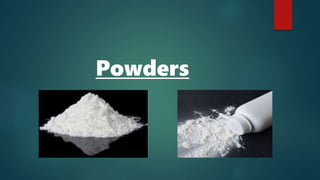
Powders
Define:
‘’A powder is defined as a solid dosage form composed
of a solid or mixture of solids reduced to a finely divided
state and intended for internal or external use.’’
Examples: Bond Body powder , Benefiber ,
Questran ,
Antacids , some Laxative etc.
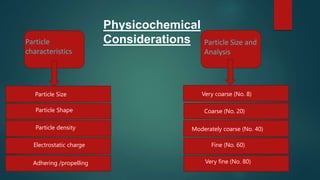
Physicochemical
Considerations
Particle
characteristics
Particle Size and
Analysis
Particle Size
Particle Shape
Particle density
Electrostatic charge
Adhering /propelling
Very coarse (No. 8)
Coarse (No. 20)
Moderately coarse (No. 40)
Fine (No. 60)
Very fine (No. 80)
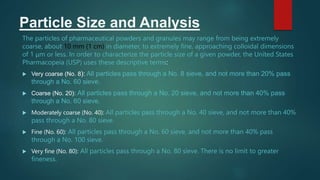
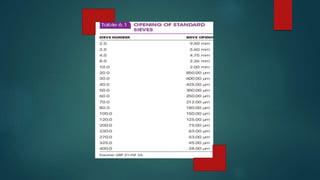
Particle Size and Analysis
The particles of pharmaceutical powders and granules may range from being extremely
coarse, about 10 mm (1 cm) in diameter, to extremely fine, approaching colloidal dimensions
of 1 μm or less. In order to characterize the particle size of a given powder, the United States
Pharmacopeia (USP) uses these descriptive terms:
 Very coarse (No. 8): All particles pass through a No. 8 sieve, and not more than 20% pass
through a No. 60 sieve.
 Coarse (No. 20): All particles pass through a No. 20 sieve, and not more than 40% pass
through a No. 60 sieve.
 Moderately coarse (No. 40): All particles pass through a No. 40 sieve, and not more than 40%
pass through a No. 80 sieve.
 Fine (No. 60): All particles pass through a No. 60 sieve, and not more than 40% pass
through a No. 100 sieve.
 Very fine (No. 80): All particles pass through a No. 80 sieve. There is no limit to greater
fineness.
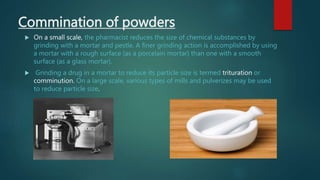
Commination of powders
 On a small scale, the pharmacist reduces the size of chemical substances by
grinding with a mortar and pestle. A finer grinding action is accomplished by using
a mortar with a rough surface (as a porcelain mortar) than one with a smooth
surface (as a glass mortar).
 Grinding a drug in a mortar to reduce its particle size is termed trituration or
comminution. On a large scale, various types of mills and pulverizes may be used
to reduce particle size.
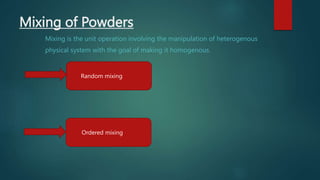
Mixing of Powders
Mixing is the unit operation involving the manipulation of heterogenous
physical system with the goal of making it homogenous.
Random mixing
Ordered mixing
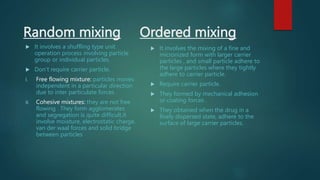
Random mixing Ordered mixing
 It involves a shuffling type unit
operation process involving particle
group or individual particles.
 Don’t require carrier particle.
I. Free flowing mixture: particles moves
independent in a particular direction
due to inter particulate forces .
II. Cohesive mixtures: they are not free
flowing . They form agglomerates
and segregation is quite difficult.it
involve moisture, electrostatic charge,
van der waal forces and solid bridge
between particles
 It involves the mixing of a fine and
micronized form with larger carrier
particles , and small particle adhere to
the large particles where they tightly
adhere to carrier particle.
 Require carrier particle.
 They formed by mechanical adhesion
or coating forces .
 They obtained when the drug in a
finely dispersed state, adhere to the
surface of large carrier particles.
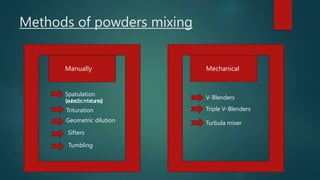
Methods of powders mixing
Manually Mechanical
Spatulation
(eutecticmixtures)
Trituration
Geometric dilution
Sifters
Tumbling
V-Blenders
Triple V-Blenders
Turbula mixer
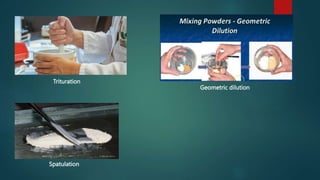
Spatulation
Trituration
Geometric dilution
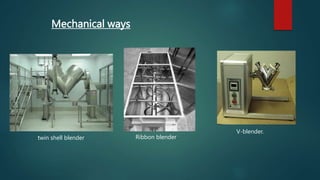
V-blender.
Ribbon blender
twin shell blender
Mechanical ways
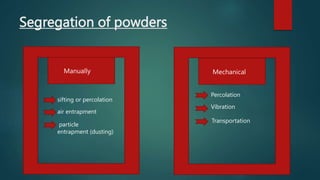
Segregation of powders
Manually Mechanical
sifting or percolation
air entrapment
particle
entrapment (dusting)
Percolation
Vibration
Transportation
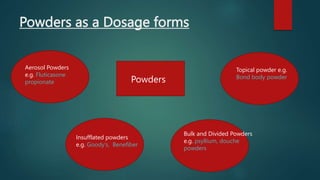
Powders as a Dosage forms
Powders
Aerosol Powders
e.g. Fluticasone
propionate
Bulk and Divided Powders
e.g. psyllium, douche
powders
Insufflated powders
e.g. Goody’s, Benefiber
Topical powder e.g.
Bond body powder
Aerosol Powders
Topical Powders
Insufflation Powders
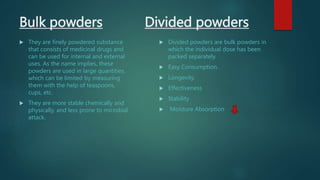
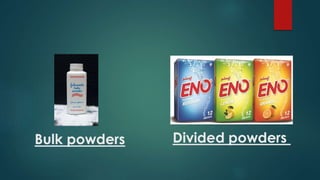
Bulk powders Divided powders
 They are finely powdered substance
that consists of medicinal drugs and
can be used for internal and external
uses. As the name implies, these
powders are used in large quantities,
which can be limited by measuring
them with the help of teaspoons,
cups, etc.
 They are more stable chemically and
physically, and less prone to microbial
attack.
 Divided powders are bulk powders in
which the individual dose has been
packed separately.
 Easy Consumption.
 Longevity.
 Effectiveness
 Stability
 Moisture Absorption
Advantages:
I. Powder form is the most versatile and convenient to prescribe, compound and
administer.
II. A physician has the option to deviate from the conventional dose of a medicament
according to the requirement of the patient.
III. Powders are stable and do not enter into reaction in solid state, lesser difficulties are
experienced in compounding them together.
IV. It is possible to reduce them in the desired particle size range and thus facilitate
rapid absorption.
V. Less incompatibility as compared to liquid dosage form.
VI. Whenever effervescence is desired, accurate quantities of the two reacting powders
are mixed with water.
VII. It is difficult for children and infants to swallow tablets and capsules and under such
circumstances drugs may be administered in powder form making them palatable
by mixing with milk, fruit juice or honey.
Disadvantages:
i) As compared to other dosage forms, powders are time consuming to compound.
ii) Volatile, hygroscopic, oxidizing and deliquescent drugs create obvious difficulties when
dispensed as powders.
iii) Dose inaccuracy.
Reference :
ANSEL’S PHARMACEUTICAL
DOSAGE FORMS AND DRUG DELIVERY SYSTEMS
(PAGE#164-178)

Pharmaceutics 2 (Powders)

  • 1.
    Pharmaceutics II DOSAGE FORMS& DRUG DELIVERY SYSTEM
  • 2.
  • 3.
  • 4.
    Define: ‘’A powder isdefined as a solid dosage form composed of a solid or mixture of solids reduced to a finely divided state and intended for internal or external use.’’ Examples: Bond Body powder , Benefiber , Questran , Antacids , some Laxative etc.
  • 5.
    Physicochemical Considerations Particle characteristics Particle Size and Analysis ParticleSize Particle Shape Particle density Electrostatic charge Adhering /propelling Very coarse (No. 8) Coarse (No. 20) Moderately coarse (No. 40) Fine (No. 60) Very fine (No. 80)
  • 6.
    Particle Size andAnalysis The particles of pharmaceutical powders and granules may range from being extremely coarse, about 10 mm (1 cm) in diameter, to extremely fine, approaching colloidal dimensions of 1 μm or less. In order to characterize the particle size of a given powder, the United States Pharmacopeia (USP) uses these descriptive terms:  Very coarse (No. 8): All particles pass through a No. 8 sieve, and not more than 20% pass through a No. 60 sieve.  Coarse (No. 20): All particles pass through a No. 20 sieve, and not more than 40% pass through a No. 60 sieve.  Moderately coarse (No. 40): All particles pass through a No. 40 sieve, and not more than 40% pass through a No. 80 sieve.  Fine (No. 60): All particles pass through a No. 60 sieve, and not more than 40% pass through a No. 100 sieve.  Very fine (No. 80): All particles pass through a No. 80 sieve. There is no limit to greater fineness.
  • 8.
    Commination of powders On a small scale, the pharmacist reduces the size of chemical substances by grinding with a mortar and pestle. A finer grinding action is accomplished by using a mortar with a rough surface (as a porcelain mortar) than one with a smooth surface (as a glass mortar).  Grinding a drug in a mortar to reduce its particle size is termed trituration or comminution. On a large scale, various types of mills and pulverizes may be used to reduce particle size.
  • 9.
    Mixing of Powders Mixingis the unit operation involving the manipulation of heterogenous physical system with the goal of making it homogenous. Random mixing Ordered mixing
  • 10.
    Random mixing Orderedmixing  It involves a shuffling type unit operation process involving particle group or individual particles.  Don’t require carrier particle. I. Free flowing mixture: particles moves independent in a particular direction due to inter particulate forces . II. Cohesive mixtures: they are not free flowing . They form agglomerates and segregation is quite difficult.it involve moisture, electrostatic charge, van der waal forces and solid bridge between particles  It involves the mixing of a fine and micronized form with larger carrier particles , and small particle adhere to the large particles where they tightly adhere to carrier particle.  Require carrier particle.  They formed by mechanical adhesion or coating forces .  They obtained when the drug in a finely dispersed state, adhere to the surface of large carrier particles.
  • 11.
    Methods of powdersmixing Manually Mechanical Spatulation (eutecticmixtures) Trituration Geometric dilution Sifters Tumbling V-Blenders Triple V-Blenders Turbula mixer
  • 12.
  • 13.
    V-blender. Ribbon blender twin shellblender Mechanical ways
  • 14.
    Segregation of powders ManuallyMechanical sifting or percolation air entrapment particle entrapment (dusting) Percolation Vibration Transportation
  • 15.
    Powders as aDosage forms Powders Aerosol Powders e.g. Fluticasone propionate Bulk and Divided Powders e.g. psyllium, douche powders Insufflated powders e.g. Goody’s, Benefiber Topical powder e.g. Bond body powder
  • 16.
  • 17.
    Bulk powders Dividedpowders  They are finely powdered substance that consists of medicinal drugs and can be used for internal and external uses. As the name implies, these powders are used in large quantities, which can be limited by measuring them with the help of teaspoons, cups, etc.  They are more stable chemically and physically, and less prone to microbial attack.  Divided powders are bulk powders in which the individual dose has been packed separately.  Easy Consumption.  Longevity.  Effectiveness  Stability  Moisture Absorption
  • 19.
    Advantages: I. Powder formis the most versatile and convenient to prescribe, compound and administer. II. A physician has the option to deviate from the conventional dose of a medicament according to the requirement of the patient. III. Powders are stable and do not enter into reaction in solid state, lesser difficulties are experienced in compounding them together. IV. It is possible to reduce them in the desired particle size range and thus facilitate rapid absorption. V. Less incompatibility as compared to liquid dosage form. VI. Whenever effervescence is desired, accurate quantities of the two reacting powders are mixed with water. VII. It is difficult for children and infants to swallow tablets and capsules and under such circumstances drugs may be administered in powder form making them palatable by mixing with milk, fruit juice or honey.
  • 20.
    Disadvantages: i) As comparedto other dosage forms, powders are time consuming to compound. ii) Volatile, hygroscopic, oxidizing and deliquescent drugs create obvious difficulties when dispensed as powders. iii) Dose inaccuracy.
  • 21.
    Reference : ANSEL’S PHARMACEUTICAL DOSAGEFORMS AND DRUG DELIVERY SYSTEMS (PAGE#164-178)