PHARMACEUTICAL
VALIDATION
“
UNIT 01
2
PV
3
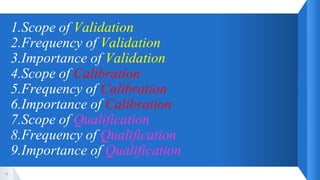
1.Scope of Validation
2.Frequency of Validation
3.Importance of Validation
4.Scope of Calibration
5.Frequency of Calibration
6.Importance of Calibration
7.Scope of Qualification
8.Frequency of Qualification
9.Importance of Qualification
4
5
“
▸ SCOPE
▸ OF
▸ VALIDATION:
▸
6
UNIT
01
7
• Validation requires an appropriate and sufficient
infrastructure including:–organization, documentation,
personnel and finances.
• Involvement of management and quality assurance
personnel
• Personnel with appropriate qualifications and experience
• Extensive preparation and planning before validation is
performed.
• A specific programme for validation activities in place.
“
▸ FREQUENCY
▸ OF
▸ VALIDATION:
▸
8
UNIT
01
9
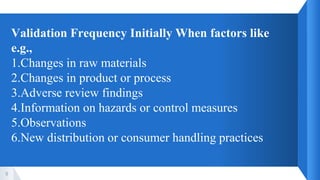
Validation Frequency Initially When factors like
e.g.,
1.Changes in raw materials
2.Changes in product or process
3.Adverse review findings
4.Information on hazards or control measures
5.Observations
6.New distribution or consumer handling practices
“
▸ IMPORTANCE
▸ OF
▸ VALIDATION:
▸
10
UNIT
01
11
1. Assurance of quality
2. Time bound
3. Process optimization
4. Reduction of quality cost.
5. Minimal batch failures, improved efficiently and productivity.
6. Reduction in rejections.
7. Increased output.
8. Fewer complaints about process related failures.
9. Reduced testing in process and in finished goods.
10. More rapid and reliable start-up of new equipments
11. Easier maintenance of equipment.
12. Improved employee awareness of process
13. Government regulation (Compliance with validation requirements is necessary for
obtaining approval to manufacture and to introduce new products)
“
▸ SCOPE
▸ OF
▸ CALIBRATION:
▸
12
UNIT
01
13
Calibration is primarily done to achieve 5 main purposes which are:
To make sure that the readings of equipment or instruments are consistent
with other measurements and display the correct readings every single time
To determine the accuracy, precision and deviation of the measurements
produced by all the instruments
To establish the reliability of the instrument being used and whether it can
be trusted to deliver repeatable results each time
Such as current good manufacturing practice (cGMP) and government
regulations are adhered to
“
▸ FREQUENCY
▸ OF
▸ CALIBRATION:
▸
14
UNIT
01
15
Frequency Of Calibration
Examine each instrument being used and study its behavior.
Based on this information, you can design a calibration
schedule for each instrument.
The interval between calibrations can vary as:
Weekly Monthly Quarterly, semi-annually or
annually After every heavy usage of the instrument
“
▸ IMPORTANCE
▸ OF
▸ CALIBRATION:
▸
16
UNIT
01
17
Calibration is responsible for defining the accuracy of any measurement and its quality
that is recorded by any instrument.
When you start working with any instrument, it must be calibrated well, thus assuring
you of accurate results.
However, over a period of time you will start observing a ‘drift’. Calibration minimizes
such uncertainties by assuring the accuracy of the test equipment.
• When you regularly calibrate your equipment, you can eliminate the drift
• Calibration helps in quantifying and controlling errors
• Further, it helps in improving the accuracy of the measuring device, which in
turn improves the quality of the end product.
• In short, regular calibration allows pharmaceutical companies to have
confidence in their results which they can record, monitor and control.
“
▸ SCOPE
▸ OF
▸ QUALIFICATION
▸
18
UNIT
01
19
Verifies the performance of equipment, systems and facilities as a whole. •
It represents the final qualification, including any requalification of the
system and equipment that you use in your business.
• Typically, the scope of Q extends to include the following scenarios:
New systems being delivered and operated for the first time
Existing systems in use (as part of a regular maintenance schedule)
Systems that have been modified to any degree
Equipment/systems which have been used more than they normally
would be
After a system has been expanded in order to increase its capacity
“
▸ FREQUENCY
▸ OF
▸ QUALIFICATION
▸
20
UNIT
01
21
The schedule or frequency you choose depends on a
lot of factors.
• This will typically be one or more of the following:
• Everyday
• Each time the equipment or system is used
• Before, after, or even during, a series of
operations
• Other periodic schedule, or as needed
“
▸ IMPORTANCE
▸ OF
▸ QUALIFICATION
▸
22
UNIT
01
23
Qualification is defined as an action of providing
that equipment or ancillary systems are properly
installed, work correctly, and actually lead to the
expected results.
Qualification is part of validation, but the
individual qualification steps alone plays
important role in quality of Product

#PHARMACEUTICAL VALIDATION

  • 1.
  • 2.
  • 3.
  • 4.
    1.Scope of Validation 2.Frequencyof Validation 3.Importance of Validation 4.Scope of Calibration 5.Frequency of Calibration 6.Importance of Calibration 7.Scope of Qualification 8.Frequency of Qualification 9.Importance of Qualification 4
  • 5.
  • 6.
    “ ▸ SCOPE ▸ OF ▸VALIDATION: ▸ 6 UNIT 01
  • 7.
    7 • Validation requiresan appropriate and sufficient infrastructure including:–organization, documentation, personnel and finances. • Involvement of management and quality assurance personnel • Personnel with appropriate qualifications and experience • Extensive preparation and planning before validation is performed. • A specific programme for validation activities in place.
  • 8.
    “ ▸ FREQUENCY ▸ OF ▸VALIDATION: ▸ 8 UNIT 01
  • 9.
    9 Validation Frequency InitiallyWhen factors like e.g., 1.Changes in raw materials 2.Changes in product or process 3.Adverse review findings 4.Information on hazards or control measures 5.Observations 6.New distribution or consumer handling practices
  • 10.
    “ ▸ IMPORTANCE ▸ OF ▸VALIDATION: ▸ 10 UNIT 01
  • 11.
    11 1. Assurance ofquality 2. Time bound 3. Process optimization 4. Reduction of quality cost. 5. Minimal batch failures, improved efficiently and productivity. 6. Reduction in rejections. 7. Increased output. 8. Fewer complaints about process related failures. 9. Reduced testing in process and in finished goods. 10. More rapid and reliable start-up of new equipments 11. Easier maintenance of equipment. 12. Improved employee awareness of process 13. Government regulation (Compliance with validation requirements is necessary for obtaining approval to manufacture and to introduce new products)
  • 12.
    “ ▸ SCOPE ▸ OF ▸CALIBRATION: ▸ 12 UNIT 01
  • 13.
    13 Calibration is primarilydone to achieve 5 main purposes which are: To make sure that the readings of equipment or instruments are consistent with other measurements and display the correct readings every single time To determine the accuracy, precision and deviation of the measurements produced by all the instruments To establish the reliability of the instrument being used and whether it can be trusted to deliver repeatable results each time Such as current good manufacturing practice (cGMP) and government regulations are adhered to
  • 14.
    “ ▸ FREQUENCY ▸ OF ▸CALIBRATION: ▸ 14 UNIT 01
  • 15.
    15 Frequency Of Calibration Examineeach instrument being used and study its behavior. Based on this information, you can design a calibration schedule for each instrument. The interval between calibrations can vary as: Weekly Monthly Quarterly, semi-annually or annually After every heavy usage of the instrument
  • 16.
    “ ▸ IMPORTANCE ▸ OF ▸CALIBRATION: ▸ 16 UNIT 01
  • 17.
    17 Calibration is responsiblefor defining the accuracy of any measurement and its quality that is recorded by any instrument. When you start working with any instrument, it must be calibrated well, thus assuring you of accurate results. However, over a period of time you will start observing a ‘drift’. Calibration minimizes such uncertainties by assuring the accuracy of the test equipment. • When you regularly calibrate your equipment, you can eliminate the drift • Calibration helps in quantifying and controlling errors • Further, it helps in improving the accuracy of the measuring device, which in turn improves the quality of the end product. • In short, regular calibration allows pharmaceutical companies to have confidence in their results which they can record, monitor and control.
  • 18.
    “ ▸ SCOPE ▸ OF ▸QUALIFICATION ▸ 18 UNIT 01
  • 19.
    19 Verifies the performanceof equipment, systems and facilities as a whole. • It represents the final qualification, including any requalification of the system and equipment that you use in your business. • Typically, the scope of Q extends to include the following scenarios: New systems being delivered and operated for the first time Existing systems in use (as part of a regular maintenance schedule) Systems that have been modified to any degree Equipment/systems which have been used more than they normally would be After a system has been expanded in order to increase its capacity
  • 20.
    “ ▸ FREQUENCY ▸ OF ▸QUALIFICATION ▸ 20 UNIT 01
  • 21.
    21 The schedule orfrequency you choose depends on a lot of factors. • This will typically be one or more of the following: • Everyday • Each time the equipment or system is used • Before, after, or even during, a series of operations • Other periodic schedule, or as needed
  • 22.
    “ ▸ IMPORTANCE ▸ OF ▸QUALIFICATION ▸ 22 UNIT 01
  • 23.
    23 Qualification is definedas an action of providing that equipment or ancillary systems are properly installed, work correctly, and actually lead to the expected results. Qualification is part of validation, but the individual qualification steps alone plays important role in quality of Product