Validation is a documented process that provides a high degree of assurance that a specific process, method, or system consistently produces a result meeting its predetermined specifications and quality attributes.
KCT’s R.G.S Collegeof Pharmacy, Nashik 1
KCT’s R.G.S College of Pharmacy, Nashik
Introduction To Validation
Presented By:
Jotshna Rajendra Adhagale
F.Y M-Pharm (Pharmaceutical Quality Assurance)
Roll No:- 1
Under the guidance of
Prof. H.R.Bhandari
2.
KCT’s R.G.S Collegeof Pharmacy, Nashik 2
CONTENT
• DEFINITION OF CALIBRATION
• DEFINITION OF QUALIFICATION
• DEFINITION OF VALIDATION
• SCOPE, FREQUENCY AND IMPORTANCE
• DIFFERENCE BETWEEN CALIBRATION AND VALIDATION
3.
KCT’s R.G.S Collegeof Pharmacy, Nashik 3
CALIBRATION
• "The documented process of comparing measurements from instruments
to a known standard, ensuring accuracy, reliability, and compliance with
specified limits.“
Examples:
• Balance Calibration: Using certified weights to verify the weighing
accuracy.
• pH Meter Calibration: Using buffer solutions (e.g., pH 4.0, 7.0, 10.0).
• HPLC Calibration: Checking flow rate, wavelength accuracy, and detector
linearity.
4.
KCT’s R.G.S Collegeof Pharmacy, Nashik 4
1. Scope of Calibration
Calibration applies to all instruments, equipment, and systems used in:
• Manufacturing
• Quality control/assurance
• Laboratory testing
• Environmental monitoring
• Storage and distribution
Instruments Typically Calibrated:
• Balances and weighing scales
• pH meters
• Temperature and humidity sensors
• HPLC, GC, UV spectrophotometers
• Pressure gauges and flow meters
• Timers and stopwatches
5.
KCT’s R.G.S Collegeof Pharmacy, Nashik 5
2. Frequency of Calibration
Calibration frequency is determined by:
• Manufacturer recommendations
• Regulatory requirements
• Risk assessments based on instrument criticality
• Usage frequency and operating conditions
• Historical calibration performance
6.
KCT’s R.G.S Collegeof Pharmacy, Nashik 6
Importance of Calibration
• ✅ Ensures Measurement Accuracy:
• Critical for correct dosing, testing, and manufacturing.
• ✅ Regulatory Compliance:
• Required by cGMP, FDA, EMA, WHO, and ISO 17025.
• ✅ Ensures Product Quality & Safety:
• Prevents batch failures due to measurement errors.
• ✅ Data Integrity:
• Only calibrated instruments provide trustworthy results.
• ✅ Risk Mitigation:
• Reduces the chance of recalls, customer complaints, and compliance issues.
7.
KCT’s R.G.S Collegeof Pharmacy, Nashik 7
QUALIFICATION
DEFINITION
“The documented process of demonstrating that equipment, systems, or facilities
are properly installed, work correctly, and consistently perform as intended
according to predefined specifications and requirements.“
8.
KCT’s R.G.S Collegeof Pharmacy, Nashik 8
Key Types of Qualification:
Design Qualification (DQ):
Ensures the design of equipment or systems meets all regulatory and process requirements.
Installation Qualification (IQ):
Verifies that the equipment or system is installed according to manufacturer’s specifications and
documented standards.
Operational Qualification (OQ):
Confirms that the equipment operates as intended throughout all anticipated operating ranges.
Performance Qualification (PQ):
Demonstrates that the equipment or system performs consistently and reproducibly under real
process conditions.
9.
KCT’s R.G.S Collegeof Pharmacy, Nashik 9
1. Scope of Qualification
• Qualification applies to all critical equipment, systems, utilities, and facilities used to
manufacture, test, and store pharmaceutical products. It ensures they operate within specified
limits and meet regulatory and GMP requirements.
• Common areas covered:
• Production equipment (e.g., mixers, tablet presses)
• Analytical instruments (e.g., HPLC, balances)
• HVAC systems
• Water systems (e.g., purified water, WFI)
• Cleanrooms and controlled environments
• Computerized systems (as part of CSV)
10.
KCT’s R.G.S Collegeof Pharmacy, Nashik 10
2. Frequency of Qualification
• The frequency depends on the risk, criticality, and type of equipment/system, and is typically
outlined in the organization’s SOPs and validation master plan.
• General guidance:
• Initial Qualification: Performed before first use.
• Requalification:
• Periodically (e.g., every 1–3 years depending on criticality)
• After major changes (e.g., relocation, major maintenance, software updates)
• After deviations or failures
• As part of continued process verification
11.
KCT’s R.G.S Collegeof Pharmacy, Nashik 11
3. Importance of Qualification
• Qualification is critical in pharmaceutical validation because it:
• ✅ Ensures compliance with cGMP and regulatory expectations
• ✅ Demonstrates fitness for intended use of equipment and systems
• ✅ Prevents product quality failures
• ✅ Supports data integrity
• ✅ Reduces risks of contamination, mix-ups, and variability
• ✅ Forms the foundation for process validation
12.
KCT’s R.G.S Collegeof Pharmacy, Nashik 12
VALIDATION
• DEFINITION
“The documented process of demonstrating, with a high degree of assurance, that a
specific process, method, system, or equipment consistently produces a product
meeting its predetermined specifications and quality attributes."
13.
KCT’s R.G.S Collegeof Pharmacy, Nashik 13
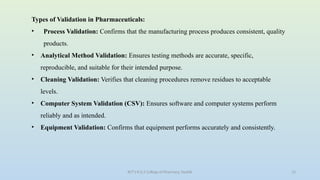
Types of Validation in Pharmaceuticals:
• Process Validation: Confirms that the manufacturing process produces consistent, quality
products.
• Analytical Method Validation: Ensures testing methods are accurate, specific,
reproducible, and suitable for their intended purpose.
• Cleaning Validation: Verifies that cleaning procedures remove residues to acceptable
levels.
• Computer System Validation (CSV): Ensures software and computer systems perform
reliably and as intended.
• Equipment Validation: Confirms that equipment performs accurately and consistently.
14.
KCT’s R.G.S Collegeof Pharmacy, Nashik 14
1. Scope of Validation
Validation in the pharmaceutical industry covers various processes, systems, and
equipment used to ensure product quality and regulatory compliance.
Key Areas Included in Scope:
• Manufacturing Processes
• Analytical Methods
• Cleaning Procedures
• Equipment and Instrumentation
• Computerized Systems (CSV)
• Packaging and Labeling Systems
15.
KCT’s R.G.S Collegeof Pharmacy, Nashik 15
2. Frequency of Validation
Type of Validation Frequency
Initial Validation
Performed during new equipment/process
qualification.
Re-Validation
When there is a significant change (equipment,
process, method).
Periodic Re-Validation
Based on a risk assessment or every 1–3 years
depending on product/process criticality.
Continuous Validation
Ongoing data collection and analysis under the process
validation lifecycle.
The frequency of validation depends on the type of validation and regulatory requirements. It includes
initial validation and periodic reviews.
Types and Frequency:
16.
KCT’s R.G.S Collegeof Pharmacy, Nashik 16
3. Importance of Validation
Validation is crucial for ensuring that pharmaceutical products are safe, effective, and of consistent quality.
• Key Benefits:
• ✅ Ensures compliance with GMP and regulatory requirements
• ✅ Reduces risk of product recalls, failures, and deviations
• ✅ Assures quality and integrity of the drug product
• ✅ Supports data integrity and traceability
• ✅ Improves efficiency and understanding of processes
• ✅ Builds confidence in systems and analytical methods
• ✅ Helps in regulatory inspections and audits
17.
KCT’s R.G.S Collegeof Pharmacy, Nashik 17
Difference Between Calibration and Validation
Aspect Calibration Validation
Definition
The process of comparing an instrument’s
output to a known standard to ensure
accuracy.
The documented process of proving that
a process, method, or system consistently
produces expected results.
Purpose
To ensure instruments give accurate
measurements.
To ensure the entire process/system
performs as intended.
Focus Equipment/instrument accuracy.
Entire process, system, or method
performance.
Scope
Limited to measuring instruments and
devices.
Broad – includes equipment, methods,
processes, cleaning, etc.
Standards Used
Uses certified standards or reference
materials.
Based on protocols, acceptance criteria,
and regulations.
Output Calibration certificate or report. Validation protocol and report.
Frequency
Regular intervals (e.g., monthly,
quarterly, annually).
Initial, re-validation, or periodic as
needed.
Regulatory Requirement Required under GMP for instruments.
Required under GMP for quality-critical
systems and processes.
Example
Calibrating a balance with standard
weights.
Validating a tablet manufacturing
process.
18.
KCT’s R.G.S Collegeof Pharmacy, Nashik 18
REFERENCES
• IJPRC 2011 ‘An overview of pharmaceutical validation: Quality
assurance view point’ by Nandkumar et.al
• https://chat.openai.com/
• Sharma, R. (2022, March 15). Pharmaceutical validation overview
[PowerPoint slides]. SlideShare.
https://www.slideshare.net/rahulsharma/pharmaceutical-validation-
overview







![KCT’s R.G.S College of Pharmacy, Nashik 18
REFERENCES
• IJPRC 2011 ‘An overview of pharmaceutical validation: Quality
assurance view point’ by Nandkumar et.al
• https://chat.openai.com/
• Sharma, R. (2022, March 15). Pharmaceutical validation overview
[PowerPoint slides]. SlideShare.
https://www.slideshare.net/rahulsharma/pharmaceutical-validation-
overview](https://image.slidesharecdn.com/validation-250707155205-3112b4a7/85/INTRODUCTION-TO-VALIDATION-PRESENTATION-pptx-18-320.jpg)


