PHARMACEUTICAL
MICROBIOLOGY (Theory)
BP 303 T
Subject’s Teacher: Mr. Sonam Bhutia
Assistant Professor
Government Pharmacy College,
Sajong
Government of Sikkim, Sikkim
University
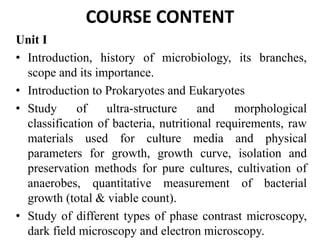
COURSE CONTENT
Unit I
• Introduction, history of microbiology, its branches,
scope and its importance.
• Introduction to Prokaryotes and Eukaryotes
• Study of ultra-structure and morphological
classification of bacteria, nutritional requirements, raw
materials used for culture media and physical
parameters for growth, growth curve, isolation and
preservation methods for pure cultures, cultivation of
anaerobes, quantitative measurement of bacterial
growth (total & viable count).
• Study of different types of phase contrast microscopy,
dark field microscopy and electron microscopy.
Unit II
• Identification of bacteria using staining
techniques (simple, Gram’s &Acid fast staining)
and biochemical tests (IMViC).
• Study of principle, procedure, merits, demerits
and applications of physical, chemical gaseous,
radiation and mechanical method of sterilization.
• Evaluation of the efficiency of sterilization
methods.
• Equipments employed in large scale sterilization.
• Sterility indicators.
Unit III
• Study of morphology, classification,
reproduction/replication and cultivation of Fungi
and Viruses.
• Classification and mode of action of
disinfectants
• Factors influencing disinfection, antiseptics and
their evaluation. For bacteriostatic and
bactericidal actions
• Evaluation of bactericidal & Bacteriostatic.
• Sterility testing of products (solids, liquids,
ophthalmic and other sterile products) according
to IP, BP and USP.
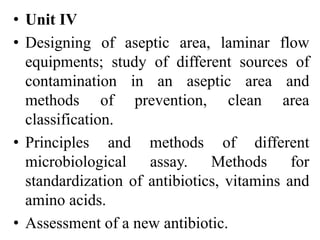
• Unit IV
• Designing of aseptic area, laminar flow
equipments; study of different sources of
contamination in an aseptic area and
methods of prevention, clean area
classification.
• Principles and methods of different
microbiological assay. Methods for
standardization of antibiotics, vitamins and
amino acids.
• Assessment of a new antibiotic.
• Unit V
• Types of spoilage, factors affecting the microbial
spoilage of pharmaceutical products, sources and types
of microbial contaminants, assessment of microbial
contamination and spoilage.
• Preservation of pharmaceutical products using
antimicrobial agents, evaluation of microbial stability of
formulations.
• Growth of animal cells in culture, general procedure for
cell culture, Primary, established and transformed cell
cultures.
• Application of cell cultures in pharmaceutical industry
and research.
PHARMACEUTICAL MICROBIOLOGY
(Practical)
1. Introduction and study of different equipments
and processing, e.g., B.O.D. incubator, laminar
flow, aseptic hood, autoclave, hot air sterilizer,
deep freezer, refrigerator, microscopes used in
experimental microbiology.
2. Sterilization of glassware, preparation and
sterilization of media.
3. Sub culturing of bacteria and fungus. Nutrient
stabs and slants preparations.
4. Staining methods- Simple, Grams staining and
acid fast staining (Demonstration with practical).
5. Isolation of pure culture of micro-
organisms by multiple streak plate
technique and other techniques.
6. Microbiological assay of antibiotics by
cup plate method and other methods
7. Motility determination by Hanging drop
method.
8. Sterility testing of pharmaceuticals.
9. Bacteriological analysis of water
10. Biochemical test.
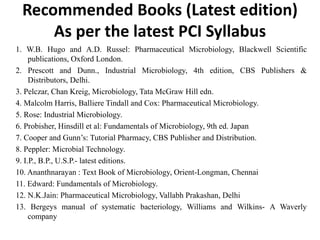
Recommended Books (Latest edition)
As per the latest PCI Syllabus
1. W.B. Hugo and A.D. Russel: Pharmaceutical Microbiology, Blackwell Scientific
publications, Oxford London.
2. Prescott and Dunn., Industrial Microbiology, 4th edition, CBS Publishers &
Distributors, Delhi.
3. Pelczar, Chan Kreig, Microbiology, Tata McGraw Hill edn.
4. Malcolm Harris, Balliere Tindall and Cox: Pharmaceutical Microbiology.
5. Rose: Industrial Microbiology.
6. Probisher, Hinsdill et al: Fundamentals of Microbiology, 9th ed. Japan
7. Cooper and Gunn’s: Tutorial Pharmacy, CBS Publisher and Distribution.
8. Peppler: Microbial Technology.
9. I.P., B.P., U.S.P.- latest editions.
10. Ananthnarayan : Text Book of Microbiology, Orient-Longman, Chennai
11. Edward: Fundamentals of Microbiology.
12. N.K.Jain: Pharmaceutical Microbiology, Vallabh Prakashan, Delhi
13. Bergeys manual of systematic bacteriology, Williams and Wilkins- A Waverly
company
To do list
for all the 3rd Sem students-2020
• Make a note copy for the subject
• Take the photocopy of the syllabus-
Ph.microbiology, which was provided in the
whatsApp group
• Paste it on the first page of the subject copy on
left side.
Do it sincerely by each one of you and send the
photo in the whatsApp group without fail.
Disciplined, Sincere and Punctual students will
be rewarded while giving Assignment Marks in
the Final Exam.
REWARD FOR BEST EXPLANATION OF ABOVE IMAGE: Next
time when we meet in our class room, each one of you
have to explain the above image and best explanation
will be given RECOGNITION.

Pharmaceutical microbiology syllabus

  • 1.
    PHARMACEUTICAL MICROBIOLOGY (Theory) BP 303T Subject’s Teacher: Mr. Sonam Bhutia Assistant Professor Government Pharmacy College, Sajong Government of Sikkim, Sikkim University
  • 2.
    COURSE CONTENT Unit I •Introduction, history of microbiology, its branches, scope and its importance. • Introduction to Prokaryotes and Eukaryotes • Study of ultra-structure and morphological classification of bacteria, nutritional requirements, raw materials used for culture media and physical parameters for growth, growth curve, isolation and preservation methods for pure cultures, cultivation of anaerobes, quantitative measurement of bacterial growth (total & viable count). • Study of different types of phase contrast microscopy, dark field microscopy and electron microscopy.
  • 3.
    Unit II • Identificationof bacteria using staining techniques (simple, Gram’s &Acid fast staining) and biochemical tests (IMViC). • Study of principle, procedure, merits, demerits and applications of physical, chemical gaseous, radiation and mechanical method of sterilization. • Evaluation of the efficiency of sterilization methods. • Equipments employed in large scale sterilization. • Sterility indicators.
  • 4.
    Unit III • Studyof morphology, classification, reproduction/replication and cultivation of Fungi and Viruses. • Classification and mode of action of disinfectants • Factors influencing disinfection, antiseptics and their evaluation. For bacteriostatic and bactericidal actions • Evaluation of bactericidal & Bacteriostatic. • Sterility testing of products (solids, liquids, ophthalmic and other sterile products) according to IP, BP and USP.
  • 5.
    • Unit IV •Designing of aseptic area, laminar flow equipments; study of different sources of contamination in an aseptic area and methods of prevention, clean area classification. • Principles and methods of different microbiological assay. Methods for standardization of antibiotics, vitamins and amino acids. • Assessment of a new antibiotic.
  • 6.
    • Unit V •Types of spoilage, factors affecting the microbial spoilage of pharmaceutical products, sources and types of microbial contaminants, assessment of microbial contamination and spoilage. • Preservation of pharmaceutical products using antimicrobial agents, evaluation of microbial stability of formulations. • Growth of animal cells in culture, general procedure for cell culture, Primary, established and transformed cell cultures. • Application of cell cultures in pharmaceutical industry and research.
  • 7.
    PHARMACEUTICAL MICROBIOLOGY (Practical) 1. Introductionand study of different equipments and processing, e.g., B.O.D. incubator, laminar flow, aseptic hood, autoclave, hot air sterilizer, deep freezer, refrigerator, microscopes used in experimental microbiology. 2. Sterilization of glassware, preparation and sterilization of media. 3. Sub culturing of bacteria and fungus. Nutrient stabs and slants preparations. 4. Staining methods- Simple, Grams staining and acid fast staining (Demonstration with practical).
  • 8.
    5. Isolation ofpure culture of micro- organisms by multiple streak plate technique and other techniques. 6. Microbiological assay of antibiotics by cup plate method and other methods 7. Motility determination by Hanging drop method. 8. Sterility testing of pharmaceuticals. 9. Bacteriological analysis of water 10. Biochemical test.
  • 9.
    Recommended Books (Latestedition) As per the latest PCI Syllabus 1. W.B. Hugo and A.D. Russel: Pharmaceutical Microbiology, Blackwell Scientific publications, Oxford London. 2. Prescott and Dunn., Industrial Microbiology, 4th edition, CBS Publishers & Distributors, Delhi. 3. Pelczar, Chan Kreig, Microbiology, Tata McGraw Hill edn. 4. Malcolm Harris, Balliere Tindall and Cox: Pharmaceutical Microbiology. 5. Rose: Industrial Microbiology. 6. Probisher, Hinsdill et al: Fundamentals of Microbiology, 9th ed. Japan 7. Cooper and Gunn’s: Tutorial Pharmacy, CBS Publisher and Distribution. 8. Peppler: Microbial Technology. 9. I.P., B.P., U.S.P.- latest editions. 10. Ananthnarayan : Text Book of Microbiology, Orient-Longman, Chennai 11. Edward: Fundamentals of Microbiology. 12. N.K.Jain: Pharmaceutical Microbiology, Vallabh Prakashan, Delhi 13. Bergeys manual of systematic bacteriology, Williams and Wilkins- A Waverly company
  • 10.
    To do list forall the 3rd Sem students-2020 • Make a note copy for the subject • Take the photocopy of the syllabus- Ph.microbiology, which was provided in the whatsApp group • Paste it on the first page of the subject copy on left side. Do it sincerely by each one of you and send the photo in the whatsApp group without fail. Disciplined, Sincere and Punctual students will be rewarded while giving Assignment Marks in the Final Exam.
  • 11.
    REWARD FOR BESTEXPLANATION OF ABOVE IMAGE: Next time when we meet in our class room, each one of you have to explain the above image and best explanation will be given RECOGNITION.