PHARMACEUTICAL ENGINEERING [PT-507]
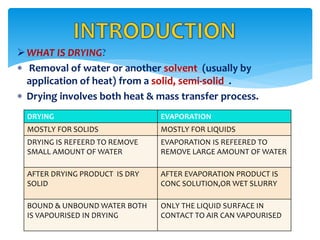
WHAT IS DRYING?
 Removal of water or another solvent (usually by
application of heat) from a solid, semi-solid .
 Drying involves both heat & mass transfer process.
DRYING EVAPORATION
MOSTLY FOR SOLIDS MOSTLY FOR LIQUIDS
DRYING IS REFEERD TO REMOVE
SMALL AMOUNT OF WATER
EVAPORATION IS REFEERED TO
REMOVE LARGE AMOUNT OF WATER
AFTER DRYING PRODUCT IS DRY
SOLID
AFTER EVAPORATION PRODUCT IS
CONC SOLUTION,OR WET SLURRY
BOUND & UNBOUND WATER BOTH
IS VAPOURISED IN DRYING
ONLY THE LIQUID SURFACE IN
CONTACT TO AIR CAN VAPOURISED
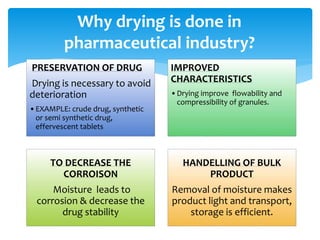
PRESERVATION OF DRUG
Drying is necessary to avoid
deterioration
•EXAMPLE: crude drug, synthetic
or semi synthetic drug,
effervescent tablets
IMPROVED
CHARACTERISTICS
•Drying improve flowability and
compressibility of granules.
TO DECREASE THE
CORROISON
Moisture leads to
corrosion & decrease the
drug stability
HANDELLING OF BULK
PRODUCT
Removal of moisture makes
product light and transport,
storage is efficient.
Why drying is done in
pharmaceutical industry?
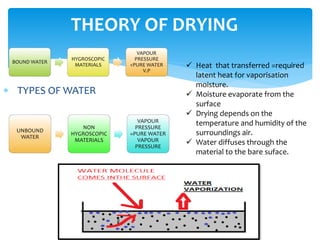
THEORY OF DRYING
 TYPES OF WATER
BOUND WATER
HYGROSCOPIC
MATERIALS
VAPOUR
PRESSURE
<PURE WATER
V.P
UNBOUND
WATER
NON
HYGROSCOPIC
MATERIALS
VAPOUR
PRESSURE
=PURE WATER
VAPOUR
PRESSURE
 Heat that transferred =required
latent heat for vaporisation
moisture.
 Moisture evaporate from the
surface
 Drying depends on the
temperature and humidity of the
surroundings air.
 Water diffuses through the
material to the bare suface.
EQUILIBRIUM MOISTURE CONTENT
 It is the amount of water
present in solid which exerts a
vapour pressure=vapour
pressure of the atmosphere
 DESORPTION: Solid containing
moisture more than EMC it losses
moisture until EMC reached.
 Sorption: Solid contains moisture less
than EMC until EMC reached.
 DEFINATION OF EMC
Vapour pressure of wet
mass=vapour pressure
of atmosphere
AT EQUILIBRIUM :AMOUNT
OF MOISTURE =EMC
MOISTURE>EMC
MOISTURE<EMC
FACTORS EFFECTING EMC
1. NATURE OF THE MATERIAL:
• EMC of non porus insoluble soild=0
example- Talc
• EMC of fibrous subtannces is high
• EMC of colloidal and porous solid are
high or variable.
2.Nature of air
• Air humidity=0;EMC=0
3.Temperature
• temperature↑=EMC↓
DEFINATION:
Amount of water that is free to evaporate from the solid
surface.
At saturation humidity(100%RH)
FMC=Total water content-EMC.
FREE MOISTURE CONTENT
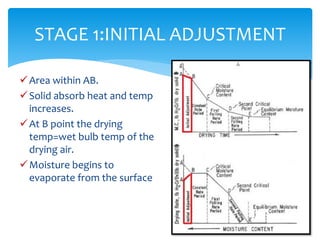
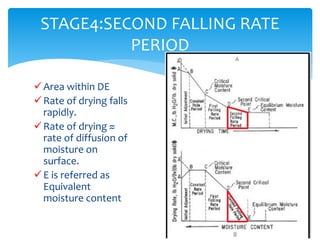
 THESE RELATIONSHIP CAN BE DESCRIBED BY TWO GRAPH
 1.MOISTURE CONTENT V/S DRYING TIME(Graph A)
 2.DRYING RATE V/S MOISTURE CONTENT(Graph B)
 BASIC FORMULAS:
 %MOISTURE CONTENT=[Mass of water in sample/mass of
the dry sample]×100
 DRYING RATE=Weight of water in sample/(time ×weight
of dry solid)
RATE RELATIONSHIP
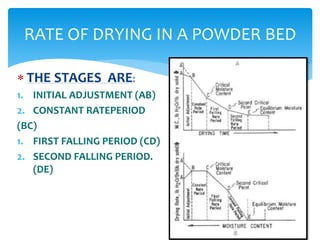
 THE STAGES ARE:
1. INITIAL ADJUSTMENT (AB)
2. CONSTANT RATEPERIOD
(BC)
1. FIRST FALLING PERIOD (CD)
2. SECOND FALLING PERIOD.
(DE)
RATE OF DRYING IN A POWDER BED
Area within AB.
Solid absorb heat and temp
increases.
At B point the drying
temp=wet bulb temp of the
drying air.
Moisture begins to
evaporate from the surface
STAGE 1:INITIAL ADJUSTMENT
Area within BC.
Temp & rate of drying
constant.
Diffusive water from the
interior of solid is
evaporates.
Rate of diffusion=rate of
evaporation
CRITICAL MOISTURE
CONTENT: C point is
referred .
STAGE 2:CONSTANT RATE PERIOD
Area within CD.
Rate of vaporization is
insufficient to saturate the
surface air.
Rate of drying is
decreased.
Dry spots appear on the
surface.
STAGE 3:FIRST FALLING RATE
PERIOD
Area within DE
Rate of drying falls
rapidly.
Rate of drying ≈
rate of diffusion of
moisture on
surface.
E is referred as
Equivalent
moisture content
STAGE4:SECOND FALLING RATE
PERIOD
STATIC BED
DRYER
• TRAY DRYER
• FREEZE
DRYER
MOVING
BED DRYER
• DRUM
DRYER
FLUIDISED
BED DRYER
• FLUIDISED
BED DRYER
PNEUMATIC
• SPRAY
DRYER
REFFERENCES
• PHARMACEUTICAL ENGINEERING;
C.V.S SUBHRAMANYM;PAGE
NO:382-390
• CHEMICAL
ENGINEERING;GHOSAL/SANYAL/DU
TTA.
• https://en.wikipedia.org/wiki/Drying
wikipedia.
PHARMACEUTICAL DRYING

PHARMACEUTICAL DRYING

  • 1.
  • 2.
    WHAT IS DRYING? Removal of water or another solvent (usually by application of heat) from a solid, semi-solid .  Drying involves both heat & mass transfer process. DRYING EVAPORATION MOSTLY FOR SOLIDS MOSTLY FOR LIQUIDS DRYING IS REFEERD TO REMOVE SMALL AMOUNT OF WATER EVAPORATION IS REFEERED TO REMOVE LARGE AMOUNT OF WATER AFTER DRYING PRODUCT IS DRY SOLID AFTER EVAPORATION PRODUCT IS CONC SOLUTION,OR WET SLURRY BOUND & UNBOUND WATER BOTH IS VAPOURISED IN DRYING ONLY THE LIQUID SURFACE IN CONTACT TO AIR CAN VAPOURISED
  • 3.
    PRESERVATION OF DRUG Dryingis necessary to avoid deterioration •EXAMPLE: crude drug, synthetic or semi synthetic drug, effervescent tablets IMPROVED CHARACTERISTICS •Drying improve flowability and compressibility of granules. TO DECREASE THE CORROISON Moisture leads to corrosion & decrease the drug stability HANDELLING OF BULK PRODUCT Removal of moisture makes product light and transport, storage is efficient. Why drying is done in pharmaceutical industry?
  • 4.
    THEORY OF DRYING TYPES OF WATER BOUND WATER HYGROSCOPIC MATERIALS VAPOUR PRESSURE <PURE WATER V.P UNBOUND WATER NON HYGROSCOPIC MATERIALS VAPOUR PRESSURE =PURE WATER VAPOUR PRESSURE  Heat that transferred =required latent heat for vaporisation moisture.  Moisture evaporate from the surface  Drying depends on the temperature and humidity of the surroundings air.  Water diffuses through the material to the bare suface.
  • 5.
    EQUILIBRIUM MOISTURE CONTENT It is the amount of water present in solid which exerts a vapour pressure=vapour pressure of the atmosphere  DESORPTION: Solid containing moisture more than EMC it losses moisture until EMC reached.  Sorption: Solid contains moisture less than EMC until EMC reached.  DEFINATION OF EMC Vapour pressure of wet mass=vapour pressure of atmosphere AT EQUILIBRIUM :AMOUNT OF MOISTURE =EMC MOISTURE>EMC MOISTURE<EMC
  • 6.
    FACTORS EFFECTING EMC 1.NATURE OF THE MATERIAL: • EMC of non porus insoluble soild=0 example- Talc • EMC of fibrous subtannces is high • EMC of colloidal and porous solid are high or variable. 2.Nature of air • Air humidity=0;EMC=0 3.Temperature • temperature↑=EMC↓
  • 7.
    DEFINATION: Amount of waterthat is free to evaporate from the solid surface. At saturation humidity(100%RH) FMC=Total water content-EMC. FREE MOISTURE CONTENT
  • 8.
     THESE RELATIONSHIPCAN BE DESCRIBED BY TWO GRAPH  1.MOISTURE CONTENT V/S DRYING TIME(Graph A)  2.DRYING RATE V/S MOISTURE CONTENT(Graph B)  BASIC FORMULAS:  %MOISTURE CONTENT=[Mass of water in sample/mass of the dry sample]×100  DRYING RATE=Weight of water in sample/(time ×weight of dry solid) RATE RELATIONSHIP
  • 9.
     THE STAGESARE: 1. INITIAL ADJUSTMENT (AB) 2. CONSTANT RATEPERIOD (BC) 1. FIRST FALLING PERIOD (CD) 2. SECOND FALLING PERIOD. (DE) RATE OF DRYING IN A POWDER BED
  • 10.
    Area within AB. Solidabsorb heat and temp increases. At B point the drying temp=wet bulb temp of the drying air. Moisture begins to evaporate from the surface STAGE 1:INITIAL ADJUSTMENT
  • 11.
    Area within BC. Temp& rate of drying constant. Diffusive water from the interior of solid is evaporates. Rate of diffusion=rate of evaporation CRITICAL MOISTURE CONTENT: C point is referred . STAGE 2:CONSTANT RATE PERIOD
  • 12.
    Area within CD. Rateof vaporization is insufficient to saturate the surface air. Rate of drying is decreased. Dry spots appear on the surface. STAGE 3:FIRST FALLING RATE PERIOD
  • 13.
    Area within DE Rateof drying falls rapidly. Rate of drying ≈ rate of diffusion of moisture on surface. E is referred as Equivalent moisture content STAGE4:SECOND FALLING RATE PERIOD
  • 14.
    STATIC BED DRYER • TRAYDRYER • FREEZE DRYER MOVING BED DRYER • DRUM DRYER FLUIDISED BED DRYER • FLUIDISED BED DRYER PNEUMATIC • SPRAY DRYER
  • 15.
    REFFERENCES • PHARMACEUTICAL ENGINEERING; C.V.SSUBHRAMANYM;PAGE NO:382-390 • CHEMICAL ENGINEERING;GHOSAL/SANYAL/DU TTA. • https://en.wikipedia.org/wiki/Drying wikipedia.