PHARMACEUTICAL JURISPRUDENCE
Surya Nath Pandey
Assistant Professor
J. K. Institute of Pharmacy & Management Khurja
Bulandshahr (U.P.)
UNIT-1
Drugs & Cosmetics Act, 1940 and its rules 1945
Contents
History
Objectives
Definitions
Schedule to the Act & Rules
Imports of drugs under the license or permit, offences and penalties
Manufacture of drugs
Conditions grant for license
Manufacture of new drugs
“Pharmaceutical Jurisprudence”
Pharmaceutical: - relating to medicinal drugs, or their
preparation, use, or sale or a compound manufactured for use as a
medicinal drug.
Jurisprudence: - the theory or philosophy of law or a legal system
History
Till 1930:- after the first world war, India was dependent on import of modern
medicines.
In 1930 (August): govt. of India appointed a drug enquiry committee under the
supervision of R. N. Chopra
This committee submitted the reports in 1931 but the govt. of India did not
attention till 1937.
In 1940: Drug & Cosmetics Act
In 1945: Drug & Cosmetics Rules
It extends to whole India
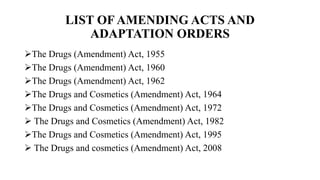
LIST OF AMENDING ACTS AND
ADAPTATION ORDERS
The Drugs (Amendment) Act, 1955
The Drugs (Amendment) Act, 1960
The Drugs (Amendment) Act, 1962
The Drugs and Cosmetics (Amendment) Act, 1964
The Drugs and Cosmetics (Amendment) Act, 1972
 The Drugs and Cosmetics (Amendment) Act, 1982
The Drugs and Cosmetics (Amendment) Act, 1995
 The Drugs and cosmetics (Amendment) Act, 2008
Objectives
To regulate the import, manufacture, distribution and sale of drugs &
cosmetics through licensing.
To prevent substandard in drugs, maintaining high standards of
medical.
Manufacture, distribution and sale of drugs and cosmetics by qualified
persons only.
To regulate the manufacture and sale of Ayurvedic, Siddha and Unani
drugs.
To establish Drugs Technical Advisory Board(DTAB) and Drugs
Consultative Committees(DCC) for Allopathic and allied drugs and
cosmetics.
Definitions
Drugs:- All medicines for internal or external use of human beings or animals and all
substances intended to be used for or in the diagnosis, treatment, mitigation or prevention of
any disease or disorder in human beings or animals, including preparations applied on
human body for the purpose of repelling insects like mosquitoes.
Such substances (other than food) intended to affect the structure or any function of the
human body or intended to be used for the destruction of insects which cause disease in
human beings or animals, as may be specified from time to time by the Central Govt. by
notification in the Official Gazette;
All substances intended for use as components of a drug including gelatin capsule
Such devices intended for internal & external use in the diagnosis, treatment or prevention
of diseases, as may be specified from time to time by the Central Govt by the notification
in the Official Gazette, after consultation with Board.
Cosmetics:- Any article intended to be rubbed, poured, sprinkled or sprayed on, or
introduced into, or otherwise applied to, the human body or any part thereof for cleansing,
beautifying, promoting attractiveness, or altering the appearance, and includes any article
intended for use as a component of cosmetic.
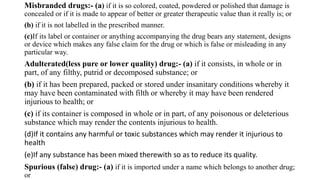
Misbranded drugs:- (a) if it is so colored, coated, powdered or polished that damage is
concealed or if it is made to appear of better or greater therapeutic value than it really is; or
(b) if it is not labelled in the prescribed manner.
(c)If its label or container or anything accompanying the drug bears any statement, designs
or device which makes any false claim for the drug or which is false or misleading in any
particular way.
Adulterated(less pure or lower quality) drug:- (a) if it consists, in whole or in
part, of any filthy, putrid or decomposed substance; or
(b) if it has been prepared, packed or stored under insanitary conditions whereby it
may have been contaminated with filth or whereby it may have been rendered
injurious to health; or
(c) if its container is composed in whole or in part, of any poisonous or deleterious
substance which may render the contents injurious to health.
(d)If it contains any harmful or toxic substances which may render it injurious to
health
(e)If any substance has been mixed therewith so as to reduce its quality.
Spurious (false) drug:- (a) if it is imported under a name which belongs to another drug;
or
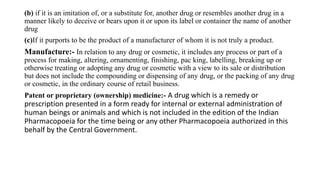
(b) if it is an imitation of, or a substitute for, another drug or resembles another drug in a
manner likely to deceive or bears upon it or upon its label or container the name of another
drug
(c)If it purports to be the product of a manufacturer of whom it is not truly a product.
Manufacture:- In relation to any drug or cosmetic, it includes any process or part of a
process for making, altering, ornamenting, finishing, pac king, labelling, breaking up or
otherwise treating or adopting any drug or cosmetic with a view to its sale or distribution
but does not include the compounding or dispensing of any drug, or the packing of any drug
or cosmetic, in the ordinary course of retail business.
Patent or proprietary (ownership) medicine:- A drug which is a remedy or
prescription presented in a form ready for internal or external administration of
human beings or animals and which is not included in the edition of the Indian
Pharmacopoeia for the time being or any other Pharmacopoeia authorized in this
behalf by the Central Government.
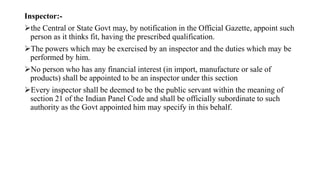
Inspector:-
the Central or State Govt may, by notification in the Official Gazette, appoint such
person as it thinks fit, having the prescribed qualification.
The powers which may be exercised by an inspector and the duties which may be
performed by him.
No person who has any financial interest (in import, manufacture or sale of
products) shall be appointed to be an inspector under this section
Every inspector shall be deemed to be the public servant within the meaning of
section 21 of the Indian Panel Code and shall be officially subordinate to such
authority as the Govt appointed him may specify in this behalf.
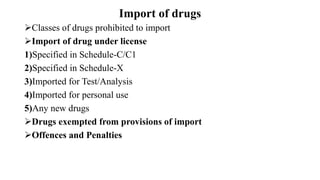
Import of drugs
Classes of drugs prohibited to import
Import of drug under license
1)Specified in Schedule-C/C1
2)Specified in Schedule-X
3)Imported for Test/Analysis
4)Imported for personal use
5)Any new drugs
Drugs exempted from provisions of import
Offences and Penalties
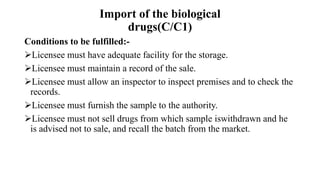
Import of the biological
drugs(C/C1)
Conditions to be fulfilled:-
Licensee must have adequate facility for the storage.
Licensee must maintain a record of the sale.
Licensee must allow an inspector to inspect premises and to check the
records.
Licensee must furnish the sample to the authority.
Licensee must not sell drugs from which sample iswithdrawn and he
is advised not to sale, and recall the batch from the market.
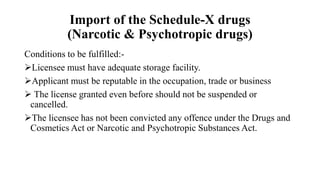
Import of the Schedule-X drugs
(Narcotic & Psychotropic drugs)
Conditions to be fulfilled:-
Licensee must have adequate storage facility.
Applicant must be reputable in the occupation, trade or business
 The license granted even before should not be suspended or
cancelled.
The licensee has not been convicted any offence under the Drugs and
Cosmetics Act or Narcotic and Psychotropic Substances Act.
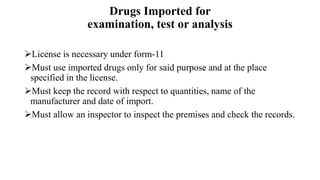
Drugs Imported for
examination, test or analysis
License is necessary under form-11
Must use imported drugs only for said purpose and at the place
specified in the license.
Must keep the record with respect to quantities, name of the
manufacturer and date of import.
Must allow an inspector to inspect the premises and check the records.
Drugs imported for personal use
Up to 100 average doses may be imported without any permit,
provided it is part of passenger’s luggage.
More than 100 doses imported with license. Apply on form no.-12-
A,12-B.
Drugs must be bonafide personal use.
 Drugs must be declared to the custom collectors if so directed.
Import of drugs without license
Substances not used for medicinal pupose
Drugs in Sch-C1 required for manufacturing and not for medicinal
use.
Substances which are both drugs and foods such as:-
• Condensed/Powdered Milk
• Malt
• Lactose
• Oats
Pre-digested foods
Ginger, Pepper, Cumin, Cinnamon
Offences:-
 Import of spurious OR adulterated drug OR drug which involves risk
to human beings or animals OR drug not having therapeutic values
Penalties:- a) 3 years imprisonment and 5000 Rs. fine on first
conviction
b) 5 years imprisonment OR 1000 Rs. fine OR both for subsequent
conviction
Offences:-Contravention of the provision
Penalties:- a) 6 months imprisonment OR 500 Rs. fine OR both for first
conviction
b) 1 year imprisonment OR 1000 Rs. fine
Schedule
Objective:- To make available Standard Quality drug/ cosmetic to consumer.
Schedule to the Act
First schedule – Names of books under Ayurvedic and Siddha systems
Second schedule – Standard to be complied with by imported drugs and by drugs manufactured for
sale, sold, stocked or exhibited for sale or distribution
Name of few books under 1st Schedule:-
Ayurveda:-
Ayurvedic Formulary Of India (Part I)
Arogya Kalpadruma
Charak Samhita
Ayurveda Samgraha
Bhaishajya Ratnavali
Siddha:-
Siddha Formulary Of India (Part I)
Bhogar
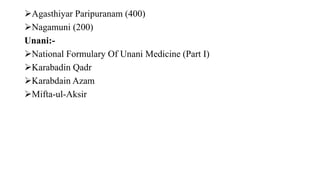
Agasthiyar Paripuranam (400)
Nagamuni (200)
Unani:-
National Formulary Of Unani Medicine (Part I)
Karabadin Qadr
Karabdain Azam
Mifta-ul-Aksir
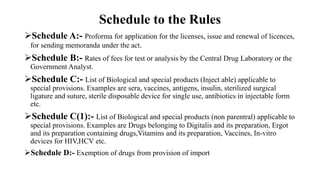
Schedule to the Rules
Schedule A:- Proforma for application for the licenses, issue and renewal of licences,
for sending memoranda under the act.
Schedule B:- Rates of fees for test or analysis by the Central Drug Laboratory or the
Government Analyst.
Schedule C:- List of Biological and special products (Inject able) applicable to
special provisions. Examples are sera, vaccines, antigens, insulin, sterilized surgical
ligature and suture, sterile disposable device for single use, antibiotics in injectable form
etc.
Schedule C(1):- List of Biological and special products (non parentral) applicable to
special provisions. Examples are Drugs belonging to Digitalis and its preparation, Ergot
and its preparation containing drugs,Vitamins and its preparation, Vaccines, In-vitro
devices for HIV,HCV etc.
Schedule D:- Exemption of drugs from provision of import
Drugs come under Schedule D are:
1) Substances not intended for medical use
2) Substances which are used both as articles of food as well as drugs: -- All condensed or
powdered milk. -- Farex, oats, latex and all other similar cereal preparations excepting those for
parenteral use. -- Virol, bovril, chicken essence and all other similar predigested food. -- Ginger,
Pepper, Cumin, Cinnamon and all other similar spices and condiments.
3) Drugs and cosmetics imported for manufacture and export by units situated in “Special
Economic Zone” as notified by the Govt. of India from time to time.
Schedule ‘D (I)’:- Information required to be submitted by the manufacturer or his authorised
agent with the application form for a registration certificate.
The format shall be properly filled in and the detailed information, secret in nature,
 may be furnished on a Computer Floppy.
Schedule ‘D (II)’:- Information required to be submitted by the manufacturer or his
authorized agent with the Application Form for the registration of a bulk
drug/formulation/special product for its import into India.
The format shall be properly filled in and the detailed information, secret in nature,
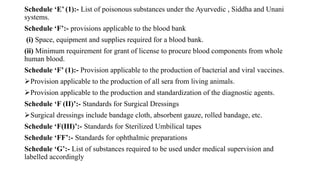
Schedule ‘E’ (1):- List of poisonous substances under the Ayurvedic , Siddha and Unani
systems.
Schedule ‘F’:- provisions applicable to the blood bank
(i) Space, equipment and supplies required for a blood bank.
(ii) Minimum requirement for grant of license to procure blood components from whole
human blood.
Schedule ‘F’ (1):- Provision applicable to the production of bacterial and viral vaccines.
Provision applicable to the production of all sera from living animals.
Provision applicable to the production and standardization of the diagnostic agents.
Schedule ‘F (II)’:- Standards for Surgical Dressings
Surgical dressings include bandage cloth, absorbent gauze, rolled bandage, etc.
Schedule ‘F(III)’:- Standards for Sterilized Umbilical tapes
Schedule ‘FF’:- Standards for ophthalmic preparations
Schedule ‘G’:- List of substances required to be used under medical supervision and
labelled accordingly
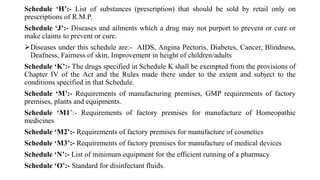
Schedule ‘H’:- List of substances (prescription) that should be sold by retail only on
prescriptions of R.M.P.
Schedule ‘J’:- Diseases and ailments which a drug may not purport to prevent or cure or
make claims to prevent or cure.
Diseases under this schedule are:- AIDS, Angina Pectoris, Diabetes, Cancer, Blindness,
Deafness, Fairness of skin, Improvement in height of children/adults
Schedule ‘K’:- The drugs specified in Schedule K shall be exempted from the provisions of
Chapter IV of the Act and the Rules made there under to the extent and subject to the
conditions specified in that Schedule.
Schedule ‘M’:- Requirements of manufacturing premises, GMP requirements of factory
premises, plants and equipments.
Schedule ‘M1’:- Requirements of factory premises for manufacture of Homeopathic
medicines
Schedule ‘M2’:- Requirements of factory premises for manufacture of cosmetics
Schedule ‘M3’:- Requirements of factory premises for manufacture of medical devices
Schedule ‘N’:- List of minimum equipment for the efficient running of a pharmacy
Schedule ‘O’:- Standard for disinfectant fluids.
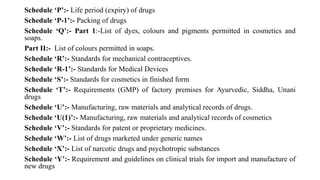
Schedule ‘P’:- Life period (expiry) of drugs
Schedule ‘P-1’:- Packing of drugs
Schedule ‘Q’:- Part 1:-List of dyes, colours and pigments permitted in cosmetics and
soaps.
Part II:- List of colours permitted in soaps.
Schedule ‘R’:- Standards for mechanical contraceptives.
Schedule ‘R-1’:- Standards for Medical Devices
Schedule ‘S’:- Standards for cosmetics in finished form
Schedule ‘T’:- Requirements (GMP) of factory premises for Ayurvedic, Siddha, Unani
drugs
Schedule ‘U’:- Manufacturing, raw materials and analytical records of drugs.
Schedule ‘U(1)’:- Manufacturing, raw materials and analytical records of cosmetics
Schedule ‘V’:- Standards for patent or proprietary medicines.
Schedule ‘W’:- List of drugs marketed under generic names
Schedule ‘X’:- List of narcotic drugs and psychotropic substances
Schedule ‘Y’:- Requirement and guidelines on clinical trials for import and manufacture of
new drugs
Manufacture of drugs
Prohibition of manufacture
Manufacture of other than in Sch-C/C1
 Manufacture of those in Sch-C/C1
 Manufacture of Sch-X drugs
Loan license
Repackaging license
 Offences & Penalties
Prohibition of manufacture
Drug not of standard quality or misbranded, adulterated or spurious.
Patent or Proprietary medicine.
Drugs in Schedule-J
Risky to human beings or animals
Drugs without therapeutic value
Manufacture of drugs other than in Schedule-C/C1
Conditions:-
Premises should comply with schedule ‘M’
Adequate facility for testing, separate from manufacturing
Adequate storage facility
Records maintained for at least 2 years from date of Exp.
Should provide sample to authority
Furnish data of stability
Maintain the inspection book
Maintain reference samples from each batch
Manufacture of drugs those in Schedule-
C/C1(Biological)
Conditions:-
 Drugs must be issued in previously sterilized sealed glass or suitable container
 Containers should comply with Schedule-F
 Some classes tested for aerobic & anaerobic microorganism. eg. Sera,Insulin, Pituitary
hormones.
Serum tested for abnormal toxicity
Parenteral in doses of 10 ml or more should be tested for freedom from Pyrogens
Separate laboratory for culture & manipulation of spore bearing Pathogens
Test for sterility should be carried out.
Manufacture Of Schedule-X drugs
Conditions:-
Accounts of all transactions regarding manuf. Should be maintained in
serially.(Preserved for 5 years)
Have to sent invoice of sale to licensing authority every 3 months
Store drugs in direct custody of responsible person.
Preparation must be labeled with XRx
Marketed in packings not exceeding
 100 unit dose –Tablets/Capsules
 300 ml- Oral liquid
 5 ml - Injection
Loan License
Definition:-
A person(applicant) who does not have his own arrangements(factory) for manufacture
but who wish to manufacturing facilities owned by another licensee. Such licenses are
called Loan license.
Loan licenses are issued for:-
1) Drugs other than specified in C/C1 & X.
2) Drugs specified in Schedule-C/C1.
Repackaging license
Definition:-
Process of breaking up any drug from a bulk container into small packages and labeling
with a view to their sale and distribution.
Repackaging of drugs is granted of drugs other than Schedule-C/C1 and X.
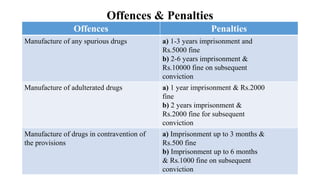
Offences & Penalties
Offences Penalties
Manufacture of any spurious drugs a) 1-3 years imprisonment and
Rs.5000 fine
b) 2-6 years imprisonment &
Rs.10000 fine on subsequent
conviction
Manufacture of adulterated drugs a) 1 year imprisonment & Rs.2000
fine
b) 2 years imprisonment &
Rs.2000 fine for subsequent
conviction
Manufacture of drugs in contravention of
the provisions
a) Imprisonment up to 3 months &
Rs.500 fine
b) Imprisonment up to 6 months
& Rs.1000 fine on subsequent
conviction
Sales of drugs
Classes of drugs prohibited to be sold
Wholesale of biological (C/C1)
Wholesale of other than those specified in C/C1 and X
Classes of drugs prohibited to be sold
Misbranded, spurious, adulterated and drugs not of standard quality
Patent/Proprietary drugs with undisclosed formula
Schedule-J drugs
Expired drugs.
Drugs used for consumption by government
schemes such as, Armed force.
 Physician’s samples
Wholesale of biological (C/C1)
Adequate premises, with greater than 10 M square area, with proper storage facility
Drugs sold only to retailer having license
Premises should be in charge of competent person who is Registered Pharmacist.
Records of purchase & sale
Records preserved for 3 years from date of sale
License should displayed on premises.
Wholesale of other than those specified in C/C1 and X
All the conditions as discussed in for biological.
 Compounding is made by or under the direct and personal supervision of a qualified
person.
THANK YOU

Pharmaceutical Jurisprudence

  • 1.
    PHARMACEUTICAL JURISPRUDENCE Surya NathPandey Assistant Professor J. K. Institute of Pharmacy & Management Khurja Bulandshahr (U.P.)
  • 2.
    UNIT-1 Drugs & CosmeticsAct, 1940 and its rules 1945
  • 3.
    Contents History Objectives Definitions Schedule to theAct & Rules Imports of drugs under the license or permit, offences and penalties Manufacture of drugs Conditions grant for license Manufacture of new drugs
  • 4.
    “Pharmaceutical Jurisprudence” Pharmaceutical: -relating to medicinal drugs, or their preparation, use, or sale or a compound manufactured for use as a medicinal drug. Jurisprudence: - the theory or philosophy of law or a legal system
  • 5.
    History Till 1930:- afterthe first world war, India was dependent on import of modern medicines. In 1930 (August): govt. of India appointed a drug enquiry committee under the supervision of R. N. Chopra This committee submitted the reports in 1931 but the govt. of India did not attention till 1937. In 1940: Drug & Cosmetics Act In 1945: Drug & Cosmetics Rules It extends to whole India
  • 6.
    LIST OF AMENDINGACTS AND ADAPTATION ORDERS The Drugs (Amendment) Act, 1955 The Drugs (Amendment) Act, 1960 The Drugs (Amendment) Act, 1962 The Drugs and Cosmetics (Amendment) Act, 1964 The Drugs and Cosmetics (Amendment) Act, 1972  The Drugs and Cosmetics (Amendment) Act, 1982 The Drugs and Cosmetics (Amendment) Act, 1995  The Drugs and cosmetics (Amendment) Act, 2008
  • 7.
    Objectives To regulate theimport, manufacture, distribution and sale of drugs & cosmetics through licensing. To prevent substandard in drugs, maintaining high standards of medical. Manufacture, distribution and sale of drugs and cosmetics by qualified persons only. To regulate the manufacture and sale of Ayurvedic, Siddha and Unani drugs. To establish Drugs Technical Advisory Board(DTAB) and Drugs Consultative Committees(DCC) for Allopathic and allied drugs and cosmetics.
  • 8.
    Definitions Drugs:- All medicinesfor internal or external use of human beings or animals and all substances intended to be used for or in the diagnosis, treatment, mitigation or prevention of any disease or disorder in human beings or animals, including preparations applied on human body for the purpose of repelling insects like mosquitoes. Such substances (other than food) intended to affect the structure or any function of the human body or intended to be used for the destruction of insects which cause disease in human beings or animals, as may be specified from time to time by the Central Govt. by notification in the Official Gazette; All substances intended for use as components of a drug including gelatin capsule Such devices intended for internal & external use in the diagnosis, treatment or prevention of diseases, as may be specified from time to time by the Central Govt by the notification in the Official Gazette, after consultation with Board. Cosmetics:- Any article intended to be rubbed, poured, sprinkled or sprayed on, or introduced into, or otherwise applied to, the human body or any part thereof for cleansing, beautifying, promoting attractiveness, or altering the appearance, and includes any article intended for use as a component of cosmetic.
  • 9.
    Misbranded drugs:- (a)if it is so colored, coated, powdered or polished that damage is concealed or if it is made to appear of better or greater therapeutic value than it really is; or (b) if it is not labelled in the prescribed manner. (c)If its label or container or anything accompanying the drug bears any statement, designs or device which makes any false claim for the drug or which is false or misleading in any particular way. Adulterated(less pure or lower quality) drug:- (a) if it consists, in whole or in part, of any filthy, putrid or decomposed substance; or (b) if it has been prepared, packed or stored under insanitary conditions whereby it may have been contaminated with filth or whereby it may have been rendered injurious to health; or (c) if its container is composed in whole or in part, of any poisonous or deleterious substance which may render the contents injurious to health. (d)If it contains any harmful or toxic substances which may render it injurious to health (e)If any substance has been mixed therewith so as to reduce its quality. Spurious (false) drug:- (a) if it is imported under a name which belongs to another drug; or
  • 10.
    (b) if itis an imitation of, or a substitute for, another drug or resembles another drug in a manner likely to deceive or bears upon it or upon its label or container the name of another drug (c)If it purports to be the product of a manufacturer of whom it is not truly a product. Manufacture:- In relation to any drug or cosmetic, it includes any process or part of a process for making, altering, ornamenting, finishing, pac king, labelling, breaking up or otherwise treating or adopting any drug or cosmetic with a view to its sale or distribution but does not include the compounding or dispensing of any drug, or the packing of any drug or cosmetic, in the ordinary course of retail business. Patent or proprietary (ownership) medicine:- A drug which is a remedy or prescription presented in a form ready for internal or external administration of human beings or animals and which is not included in the edition of the Indian Pharmacopoeia for the time being or any other Pharmacopoeia authorized in this behalf by the Central Government.
  • 11.
    Inspector:- the Central orState Govt may, by notification in the Official Gazette, appoint such person as it thinks fit, having the prescribed qualification. The powers which may be exercised by an inspector and the duties which may be performed by him. No person who has any financial interest (in import, manufacture or sale of products) shall be appointed to be an inspector under this section Every inspector shall be deemed to be the public servant within the meaning of section 21 of the Indian Panel Code and shall be officially subordinate to such authority as the Govt appointed him may specify in this behalf.
  • 12.
    Import of drugs Classesof drugs prohibited to import Import of drug under license 1)Specified in Schedule-C/C1 2)Specified in Schedule-X 3)Imported for Test/Analysis 4)Imported for personal use 5)Any new drugs Drugs exempted from provisions of import Offences and Penalties
  • 13.
    Import of thebiological drugs(C/C1) Conditions to be fulfilled:- Licensee must have adequate facility for the storage. Licensee must maintain a record of the sale. Licensee must allow an inspector to inspect premises and to check the records. Licensee must furnish the sample to the authority. Licensee must not sell drugs from which sample iswithdrawn and he is advised not to sale, and recall the batch from the market.
  • 14.
    Import of theSchedule-X drugs (Narcotic & Psychotropic drugs) Conditions to be fulfilled:- Licensee must have adequate storage facility. Applicant must be reputable in the occupation, trade or business  The license granted even before should not be suspended or cancelled. The licensee has not been convicted any offence under the Drugs and Cosmetics Act or Narcotic and Psychotropic Substances Act.
  • 15.
    Drugs Imported for examination,test or analysis License is necessary under form-11 Must use imported drugs only for said purpose and at the place specified in the license. Must keep the record with respect to quantities, name of the manufacturer and date of import. Must allow an inspector to inspect the premises and check the records.
  • 16.
    Drugs imported forpersonal use Up to 100 average doses may be imported without any permit, provided it is part of passenger’s luggage. More than 100 doses imported with license. Apply on form no.-12- A,12-B. Drugs must be bonafide personal use.  Drugs must be declared to the custom collectors if so directed.
  • 17.
    Import of drugswithout license Substances not used for medicinal pupose Drugs in Sch-C1 required for manufacturing and not for medicinal use. Substances which are both drugs and foods such as:- • Condensed/Powdered Milk • Malt • Lactose • Oats Pre-digested foods Ginger, Pepper, Cumin, Cinnamon
  • 18.
    Offences:-  Import ofspurious OR adulterated drug OR drug which involves risk to human beings or animals OR drug not having therapeutic values Penalties:- a) 3 years imprisonment and 5000 Rs. fine on first conviction b) 5 years imprisonment OR 1000 Rs. fine OR both for subsequent conviction Offences:-Contravention of the provision Penalties:- a) 6 months imprisonment OR 500 Rs. fine OR both for first conviction b) 1 year imprisonment OR 1000 Rs. fine
  • 19.
    Schedule Objective:- To makeavailable Standard Quality drug/ cosmetic to consumer. Schedule to the Act First schedule – Names of books under Ayurvedic and Siddha systems Second schedule – Standard to be complied with by imported drugs and by drugs manufactured for sale, sold, stocked or exhibited for sale or distribution Name of few books under 1st Schedule:- Ayurveda:- Ayurvedic Formulary Of India (Part I) Arogya Kalpadruma Charak Samhita Ayurveda Samgraha Bhaishajya Ratnavali Siddha:- Siddha Formulary Of India (Part I) Bhogar
  • 20.
    Agasthiyar Paripuranam (400) Nagamuni(200) Unani:- National Formulary Of Unani Medicine (Part I) Karabadin Qadr Karabdain Azam Mifta-ul-Aksir
  • 21.
    Schedule to theRules Schedule A:- Proforma for application for the licenses, issue and renewal of licences, for sending memoranda under the act. Schedule B:- Rates of fees for test or analysis by the Central Drug Laboratory or the Government Analyst. Schedule C:- List of Biological and special products (Inject able) applicable to special provisions. Examples are sera, vaccines, antigens, insulin, sterilized surgical ligature and suture, sterile disposable device for single use, antibiotics in injectable form etc. Schedule C(1):- List of Biological and special products (non parentral) applicable to special provisions. Examples are Drugs belonging to Digitalis and its preparation, Ergot and its preparation containing drugs,Vitamins and its preparation, Vaccines, In-vitro devices for HIV,HCV etc. Schedule D:- Exemption of drugs from provision of import
  • 22.
    Drugs come underSchedule D are: 1) Substances not intended for medical use 2) Substances which are used both as articles of food as well as drugs: -- All condensed or powdered milk. -- Farex, oats, latex and all other similar cereal preparations excepting those for parenteral use. -- Virol, bovril, chicken essence and all other similar predigested food. -- Ginger, Pepper, Cumin, Cinnamon and all other similar spices and condiments. 3) Drugs and cosmetics imported for manufacture and export by units situated in “Special Economic Zone” as notified by the Govt. of India from time to time. Schedule ‘D (I)’:- Information required to be submitted by the manufacturer or his authorised agent with the application form for a registration certificate. The format shall be properly filled in and the detailed information, secret in nature,  may be furnished on a Computer Floppy. Schedule ‘D (II)’:- Information required to be submitted by the manufacturer or his authorized agent with the Application Form for the registration of a bulk drug/formulation/special product for its import into India. The format shall be properly filled in and the detailed information, secret in nature,
  • 23.
    Schedule ‘E’ (1):-List of poisonous substances under the Ayurvedic , Siddha and Unani systems. Schedule ‘F’:- provisions applicable to the blood bank (i) Space, equipment and supplies required for a blood bank. (ii) Minimum requirement for grant of license to procure blood components from whole human blood. Schedule ‘F’ (1):- Provision applicable to the production of bacterial and viral vaccines. Provision applicable to the production of all sera from living animals. Provision applicable to the production and standardization of the diagnostic agents. Schedule ‘F (II)’:- Standards for Surgical Dressings Surgical dressings include bandage cloth, absorbent gauze, rolled bandage, etc. Schedule ‘F(III)’:- Standards for Sterilized Umbilical tapes Schedule ‘FF’:- Standards for ophthalmic preparations Schedule ‘G’:- List of substances required to be used under medical supervision and labelled accordingly
  • 24.
    Schedule ‘H’:- Listof substances (prescription) that should be sold by retail only on prescriptions of R.M.P. Schedule ‘J’:- Diseases and ailments which a drug may not purport to prevent or cure or make claims to prevent or cure. Diseases under this schedule are:- AIDS, Angina Pectoris, Diabetes, Cancer, Blindness, Deafness, Fairness of skin, Improvement in height of children/adults Schedule ‘K’:- The drugs specified in Schedule K shall be exempted from the provisions of Chapter IV of the Act and the Rules made there under to the extent and subject to the conditions specified in that Schedule. Schedule ‘M’:- Requirements of manufacturing premises, GMP requirements of factory premises, plants and equipments. Schedule ‘M1’:- Requirements of factory premises for manufacture of Homeopathic medicines Schedule ‘M2’:- Requirements of factory premises for manufacture of cosmetics Schedule ‘M3’:- Requirements of factory premises for manufacture of medical devices Schedule ‘N’:- List of minimum equipment for the efficient running of a pharmacy Schedule ‘O’:- Standard for disinfectant fluids.
  • 25.
    Schedule ‘P’:- Lifeperiod (expiry) of drugs Schedule ‘P-1’:- Packing of drugs Schedule ‘Q’:- Part 1:-List of dyes, colours and pigments permitted in cosmetics and soaps. Part II:- List of colours permitted in soaps. Schedule ‘R’:- Standards for mechanical contraceptives. Schedule ‘R-1’:- Standards for Medical Devices Schedule ‘S’:- Standards for cosmetics in finished form Schedule ‘T’:- Requirements (GMP) of factory premises for Ayurvedic, Siddha, Unani drugs Schedule ‘U’:- Manufacturing, raw materials and analytical records of drugs. Schedule ‘U(1)’:- Manufacturing, raw materials and analytical records of cosmetics Schedule ‘V’:- Standards for patent or proprietary medicines. Schedule ‘W’:- List of drugs marketed under generic names Schedule ‘X’:- List of narcotic drugs and psychotropic substances Schedule ‘Y’:- Requirement and guidelines on clinical trials for import and manufacture of new drugs
  • 26.
    Manufacture of drugs Prohibitionof manufacture Manufacture of other than in Sch-C/C1  Manufacture of those in Sch-C/C1  Manufacture of Sch-X drugs Loan license Repackaging license  Offences & Penalties
  • 27.
    Prohibition of manufacture Drugnot of standard quality or misbranded, adulterated or spurious. Patent or Proprietary medicine. Drugs in Schedule-J Risky to human beings or animals Drugs without therapeutic value Manufacture of drugs other than in Schedule-C/C1 Conditions:- Premises should comply with schedule ‘M’ Adequate facility for testing, separate from manufacturing Adequate storage facility Records maintained for at least 2 years from date of Exp. Should provide sample to authority Furnish data of stability Maintain the inspection book Maintain reference samples from each batch
  • 28.
    Manufacture of drugsthose in Schedule- C/C1(Biological) Conditions:-  Drugs must be issued in previously sterilized sealed glass or suitable container  Containers should comply with Schedule-F  Some classes tested for aerobic & anaerobic microorganism. eg. Sera,Insulin, Pituitary hormones. Serum tested for abnormal toxicity Parenteral in doses of 10 ml or more should be tested for freedom from Pyrogens Separate laboratory for culture & manipulation of spore bearing Pathogens Test for sterility should be carried out.
  • 29.
    Manufacture Of Schedule-Xdrugs Conditions:- Accounts of all transactions regarding manuf. Should be maintained in serially.(Preserved for 5 years) Have to sent invoice of sale to licensing authority every 3 months Store drugs in direct custody of responsible person. Preparation must be labeled with XRx Marketed in packings not exceeding  100 unit dose –Tablets/Capsules  300 ml- Oral liquid  5 ml - Injection
  • 30.
    Loan License Definition:- A person(applicant)who does not have his own arrangements(factory) for manufacture but who wish to manufacturing facilities owned by another licensee. Such licenses are called Loan license. Loan licenses are issued for:- 1) Drugs other than specified in C/C1 & X. 2) Drugs specified in Schedule-C/C1. Repackaging license Definition:- Process of breaking up any drug from a bulk container into small packages and labeling with a view to their sale and distribution. Repackaging of drugs is granted of drugs other than Schedule-C/C1 and X.
  • 31.
    Offences & Penalties OffencesPenalties Manufacture of any spurious drugs a) 1-3 years imprisonment and Rs.5000 fine b) 2-6 years imprisonment & Rs.10000 fine on subsequent conviction Manufacture of adulterated drugs a) 1 year imprisonment & Rs.2000 fine b) 2 years imprisonment & Rs.2000 fine for subsequent conviction Manufacture of drugs in contravention of the provisions a) Imprisonment up to 3 months & Rs.500 fine b) Imprisonment up to 6 months & Rs.1000 fine on subsequent conviction
  • 32.
    Sales of drugs Classesof drugs prohibited to be sold Wholesale of biological (C/C1) Wholesale of other than those specified in C/C1 and X Classes of drugs prohibited to be sold Misbranded, spurious, adulterated and drugs not of standard quality Patent/Proprietary drugs with undisclosed formula Schedule-J drugs Expired drugs. Drugs used for consumption by government schemes such as, Armed force.  Physician’s samples
  • 33.
    Wholesale of biological(C/C1) Adequate premises, with greater than 10 M square area, with proper storage facility Drugs sold only to retailer having license Premises should be in charge of competent person who is Registered Pharmacist. Records of purchase & sale Records preserved for 3 years from date of sale License should displayed on premises. Wholesale of other than those specified in C/C1 and X All the conditions as discussed in for biological.  Compounding is made by or under the direct and personal supervision of a qualified person.
  • 34.