SUPPLY CHAIN IN
PHARMACEUTICAL INDUSTRY
SUBMITTED BY – GROUP 33
TANIMA CHOWDHURY (UM15367)
V SANJEEV RAMAN (UM15369)
VIDISH MANTRI (UM15371)
ABHISHEK PATRA (UM15377)
MOHIT AGARWAL (UM15380)
SIBASHIS BISWAL (UM15382)
PIYUSH VIRMANI (UM15384)
Table of contents
1) Introduction
2) The pharmaceutical supply chain
3) Critical issues in managing pharmaceuticals
4) Risks in Supply Chain
5) Current Distribution System in India
6) Pricing and margins
7) Supply Chain at Cipla
8) The Future of India’s Distribution System
9) Conclusion
1) Introduction
The pharmaceutical industry develops, produces, distributes and markets pharmaceuticals for
medication purpose. The industry is highly regulated with strict restrictions on patenting, testing,
marketing and safety of the drugs manufactured and supplied. The Economist Intelligence Unit has
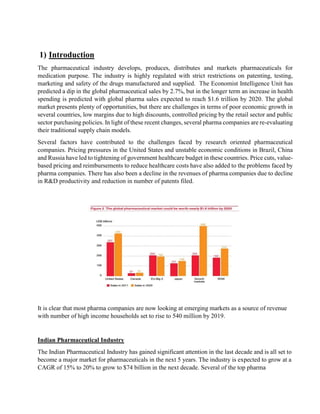
predicted a dip in the global pharmaceutical sales by 2.7%, but in the longer term an increase in health
spending is predicted with global pharma sales expected to reach $1.6 trillion by 2020. The global
market presents plenty of opportunities, but there are challenges in terms of poor economic growth in
several countries, low margins due to high discounts, controlled pricing by the retail sector and public
sector purchasing policies. In light of these recent changes, several pharma companies are re-evaluating
their traditional supply chain models.
Several factors have contributed to the challenges faced by research oriented pharmaceutical
companies. Pricing pressures in the United States and unstable economic conditions in Brazil, China
and Russia have led to tightening of government healthcare budget in these countries. Price cuts, value-
based pricing and reimbursements to reduce healthcare costs have also added to the problems faced by
pharma companies. There has also been a decline in the revenues of pharma companies due to decline
in R&D productivity and reduction in number of patents filed.
It is clear that most pharma companies are now looking at emerging markets as a source of revenue
with number of high income households set to rise to 540 million by 2019.
Indian Pharmaceutical Industry
The Indian Pharmaceutical Industry has gained significant attention in the last decade and is all set to
become a major market for pharmaceuticals in the next 5 years. The industry is expected to grow at a
CAGR of 15% to 20% to grow to $74 billion in the next decade. Several of the top pharma
companies in India are partly foreign-owned. The major companies in India are Cipla, Lupin Ltd,
Dr.Reddy’s, Sun Pharmaceuticals, Merck, Novartis, Glenmark and Cadila healthcare. Economic
growth in India has also contributed to increase in purchasing power and higher spending on
healthcare among middle class Indians.
Some of the companies ranked by market capitalization in India are listed below:-
Rank Company Market Capitalization
2015 (INR crores)
1 Sun Pharmaceutical 2,17,636
2 Lupin Ltd 84,193
3 Dr. Reddy's Laboratories 63,779
4 Cipla 52,081
5 Aurobindo Pharma 42,454
6 Cadila Healthcare 38,677
7 Glenmark Pharmaceuticals 26,026[16]
9 Divi's Laboratories 24,847
10 Torrent Pharmaceuticals 22,320
The Indian pharmaceutical industry is witnessing significant acquisition activity, increased
investment, deeper penetration into rural markets and increased healthcare insurance coverage.
Patented drug sales are projected to increase, and Over-the-counter (OTC) segment is expected to be
a strong growth driver in the industry.
Some of the demand drivers for this industry are as follows:-
 Active participation by foreign MNC’s selling drugs at a lower price than in developed
markets
 Exports to regulated and semi regulated markets coupled with healthcare reforms
 Expansion of product portfolios adding several therapy areas
 Significant improvement in medical technology, implants, disposables markets
2) The pharmaceutical supply chain
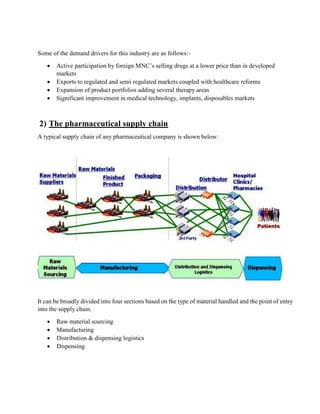
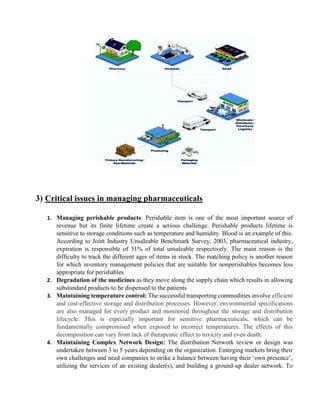
A typical supply chain of any pharmaceutical company is shown below:
It can be broadly divided into four sections based on the type of material handled and the point of entry
into the supply chain.
 Raw material sourcing
 Manufacturing
 Distribution & dispensing logistics
 Dispensing
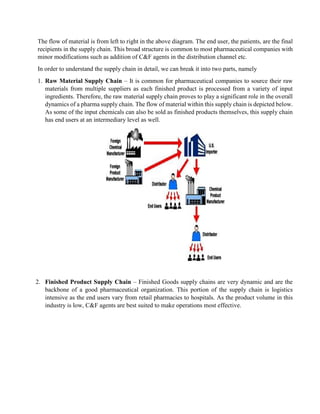
The flow of material is from left to right in the above diagram. The end user, the patients, are the final
recipients in the supply chain. This broad structure is common to most pharmaceutical companies with
minor modifications such as addition of C&F agents in the distribution channel etc.
In order to understand the supply chain in detail, we can break it into two parts, namely
1. Raw Material Supply Chain – It is common for pharmaceutical companies to source their raw
materials from multiple suppliers as each finished product is processed from a variety of input
ingredients. Therefore, the raw material supply chain proves to play a significant role in the overall
dynamics of a pharma supply chain. The flow of material within this supply chain is depicted below.
As some of the input chemicals can also be sold as finished products themselves, this supply chain
has end users at an intermediary level as well.
2. Finished Product Supply Chain – Finished Goods supply chains are very dynamic and are the
backbone of a good pharmaceutical organization. This portion of the supply chain is logistics
intensive as the end users vary from retail pharmacies to hospitals. As the product volume in this
industry is low, C&F agents are best suited to make operations most effective.
3) Critical issues in managing pharmaceuticals
1. Managing perishable products: Perishable item is one of the most important source of
revenue but its finite lifetime create a serious challenge. Perishable products lifetime is
sensitive to storage conditions such as temperature and humidity. Blood is an example of this.
According to Joint Industry Unsaleable Benchmark Survey, 2003, pharmaceutical industry,
expiration is responsible of 31% of total unsaleable respectively. The main reason is the
difficulty to track the different ages of items in stock. The matching policy is another reason
for which inventory management policies that are suitable for nonperishables becomes less
appropriate for perishables
2. Degradation of the medicines as they move along the supply chain which results in allowing
substandard products to be dispensed to the patients
3. Maintaining temperature control: The successful transporting commodities involve efficient
and cost-effective storage and distribution processes. However, environmental specifications
are also managed for every product and monitored throughout the storage and distribution
lifecycle. This is especially important for sensitive pharmaceuticals, which can be
fundamentally compromised when exposed to incorrect temperatures. The effects of this
decomposition can vary from lack of therapeutic effect to toxicity and even death.
4. Maintaining Complex Network Design: The distribution Network review or design was
undertaken between 3 to 5 years depending on the organization. Emerging markets bring their
own challenges and need companies to strike a balance between having their ‘own presence’,
utilizing the services of an existing dealer(s), and building a ground-up dealer network. To
understand the Complexity in this Industry, we can consider the case of American global
Pharmaceutical Corporation. About 30,000–35,000 different stock keeping units (SKUs),
provided by a network of over 80 internal manufacturing sites and more than 300 external
suppliers, are in transit over 4,000 international trade lanes to more than 110 markets
worldwide.
5. More focus on R&D: Due to Rising health care spending and escalating drug prices have
sparked considerable interest in how new drugs are discovered, tested, and sold—and in how
well those processes serve the interests of consumers. Research and development costs vary
widely from one new drug to the next. Those costs depend on the type of drug being developed,
the likelihood of failure, and whether the drug is based on a molecule not used before in any
pharmaceutical product (a new molecular entity, or NME) or instead is an incremental
modification of an existing drug. The pharmaceutical industry spends more on research and
development, relative to its sales revenue, than almost any other industry in the United States
6. Shipping of expiry products: Customers of food and drug industries always expect products
to be shipped to them with newer Expiry date or Best Before date. And therefore, it is critical
for pharmaceutical industries, to avoid shipping short-dated products to customers.
7. In case of an epidemic break-out, global demand for certain medicines overshoots the current
demand
8. Product withdrawal during sales due to side-effects and expiry issues: As mention above,
if the pharmaceutical industry does not consider shipping of short dated products to customer
then it will lead to customer dis satisfaction and lead to unnecessary credit returns and waste
throughout the whole supply chain, starting from manufacturers, distributors, retail stores and
all the way to end users.
9. Training & education cost to the stakeholders is high: Success of Pharmaceutical industry
depends on strong relationship with a broader range of stakeholder such as patient and
advocacy groups and payers. Medical education, including the planning and grant support for
medical education to healthcare providers and the training of internal teams require high
stakeholder cost.
10. Integration of domestic and international businesses: Emerging markets will be an
important contributor to pharma sales growth. As developed economies continue to constrain
or cut healthcare funding, governments in many emerging markets are making healthcare a
priority. They are investing in infrastructure, funding services, encouraging the development
of a domestic industry, and expanding health insurance to a broader population.
4) Risks in Supply Chain
Introduction
The pharmaceutical industry can be defined as a complex of processes, operations and organizations
involved in the discovery, development and manufacture of drugs and medications. The World Health
Organisation (WHO) defines a drug or pharmaceutical preparation as: any substance or mixture of
substances manufactured, sold, offered for sale or represented for use in the diagnosis, treatment,
mitigation or prevention of disease, abnormal physical state or the symptoms thereof in man or animal;
[and for use in] restoring, correcting or modifying organic functions in man or animal. This is a very
wide definition, and correspondingly, there are number of key players in the pharmaceutical industry,
including:
 The large, research and development-based multinationals with a global presence in branded
products, both ethical/prescription and over-the-counter. They tend to have manufacturing
sites in many locations.
 The large generic manufacturers, who produce out-of-patent ethical products and over-the-
counter products.
 Local manufacturing companies that operate in their home country, producing both generic
products and branded products under license or contract.
 Contract manufacturers, who do not have their own product portfolio, but produce either key
intermediates, active ingredients (AI) or even final products by providing outsourcing services
to other companies.
 Drug discovery and biotechnology companies, often relatively new start-ups with no
significant manufacturing capacity.
Most of the material in this paper is particularly relevant to the first group. This group dominates the
marketplace and, due to the global nature of the enterprises involved, tends to have the most
challenging supply chain problems.
Changing Circumstances in the Industry
In the recent past, the high returns on investment and high turnovers from “blockbuster” products
resulted in the following regime,
 Good R&D productivity, often creating compounds to treat previously untreatable diseases
 Long effective patent lives of these compounds
 Ability of these patents to provide technological barriers to entry
 A limited number of product substitutes in a given therapeutic area
 A low price sensitivity; supported by the separation between prescribing and paying
responsibilities.
The resulting corporate strategy was to ensure high margins by exploiting the price inelasticity and
invest a large proportion of the resultant profits in R&D (approximately 25% of sales), in order to
ensure a healthy product pipeline.
The more recent circumstances are much more challenging:
 R&D productivity (in terms of numbers of new chemical entities (NCE) registered per unit
amount of investment) is declining
 Effective patent lives are shortening
 Even while active, patents provide lower barriers to entry
 There are many product substitutes in many therapeutic areas; either alternative compounds
(“me-too drugs”) or off-patent generics
• the payers of healthcare are exerting strong price pressure and influencing prescribing practices; this
means that in order to be approved, new drugs must address new therapeutic areas or have very
significant cost or health benefits over existing treatments
The life-cycle of a pharmaceutical product
In order to put this paper in the right context, it is important to describe the life-cycle of a drug; it is
somewhat different from that of other process industry products. The research or discovery phase tends
to use thousands of more or less random test compounds against therapeutic targets. It typically takes
about 10 years to result in a potential new drug that is registered. From this point onwards patent
protection applies. The potential new drug must then be tested for both safety and efficacy. This
involves a variety of trials; early on for toxicity and later on for ability to alleviate symptoms and
remove disease. Finally, the process development activity comes up with a chemical or biochemical
route to manufacture and an associated manufacturing process. This set of activities typically takes 6–
8 years and is usually known as the development activity. Finally, the more familiar processes of
manufacturing and distribution follow.
Operational issues in the pharmaceutical supply chain
Although the processes will vary between companies, all major pharmaceutical companies will operate
ERP systems and follow a business process along the following lines:
 Demand management—in each geographical region, forward forecasts (e.g. 3–24 months) are
developed, based on historical data, market intelligence, etc. Tenders for manufacture may also
be evaluated and possibly accepted at this stage.
 Inventory management and distribution requirements planning—the demands determined are
aggregated and imposed on the appropriate warehouse/distribution centre. The impact on
finished goods inventory is assessed and if necessary, orders are placed on upstream secondary
manufacturing sites.
 Secondary production planning and scheduling—the orders placed on the secondary sites are
planned (typically using MRP-II type tools) and then scheduled in detail (typically using APS
tools). The impact of production plans on active ingredient raw material stocks is evaluated and
if necessary, orders for AI are placed on the upstream.
 Primary manufacturing campaign planning and AI inventory management. Here, the demands
placed by secondary manufacturing are satisfied by careful management of inventory and
production planning.
Strategic and design issues in the pharmaceutical supply chain
The decisions to be taken at this level include:
 Pipeline and development management—this involves the selection of potential drugs to
develop further, and the planning of the development activity.
 Process development—the investigation of manufacturing routes and the generation of
manufacturing processes.
 Capacity planning and plant and supply chain network design.
 Plant design—the selection and sizing of the major equipment and storage units.
Some of the key issues are:
1. Uncertainty in the demands for existing drugs (due to competition, uncertainty in the ability to
extend the protected life through new formulations, etc.).
2. Uncertainty in the pipeline of new drugs—in particular, which ones will be successful in trials,
what sort of dosage and treatment regime will be optimal.
3. Process development—this is a complex problem, driven by chemistry and yield optimisation.
It often results in inefficient processes that are operated much more slowly than the intrinsic
rates—giving rise to batch processes and long cycle times responsible for some of the problems
seen at the primary production planning stage.
4. Capacity planning—the long lead times to make capacity effective mean that decisions often
need to be taken at times of high uncertainty. Waiting for the uncertainties to be resolved might
delay the time to market by an unacceptable amount.
5. Network design—often tax implications take precedence over logistics issues, these result in
economic but potentially complicated supply chains.
6. Plant design—this tends to be very traditional, with no real change in manufacturing
technology for 50 years (the workhorse of the primary manufacturing site is the glass-lined
stainless steel batch reactor). There are significant opportunities for intensified, continuous
processing.
5) Current Distribution System in India
India is a geographically diverse country with extreme climates that make distribution a critical
function. The long channel of distribution and high incidence of brand substitution makes it
mandatory for a company to make all its stock keeping units (SKUs) available at all levels at all
times. In India, most brands have generic versions of drugs and retailers can usually obtain higher
margins with generics than for branded products. To reduce risks of substitution, innovator
companies must make sure their products are made available to the stockists and retail shops. Drug
distribution in India has witnessed a paradigm shift. Before 1990, pharmaceutical companies used a
different distribution system, in which they established their own depots and warehouses that now
have been replaced by clearing and forwarding agents (CFAs). These organizations are primarily
responsible for maintaining storage (stock) of the company’s products and forwarding SKUs to the
stockist on request. Most companies keep 1–3 CFAs in each Indian state. On an average, a company
may work with a total of 25–35 CFAs. Unlike a CFA that can handle the stock of one company, a
stockist (distributor) can simultaneously handle more than one company (usually, 5–15 depending on
the city area), and may go up to even 30–50 different manufacturers. The stockist, in turn, after 30–
45 days (a typical credit or time limit) pays for the products directly in the name of the
pharmaceutical company. The CFAs are paid by the company yearly, once or twice, on a basis of the
percentage of total turnover of products
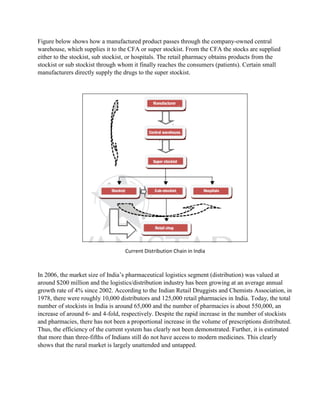
Figure below shows how a manufactured product passes through the company-owned central
warehouse, which supplies it to the CFA or super stockist. From the CFA the stocks are supplied
either to the stockist, sub stockist, or hospitals. The retail pharmacy obtains products from the
stockist or sub stockist through whom it finally reaches the consumers (patients). Certain small
manufacturers directly supply the drugs to the super stockist.
Current Distribution Chain in India
In 2006, the market size of India’s pharmaceutical logistics segment (distribution) was valued at
around $200 million and the logistics/distribution industry has been growing at an average annual
growth rate of 4% since 2002. According to the Indian Retail Druggists and Chemists Association, in
1978, there were roughly 10,000 distributors and 125,000 retail pharmacies in India. Today, the total
number of stockists in India is around 65,000 and the number of pharmacies is about 550,000, an
increase of around 6- and 4-fold, respectively. Despite the rapid increase in the number of stockists
and pharmacies, there has not been a proportional increase in the volume of prescriptions distributed.
Thus, the efficiency of the current system has clearly not been demonstrated. Further, it is estimated
that more than three-fifths of Indians still do not have access to modern medicines. This clearly
shows that the rural market is largely unattended and untapped.
6) Pricing and margins
The prices and the margins of drugs for the wholesaler and retailers are largely decided by the
National Pharmaceutical Pricing Authority (NPPA), which varies depending on whether the active
constituent of the product is a scheduled drug or a non-scheduled drug. Scheduled drugs are price
controlled whereas non-scheduled drugs are not. The NPPA is an organization of the government of
India established to fix or revise prices of controlled bulk drugs and formulations. Companies must
keep drug prices affordable to the general public. To keep medicines within reach of the poor
population, the government has covered 76 scheduled drugs. In addition to the above mentioned
margins, wholesalers and retailers are also compensated with additional trade offers. Hospitals and
large institutions sometimes directly negotiate with the manufacturing company and get the drugs in
their pharmacy at lower costs. Stockists compete with each other in a given city. Generally, hospitals
order large quantities and can negotiate with stockists, who provide payment terms, credit periods,
and margins.
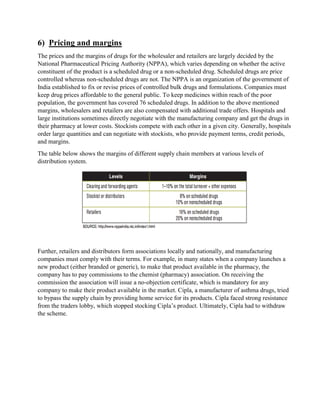
The table below shows the margins of different supply chain members at various levels of
distribution system.
Further, retailers and distributors form associations locally and nationally, and manufacturing
companies must comply with their terms. For example, in many states when a company launches a
new product (either branded or generic), to make that product available in the pharmacy, the
company has to pay commissions to the chemist (pharmacy) association. On receiving the
commission the association will issue a no-objection certificate, which is mandatory for any
company to make their product available in the market. Cipla, a manufacturer of asthma drugs, tried
to bypass the supply chain by providing home service for its products. Cipla faced strong resistance
from the traders lobby, which stopped stocking Cipla’s product. Ultimately, Cipla had to withdraw
the scheme.
7) Supply chain at Cipla
Cipla Limited is an Indian multinational pharmaceutical and biotechnology company, headquartered
in Mumbai, Cipla primarily develops medicines to treat cardio vascular disease, arthritis, diabetes
control and depression; other medical conditions.
At Cipla, successful inventory management involves balancing the cost of inventory with benefits of
inventory by
 Tracking information on each item used or sold
 Keeping stock low-but not sacrificing the service or performance
 Obtaining lower prices by making volume purchases
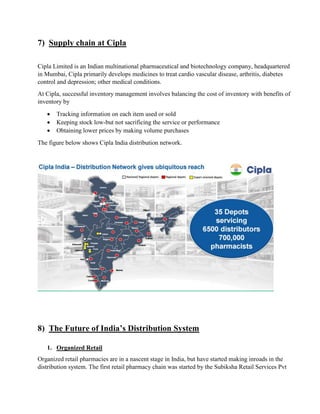
The figure below shows Cipla India distribution network.
8) The Future of India’s Distribution System
1. Organized Retail
Organized retail pharmacies are in a nascent stage in India, but have started making inroads in the
distribution system. The first retail pharmacy chain was started by the Subiksha Retail Services Pvt
Ltd. The Medicine Shoppe, one of the largest retail drug stores in the US, opened two retail outlets in
Mumbai and has franchised three more in Mumbai, Calcutta, and Baroda. Others have also entered
the field including Health & Glow, Pills & Powders, and Reliance that has set up units under the
brand name of Reliance Wellness. Nitin Gokarn, senior manager of supply-chain management
(SCM) at Merck India, is optimistic for the growth of organized retail. He says that, “Though
organized retail faces strong resistance from the traders lobby, it has a great potential.” He also
opines that, “It will take a great deal of political will and reforms to make this happen.” With an
organized retail system, pharmaceutical companies would be able to offer medicine at higher
margins, and some speculate that retailers may even be able to pass on cost benefits to the end-users
as well.
2. Value Added Tax (VAT) Impact
With the introduction of VAT, medicine prices have been standardized and price discrimination, in
which different states pay different prices for the same products, has reduced. VAT has also helped
reduce the illegal interstate transfer of goods and the unethical interstate trade for higher margins. Per
the new rules, sales tax is levied at each stage of value addition and credit for the tax paid on the
inputs can be obtained
3. IT Adoption
IT adoption in healthcare has grown drastically. Pharmaceutical companies have realized the need for
integrated solutions in SCM to keep inventories at optimum levels, to improve distribution, to
provide for liquidation of stock, and to streamline interconnectivity between manufacturing facilities,
warehouses, and CFAs in different states. The use of software like SAP and SAS, apart from other
customized software, is increasing. However, the adoption of technologies such as radio-frequency
identification (RFID) has been slow.
4. Future Challenges
Pharmaceutical companies in India have realized the importance of SCM and are aggressively
looking for ways to improve the costs associated with SCM. Distribution in India is proportionally
much more costly than it is in the US or EU. The companies, which have spent as much as one-third
of their revenues toward financing their supply-chain operations, recognize that the cost of logistics
is very high in India. In US and EU, the expenditure on SCM alone is perhaps 2%, whereas in India
it averages 4–6% of total sales. According to Gokarn, “It’s mainly because in India the cost of drugs
is very low compared to the developed markets. Taking into consideration the poor infrastructure and
extreme geographic conditions, it is difficult to curtail the cost involved in SCM.”
5. Long-Channel Inventory Management
The multilayered distribution channel and lobbying at all layers has been successful at preventing
pharmaceutical companies from bringing in significant reforms toward higher trade margins, and at
bypassing the multiple distribution layers to reach customers directly. Because pharmaceutical
companies do not have direct access to retailers’ data on sales (tertiary sales), most pharmaceutical
companies depend on stockists’ sales data to monitor sales (secondary sales). The primary sale
involves transferring stock from the central warehouse to its CFA. The medical representatives are
given predefined sales targets. To meet these targets they push inventory on the stockist to levels that
exceed the actual demand. When the next level of sale does not take place, the stockist will either
return goods to the company or the stock expires.
6. Increasing Competition Between Wholesalers and Retailers
Today, with so many mergers and acquisitions in the Indian pharmaceutical industry, the number of
stockists for each company has increased. Now two stockists of the same company may be
competing against each other. Retailers take advantage of this situation by prolonging the credit
period and asking for more discounts, which has an adverse effect on stockists, because they have to
comply with the retailers to sustain their business
7. Brand Substitution
The emergence of generic drugs has also taken a toll on Indian pharmaceutical company sales, as
prices can be almost 2 to 15 times less for the same drug. Moreover, to capture market share
generics, companies offer higher trade margins at the retail level. Sometimes generic drugs provide
up to 500% trade margins, which is a lucrative offer for a retailer to pass up, and this leads to brand
substitution.
8. Recalling Drugs
There is no foolproof system for recalling drugs in India. Once a medicine is released into the
market, it becomes a daunting task for a pharmaceutical company to recall because of the highly
fragmented nature of the distribution network. Newer technologies such as RFID would help in
keeping track of products along the entire chain and would limit counterfeit drugs to enter into the
system.
9. International Competitiveness and Cold-Chain Management
Indian pharmaceutical companies are increasingly seeking opportunities to supply drugs to the world
market. More developed cold-chain management practices will be required to achieve this goal. This
is one of the major challenges faced by the industry if they are to retain product quality during
shipment. Companies like Eli Lilly in India have implemented initiatives such as having their own
vehicles equipped with cold-chain management systems. Other companies such as World Courier
have developed cold-chain management models to help pharmaceutical companies maintain the cold
chain
9) Conclusion
Manufacturers must ensure that their drug reaches customers with uncompromised quality. In India,
because manufacturers do not retain control over the multilayered distribution system, the cold-chain
management process continues to be difficult and expensive. However, manufacturers are
increasingly realizing the importance of an effective distribution system, all the way to the end-
customer. Coping with the challenges of streamlining the systems in India will ultimately benefit the
patient and the healthcare system

Supply chain in pharma sector

  • 1.
    SUPPLY CHAIN IN PHARMACEUTICALINDUSTRY SUBMITTED BY – GROUP 33 TANIMA CHOWDHURY (UM15367) V SANJEEV RAMAN (UM15369) VIDISH MANTRI (UM15371) ABHISHEK PATRA (UM15377) MOHIT AGARWAL (UM15380) SIBASHIS BISWAL (UM15382) PIYUSH VIRMANI (UM15384)
  • 2.
    Table of contents 1)Introduction 2) The pharmaceutical supply chain 3) Critical issues in managing pharmaceuticals 4) Risks in Supply Chain 5) Current Distribution System in India 6) Pricing and margins 7) Supply Chain at Cipla 8) The Future of India’s Distribution System 9) Conclusion
  • 3.
    1) Introduction The pharmaceuticalindustry develops, produces, distributes and markets pharmaceuticals for medication purpose. The industry is highly regulated with strict restrictions on patenting, testing, marketing and safety of the drugs manufactured and supplied. The Economist Intelligence Unit has predicted a dip in the global pharmaceutical sales by 2.7%, but in the longer term an increase in health spending is predicted with global pharma sales expected to reach $1.6 trillion by 2020. The global market presents plenty of opportunities, but there are challenges in terms of poor economic growth in several countries, low margins due to high discounts, controlled pricing by the retail sector and public sector purchasing policies. In light of these recent changes, several pharma companies are re-evaluating their traditional supply chain models. Several factors have contributed to the challenges faced by research oriented pharmaceutical companies. Pricing pressures in the United States and unstable economic conditions in Brazil, China and Russia have led to tightening of government healthcare budget in these countries. Price cuts, value- based pricing and reimbursements to reduce healthcare costs have also added to the problems faced by pharma companies. There has also been a decline in the revenues of pharma companies due to decline in R&D productivity and reduction in number of patents filed. It is clear that most pharma companies are now looking at emerging markets as a source of revenue with number of high income households set to rise to 540 million by 2019. Indian Pharmaceutical Industry The Indian Pharmaceutical Industry has gained significant attention in the last decade and is all set to become a major market for pharmaceuticals in the next 5 years. The industry is expected to grow at a CAGR of 15% to 20% to grow to $74 billion in the next decade. Several of the top pharma
  • 4.
    companies in Indiaare partly foreign-owned. The major companies in India are Cipla, Lupin Ltd, Dr.Reddy’s, Sun Pharmaceuticals, Merck, Novartis, Glenmark and Cadila healthcare. Economic growth in India has also contributed to increase in purchasing power and higher spending on healthcare among middle class Indians. Some of the companies ranked by market capitalization in India are listed below:- Rank Company Market Capitalization 2015 (INR crores) 1 Sun Pharmaceutical 2,17,636 2 Lupin Ltd 84,193 3 Dr. Reddy's Laboratories 63,779 4 Cipla 52,081 5 Aurobindo Pharma 42,454 6 Cadila Healthcare 38,677 7 Glenmark Pharmaceuticals 26,026[16] 9 Divi's Laboratories 24,847 10 Torrent Pharmaceuticals 22,320 The Indian pharmaceutical industry is witnessing significant acquisition activity, increased investment, deeper penetration into rural markets and increased healthcare insurance coverage. Patented drug sales are projected to increase, and Over-the-counter (OTC) segment is expected to be a strong growth driver in the industry.
  • 5.
    Some of thedemand drivers for this industry are as follows:-  Active participation by foreign MNC’s selling drugs at a lower price than in developed markets  Exports to regulated and semi regulated markets coupled with healthcare reforms  Expansion of product portfolios adding several therapy areas  Significant improvement in medical technology, implants, disposables markets 2) The pharmaceutical supply chain A typical supply chain of any pharmaceutical company is shown below: It can be broadly divided into four sections based on the type of material handled and the point of entry into the supply chain.  Raw material sourcing  Manufacturing  Distribution & dispensing logistics  Dispensing
  • 6.
    The flow ofmaterial is from left to right in the above diagram. The end user, the patients, are the final recipients in the supply chain. This broad structure is common to most pharmaceutical companies with minor modifications such as addition of C&F agents in the distribution channel etc. In order to understand the supply chain in detail, we can break it into two parts, namely 1. Raw Material Supply Chain – It is common for pharmaceutical companies to source their raw materials from multiple suppliers as each finished product is processed from a variety of input ingredients. Therefore, the raw material supply chain proves to play a significant role in the overall dynamics of a pharma supply chain. The flow of material within this supply chain is depicted below. As some of the input chemicals can also be sold as finished products themselves, this supply chain has end users at an intermediary level as well. 2. Finished Product Supply Chain – Finished Goods supply chains are very dynamic and are the backbone of a good pharmaceutical organization. This portion of the supply chain is logistics intensive as the end users vary from retail pharmacies to hospitals. As the product volume in this industry is low, C&F agents are best suited to make operations most effective.
  • 7.
    3) Critical issuesin managing pharmaceuticals 1. Managing perishable products: Perishable item is one of the most important source of revenue but its finite lifetime create a serious challenge. Perishable products lifetime is sensitive to storage conditions such as temperature and humidity. Blood is an example of this. According to Joint Industry Unsaleable Benchmark Survey, 2003, pharmaceutical industry, expiration is responsible of 31% of total unsaleable respectively. The main reason is the difficulty to track the different ages of items in stock. The matching policy is another reason for which inventory management policies that are suitable for nonperishables becomes less appropriate for perishables 2. Degradation of the medicines as they move along the supply chain which results in allowing substandard products to be dispensed to the patients 3. Maintaining temperature control: The successful transporting commodities involve efficient and cost-effective storage and distribution processes. However, environmental specifications are also managed for every product and monitored throughout the storage and distribution lifecycle. This is especially important for sensitive pharmaceuticals, which can be fundamentally compromised when exposed to incorrect temperatures. The effects of this decomposition can vary from lack of therapeutic effect to toxicity and even death. 4. Maintaining Complex Network Design: The distribution Network review or design was undertaken between 3 to 5 years depending on the organization. Emerging markets bring their own challenges and need companies to strike a balance between having their ‘own presence’, utilizing the services of an existing dealer(s), and building a ground-up dealer network. To
  • 8.
    understand the Complexityin this Industry, we can consider the case of American global Pharmaceutical Corporation. About 30,000–35,000 different stock keeping units (SKUs), provided by a network of over 80 internal manufacturing sites and more than 300 external suppliers, are in transit over 4,000 international trade lanes to more than 110 markets worldwide. 5. More focus on R&D: Due to Rising health care spending and escalating drug prices have sparked considerable interest in how new drugs are discovered, tested, and sold—and in how well those processes serve the interests of consumers. Research and development costs vary widely from one new drug to the next. Those costs depend on the type of drug being developed, the likelihood of failure, and whether the drug is based on a molecule not used before in any pharmaceutical product (a new molecular entity, or NME) or instead is an incremental modification of an existing drug. The pharmaceutical industry spends more on research and development, relative to its sales revenue, than almost any other industry in the United States 6. Shipping of expiry products: Customers of food and drug industries always expect products to be shipped to them with newer Expiry date or Best Before date. And therefore, it is critical for pharmaceutical industries, to avoid shipping short-dated products to customers. 7. In case of an epidemic break-out, global demand for certain medicines overshoots the current demand 8. Product withdrawal during sales due to side-effects and expiry issues: As mention above, if the pharmaceutical industry does not consider shipping of short dated products to customer then it will lead to customer dis satisfaction and lead to unnecessary credit returns and waste throughout the whole supply chain, starting from manufacturers, distributors, retail stores and all the way to end users. 9. Training & education cost to the stakeholders is high: Success of Pharmaceutical industry depends on strong relationship with a broader range of stakeholder such as patient and advocacy groups and payers. Medical education, including the planning and grant support for medical education to healthcare providers and the training of internal teams require high stakeholder cost. 10. Integration of domestic and international businesses: Emerging markets will be an important contributor to pharma sales growth. As developed economies continue to constrain or cut healthcare funding, governments in many emerging markets are making healthcare a priority. They are investing in infrastructure, funding services, encouraging the development of a domestic industry, and expanding health insurance to a broader population. 4) Risks in Supply Chain Introduction The pharmaceutical industry can be defined as a complex of processes, operations and organizations involved in the discovery, development and manufacture of drugs and medications. The World Health Organisation (WHO) defines a drug or pharmaceutical preparation as: any substance or mixture of substances manufactured, sold, offered for sale or represented for use in the diagnosis, treatment, mitigation or prevention of disease, abnormal physical state or the symptoms thereof in man or animal;
  • 9.
    [and for usein] restoring, correcting or modifying organic functions in man or animal. This is a very wide definition, and correspondingly, there are number of key players in the pharmaceutical industry, including:  The large, research and development-based multinationals with a global presence in branded products, both ethical/prescription and over-the-counter. They tend to have manufacturing sites in many locations.  The large generic manufacturers, who produce out-of-patent ethical products and over-the- counter products.  Local manufacturing companies that operate in their home country, producing both generic products and branded products under license or contract.  Contract manufacturers, who do not have their own product portfolio, but produce either key intermediates, active ingredients (AI) or even final products by providing outsourcing services to other companies.  Drug discovery and biotechnology companies, often relatively new start-ups with no significant manufacturing capacity. Most of the material in this paper is particularly relevant to the first group. This group dominates the marketplace and, due to the global nature of the enterprises involved, tends to have the most challenging supply chain problems. Changing Circumstances in the Industry In the recent past, the high returns on investment and high turnovers from “blockbuster” products resulted in the following regime,  Good R&D productivity, often creating compounds to treat previously untreatable diseases  Long effective patent lives of these compounds  Ability of these patents to provide technological barriers to entry  A limited number of product substitutes in a given therapeutic area  A low price sensitivity; supported by the separation between prescribing and paying responsibilities. The resulting corporate strategy was to ensure high margins by exploiting the price inelasticity and invest a large proportion of the resultant profits in R&D (approximately 25% of sales), in order to ensure a healthy product pipeline. The more recent circumstances are much more challenging:  R&D productivity (in terms of numbers of new chemical entities (NCE) registered per unit amount of investment) is declining  Effective patent lives are shortening  Even while active, patents provide lower barriers to entry  There are many product substitutes in many therapeutic areas; either alternative compounds (“me-too drugs”) or off-patent generics
  • 10.
    • the payersof healthcare are exerting strong price pressure and influencing prescribing practices; this means that in order to be approved, new drugs must address new therapeutic areas or have very significant cost or health benefits over existing treatments The life-cycle of a pharmaceutical product In order to put this paper in the right context, it is important to describe the life-cycle of a drug; it is somewhat different from that of other process industry products. The research or discovery phase tends to use thousands of more or less random test compounds against therapeutic targets. It typically takes about 10 years to result in a potential new drug that is registered. From this point onwards patent protection applies. The potential new drug must then be tested for both safety and efficacy. This involves a variety of trials; early on for toxicity and later on for ability to alleviate symptoms and remove disease. Finally, the process development activity comes up with a chemical or biochemical route to manufacture and an associated manufacturing process. This set of activities typically takes 6– 8 years and is usually known as the development activity. Finally, the more familiar processes of manufacturing and distribution follow. Operational issues in the pharmaceutical supply chain Although the processes will vary between companies, all major pharmaceutical companies will operate ERP systems and follow a business process along the following lines:  Demand management—in each geographical region, forward forecasts (e.g. 3–24 months) are developed, based on historical data, market intelligence, etc. Tenders for manufacture may also be evaluated and possibly accepted at this stage.  Inventory management and distribution requirements planning—the demands determined are aggregated and imposed on the appropriate warehouse/distribution centre. The impact on finished goods inventory is assessed and if necessary, orders are placed on upstream secondary manufacturing sites.  Secondary production planning and scheduling—the orders placed on the secondary sites are planned (typically using MRP-II type tools) and then scheduled in detail (typically using APS tools). The impact of production plans on active ingredient raw material stocks is evaluated and if necessary, orders for AI are placed on the upstream.  Primary manufacturing campaign planning and AI inventory management. Here, the demands placed by secondary manufacturing are satisfied by careful management of inventory and production planning. Strategic and design issues in the pharmaceutical supply chain The decisions to be taken at this level include:  Pipeline and development management—this involves the selection of potential drugs to develop further, and the planning of the development activity.  Process development—the investigation of manufacturing routes and the generation of manufacturing processes.
  • 11.
     Capacity planningand plant and supply chain network design.  Plant design—the selection and sizing of the major equipment and storage units. Some of the key issues are: 1. Uncertainty in the demands for existing drugs (due to competition, uncertainty in the ability to extend the protected life through new formulations, etc.). 2. Uncertainty in the pipeline of new drugs—in particular, which ones will be successful in trials, what sort of dosage and treatment regime will be optimal. 3. Process development—this is a complex problem, driven by chemistry and yield optimisation. It often results in inefficient processes that are operated much more slowly than the intrinsic rates—giving rise to batch processes and long cycle times responsible for some of the problems seen at the primary production planning stage. 4. Capacity planning—the long lead times to make capacity effective mean that decisions often need to be taken at times of high uncertainty. Waiting for the uncertainties to be resolved might delay the time to market by an unacceptable amount. 5. Network design—often tax implications take precedence over logistics issues, these result in economic but potentially complicated supply chains. 6. Plant design—this tends to be very traditional, with no real change in manufacturing technology for 50 years (the workhorse of the primary manufacturing site is the glass-lined stainless steel batch reactor). There are significant opportunities for intensified, continuous processing. 5) Current Distribution System in India India is a geographically diverse country with extreme climates that make distribution a critical function. The long channel of distribution and high incidence of brand substitution makes it mandatory for a company to make all its stock keeping units (SKUs) available at all levels at all times. In India, most brands have generic versions of drugs and retailers can usually obtain higher margins with generics than for branded products. To reduce risks of substitution, innovator companies must make sure their products are made available to the stockists and retail shops. Drug distribution in India has witnessed a paradigm shift. Before 1990, pharmaceutical companies used a different distribution system, in which they established their own depots and warehouses that now have been replaced by clearing and forwarding agents (CFAs). These organizations are primarily responsible for maintaining storage (stock) of the company’s products and forwarding SKUs to the stockist on request. Most companies keep 1–3 CFAs in each Indian state. On an average, a company may work with a total of 25–35 CFAs. Unlike a CFA that can handle the stock of one company, a stockist (distributor) can simultaneously handle more than one company (usually, 5–15 depending on the city area), and may go up to even 30–50 different manufacturers. The stockist, in turn, after 30– 45 days (a typical credit or time limit) pays for the products directly in the name of the pharmaceutical company. The CFAs are paid by the company yearly, once or twice, on a basis of the percentage of total turnover of products
  • 12.
    Figure below showshow a manufactured product passes through the company-owned central warehouse, which supplies it to the CFA or super stockist. From the CFA the stocks are supplied either to the stockist, sub stockist, or hospitals. The retail pharmacy obtains products from the stockist or sub stockist through whom it finally reaches the consumers (patients). Certain small manufacturers directly supply the drugs to the super stockist. Current Distribution Chain in India In 2006, the market size of India’s pharmaceutical logistics segment (distribution) was valued at around $200 million and the logistics/distribution industry has been growing at an average annual growth rate of 4% since 2002. According to the Indian Retail Druggists and Chemists Association, in 1978, there were roughly 10,000 distributors and 125,000 retail pharmacies in India. Today, the total number of stockists in India is around 65,000 and the number of pharmacies is about 550,000, an increase of around 6- and 4-fold, respectively. Despite the rapid increase in the number of stockists and pharmacies, there has not been a proportional increase in the volume of prescriptions distributed. Thus, the efficiency of the current system has clearly not been demonstrated. Further, it is estimated that more than three-fifths of Indians still do not have access to modern medicines. This clearly shows that the rural market is largely unattended and untapped.
  • 13.
    6) Pricing andmargins The prices and the margins of drugs for the wholesaler and retailers are largely decided by the National Pharmaceutical Pricing Authority (NPPA), which varies depending on whether the active constituent of the product is a scheduled drug or a non-scheduled drug. Scheduled drugs are price controlled whereas non-scheduled drugs are not. The NPPA is an organization of the government of India established to fix or revise prices of controlled bulk drugs and formulations. Companies must keep drug prices affordable to the general public. To keep medicines within reach of the poor population, the government has covered 76 scheduled drugs. In addition to the above mentioned margins, wholesalers and retailers are also compensated with additional trade offers. Hospitals and large institutions sometimes directly negotiate with the manufacturing company and get the drugs in their pharmacy at lower costs. Stockists compete with each other in a given city. Generally, hospitals order large quantities and can negotiate with stockists, who provide payment terms, credit periods, and margins. The table below shows the margins of different supply chain members at various levels of distribution system. Further, retailers and distributors form associations locally and nationally, and manufacturing companies must comply with their terms. For example, in many states when a company launches a new product (either branded or generic), to make that product available in the pharmacy, the company has to pay commissions to the chemist (pharmacy) association. On receiving the commission the association will issue a no-objection certificate, which is mandatory for any company to make their product available in the market. Cipla, a manufacturer of asthma drugs, tried to bypass the supply chain by providing home service for its products. Cipla faced strong resistance from the traders lobby, which stopped stocking Cipla’s product. Ultimately, Cipla had to withdraw the scheme.
  • 14.
    7) Supply chainat Cipla Cipla Limited is an Indian multinational pharmaceutical and biotechnology company, headquartered in Mumbai, Cipla primarily develops medicines to treat cardio vascular disease, arthritis, diabetes control and depression; other medical conditions. At Cipla, successful inventory management involves balancing the cost of inventory with benefits of inventory by  Tracking information on each item used or sold  Keeping stock low-but not sacrificing the service or performance  Obtaining lower prices by making volume purchases The figure below shows Cipla India distribution network. 8) The Future of India’s Distribution System 1. Organized Retail Organized retail pharmacies are in a nascent stage in India, but have started making inroads in the distribution system. The first retail pharmacy chain was started by the Subiksha Retail Services Pvt
  • 15.
    Ltd. The MedicineShoppe, one of the largest retail drug stores in the US, opened two retail outlets in Mumbai and has franchised three more in Mumbai, Calcutta, and Baroda. Others have also entered the field including Health & Glow, Pills & Powders, and Reliance that has set up units under the brand name of Reliance Wellness. Nitin Gokarn, senior manager of supply-chain management (SCM) at Merck India, is optimistic for the growth of organized retail. He says that, “Though organized retail faces strong resistance from the traders lobby, it has a great potential.” He also opines that, “It will take a great deal of political will and reforms to make this happen.” With an organized retail system, pharmaceutical companies would be able to offer medicine at higher margins, and some speculate that retailers may even be able to pass on cost benefits to the end-users as well. 2. Value Added Tax (VAT) Impact With the introduction of VAT, medicine prices have been standardized and price discrimination, in which different states pay different prices for the same products, has reduced. VAT has also helped reduce the illegal interstate transfer of goods and the unethical interstate trade for higher margins. Per the new rules, sales tax is levied at each stage of value addition and credit for the tax paid on the inputs can be obtained 3. IT Adoption IT adoption in healthcare has grown drastically. Pharmaceutical companies have realized the need for integrated solutions in SCM to keep inventories at optimum levels, to improve distribution, to provide for liquidation of stock, and to streamline interconnectivity between manufacturing facilities, warehouses, and CFAs in different states. The use of software like SAP and SAS, apart from other customized software, is increasing. However, the adoption of technologies such as radio-frequency identification (RFID) has been slow. 4. Future Challenges Pharmaceutical companies in India have realized the importance of SCM and are aggressively looking for ways to improve the costs associated with SCM. Distribution in India is proportionally much more costly than it is in the US or EU. The companies, which have spent as much as one-third of their revenues toward financing their supply-chain operations, recognize that the cost of logistics is very high in India. In US and EU, the expenditure on SCM alone is perhaps 2%, whereas in India it averages 4–6% of total sales. According to Gokarn, “It’s mainly because in India the cost of drugs is very low compared to the developed markets. Taking into consideration the poor infrastructure and extreme geographic conditions, it is difficult to curtail the cost involved in SCM.” 5. Long-Channel Inventory Management The multilayered distribution channel and lobbying at all layers has been successful at preventing pharmaceutical companies from bringing in significant reforms toward higher trade margins, and at
  • 16.
    bypassing the multipledistribution layers to reach customers directly. Because pharmaceutical companies do not have direct access to retailers’ data on sales (tertiary sales), most pharmaceutical companies depend on stockists’ sales data to monitor sales (secondary sales). The primary sale involves transferring stock from the central warehouse to its CFA. The medical representatives are given predefined sales targets. To meet these targets they push inventory on the stockist to levels that exceed the actual demand. When the next level of sale does not take place, the stockist will either return goods to the company or the stock expires. 6. Increasing Competition Between Wholesalers and Retailers Today, with so many mergers and acquisitions in the Indian pharmaceutical industry, the number of stockists for each company has increased. Now two stockists of the same company may be competing against each other. Retailers take advantage of this situation by prolonging the credit period and asking for more discounts, which has an adverse effect on stockists, because they have to comply with the retailers to sustain their business 7. Brand Substitution The emergence of generic drugs has also taken a toll on Indian pharmaceutical company sales, as prices can be almost 2 to 15 times less for the same drug. Moreover, to capture market share generics, companies offer higher trade margins at the retail level. Sometimes generic drugs provide up to 500% trade margins, which is a lucrative offer for a retailer to pass up, and this leads to brand substitution. 8. Recalling Drugs There is no foolproof system for recalling drugs in India. Once a medicine is released into the market, it becomes a daunting task for a pharmaceutical company to recall because of the highly fragmented nature of the distribution network. Newer technologies such as RFID would help in keeping track of products along the entire chain and would limit counterfeit drugs to enter into the system. 9. International Competitiveness and Cold-Chain Management Indian pharmaceutical companies are increasingly seeking opportunities to supply drugs to the world market. More developed cold-chain management practices will be required to achieve this goal. This is one of the major challenges faced by the industry if they are to retain product quality during shipment. Companies like Eli Lilly in India have implemented initiatives such as having their own vehicles equipped with cold-chain management systems. Other companies such as World Courier have developed cold-chain management models to help pharmaceutical companies maintain the cold chain
  • 17.
    9) Conclusion Manufacturers mustensure that their drug reaches customers with uncompromised quality. In India, because manufacturers do not retain control over the multilayered distribution system, the cold-chain management process continues to be difficult and expensive. However, manufacturers are increasingly realizing the importance of an effective distribution system, all the way to the end- customer. Coping with the challenges of streamlining the systems in India will ultimately benefit the patient and the healthcare system