Introduction to CRM
Customer Relationship Management (CRM) refers to the strategies,
practices, and technologies that companies use to manage and analyze
customer interactions and data throughout the customer lifecycle. This
data helps businesses improve relationships with customers, streamline
processes, and improve profitability. CRM encompasses various aspects,
including sales, marketing, customer service, and support.
by Arun Upadhyay
Defining CRM
Core Definition
CRM can be defined as a
technology-enabled strategy
to manage a company's
interactions with current and
potential customers. It
involves using data analysis
about customers' history with
a company to improve
business relationships,
specifically focusing on
customer retention and
ultimately, driving sales
growth.
Technology Aspect
At its simplest, CRM is a tool
that helps businesses
manage customer
relationships. It enables
businesses to stay
connected to their
customers, streamline
processes, and improve
profitability, while also
fostering customer
satisfaction and ultimately,
loyalty.
Strategic Importance
CRM is a strategic approach
that helps organizations
understand their customers'
needs and behavior and
provides a way to manage
and improve the way they
are engaging with them. It's
not just a software—it's a
strategy.
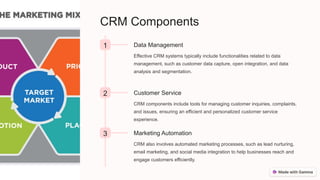
CRM Components
1 Data Management
Effective CRM systems typically include functionalities related to data
management, such as customer data capture, open integration, and data
analysis and segmentation.
2 Customer Service
CRM components include tools for managing customer inquiries, complaints,
and issues, ensuring an efficient and personalized customer service
experience.
3 Marketing Automation
CRM also involves automated marketing processes, such as lead nurturing,
email marketing, and social media integration to help businesses reach and
engage customers efficiently.
Benefits of CRM
Enhanced Customer
Relationships
CRM systems enable
companies to capture,
store, and analyze
customer interactions,
which helps them build
and maintain stronger,
more fulfilling
relationships with their
clients.
Improved Customer
Service
One of the significant
benefits of CRM is
improving customer
service experience, by
providing a more
personalized and
targeted approach based
on customer insights.
Streamlined
Marketing
CRM technology allows
businesses to manage,
automate, and
synchronize sales,
marketing, customer
service, and technical
support, leading to
improved efficiencies and
a unified view of the
customer.
CRM Implementation Strategies
1 Data Quality Management
Ensuring that the customer data within
the CRM system is of the highest
quality by reducing duplication,
ensuring accuracy, and maintaining
consistency.
2 Customization & Integration
Adapting CRM systems to fit business
needs, integrating with other systems,
and providing a seamless user
experience.
3 User Training
Proper training and support to ensure
that employees understand the system
and processes, and can effectively use
CRM tools to enhance customer
relationships.
4 Change Management
Ensuring a smooth transition and
adoption of CRM technologies,
processes, and policies within the
organization to bring about positive
change.
Real-Life CRM Success
Case 1
A retail business saw a
substantial increase in
customer retention and
loyalty through
personalized rewards and
incentives using CRM data
analysis.
Case 2
A service business
achieved significant
productivity gains by
streamlining customer
support and service
processes with CRM tools
and automation.
Case 3
A technology company
used CRM insights to
understand customer
behavior and preferences,
leading to successful
product innovation and
sales growth.
Challenges in Implementing CRM
Data Integration
Complexity
Integrating data from
various sources into a
single CRM system can be
challenging, leading to
data quality issues and
incomplete customer
views.
User Adoption
Resistance to change and
lack of proper training can
hinder successful CRM
implementation and usage
among employees.
Cost and Complexity
Implementing and
maintaining a CRM system
can be costly, and the
complexity might
overwhelm organizations
without proper planning or
resources.
Best Practices for Successful CRM
Clear Objectives
Establish clear objectives for the
implementation and communicate them
effectively throughout the organization
to ensure alignment and commitment.
Continuous Improvement
Continuously analyze and review CRM
processes to identify areas for
improvement and make adjustments to
enhance customer relationships.
Data Security and Privacy
Ensure that the CRM system adheres to data protection laws and industry standards to
safeguard customer information and maintain trust.
Future of CRM
1 AI and Automation
The future of CRM systems will likely involve advanced AI and automation to
further personalize customer interactions and empower businesses with predictive
analytics.
2 Data Integration and Insights
Increased focus on seamless data integration and holistic customer insights to
drive smarter business decisions and improved customer experiences.
3 Integration with Emerging Technologies
CRM systems will integrate with emerging technologies, such as augmented
reality and virtual reality, to enhance customer interactions and experiences.
Conclusion
1 Integrated
Business
Strategy
CRM is evolving as an
essential part of an
integrated business
strategy, enabling
organizations to build
and sustain lasting
customer relationships
that drive business
growth.
2 Customer-Centric
Approach
Addressing evolving
customer needs and
preferences through
innovative CRM
strategies will
continue to be a
central focus for
businesses across
industries.
3 Technological
Advancements
The future of CRM will
see advancements
driven by
technological
innovations, paving
the way for more
sophisticated and
efficient customer
relationship
management.

Introduction-to-CRM.pptx

  • 1.
    Introduction to CRM CustomerRelationship Management (CRM) refers to the strategies, practices, and technologies that companies use to manage and analyze customer interactions and data throughout the customer lifecycle. This data helps businesses improve relationships with customers, streamline processes, and improve profitability. CRM encompasses various aspects, including sales, marketing, customer service, and support. by Arun Upadhyay
  • 2.
    Defining CRM Core Definition CRMcan be defined as a technology-enabled strategy to manage a company's interactions with current and potential customers. It involves using data analysis about customers' history with a company to improve business relationships, specifically focusing on customer retention and ultimately, driving sales growth. Technology Aspect At its simplest, CRM is a tool that helps businesses manage customer relationships. It enables businesses to stay connected to their customers, streamline processes, and improve profitability, while also fostering customer satisfaction and ultimately, loyalty. Strategic Importance CRM is a strategic approach that helps organizations understand their customers' needs and behavior and provides a way to manage and improve the way they are engaging with them. It's not just a software—it's a strategy.
  • 3.
    CRM Components 1 DataManagement Effective CRM systems typically include functionalities related to data management, such as customer data capture, open integration, and data analysis and segmentation. 2 Customer Service CRM components include tools for managing customer inquiries, complaints, and issues, ensuring an efficient and personalized customer service experience. 3 Marketing Automation CRM also involves automated marketing processes, such as lead nurturing, email marketing, and social media integration to help businesses reach and engage customers efficiently.
  • 4.
    Benefits of CRM EnhancedCustomer Relationships CRM systems enable companies to capture, store, and analyze customer interactions, which helps them build and maintain stronger, more fulfilling relationships with their clients. Improved Customer Service One of the significant benefits of CRM is improving customer service experience, by providing a more personalized and targeted approach based on customer insights. Streamlined Marketing CRM technology allows businesses to manage, automate, and synchronize sales, marketing, customer service, and technical support, leading to improved efficiencies and a unified view of the customer.
  • 5.
    CRM Implementation Strategies 1Data Quality Management Ensuring that the customer data within the CRM system is of the highest quality by reducing duplication, ensuring accuracy, and maintaining consistency. 2 Customization & Integration Adapting CRM systems to fit business needs, integrating with other systems, and providing a seamless user experience. 3 User Training Proper training and support to ensure that employees understand the system and processes, and can effectively use CRM tools to enhance customer relationships. 4 Change Management Ensuring a smooth transition and adoption of CRM technologies, processes, and policies within the organization to bring about positive change.
  • 6.
    Real-Life CRM Success Case1 A retail business saw a substantial increase in customer retention and loyalty through personalized rewards and incentives using CRM data analysis. Case 2 A service business achieved significant productivity gains by streamlining customer support and service processes with CRM tools and automation. Case 3 A technology company used CRM insights to understand customer behavior and preferences, leading to successful product innovation and sales growth.
  • 7.
    Challenges in ImplementingCRM Data Integration Complexity Integrating data from various sources into a single CRM system can be challenging, leading to data quality issues and incomplete customer views. User Adoption Resistance to change and lack of proper training can hinder successful CRM implementation and usage among employees. Cost and Complexity Implementing and maintaining a CRM system can be costly, and the complexity might overwhelm organizations without proper planning or resources.
  • 8.
    Best Practices forSuccessful CRM Clear Objectives Establish clear objectives for the implementation and communicate them effectively throughout the organization to ensure alignment and commitment. Continuous Improvement Continuously analyze and review CRM processes to identify areas for improvement and make adjustments to enhance customer relationships. Data Security and Privacy Ensure that the CRM system adheres to data protection laws and industry standards to safeguard customer information and maintain trust.
  • 9.
    Future of CRM 1AI and Automation The future of CRM systems will likely involve advanced AI and automation to further personalize customer interactions and empower businesses with predictive analytics. 2 Data Integration and Insights Increased focus on seamless data integration and holistic customer insights to drive smarter business decisions and improved customer experiences. 3 Integration with Emerging Technologies CRM systems will integrate with emerging technologies, such as augmented reality and virtual reality, to enhance customer interactions and experiences.
  • 10.
    Conclusion 1 Integrated Business Strategy CRM isevolving as an essential part of an integrated business strategy, enabling organizations to build and sustain lasting customer relationships that drive business growth. 2 Customer-Centric Approach Addressing evolving customer needs and preferences through innovative CRM strategies will continue to be a central focus for businesses across industries. 3 Technological Advancements The future of CRM will see advancements driven by technological innovations, paving the way for more sophisticated and efficient customer relationship management.