PARAPHRASING
        Techniques


Tactics to rewrite something
     in a different way
Paraphrasing
   To paraphrase is to say the same thing in
    another way, using your own words.

   We can successfully paraphrase by using
    a combination of techniques.
Paraphrasing
            Techniques
ν   Change from a Clause to a Phrase (or
    vice versa)
ν   Change from Quoted Speech to
    Indirect Speech (or vice versa)
ν   Change from Active Voice to Passive
    Voice (or vice versa)
ν   Change to Synonyms
ν   Change Word Forms
Phrase –Clause - Sentence
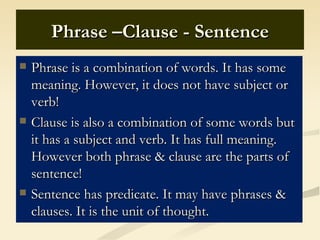
   Phrase is a combination of words. It has some
    meaning. However, it does not have subject or
    verb!
   Clause is also a combination of some words but
    it has a subject and verb. It has full meaning.
    However both phrase & clause are the parts of
    sentence!
   Sentence has predicate. It may have phrases &
    clauses. It is the unit of thought.
Phrase –Clause - Sentence
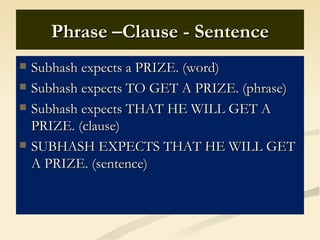
   Subhash expects a PRIZE. (word)
   Subhash expects TO GET A PRIZE. (phrase)
   Subhash expects THAT HE WILL GET A
    PRIZE. (clause)
   SUBHASH EXPECTS THAT HE WILL GET
    A PRIZE. (sentence)
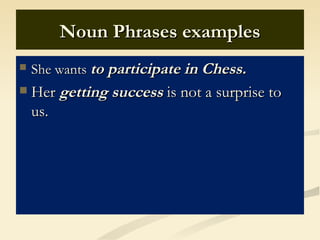
Noun Phrases examples
   She wants to participate in Chess.
   Her getting success is not a surprise to
    us.
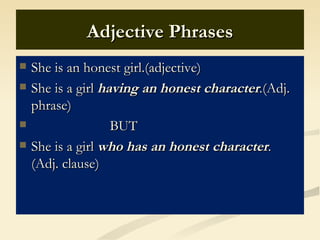
Adjective Phrases
   She is an honest girl.(adjective)
   She is a girl having an honest character.(Adj.
    phrase)
                   BUT
   She is a girl who has an honest character.
    (Adj. clause)
Adverb Phrases
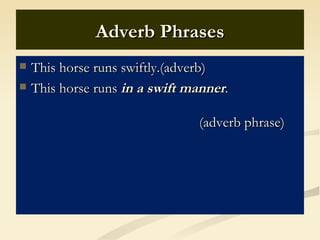
   This horse runs swiftly.(adverb)
   This horse runs in a swift manner.

                                (adverb phrase)
Clauses
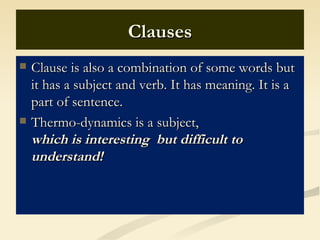
   Clause is also a combination of some words but
    it has a subject and verb. It has meaning. It is a
    part of sentence.
   Thermo-dynamics is a subject,
    which is interesting but difficult to
    understand!
Noun Clauses
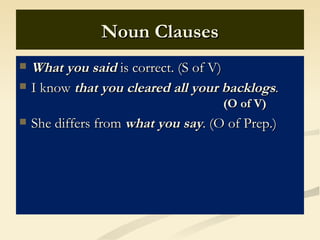
   What you said is correct. (S of V)
   I know that you cleared all your backlogs.
                                     (O of V)
   She differs from what you say. (O of Prep.)
Noun Clauses
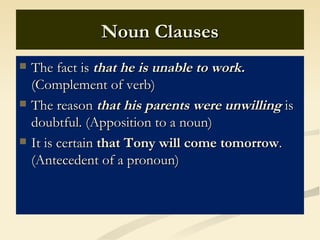
   The fact is that he is unable to work.
    (Complement of verb)
   The reason that his parents were unwilling is
    doubtful. (Apposition to a noun)
   It is certain that Tony will come tomorrow.
    (Antecedent of a pronoun)
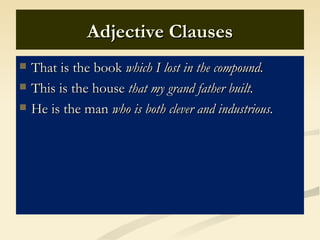
Adjective Clauses
   That is the book which I lost in the compound.
   This is the house that my grand father built.
   He is the man who is both clever and industrious.
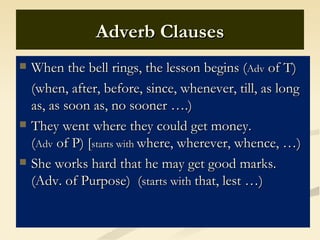
Adverb Clauses
   When the bell rings, the lesson begins (Adv of T)
    (when, after, before, since, whenever, till, as long
    as, as soon as, no sooner ….)
   They went where they could get money.
    (Adv of P) [starts with where, wherever, whence, …)
   She works hard that he may get good marks.
    (Adv. of Purpose) (starts with that, lest …)
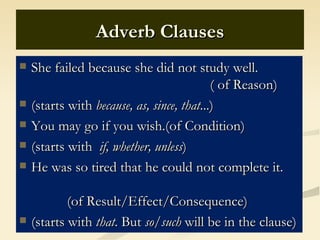
Adverb Clauses
   She failed because she did not study well.
                                            ( of Reason)
   (starts with because, as, since, that...)
   You may go if you wish.(of Condition)
   (starts with if, whether, unless)
   He was so tired that he could not complete it.

            (of Result/Effect/Consequence)
   (starts with that. But so/such will be in the clause)
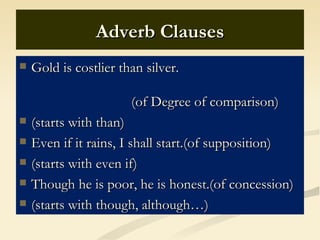
Adverb Clauses
   Gold is costlier than silver.

                       (of Degree of comparison)
   (starts with than)
   Even if it rains, I shall start.(of supposition)
   (starts with even if)
   Though he is poor, he is honest.(of concession)
   (starts with though, although…)
Adverb Clauses
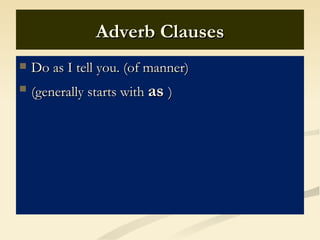
   Do as I tell you. (of manner)
   (generally starts with as )
Parenthetical Clause
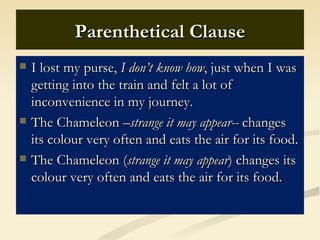
   I lost my purse, I don’t know how, just when I was
    getting into the train and felt a lot of
    inconvenience in my journey.
   The Chameleon –strange it may appear-- changes
    its colour very often and eats the air for its food.
   The Chameleon (strange it may appear) changes its
    colour very often and eats the air for its food.
Change from a Clause to a Phrase
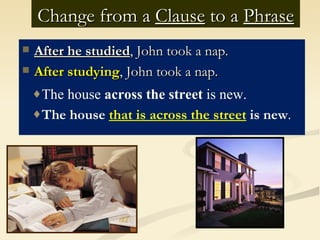
   After he studied, John took a nap.
   After studying, John took a nap.
    ♦The house across the street is new.
    ♦The house that is across the street is new.
Change from Quoted Speech to
           Indirect Speech
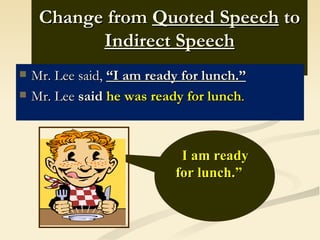
   Mr. Lee said, “I am ready for lunch.”
   Mr. Lee said he was ready for lunch.


                            “I am ready
                            for lunch.”
Change from Active Voice to
      Passive Voice

   A hotel employee will carry your bags.
   Your bags will be carried by a hotel
    employee.
……and replace words with
          synonyms.
   A hotel employee will carry your bags.
   Your bags will be carried by a hotel
    employee.
♦Your luggage will be picked up by a bell boy.
Change Word Forms
   Use an adverb instead of an adjective
   Use a verb to replace a noun.

   GROG is an accurate typist.
   GROG types accurately.
Change to Synonyms
 Replace the original words with words
  that mean the same.
The stallion was content with the mare.
      The stallion was happy with the mare.
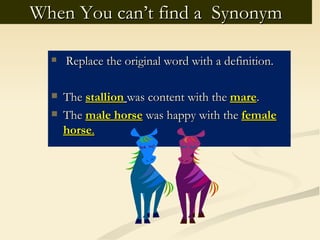
When You can’t find a Synonym

     Replace the original word with a definition.

     The stallion was content with the mare.
     The male horse was happy with the female
      horse.
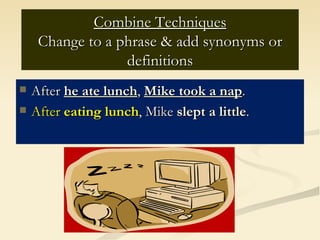
Combine Techniques
     Change to a phrase & add synonyms or
                  definitions
   After he ate lunch, Mike took a nap.
   After eating lunch, Mike slept a little.
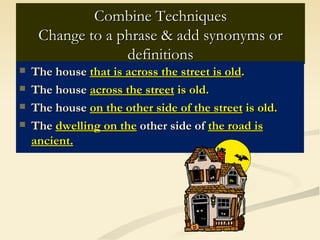
Combine Techniques
     Change to a phrase & add synonyms or
                  definitions
   The house that is across the street is old.
   The house across the street is old.
   The house on the other side of the street is old.
   The dwelling on the other side of the road is
    ancient.
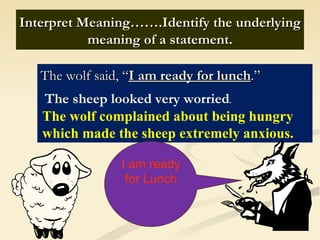
Interpret Meaning…….Identify the underlying
           meaning of a statement.

   The wolf said, “I am ready for lunch.”
   The sheep looked very worried.
   The wolf complained about being hungry
   which made the sheep extremely anxious.

                I am ready
                 for Lunch
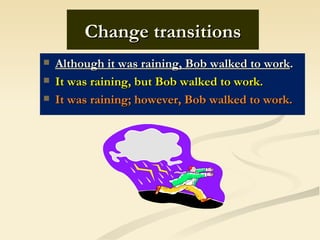
Change transitions
   Although it was raining, Bob walked to work.
   It was raining, but Bob walked to work.
   It was raining; however, Bob walked to work.
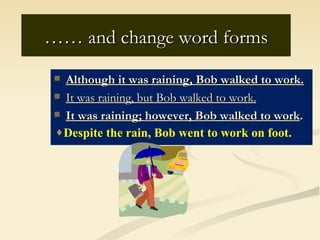
…… and change word forms
  Although it was raining, Bob walked to work.
  It was raining, but Bob walked to work.

  It was raining; however, Bob walked to work.

 ♦Despite the rain, Bob went to work on foot.
Your Turn
       Paraphrase the following:
• Today, people are worried about internet security.
• Advocates of internet tracking believe that it helps
marketers to understand what people want.
• People who oppose internet tracking believe that it is
an invasion of privacy.
• This information age will cause more and more
people to become concerned with the level of
personal detail that can be found from the internet.

Pharaphrase

  • 1.
    PARAPHRASING Techniques Tactics to rewrite something in a different way
  • 2.
    Paraphrasing  To paraphrase is to say the same thing in another way, using your own words.  We can successfully paraphrase by using a combination of techniques.
  • 3.
    Paraphrasing Techniques ν Change from a Clause to a Phrase (or vice versa) ν Change from Quoted Speech to Indirect Speech (or vice versa) ν Change from Active Voice to Passive Voice (or vice versa) ν Change to Synonyms ν Change Word Forms
  • 4.
    Phrase –Clause -Sentence  Phrase is a combination of words. It has some meaning. However, it does not have subject or verb!  Clause is also a combination of some words but it has a subject and verb. It has full meaning. However both phrase & clause are the parts of sentence!  Sentence has predicate. It may have phrases & clauses. It is the unit of thought.
  • 5.
    Phrase –Clause -Sentence  Subhash expects a PRIZE. (word)  Subhash expects TO GET A PRIZE. (phrase)  Subhash expects THAT HE WILL GET A PRIZE. (clause)  SUBHASH EXPECTS THAT HE WILL GET A PRIZE. (sentence)
  • 6.
    Noun Phrases examples  She wants to participate in Chess.  Her getting success is not a surprise to us.
  • 7.
    Adjective Phrases  She is an honest girl.(adjective)  She is a girl having an honest character.(Adj. phrase)  BUT  She is a girl who has an honest character. (Adj. clause)
  • 8.
    Adverb Phrases  This horse runs swiftly.(adverb)  This horse runs in a swift manner. (adverb phrase)
  • 9.
    Clauses  Clause is also a combination of some words but it has a subject and verb. It has meaning. It is a part of sentence.  Thermo-dynamics is a subject, which is interesting but difficult to understand!
  • 10.
    Noun Clauses  What you said is correct. (S of V)  I know that you cleared all your backlogs. (O of V)  She differs from what you say. (O of Prep.)
  • 11.
    Noun Clauses  The fact is that he is unable to work. (Complement of verb)  The reason that his parents were unwilling is doubtful. (Apposition to a noun)  It is certain that Tony will come tomorrow. (Antecedent of a pronoun)
  • 12.
    Adjective Clauses  That is the book which I lost in the compound.  This is the house that my grand father built.  He is the man who is both clever and industrious.
  • 13.
    Adverb Clauses  When the bell rings, the lesson begins (Adv of T) (when, after, before, since, whenever, till, as long as, as soon as, no sooner ….)  They went where they could get money. (Adv of P) [starts with where, wherever, whence, …)  She works hard that he may get good marks. (Adv. of Purpose) (starts with that, lest …)
  • 14.
    Adverb Clauses  She failed because she did not study well. ( of Reason)  (starts with because, as, since, that...)  You may go if you wish.(of Condition)  (starts with if, whether, unless)  He was so tired that he could not complete it. (of Result/Effect/Consequence)  (starts with that. But so/such will be in the clause)
  • 15.
    Adverb Clauses  Gold is costlier than silver. (of Degree of comparison)  (starts with than)  Even if it rains, I shall start.(of supposition)  (starts with even if)  Though he is poor, he is honest.(of concession)  (starts with though, although…)
  • 16.
    Adverb Clauses  Do as I tell you. (of manner)  (generally starts with as )
  • 17.
    Parenthetical Clause  I lost my purse, I don’t know how, just when I was getting into the train and felt a lot of inconvenience in my journey.  The Chameleon –strange it may appear-- changes its colour very often and eats the air for its food.  The Chameleon (strange it may appear) changes its colour very often and eats the air for its food.
  • 18.
    Change from aClause to a Phrase  After he studied, John took a nap.  After studying, John took a nap. ♦The house across the street is new. ♦The house that is across the street is new.
  • 19.
    Change from QuotedSpeech to Indirect Speech  Mr. Lee said, “I am ready for lunch.”  Mr. Lee said he was ready for lunch. “I am ready for lunch.”
  • 20.
    Change from ActiveVoice to Passive Voice  A hotel employee will carry your bags.  Your bags will be carried by a hotel employee.
  • 21.
    ……and replace wordswith synonyms.  A hotel employee will carry your bags.  Your bags will be carried by a hotel employee. ♦Your luggage will be picked up by a bell boy.
  • 22.
    Change Word Forms  Use an adverb instead of an adjective  Use a verb to replace a noun.  GROG is an accurate typist.  GROG types accurately.
  • 23.
    Change to Synonyms Replace the original words with words that mean the same. The stallion was content with the mare. The stallion was happy with the mare.
  • 24.
    When You can’tfind a Synonym  Replace the original word with a definition.  The stallion was content with the mare.  The male horse was happy with the female horse.
  • 25.
    Combine Techniques Change to a phrase & add synonyms or definitions  After he ate lunch, Mike took a nap.  After eating lunch, Mike slept a little.
  • 26.
    Combine Techniques Change to a phrase & add synonyms or definitions  The house that is across the street is old.  The house across the street is old.  The house on the other side of the street is old.  The dwelling on the other side of the road is ancient.
  • 27.
    Interpret Meaning…….Identify theunderlying meaning of a statement. The wolf said, “I am ready for lunch.” The sheep looked very worried. The wolf complained about being hungry which made the sheep extremely anxious. I am ready for Lunch
  • 28.
    Change transitions  Although it was raining, Bob walked to work.  It was raining, but Bob walked to work.  It was raining; however, Bob walked to work.
  • 29.
    …… and changeword forms  Although it was raining, Bob walked to work.  It was raining, but Bob walked to work.  It was raining; however, Bob walked to work. ♦Despite the rain, Bob went to work on foot.
  • 30.
    Your Turn Paraphrase the following: • Today, people are worried about internet security. • Advocates of internet tracking believe that it helps marketers to understand what people want. • People who oppose internet tracking believe that it is an invasion of privacy. • This information age will cause more and more people to become concerned with the level of personal detail that can be found from the internet.