بسم الله الرحمن الرحيم
Phage Therapy Fatma F. Abu-Qados  To: Dr.Abdelraouf A. El-Manama 30.01.11
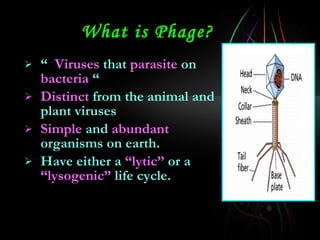
What is Phage? “  Viruses  that  parasite  on  bacteria  “ Distinct  from the animal and plant viruses Simple  and  abundant  organisms on earth. Have either a  “lytic”  or a  “lysogenic”  life cycle.
Hello ..  I’m Phage
Types of Phages λ phage – Lysogen T2 phage T4 phage T7 phage M13 phage MS2 phage P1 phage Enterobacteria phage P2
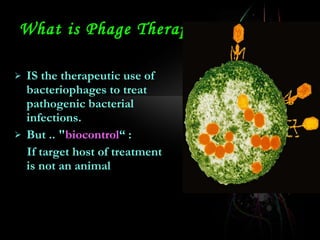
What is Phage Therapy ? IS the therapeutic use of bacteriophages to treat pathogenic bacterial infections. But .. " biocontrol “ :  If target host of treatment is not an animal
Lytic Vs. Lysogenic Destruction  (lysis ) Growth suppression effects  (lysogeny) lytic phages are the most suitable candidates for phage therapy..   Why ??   because they  quickly reproduce  within and lyse the bacteria in their host range,  growing exponentially  in number. In contrast , temperate phages ( lysogenic) , which can  bolster  their bacterial host's  virulence ,  resilience , and general capacity to  proliferate  are generally unsuitable for therapeutic applications. 
Lytic cycle …
Attachment
More & More
Penetration & swelling
Lyses
Spreading
 
Depending on the  species and conditions , each “parent” phage can produce on average approximately  200 “daughters”  per lytic cycle.  40 000 progeny  at the end of the 2nd cycle; 8 million  at the end of the 3rd cycle;  1.6 billion  at the end of the 4th cycle; and so on…. Amplfication  ..
Since ancient times,  river waters  having the ability to cure infectious diseases, such as  leprosy .  Phages were discovered in 1915 by British microbiologist  Felix Twort , and, independently in 1917, by French-Canadian microbiologist  Felix d’Hérelle. Twort did not pursue  his discovery, whereas  d’Hérelle systematically investigated  the nature of bacteriophages and explored their ability to function as therapeutic agents History
Is that still being Used now ? Although extensively used and developed mainly in former Soviet Union countries for about 90 years, this method of therapy is  still being tested  elsewhere for treatment of a variety of  bacterial and poly-microbial biofilm infections , and has not yet been approved in countries other than Georgia.
Advantages Phages  thrive  in the presence of bacteria, and  die  out in their absence.  Extreme specificity  and chemically large nature.  Do not cause allergies or affect the body's natural  immune system .  Low chemotherapeutic index . Support and enhance vital  microflora.
Cont. Adv. More  rapidly and effectively  than standard antibiotics.  Have a long  shelf life  (up to 2 years).  Production  costs  of phages are  low . "green-natural-alternative"  and its production is environment-friendly.  For both  prevention  &  treatment  .  Administered in a limited number of  small doses  over a short  period of time.
Disadvantages   Must be  refrigerated  until used . High  specificity   ….  when the exact species of an infecting  bacteria is unknown  or if there is  a  multiple infection .  Should be  tested  in the lab prior to application, making phages  less suitable for acute   cases  where time is not available.
Cont. Disadv. Resistance   However, evolution drives the rapid emergence of new phages that can destroy bacteria that have become resistant. This means that there should be an  "inexhaustible" supply. Injected  into the  bloodstream  are recognized by the human  immune system . For this reason, it appears that a particular phage can only be used  once for intravenous treatment
Where we can find Phage? In humans and animal intestines In running water In the soil  Effluent outlets , sewage From  corpses .
Culture Because Phages are  "bacterium-specific"  , it is necessary to take a swab from the patient and culture it prior to treatment. The samples are taken and applied to the bacteria that  are to be destroyed (To be tested)  which have been cultured on growth medium. If the bacteria die, as usually happens, the mixture is  centrifuged ; the phages collect on the top of the mixture and can be drawn off. Occasionally, isolation of therapeutic phages can require a  few months  to complete, but clinics generally keep supplies of  phage cocktails  for the most common bacterial strains in a geographical area.
 
  How can be Administrated ? Orally.. Topically on infected wounds  Injection is rarely used, avoiding immune system stimulation..
Topical use ..
Treatment 4 WHAT ? For  bacterial infections  .. e.g :  laryngitis, skin infections, dysentery, conjunctivitis, periodontitis, gingivitis, sinusitis, urinary tract infections and intestinal infections, burns, boils,poly-microbial biofilms on chronic wounds, ulcers and infected surgical sites.
Other uses .. Veterinary science Agriculture Food additive .  phages against  Listeria  on  cheese and meat  are generally recognized as safe (GRAS status).
Phage on Wounds


Future hopes Cancer therapy …. ! Meningitis ,,, cross the BBB …!
Conclusion Multidrug-resistant bacteria  have opened a second  window  for phage therapy. Phage therapy can then serve as a  stand-alone therapy  for infections that are  fully resistant . It will also then be able to serve as a  co-therapeutic  agent for infections that are  still susceptible  to antibiotics.
Questions ?
 

Phage therapy

  • 1.
  • 2.
    Phage Therapy FatmaF. Abu-Qados To: Dr.Abdelraouf A. El-Manama 30.01.11
  • 3.
    What is Phage?“ Viruses that parasite on bacteria “ Distinct from the animal and plant viruses Simple and abundant organisms on earth. Have either a “lytic” or a “lysogenic” life cycle.
  • 4.
    Hello .. I’m Phage
  • 5.
    Types of Phagesλ phage – Lysogen T2 phage T4 phage T7 phage M13 phage MS2 phage P1 phage Enterobacteria phage P2
  • 6.
    What is PhageTherapy ? IS the therapeutic use of bacteriophages to treat pathogenic bacterial infections. But .. " biocontrol “ : If target host of treatment is not an animal
  • 7.
    Lytic Vs. LysogenicDestruction (lysis ) Growth suppression effects (lysogeny) lytic phages are the most suitable candidates for phage therapy.. Why ?? because they quickly reproduce within and lyse the bacteria in their host range, growing exponentially in number. In contrast , temperate phages ( lysogenic) , which can bolster their bacterial host's virulence , resilience , and general capacity to proliferate are generally unsuitable for therapeutic applications. 
  • 8.
  • 9.
  • 10.
  • 11.
  • 12.
  • 13.
  • 14.
  • 15.
    Depending on the species and conditions , each “parent” phage can produce on average approximately 200 “daughters” per lytic cycle. 40 000 progeny at the end of the 2nd cycle; 8 million at the end of the 3rd cycle; 1.6 billion at the end of the 4th cycle; and so on…. Amplfication ..
  • 16.
    Since ancient times, river waters having the ability to cure infectious diseases, such as leprosy . Phages were discovered in 1915 by British microbiologist Felix Twort , and, independently in 1917, by French-Canadian microbiologist Felix d’Hérelle. Twort did not pursue his discovery, whereas d’Hérelle systematically investigated the nature of bacteriophages and explored their ability to function as therapeutic agents History
  • 17.
    Is that stillbeing Used now ? Although extensively used and developed mainly in former Soviet Union countries for about 90 years, this method of therapy is still being tested elsewhere for treatment of a variety of bacterial and poly-microbial biofilm infections , and has not yet been approved in countries other than Georgia.
  • 18.
    Advantages Phages thrive in the presence of bacteria, and die out in their absence. Extreme specificity and chemically large nature. Do not cause allergies or affect the body's natural immune system . Low chemotherapeutic index . Support and enhance vital microflora.
  • 19.
    Cont. Adv. More rapidly and effectively than standard antibiotics. Have a long shelf life (up to 2 years). Production costs of phages are low . "green-natural-alternative" and its production is environment-friendly. For both prevention & treatment . Administered in a limited number of small doses over a short period of time.
  • 20.
    Disadvantages Must be refrigerated until used . High specificity …. when the exact species of an infecting bacteria is unknown or if there is a multiple infection . Should be tested in the lab prior to application, making phages less suitable for acute cases where time is not available.
  • 21.
    Cont. Disadv. Resistance However, evolution drives the rapid emergence of new phages that can destroy bacteria that have become resistant. This means that there should be an "inexhaustible" supply. Injected into the bloodstream are recognized by the human immune system . For this reason, it appears that a particular phage can only be used once for intravenous treatment
  • 22.
    Where we canfind Phage? In humans and animal intestines In running water In the soil Effluent outlets , sewage From corpses .
  • 23.
    Culture Because Phagesare "bacterium-specific" , it is necessary to take a swab from the patient and culture it prior to treatment. The samples are taken and applied to the bacteria that are to be destroyed (To be tested) which have been cultured on growth medium. If the bacteria die, as usually happens, the mixture is centrifuged ; the phages collect on the top of the mixture and can be drawn off. Occasionally, isolation of therapeutic phages can require a few months to complete, but clinics generally keep supplies of phage cocktails for the most common bacterial strains in a geographical area.
  • 24.
  • 25.
    Howcan be Administrated ? Orally.. Topically on infected wounds Injection is rarely used, avoiding immune system stimulation..
  • 26.
  • 27.
    Treatment 4 WHAT? For bacterial infections .. e.g : laryngitis, skin infections, dysentery, conjunctivitis, periodontitis, gingivitis, sinusitis, urinary tract infections and intestinal infections, burns, boils,poly-microbial biofilms on chronic wounds, ulcers and infected surgical sites.
  • 28.
    Other uses ..Veterinary science Agriculture Food additive . phages against Listeria on cheese and meat are generally recognized as safe (GRAS status).
  • 29.
  • 30.
  • 31.
  • 32.
  • 33.
    Future hopes Cancertherapy …. ! Meningitis ,,, cross the BBB …!
  • 34.
    Conclusion Multidrug-resistant bacteria have opened a second window for phage therapy. Phage therapy can then serve as a stand-alone therapy for infections that are fully resistant . It will also then be able to serve as a co-therapeutic agent for infections that are still susceptible to antibiotics.
  • 35.
  • 36.