Mycoviruses and their pathogenesis
Submitted to :
Dr Yasir Iftikhar
Submitted by :
Roll no’s: 24 , 39 , 41, 53
Myco-viruses:
The virus that infect fungi and replicate inside
fungi are called Mycovirus.
 These are also called as fungal virus ,mycophage
and fungicidal virus.
 Mycovirus first time was recorded on cultivated
mushrooms (Agaricus bisporus) in the late 1940’s and
was called the La France disease or watery strip .
La France Disease
The La France Disease of mushroom is also
known as X disease or watery stripe.
Due to this Disease:
Reduced yield
Slow mycelial growth
Water logging of tissue
Malformation
Miss shaped mushroom
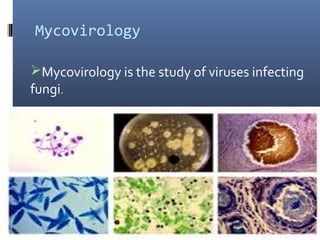
Mycovirology
Mycovirology is the study of viruses infecting
fungi.
General characteristics
They are isometric particles.
The majority of Mycoviruses have segmented
double-stranded RNA (dsRNA) genomes.
 Approximately 30% have positive sense, single-
stranded RNA (+ssRNA) genome.
Host range
Mycoviruses are found in all four phyla of the
true fungi.
Chytridiomycota
Zygomycota
Ascomycota
Basidiomycota
Symptoms associated with
Mycoviruses:
Infections with fungal viruses often remain
persistently unappear in their hosts.
 Micoviruses can alter phenotypes, such as
reduced growth, pigmentation, lack of
sporulation .
 Changes of colony and lesion in morphology of
fungus is very important .
Transmission
Natural vectors of Mycoviruses are unknown due
to lack of extracellular movement from cell to
cell.
 Intercellular transmissions only through hyphal
fusion and cell division and spread via sexually or
asexually spores have been observed .
Vegetative incompatibility reactions inhibit
hyphal fusion and reduce viral transmission.
Movement of mycoviruses within
fungi:
Virus dissemination in mycelial networks
via dolipores and septa , as organelles easily
migrate in between adjacent cells.
Virus can move with the cytoplasm and
extends into new hyphae.
Pathogenesis
The majority of Mycovirus families do not
exclusively infect fungi.
The families which exclusively infect fungi are
 Reoviridae
 Hypoviridae
 totiviridae.
 Narnaviridae etc.
Hypovirulence:
 It is advantageous infection of viruses which
decrease the pathogenicity of plant pathogenic
fungi .
It is most common in Mycoviruses and use for
biological control.
Its most common example are cryphonecteria
parasitica on chestnut blight.
Importance :
 Killer isolates secrete proteins that are toxic to
sensitive cells of the same or closely related
species . There are potentially interesting
application of killer yeast in medicine, food
industry, and in agriculture.
 harmful pests such as Botrytis cinerae
,cryphonecteria parasitica , provide significant
information that Mycoviruses can decrease
Fungal pathogencity.
 So these can be used as biological control against
harmful Fungus.
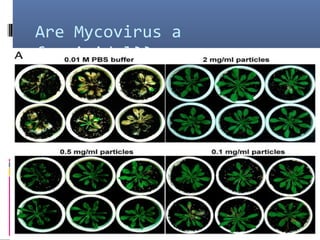
Are Mycovirus a
fungicidal??
mycoviruses and pathogensis

mycoviruses and pathogensis

  • 2.
    Mycoviruses and theirpathogenesis Submitted to : Dr Yasir Iftikhar Submitted by : Roll no’s: 24 , 39 , 41, 53
  • 3.
    Myco-viruses: The virus thatinfect fungi and replicate inside fungi are called Mycovirus.  These are also called as fungal virus ,mycophage and fungicidal virus.  Mycovirus first time was recorded on cultivated mushrooms (Agaricus bisporus) in the late 1940’s and was called the La France disease or watery strip .
  • 4.
    La France Disease TheLa France Disease of mushroom is also known as X disease or watery stripe. Due to this Disease: Reduced yield Slow mycelial growth Water logging of tissue Malformation Miss shaped mushroom
  • 6.
    Mycovirology Mycovirology is thestudy of viruses infecting fungi.
  • 7.
    General characteristics They areisometric particles. The majority of Mycoviruses have segmented double-stranded RNA (dsRNA) genomes.  Approximately 30% have positive sense, single- stranded RNA (+ssRNA) genome.
  • 8.
    Host range Mycoviruses arefound in all four phyla of the true fungi. Chytridiomycota Zygomycota Ascomycota Basidiomycota
  • 10.
    Symptoms associated with Mycoviruses: Infectionswith fungal viruses often remain persistently unappear in their hosts.  Micoviruses can alter phenotypes, such as reduced growth, pigmentation, lack of sporulation .
  • 13.
     Changes ofcolony and lesion in morphology of fungus is very important .
  • 14.
    Transmission Natural vectors ofMycoviruses are unknown due to lack of extracellular movement from cell to cell.  Intercellular transmissions only through hyphal fusion and cell division and spread via sexually or asexually spores have been observed . Vegetative incompatibility reactions inhibit hyphal fusion and reduce viral transmission.
  • 17.
    Movement of mycoviruseswithin fungi: Virus dissemination in mycelial networks via dolipores and septa , as organelles easily migrate in between adjacent cells. Virus can move with the cytoplasm and extends into new hyphae.
  • 18.
    Pathogenesis The majority ofMycovirus families do not exclusively infect fungi. The families which exclusively infect fungi are  Reoviridae  Hypoviridae  totiviridae.  Narnaviridae etc.
  • 20.
    Hypovirulence:  It isadvantageous infection of viruses which decrease the pathogenicity of plant pathogenic fungi . It is most common in Mycoviruses and use for biological control. Its most common example are cryphonecteria parasitica on chestnut blight.
  • 22.
  • 24.
     Killer isolatessecrete proteins that are toxic to sensitive cells of the same or closely related species . There are potentially interesting application of killer yeast in medicine, food industry, and in agriculture.  harmful pests such as Botrytis cinerae ,cryphonecteria parasitica , provide significant information that Mycoviruses can decrease Fungal pathogencity.  So these can be used as biological control against harmful Fungus.
  • 26.