Transduction I
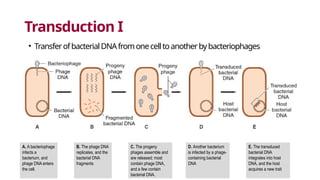
• TransferofbacterialDNAfromonecelltoanotherbybacteriophages
A.A bacteriophage
infects a
bacterium, and
phage DNA enters
the cell.
B. The phage DNA
replicates, and the
bacterial DNA
fragments
C. The progeny
phages assemble and
are released; most
contain phage DNA,
and a few contain
bacterial DNA.
D. Another bacterium
is infected by a phage-
containing bacterial
DNA
E. The transduced
bacterial DNA
integrates into host
DNA, and the host
acquires a new trait
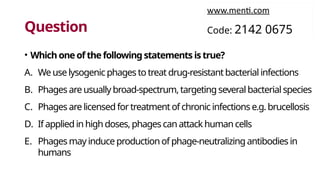
Question
• Which oneof the following statements is true?
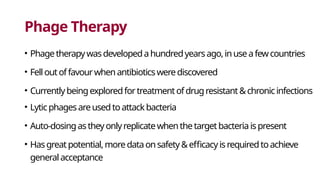
A. We use lysogenic phages to treat drug-resistant bacterial infections
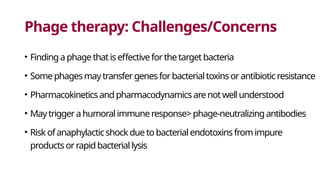
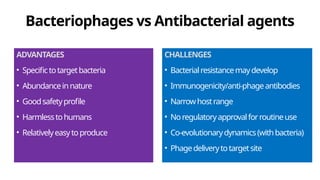
B. Phages are usually broad-spectrum,targeting several bacterial species
C. Phages are licensed for treatment of chronic infections e.g.brucellosis
D. If applied in high doses, phages can attack human cells
E. Phages may induce production of phage-neutralizing antibodies in
humans
www.menti.com
Code: 2142 0675
#11 Phage Classification and Characterization https://link.springer.com/protocol/10.1007/978-1-60327-164-6_13
#12
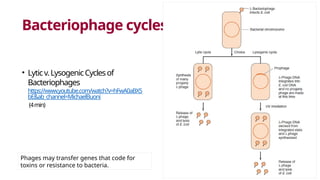
Comparison of the lytic and lysogenic cycles of bacteriophage (phage) replication. In the lytic cycle, replication of the phage is completed without interruption. In the lysogenic cycle, replication of the phage is interrupted, and the phage DNA integrates into the bacterial DNA. The integrated DNA is called a prophage and can remain in the integrated state for long periods. If the bacteria are exposed to certain activators such as ultraviolet (UV) light, the prophage DNA is excised from the bacterial DNA and the phage enters the lytic cycle, which ends with the production of progeny phage.
#14 SOURCE: LANGE Review of Medical Microbiology and Immunology by Levinson et al.
Transduction. A: A bacteriophage infects a bacterium, and phage DNA enters the cell. B: The phage DNA replicates, and the bacterial DNA fragments. C: The progeny phages assemble and are released; most contain phage DNA, and a few contain bacterial DNA. D: Another bacterium is infected by a phage-containing bacterial DNA. E: The transduced bacterial DNA integrates into host DNA, and the host acquires a new trait. This host bacterium survives because no viral DNA is transduced; therefore, no viral replication can occur
#15 SOURCE: LANGE Review of Medical Microbiology and Immunology by Levinson et al.
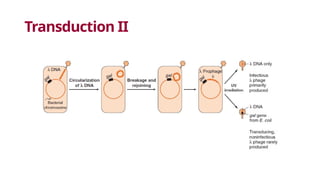
Lysogeny. The linear lambda (λ) phage DNA is injected into the bacterium, circularizes, and then integrates into the bacterial DNA. When integrated, the phage DNA is called a prophage. When the prophage is induced to enter the replicative cycle, aberrant excision of the phage DNA can occur (i.e., part of the phage DNA and part of the bacterial DNA including the adjacent gal gene are excised). The gal gene can now be transduced to another bacterium.
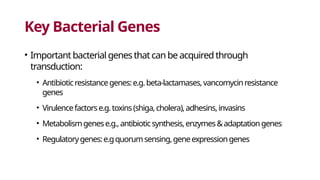
#16 Antibiotic resistance genes:
β-lactamases: These enzymes inactivate β-lactam antibiotics, rendering bacteria resistant to penicillin, cephalosporins, and carbapenems. Examples include TEM-1 and SHV-1 β-lactamases.
Vancomycin-resistant genes: These genes encode enzymes that modify peptidoglycan, the cell wall component targeted by vancomycin, making bacteria resistant to this last-resort antibiotic. Examples include vanA and vanB genes.
Tetracycline resistance genes: These genes encode efflux pumps that actively transport tetracycline antibiotics out of the cell, leading to resistance. Examples include tetA and tetM genes.
Virulence factors:
Toxins: These proteins damage host cells and tissues, contributing to disease severity. Examples include Shiga toxin in E. coli and cholera toxin in Vibrio cholerae.
Adhesins: These proteins promote bacterial attachment to host cells, facilitating colonization and infection. Examples include the fimbriae of E. coli and the Spa protein of Staphylococcus aureus.
Invasins: These proteins allow bacteria to invade host cells, facilitating intracellular survival and replication. Examples include the Inv protein of Salmonella typhimurium and the internalins of Listeria monocytogenes.
Metabolic genes:
Antibiotic production genes: These genes encode enzymes involved in the biosynthesis of various antibiotics, allowing bacteria to compete with other microbes. Examples include the nisin biosynthetic genes in Lactococcus lactis and the bacitracin biosynthetic genes in Bacillus subtilis.
Degradation genes: These genes encode enzymes that break down complex molecules, allowing bacteria to utilize diverse carbon sources. Examples include the cellulose degradation genes in Cellulomonas sp. and the chitin degradation genes in Aeromonas hydrophila.
Adaptation genes: These genes help bacteria survive in specific environments. Examples include the cold-shock genes in Psychrobacter sp. and the heat-shock genes in Thermus aquaticus.
Regulatory genes:
Two-component systems: These signaling pathways sense environmental changes and regulate gene expression accordingly. Examples include the PhoPQ system in Salmonella typhimurium and the EnvZ/OmpR system in E. coli.
Quorum sensing genes: These genes allow bacteria to communicate with each other and coordinate their behavior, contributing to biofilm formation and virulence. Examples include the lux genes in Vibrio fischeri and the agr genes in Staphylococcus aureus.
#19 Bacteriophages and their implications on future biotechnology: a review https://virologyj.biomedcentral.com/articles/10.1186/1743-422X-9-9
#21 Bacteriophage Therapy: Clinical Trials and Regulatory Hurdles https://www.frontiersin.org/articles/10.3389/fcimb.2018.00376/full