EXPERIMENT 1
PART 2
APPLICATION: MAKING PH
INDICATOR
ABSTRACT
 This experiment objective are to learn how to make pH meter and to learn
how to prepare buffer system. Acidity is measured on a pH scale. pH stands
for "potential for Hydrogen." Acidity is caused by hydrogen atoms that have
lost their electrons and are roaming free in water [H+]. The opposite of acidic
is alkaline (or basic). Alkaline gets its name from the "al kali" plant whose
ashes are capable of neutralizing acids. It does this because it contains KOH.
The "OH" is called hydroxide and as the equation shows, it combines with
the acid [H+] to form water. Extract from part of plant that have most
pigmented. Then, after filtration take place, extract of plant is used to test the
pH range of the indicator. The solution that have range 1 until 13 are
prepared to test the extract of red cabbage, turmeric, soap, detergent, vinegar
and orange juice. The pigment in red cabbage is known for its ability to
change colors depending on the pH (level of acidity) that it comes in contact
with compared to turmeric. Vinegar, orange juice. And others is needed to
check how the red cabbage and turmeric extract responds to an acid. and
based.
INTRODUCTION
Acidity or alkalinity is measured by chemists in term of
the concentration of the hydrogen ion. Thus pH (literally
potential of Hydrogen) is a symbol representing
quantitatively the hydrogen ion concentration. Thus pure
water at normal temperature has a value of 7. pH values
from 0 to 7 indicate a decreasing sequence of acidity, pH
values from 7 to 13 an increasing sequence of alkalinity.
Red cabbage contains a pigment molecule called flavin (an
anthocyanin). This water-soluble pigment is also found in apple
skin, plums, poppies, cornflowers, and grapes. Very acidic
solutions will turn anthocyanin a red color. Natural solutions
result in a purplish color. Basic solutions appear in greenish-
yellow. Therefore, it is possible to determine the pH of a
solution based on the color it turns the anthocyanin pigments in
red cabbage juice. Turmeric(Curcuma longa)is a plant whose
parts are often used as a spice in cooking. Turmeric is an
example of a natural pH indicator which means that it can be
used to determine a substance’s pH.
MATERIAL AND METHOD
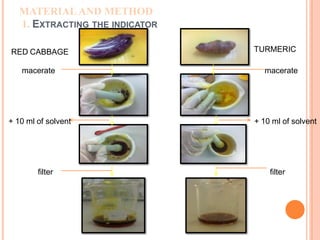
1. EXTRACTING THE INDICATOR
RED CABBAGE TURMERIC
macerate macerate
+ 10 ml of solvent + 10 ml of solvent
filter filter
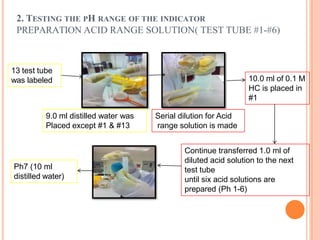
2. TESTING THE PH RANGE OF THE INDICATOR
PREPARATION ACID RANGE SOLUTION( TEST TUBE #1-#6)
13 test tube
was labeled
9.0 ml distilled water was
Placed except #1 & #13
Serial dilution for Acid
range solution is made
10.0 ml of 0.1 M
HC is placed in
#1
Continue transferred 1.0 ml of
diluted acid solution to the next
test tube
until six acid solutions are
prepared (Ph 1-6)
Ph7 (10 ml
distilled water)
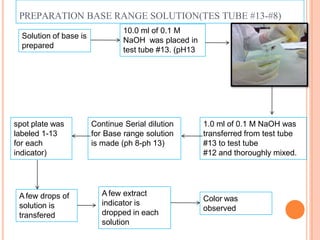
PREPARATION BASE RANGE SOLUTION(TES TUBE #13-#8)
Solution of base is
prepared
10.0 ml of 0.1 M
NaOH was placed in
test tube #13. (pH13
1.0 ml of 0.1 M NaOH was
transferred from test tube
#13 to test tube
#12 and thoroughly mixed.
Continue Serial dilution
for Base range solution
is made (ph 8-ph 13)
spot plate was
labeled 1-13
for each
indicator)
A few drops of
solution is
transfered
A few extract
indicator is
dropped in each
solution
Color was
observed
TESTING THE PH OF OTHER LIQUIDS
When the pH indicators has been determined
household chemicals was used to test their pH
RESULT
TESTING THE PH RANGE OF THE INDICATOR
RED CABBAGE
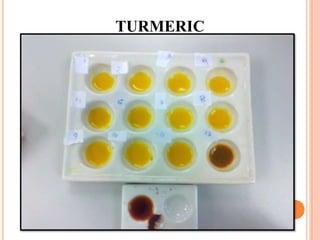
TURMERIC
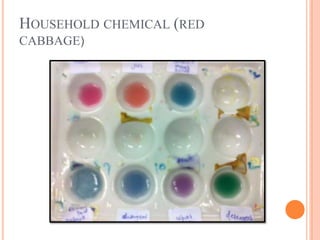
HOUSEHOLD CHEMICAL (RED
CABBAGE)
HOUSEHOLD CHEMICAL (TURMERIC))
DISCUSSION
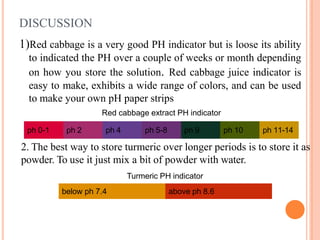
1)Red cabbage is a very good PH indicator but is loose its ability
to indicated the PH over a couple of weeks or month depending
on how you store the solution. Red cabbage juice indicator is
easy to make, exhibits a wide range of colors, and can be used
to make your own pH paper strips
Red cabbage extract PH indicator
ph 2 ph 4 ph 5-8 ph 9 ph 10 ph 11-14
ph 0-1
2. The best way to store turmeric over longer periods is to store it as
powder. To use it just mix a bit of powder with water.
Turmeric PH indicator
below ph 7.4 above ph 8.6
3.The turmeric indicator changes colour between roughly a pH of
7.4 and 8.6. If turmeric is exposed to neutral or acidic
substances (those with a pH of less than 7.4) it will retain its
yellow colouration. However, if turmeric is exposed to more
alkaline substances (those with a pH greater than 8.6) it
becomes a dark pink/red.
4.That’s because turmeric contains a yellow pigment called
curcumin, which is pH sensitive. Its molecules change shape in
solutions of different pH. They are yellow in solutions that are
acidic, like orange juice and vinegar , but they turn dark red in
solutions that are basic like laundry detergent.
5. The colour of anthocyanins changes with pH from a yellowy
green in very alkaline solutions, to a blue-ish purple in neutral
solutions, to bright pink in acidic solutions.
TESTING PH OF OTHER LIQUID
 Vinegar – acid (the color of vinegar turn to pink after added with
red cabbage and yellow color after added with turmeric)
 Orange juice – acid (the color of orange juice turn to orange/light
red after added with red cabbage and light yellow color after
added with turmeric)
 Toothpaste – base/alkaline (the color of toothpaste turn to purple
after added with red cabbage and yellow color after added with
turmeric)
REFERENCES
 http://www.chemistryland.com/CHM107Lab/Lab1/L
ab1PreparingCabbageExtract.htm
 http://chemistry.about.com/od/acidsbase1/a/red-
cabbage-ph-indicator.htm
 http://sciencesquad.questacon.edu.au/activities/col
ourful_chemistry.html
REFERENCES
 http://www.abc.net.au/science/articles/2012/04/03/34702
05.htm?site=science/tricks
 http://tuxgraphics.org/npa/litmus-redcabbage-tumeric-
radish-ph-indicator/
 http://www.ehow.com/how_8497638_make-turmeric-ph-
indicator.html

pH indicator experiment

  • 1.
  • 2.
    ABSTRACT  This experimentobjective are to learn how to make pH meter and to learn how to prepare buffer system. Acidity is measured on a pH scale. pH stands for "potential for Hydrogen." Acidity is caused by hydrogen atoms that have lost their electrons and are roaming free in water [H+]. The opposite of acidic is alkaline (or basic). Alkaline gets its name from the "al kali" plant whose ashes are capable of neutralizing acids. It does this because it contains KOH. The "OH" is called hydroxide and as the equation shows, it combines with the acid [H+] to form water. Extract from part of plant that have most pigmented. Then, after filtration take place, extract of plant is used to test the pH range of the indicator. The solution that have range 1 until 13 are prepared to test the extract of red cabbage, turmeric, soap, detergent, vinegar and orange juice. The pigment in red cabbage is known for its ability to change colors depending on the pH (level of acidity) that it comes in contact with compared to turmeric. Vinegar, orange juice. And others is needed to check how the red cabbage and turmeric extract responds to an acid. and based.
  • 3.
    INTRODUCTION Acidity or alkalinityis measured by chemists in term of the concentration of the hydrogen ion. Thus pH (literally potential of Hydrogen) is a symbol representing quantitatively the hydrogen ion concentration. Thus pure water at normal temperature has a value of 7. pH values from 0 to 7 indicate a decreasing sequence of acidity, pH values from 7 to 13 an increasing sequence of alkalinity.
  • 4.
    Red cabbage containsa pigment molecule called flavin (an anthocyanin). This water-soluble pigment is also found in apple skin, plums, poppies, cornflowers, and grapes. Very acidic solutions will turn anthocyanin a red color. Natural solutions result in a purplish color. Basic solutions appear in greenish- yellow. Therefore, it is possible to determine the pH of a solution based on the color it turns the anthocyanin pigments in red cabbage juice. Turmeric(Curcuma longa)is a plant whose parts are often used as a spice in cooking. Turmeric is an example of a natural pH indicator which means that it can be used to determine a substance’s pH.
  • 5.
    MATERIAL AND METHOD 1.EXTRACTING THE INDICATOR RED CABBAGE TURMERIC macerate macerate + 10 ml of solvent + 10 ml of solvent filter filter
  • 6.
    2. TESTING THEPH RANGE OF THE INDICATOR PREPARATION ACID RANGE SOLUTION( TEST TUBE #1-#6) 13 test tube was labeled 9.0 ml distilled water was Placed except #1 & #13 Serial dilution for Acid range solution is made 10.0 ml of 0.1 M HC is placed in #1 Continue transferred 1.0 ml of diluted acid solution to the next test tube until six acid solutions are prepared (Ph 1-6) Ph7 (10 ml distilled water)
  • 7.
    PREPARATION BASE RANGESOLUTION(TES TUBE #13-#8) Solution of base is prepared 10.0 ml of 0.1 M NaOH was placed in test tube #13. (pH13 1.0 ml of 0.1 M NaOH was transferred from test tube #13 to test tube #12 and thoroughly mixed. Continue Serial dilution for Base range solution is made (ph 8-ph 13) spot plate was labeled 1-13 for each indicator) A few drops of solution is transfered A few extract indicator is dropped in each solution Color was observed
  • 8.
    TESTING THE PHOF OTHER LIQUIDS When the pH indicators has been determined household chemicals was used to test their pH
  • 9.
    RESULT TESTING THE PHRANGE OF THE INDICATOR RED CABBAGE
  • 10.
  • 11.
  • 12.
  • 13.
    DISCUSSION 1)Red cabbage isa very good PH indicator but is loose its ability to indicated the PH over a couple of weeks or month depending on how you store the solution. Red cabbage juice indicator is easy to make, exhibits a wide range of colors, and can be used to make your own pH paper strips Red cabbage extract PH indicator ph 2 ph 4 ph 5-8 ph 9 ph 10 ph 11-14 ph 0-1 2. The best way to store turmeric over longer periods is to store it as powder. To use it just mix a bit of powder with water. Turmeric PH indicator below ph 7.4 above ph 8.6
  • 14.
    3.The turmeric indicatorchanges colour between roughly a pH of 7.4 and 8.6. If turmeric is exposed to neutral or acidic substances (those with a pH of less than 7.4) it will retain its yellow colouration. However, if turmeric is exposed to more alkaline substances (those with a pH greater than 8.6) it becomes a dark pink/red. 4.That’s because turmeric contains a yellow pigment called curcumin, which is pH sensitive. Its molecules change shape in solutions of different pH. They are yellow in solutions that are acidic, like orange juice and vinegar , but they turn dark red in solutions that are basic like laundry detergent. 5. The colour of anthocyanins changes with pH from a yellowy green in very alkaline solutions, to a blue-ish purple in neutral solutions, to bright pink in acidic solutions.
  • 15.
    TESTING PH OFOTHER LIQUID  Vinegar – acid (the color of vinegar turn to pink after added with red cabbage and yellow color after added with turmeric)  Orange juice – acid (the color of orange juice turn to orange/light red after added with red cabbage and light yellow color after added with turmeric)  Toothpaste – base/alkaline (the color of toothpaste turn to purple after added with red cabbage and yellow color after added with turmeric)
  • 16.
  • 17.