To join visit:
www.cloud-council.org
                        1
The Practical Guide to
                    Cloud Service Level
                       Agreements


                                               Melvin Greer
                             Senior Fellow, Lockheed Martin
Chair, Cloud Standards Customer Council Steering Committee

                                              April 10, 2012


                                                       2
Engaging the customer via the Cloud
Standards Customer Council
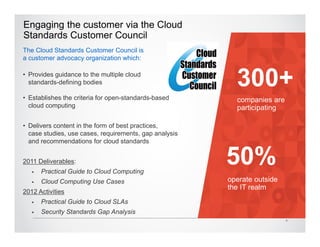
The Cloud Standards Customer Council is
a customer advocacy organization which:

• Provides guidance to the multiple cloud
  standards-defining bodies                               300+
• Establishes the criteria for open-standards-based       companies are
  cloud computing                                         participating

• Delivers content in the form of best practices,
  case studies, use cases, requirements, gap analysis
  and recommendations for cloud standards


2011 Deliverables:
      Practical Guide to Cloud Computing
                                                        50%
      Cloud Computing Use Cases                         operate outside
                                                        the IT realm
2012 Activities
      Practical Guide to Cloud SLAs
      Security Standards Gap Analysis
                                                                          3
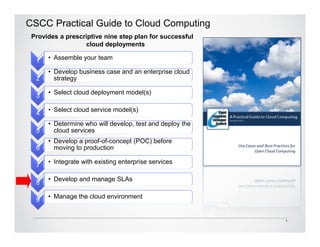
CSCC Practical Guide to Cloud Computing
 Provides a prescriptive nine step plan for successful
                  cloud deployments

      • Assemble your team
  1
      • Develop business case and an enterprise cloud
  2     strategy

      • Select cloud deployment model(s)
  3

      • Select cloud service model(s)
  4
      • Determine who will develop, test and deploy the
  5     cloud services
      • Develop a proof-of-concept (POC) before
  6     moving to production

      • Integrate with existing enterprise services
  7

      • Develop and manage SLAs
  8

      • Manage the cloud environment
  9


                                                          4
Cloud Service Level Agreements
 Current Landscape
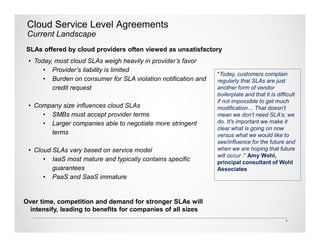
SLAs offered by cloud providers often viewed as unsatisfactory
 • Today, most cloud SLAs weigh heavily in provider’s favor
      • Provider’s liability is limited
                                                                "Today, customers complain
      • Burden on consumer for SLA violation notification and   regularly that SLAs are just
         credit request                                         another form of vendor
                                                                boilerplate and that it is difficult
                                                                if not impossible to get much
 • Company size influences cloud SLAs                           modification… That doesn’t
     • SMBs must accept provider terms                          mean we don’t need SLA’s; we
     • Larger companies able to negotiate more stringent        do. It's important we make it
                                                                clear what is going on now
       terms                                                    versus what we would like to
                                                                see/influence for the future and
 • Cloud SLAs vary based on service model                       when we are hoping that future
                                                                will occur ." Amy Wohl,
      • IaaS most mature and typically contains specific        principal consultant of Wohl
         guarantees                                             Associates
      • PaaS and SaaS immature


Over time, competition and demand for stronger SLAs will
 intensify, leading to benefits for companies of all sizes
                                                                                               5
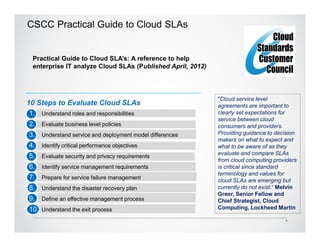
CSCC Practical Guide to Cloud SLAs


 Practical Guide to Cloud SLA’s: A reference to help
 enterprise IT analyze Cloud SLAs (Published April, 2012)


                                                            "Cloud service level
10 Steps to Evaluate Cloud SLAs                             agreements are important to
1.   Understand roles and responsibilities                  clearly set expectations for
                                                            service between cloud
2.   Evaluate business level policies                       consumers and providers.
3.   Understand service and deployment model differences    Providing guidance to decision
                                                            makers on what to expect and
4.   Identify critical performance objectives               what to be aware of as they
                                                            evaluate and compare SLAs
5.   Evaluate security and privacy requirements
                                                            from cloud computing providers
6.   Identify service management requirements               is critical since standard
                                                            terminology and values for
7.   Prepare for service failure management
                                                            cloud SLAs are emerging but
8.   Understand the disaster recovery plan                  currently do not exist.“ Melvin
                                                            Greer, Senior Fellow and
9.   Define an effective management process                 Chief Strategist, Cloud
10. Understand the exit process                             Computing, Lockheed Martin

                                                                                      6
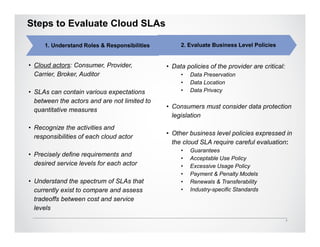
Steps to Evaluate Cloud SLAs

     1. Understand Roles & Responsibilities        2. Evaluate Business Level Policies


• Cloud actors: Consumer, Provider,           • Data policies of the provider are critical:
  Carrier, Broker, Auditor                         •   Data Preservation
                                                   •   Data Location
• SLAs can contain various expectations            •   Data Privacy
  between the actors and are not limited to
                                              • Consumers must consider data protection
  quantitative measures
                                                legislation
• Recognize the activities and
                                              • Other business level policies expressed in
  responsibilities of each cloud actor
                                                the cloud SLA require careful evaluation:
                                                   •   Guarantees
• Precisely define requirements and
                                                   •   Acceptable Use Policy
  desired service levels for each actor            •   Excessive Usage Policy
                                                   •   Payment & Penalty Models
• Understand the spectrum of SLAs that             •   Renewals & Transferability
  currently exist to compare and assess            •   Industry-specific Standards
  tradeoffs between cost and service
  levels
                                                                                              7
Steps to Evaluate Cloud SLAs
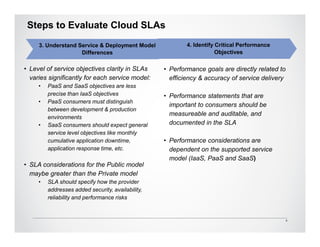
     3. Understand Service & Deployment Model              4. Identify Critical Performance
                    Differences                                        Objectives

• Level of service objectives clarity in SLAs      • Performance goals are directly related to
  varies significantly for each service model:       efficiency & accuracy of service delivery
     •   PaaS and SaaS objectives are less
         precise than IaaS objectives              • Performance statements that are
     •   PaaS consumers must distinguish
                                                     important to consumers should be
         between development & production
                                                     measureable and auditable, and
         environments
     •   SaaS consumers should expect general        documented in the SLA
         service level objectives like monthly
         cumulative application downtime,          • Performance considerations are
         application response time, etc.             dependent on the supported service
                                                     model (IaaS, PaaS and SaaS)
• SLA considerations for the Public model
  maybe greater than the Private model
     •   SLA should specify how the provider
         addresses added security, availability,
         reliability and performance risks


                                                                                                 8
Steps to Evaluate Cloud SLAs
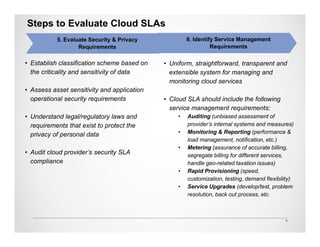
           5. Evaluate Security & Privacy             6. Identify Service Management
                   Requirements                                 Requirements

• Establish classification scheme based on   • Uniform, straightforward, transparent and
  the criticality and sensitivity of data      extensible system for managing and
                                               monitoring cloud services
• Assess asset sensitivity and application
  operational security requirements          • Cloud SLA should include the following
                                               service management requirements:
• Understand legal/regulatory laws and            •   Auditing (unbiased assessment of
  requirements that exist to protect the              provider’s internal systems and measures)
  privacy of personal data                        •   Monitoring & Reporting (performance &
                                                      load management, notification, etc.)
                                                  •   Metering (assurance of accurate billing,
• Audit cloud provider’s security SLA                 segregate billing for different services,
  compliance                                          handle geo-related taxation issues)
                                                  •   Rapid Provisioning (speed,
                                                      customization, testing, demand flexibility)
                                                  •   Service Upgrades (develop/test, problem
                                                      resolution, back out process, etc.


                                                                                             9
Steps to Evaluate Cloud SLAs
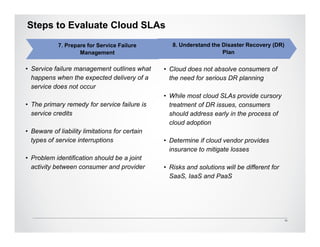
            7. Prepare for Service Failure         8. Understand the Disaster Recovery (DR)
                    Management                                       Plan

• Service failure management outlines what      • Cloud does not absolve consumers of
  happens when the expected delivery of a         the need for serious DR planning
  service does not occur
                                                • While most cloud SLAs provide cursory
• The primary remedy for service failure is       treatment of DR issues, consumers
  service credits                                 should address early in the process of
                                                  cloud adoption
• Beware of liability limitations for certain
  types of service interruptions                • Determine if cloud vendor provides
                                                  insurance to mitigate losses
• Problem identification should be a joint
  activity between consumer and provider        • Risks and solutions will be different for
                                                  SaaS, IaaS and PaaS


                                                                                              10
Steps to Evaluate Cloud SLAs

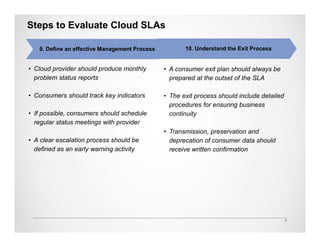
   9. Define an effective Management Process          10. Understand the Exit Process


• Cloud provider should produce monthly        • A consumer exit plan should always be
  problem status reports                         prepared at the outset of the SLA

• Consumers should track key indicators        • The exit process should include detailed
                                                 procedures for ensuring business
• If possible, consumers should schedule         continuity
  regular status meetings with provider
                                               • Transmission, preservation and
• A clear escalation process should be           deprecation of consumer data should
  defined as an early warning activity           receive written confirmation


                                                                                            11
CSCC Resources and Channels for Feedback / Comment


 Member Application: http://www.cloud-council.org/application
   – Membership is free to qualifying companies
 Web Site: http://www.cloud-council.org
 OMG Contact / Sponsorship: Ken Berk - ken.berk@omg.org
 Join a CSCC Working Group: http://www.cloud-council.org/workinggroups.htm
 Resources:
   –   Practical Guide to Cloud Computing V1:
       http://www.cloudstandardscustomercouncil.org/10052011.htm
   –   Practical Guide to Cloud SLAs V1:
       http://www.cloudstandardscustomercouncil.org/04102012.htm
   –   Use Cases V1: http://www.cloudstandardscustomercouncil.org/Cloud_Computing_Use_Cases-
       2.htm


                                                                                           12
Melvin Greer
        Senior Fellow, Lockheed Martin
        Chief Strategist Cloud Computing

        Chair, Cloud Standards Customer Council
        Steering Committee

        Contact: www.melvingreer.com


Disclaimer: the views expressed in this presentation are the author’s
alone, and do not necessarily represent the official view of any
component or institution with which he is affiliated


                                                                        13

Pg cloud sla040512mgreer

  • 1.
  • 2.
    The Practical Guideto Cloud Service Level Agreements Melvin Greer Senior Fellow, Lockheed Martin Chair, Cloud Standards Customer Council Steering Committee April 10, 2012 2
  • 3.
    Engaging the customervia the Cloud Standards Customer Council The Cloud Standards Customer Council is a customer advocacy organization which: • Provides guidance to the multiple cloud standards-defining bodies 300+ • Establishes the criteria for open-standards-based companies are cloud computing participating • Delivers content in the form of best practices, case studies, use cases, requirements, gap analysis and recommendations for cloud standards 2011 Deliverables: Practical Guide to Cloud Computing 50% Cloud Computing Use Cases operate outside the IT realm 2012 Activities Practical Guide to Cloud SLAs Security Standards Gap Analysis 3
  • 4.
    CSCC Practical Guideto Cloud Computing Provides a prescriptive nine step plan for successful cloud deployments • Assemble your team 1 • Develop business case and an enterprise cloud 2 strategy • Select cloud deployment model(s) 3 • Select cloud service model(s) 4 • Determine who will develop, test and deploy the 5 cloud services • Develop a proof-of-concept (POC) before 6 moving to production • Integrate with existing enterprise services 7 • Develop and manage SLAs 8 • Manage the cloud environment 9 4
  • 5.
    Cloud Service LevelAgreements Current Landscape SLAs offered by cloud providers often viewed as unsatisfactory • Today, most cloud SLAs weigh heavily in provider’s favor • Provider’s liability is limited "Today, customers complain • Burden on consumer for SLA violation notification and regularly that SLAs are just credit request another form of vendor boilerplate and that it is difficult if not impossible to get much • Company size influences cloud SLAs modification… That doesn’t • SMBs must accept provider terms mean we don’t need SLA’s; we • Larger companies able to negotiate more stringent do. It's important we make it clear what is going on now terms versus what we would like to see/influence for the future and • Cloud SLAs vary based on service model when we are hoping that future will occur ." Amy Wohl, • IaaS most mature and typically contains specific principal consultant of Wohl guarantees Associates • PaaS and SaaS immature Over time, competition and demand for stronger SLAs will intensify, leading to benefits for companies of all sizes 5
  • 6.
    CSCC Practical Guideto Cloud SLAs Practical Guide to Cloud SLA’s: A reference to help enterprise IT analyze Cloud SLAs (Published April, 2012) "Cloud service level 10 Steps to Evaluate Cloud SLAs agreements are important to 1. Understand roles and responsibilities clearly set expectations for service between cloud 2. Evaluate business level policies consumers and providers. 3. Understand service and deployment model differences Providing guidance to decision makers on what to expect and 4. Identify critical performance objectives what to be aware of as they evaluate and compare SLAs 5. Evaluate security and privacy requirements from cloud computing providers 6. Identify service management requirements is critical since standard terminology and values for 7. Prepare for service failure management cloud SLAs are emerging but 8. Understand the disaster recovery plan currently do not exist.“ Melvin Greer, Senior Fellow and 9. Define an effective management process Chief Strategist, Cloud 10. Understand the exit process Computing, Lockheed Martin 6
  • 7.
    Steps to EvaluateCloud SLAs 1. Understand Roles & Responsibilities 2. Evaluate Business Level Policies • Cloud actors: Consumer, Provider, • Data policies of the provider are critical: Carrier, Broker, Auditor • Data Preservation • Data Location • SLAs can contain various expectations • Data Privacy between the actors and are not limited to • Consumers must consider data protection quantitative measures legislation • Recognize the activities and • Other business level policies expressed in responsibilities of each cloud actor the cloud SLA require careful evaluation: • Guarantees • Precisely define requirements and • Acceptable Use Policy desired service levels for each actor • Excessive Usage Policy • Payment & Penalty Models • Understand the spectrum of SLAs that • Renewals & Transferability currently exist to compare and assess • Industry-specific Standards tradeoffs between cost and service levels 7
  • 8.
    Steps to EvaluateCloud SLAs 3. Understand Service & Deployment Model 4. Identify Critical Performance Differences Objectives • Level of service objectives clarity in SLAs • Performance goals are directly related to varies significantly for each service model: efficiency & accuracy of service delivery • PaaS and SaaS objectives are less precise than IaaS objectives • Performance statements that are • PaaS consumers must distinguish important to consumers should be between development & production measureable and auditable, and environments • SaaS consumers should expect general documented in the SLA service level objectives like monthly cumulative application downtime, • Performance considerations are application response time, etc. dependent on the supported service model (IaaS, PaaS and SaaS) • SLA considerations for the Public model maybe greater than the Private model • SLA should specify how the provider addresses added security, availability, reliability and performance risks 8
  • 9.
    Steps to EvaluateCloud SLAs 5. Evaluate Security & Privacy 6. Identify Service Management Requirements Requirements • Establish classification scheme based on • Uniform, straightforward, transparent and the criticality and sensitivity of data extensible system for managing and monitoring cloud services • Assess asset sensitivity and application operational security requirements • Cloud SLA should include the following service management requirements: • Understand legal/regulatory laws and • Auditing (unbiased assessment of requirements that exist to protect the provider’s internal systems and measures) privacy of personal data • Monitoring & Reporting (performance & load management, notification, etc.) • Metering (assurance of accurate billing, • Audit cloud provider’s security SLA segregate billing for different services, compliance handle geo-related taxation issues) • Rapid Provisioning (speed, customization, testing, demand flexibility) • Service Upgrades (develop/test, problem resolution, back out process, etc. 9
  • 10.
    Steps to EvaluateCloud SLAs 7. Prepare for Service Failure 8. Understand the Disaster Recovery (DR) Management Plan • Service failure management outlines what • Cloud does not absolve consumers of happens when the expected delivery of a the need for serious DR planning service does not occur • While most cloud SLAs provide cursory • The primary remedy for service failure is treatment of DR issues, consumers service credits should address early in the process of cloud adoption • Beware of liability limitations for certain types of service interruptions • Determine if cloud vendor provides insurance to mitigate losses • Problem identification should be a joint activity between consumer and provider • Risks and solutions will be different for SaaS, IaaS and PaaS 10
  • 11.
    Steps to EvaluateCloud SLAs 9. Define an effective Management Process 10. Understand the Exit Process • Cloud provider should produce monthly • A consumer exit plan should always be problem status reports prepared at the outset of the SLA • Consumers should track key indicators • The exit process should include detailed procedures for ensuring business • If possible, consumers should schedule continuity regular status meetings with provider • Transmission, preservation and • A clear escalation process should be deprecation of consumer data should defined as an early warning activity receive written confirmation 11
  • 12.
    CSCC Resources andChannels for Feedback / Comment Member Application: http://www.cloud-council.org/application – Membership is free to qualifying companies Web Site: http://www.cloud-council.org OMG Contact / Sponsorship: Ken Berk - ken.berk@omg.org Join a CSCC Working Group: http://www.cloud-council.org/workinggroups.htm Resources: – Practical Guide to Cloud Computing V1: http://www.cloudstandardscustomercouncil.org/10052011.htm – Practical Guide to Cloud SLAs V1: http://www.cloudstandardscustomercouncil.org/04102012.htm – Use Cases V1: http://www.cloudstandardscustomercouncil.org/Cloud_Computing_Use_Cases- 2.htm 12
  • 13.
    Melvin Greer Senior Fellow, Lockheed Martin Chief Strategist Cloud Computing Chair, Cloud Standards Customer Council Steering Committee Contact: www.melvingreer.com Disclaimer: the views expressed in this presentation are the author’s alone, and do not necessarily represent the official view of any component or institution with which he is affiliated 13