Performance and Statistics Collector (Perfstat 7-mode)
7.36 UNIX/Linux, 7.36 Windows
Windows
rsh may hang if there are no remaining ports on the filer for the stderr socket. The filer will indicate "couldn't
connect second port". Perfstat should detect and abort the command, but output from the command is lost, and in
rare circumstances the command may have to be killed by hand.
Aborted instances of rsh may cause console warnings about inaccessible files.
Windows disk performance counters are assumed to be enabled. Older versions of windows may require explicit
activation with diskperf -y and a reboot.
Perfstat on Windows XP Service Pack 2 will display "Terminal read..." errors. This is a problem in rsh.exe - see
Microsoft KB article: KB892099.

Perfstat: Version 7.36 4-2011
- perfstat.exe is a tool for capturing performance
and configuration statistics.
- Output from perfstat is sent to standard out and
is typically captured in an output file for
later analysis.
- perfstat.exe is capable of capturing info from one Windows host and
multiple NetApp storage controllers simultaneously.
- For controller data capture, the user must have RSH or
SSH privileges to the controller. Unless instructed otherwise,
perfstat will use 'root' as the default username to communicate
remotely with storage controllers.



Usage: (basic options list)
perfstat [-f controllername] [-t time] > perfstat.out
perfstat –f akfiler7.ak.providence.org -t 5 -I 5 -I > perfstat"Date_%date:~4,2%%date:~7,2%%date:~10,4%Time_%time:~0,2%h%time:~3,2%m%time:~6,2%s"

H:NAUtilyperfstat7_20110411.exe -f NAS2854 -t 5 -I 5 -I > perfstat"NAS2854_Date_%date:~4,2%%date:~7,2%%date:~10,4%Time_%time:~0,2%h%time:~3,2%m%time:~6,2%s"
where:
-f controllername - host name or IP address of target controller
-t time - collect performance data for 'time' minutes
Simple Example:
Capture data on local host and one controller for 5 minutes:
perfstat -f controller1 -t 5 > perfstat.out
Capture data on multiple hosts and controllers for 10 minutes:
perfstat -f controller1,controller2 -t 10 > perfstat.out
Capture data for five 1 minute iterations, with 10 minutes between
successive iterations:
perfstat -f controller1 -t 1 -i 5,10 > perfstat.out
Usage: (more
perfstat
[-f
[-t
[-i

complete options list)

controllername[,controllername1,controllername2,...]]
time] (sample time per iteration, default 2)
n[,m]] (repeat n times with m minutes between samples,
defaults: n=1,m=0)
[-I] (force perfstat to execute all iterations)
[-l login[:password]] (rsh/ssh login and password for rsh only)
[-F] (do not capture information from local host)
[-V] (do not capture vfiler data)
[-p] (capture performance data only, no config info
[-c] (capture config info only, no performance data
[-L] (capture logs - beware verbose output
[-E cmd[,cmd2,cmd3]... (exclude commands)
[-P domain1[,domain2,domain3...] (capture profiles,
use "-P flat" to capture complete profile)
[-v] (print version info only)
[-q] (quiet mode - suppress all console input)
[-x] (print what commands will be issued without actually
issuing them
[-d] (debug mode - beware verbose output)
[-m msinfo_path] (path to msinfo32.exe)
[-S pw:|kf:] (use ssh instead of rsh)
[-k] (disable collection of "stutter" statit; i.e.,
collect 1 statit report that covers the entire
iteration)
[-K] (collect only "stutter" statit reports over
the entire iteration)
[-T default | sk_mod,level[,sk_mod2,level,...]] (collect sktrace)
[-B sk_buffer_size] (specify sktrace buffer size)
[-C seconds] (the number of seconds to wait on command processesdefault is 70 seconds)
[-w minutes] (total number of minutes to wait for perfstat
execution to complete. Default will be 5 minutes)

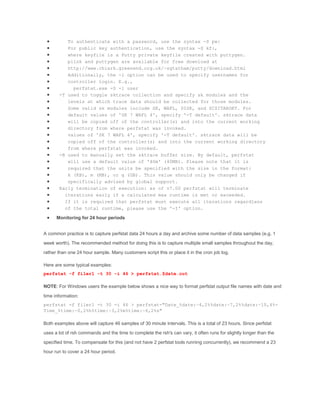
Notes:
-P saves profiling data in a subdirectory 'gmon' of the current working
directory and deletes any existing gmon files on the controller
-E exludes all foreground commands that have at least the cmd as a
substring; E.g.
-E snap,vol
- excludes all 'snap*' and 'vol*' commands
-E "snap list -v" - excludes only the command 'snap list -v'
-S requires the plink ssh client to be available in the working path
To authenticate with a password, use the syntax -S pw:
For public key authentication, use the syntax -S kf:,
where keyfile is a Putty private keyfile created with puttygen.
plink and puttygen are available for free download at
http://www.chiark.greenend.org.uk/~sgtatham/putty/download.html
Additionally, the -l option can be used to specify usernames for
controller login. E.g.,
perfstat.exe -S -l user
-T used to toggle sktrace collection and specify sk modules and the
levels at which trace data should be collected for those modules.
Some valid sk modules include SK, WAFL, DISK, and SCSITARGET. For
default values of 'SK 7 WAFL 4', specify '-T default'. sktrace data
will be copied off of the controller(s) and into the current working
directory from where perfstat was invoked.
values of 'SK 7 WAFL 4', specify '-T default'. sktrace data will be
copied off of the controller(s) and into the current working directory
from where perfstat was invoked.
-B used to manually set the sktrace buffer size. By default, perfstat
will use a default value of '40m' (40MB). Please note that it is
required that the units be specified with the size in the format:
k (KB), m (MB), or g (GB). This value should only be changed if
specifically advised by global support.
Early termination of execution: as of v7.00 perfstat will terminate
iterations early if a calculated max runtime is met or exceeded.
If it is required that perfstat must execute all iterations regardless
of the total runtime, please use the '-I' option.
Monitoring for 24 hour periods
A common practice is to capture perfstat data 24 hours a day and archive some number of data samples (e.g. 1
week worth). The recommended method for doing this is to capture multiple small samples throughout the day,
rather than one 24 hour sample. Many customers script this or place it in the cron job log.
Here are some typical examples:
perfstat -f filer1 -t 30 -i 46 > perfstat.$date.out
NOTE: For Windows users the example below shows a nice way to format perfstat output file names with date and
time information:
perfstat -f filer1 -t 30 -i 46 > perfstat-"Date_%date:~4,2%%date:~7,2%%date:~10,4%Time_%time:~0,2%h%time:~3,2%m%time:~6,2%s"
Both examples above will capture 46 samples of 30 minute intervals. This is a total of 23 hours. Since perfstat
uses a lot of rsh commands and the time to complete the rsh's can vary, it often runs for slightly longer than the
specified time. To compensate for this (and not have 2 perfstat tools running concurrently), we recommend a 23
hour run to cover a 24 hour period.
H:NAUtily>perfstat7_20110411.exe -f NAS2854 -t 5 -I 5 -I > perfstat-"NAS2854_D
ate_%date:~4,2%%date:~7,2%%date:~10,4%-Time_%time:~0,2%h%time:~3,2%m%time:~6,2%s
"
Perfstat v7.36 (4-2011)
RSH to filer NAS2854 fails! Quitting.

H:NAUtily>perfstat7_20110411.exe -f NAS2854.providence.org -t 5 -I 5 -I > perf
stat-"NAS2854_Date_%date:~4,2%%date:~7,2%%date:~10,4%-Time_%time:~0,2%h%time:~3,
2%m%time:~6,2%s"
Perfstat v7.36 (4-2011)
RSH to filer NAS2854.providence.org fails! Quitting.

H:NAUtily>perfstat7_20110411.exe -f 170.220.66.13 -t 5 -I 5 -I > perfstat-"NAS
2854_Date_%date:~4,2%%date:~7,2%%date:~10,4%-Time_%time:~0,2%h%time:~3,2%m%time:
~6,2%s"
Perfstat v7.36 (4-2011)
RSH to filer 170.220.66.13 fails! Quitting.

H:NAUtily>perfstat7_20110411.exe -f akfiler5.ak.providence.org -t 5 -I 5 -I >
perfstat-"NAS2854_Date_%date:~4,2%%date:~7,2%%date:~10,4%-Time_%time:~0,2%h%time
:~3,2%m%time:~6,2%s"
Perfstat v7.36 (4-2011)
RSH to filer akfiler5.ak.providence.org fails! Quitting.

H:NAUtily>

Perf stat windows

  • 1.
    Performance and StatisticsCollector (Perfstat 7-mode) 7.36 UNIX/Linux, 7.36 Windows Windows rsh may hang if there are no remaining ports on the filer for the stderr socket. The filer will indicate "couldn't connect second port". Perfstat should detect and abort the command, but output from the command is lost, and in rare circumstances the command may have to be killed by hand. Aborted instances of rsh may cause console warnings about inaccessible files. Windows disk performance counters are assumed to be enabled. Older versions of windows may require explicit activation with diskperf -y and a reboot. Perfstat on Windows XP Service Pack 2 will display "Terminal read..." errors. This is a problem in rsh.exe - see Microsoft KB article: KB892099. Perfstat: Version 7.36 4-2011 - perfstat.exe is a tool for capturing performance and configuration statistics. - Output from perfstat is sent to standard out and is typically captured in an output file for later analysis. - perfstat.exe is capable of capturing info from one Windows host and multiple NetApp storage controllers simultaneously. - For controller data capture, the user must have RSH or SSH privileges to the controller. Unless instructed otherwise, perfstat will use 'root' as the default username to communicate remotely with storage controllers.  Usage: (basic options list) perfstat [-f controllername] [-t time] > perfstat.out perfstat –f akfiler7.ak.providence.org -t 5 -I 5 -I > perfstat"Date_%date:~4,2%%date:~7,2%%date:~10,4%Time_%time:~0,2%h%time:~3,2%m%time:~6,2%s" H:NAUtilyperfstat7_20110411.exe -f NAS2854 -t 5 -I 5 -I > perfstat"NAS2854_Date_%date:~4,2%%date:~7,2%%date:~10,4%Time_%time:~0,2%h%time:~3,2%m%time:~6,2%s" where: -f controllername - host name or IP address of target controller -t time - collect performance data for 'time' minutes Simple Example: Capture data on local host and one controller for 5 minutes: perfstat -f controller1 -t 5 > perfstat.out Capture data on multiple hosts and controllers for 10 minutes: perfstat -f controller1,controller2 -t 10 > perfstat.out Capture data for five 1 minute iterations, with 10 minutes between successive iterations: perfstat -f controller1 -t 1 -i 5,10 > perfstat.out
  • 2.
    Usage: (more perfstat [-f [-t [-i complete optionslist) controllername[,controllername1,controllername2,...]] time] (sample time per iteration, default 2) n[,m]] (repeat n times with m minutes between samples, defaults: n=1,m=0) [-I] (force perfstat to execute all iterations) [-l login[:password]] (rsh/ssh login and password for rsh only) [-F] (do not capture information from local host) [-V] (do not capture vfiler data) [-p] (capture performance data only, no config info [-c] (capture config info only, no performance data [-L] (capture logs - beware verbose output [-E cmd[,cmd2,cmd3]... (exclude commands) [-P domain1[,domain2,domain3...] (capture profiles, use "-P flat" to capture complete profile) [-v] (print version info only) [-q] (quiet mode - suppress all console input) [-x] (print what commands will be issued without actually issuing them [-d] (debug mode - beware verbose output) [-m msinfo_path] (path to msinfo32.exe) [-S pw:|kf:] (use ssh instead of rsh) [-k] (disable collection of "stutter" statit; i.e., collect 1 statit report that covers the entire iteration) [-K] (collect only "stutter" statit reports over the entire iteration) [-T default | sk_mod,level[,sk_mod2,level,...]] (collect sktrace) [-B sk_buffer_size] (specify sktrace buffer size) [-C seconds] (the number of seconds to wait on command processesdefault is 70 seconds) [-w minutes] (total number of minutes to wait for perfstat execution to complete. Default will be 5 minutes) Notes: -P saves profiling data in a subdirectory 'gmon' of the current working directory and deletes any existing gmon files on the controller -E exludes all foreground commands that have at least the cmd as a substring; E.g. -E snap,vol - excludes all 'snap*' and 'vol*' commands -E "snap list -v" - excludes only the command 'snap list -v' -S requires the plink ssh client to be available in the working path
  • 3.
    To authenticate witha password, use the syntax -S pw: For public key authentication, use the syntax -S kf:, where keyfile is a Putty private keyfile created with puttygen. plink and puttygen are available for free download at http://www.chiark.greenend.org.uk/~sgtatham/putty/download.html Additionally, the -l option can be used to specify usernames for controller login. E.g., perfstat.exe -S -l user -T used to toggle sktrace collection and specify sk modules and the levels at which trace data should be collected for those modules. Some valid sk modules include SK, WAFL, DISK, and SCSITARGET. For default values of 'SK 7 WAFL 4', specify '-T default'. sktrace data will be copied off of the controller(s) and into the current working directory from where perfstat was invoked. values of 'SK 7 WAFL 4', specify '-T default'. sktrace data will be copied off of the controller(s) and into the current working directory from where perfstat was invoked. -B used to manually set the sktrace buffer size. By default, perfstat will use a default value of '40m' (40MB). Please note that it is required that the units be specified with the size in the format: k (KB), m (MB), or g (GB). This value should only be changed if specifically advised by global support. Early termination of execution: as of v7.00 perfstat will terminate iterations early if a calculated max runtime is met or exceeded. If it is required that perfstat must execute all iterations regardless of the total runtime, please use the '-I' option. Monitoring for 24 hour periods A common practice is to capture perfstat data 24 hours a day and archive some number of data samples (e.g. 1 week worth). The recommended method for doing this is to capture multiple small samples throughout the day, rather than one 24 hour sample. Many customers script this or place it in the cron job log. Here are some typical examples: perfstat -f filer1 -t 30 -i 46 > perfstat.$date.out NOTE: For Windows users the example below shows a nice way to format perfstat output file names with date and time information: perfstat -f filer1 -t 30 -i 46 > perfstat-"Date_%date:~4,2%%date:~7,2%%date:~10,4%Time_%time:~0,2%h%time:~3,2%m%time:~6,2%s" Both examples above will capture 46 samples of 30 minute intervals. This is a total of 23 hours. Since perfstat uses a lot of rsh commands and the time to complete the rsh's can vary, it often runs for slightly longer than the specified time. To compensate for this (and not have 2 perfstat tools running concurrently), we recommend a 23 hour run to cover a 24 hour period.
  • 4.
    H:NAUtily>perfstat7_20110411.exe -f NAS2854-t 5 -I 5 -I > perfstat-"NAS2854_D ate_%date:~4,2%%date:~7,2%%date:~10,4%-Time_%time:~0,2%h%time:~3,2%m%time:~6,2%s " Perfstat v7.36 (4-2011) RSH to filer NAS2854 fails! Quitting. H:NAUtily>perfstat7_20110411.exe -f NAS2854.providence.org -t 5 -I 5 -I > perf stat-"NAS2854_Date_%date:~4,2%%date:~7,2%%date:~10,4%-Time_%time:~0,2%h%time:~3, 2%m%time:~6,2%s" Perfstat v7.36 (4-2011) RSH to filer NAS2854.providence.org fails! Quitting. H:NAUtily>perfstat7_20110411.exe -f 170.220.66.13 -t 5 -I 5 -I > perfstat-"NAS 2854_Date_%date:~4,2%%date:~7,2%%date:~10,4%-Time_%time:~0,2%h%time:~3,2%m%time: ~6,2%s" Perfstat v7.36 (4-2011) RSH to filer 170.220.66.13 fails! Quitting. H:NAUtily>perfstat7_20110411.exe -f akfiler5.ak.providence.org -t 5 -I 5 -I > perfstat-"NAS2854_Date_%date:~4,2%%date:~7,2%%date:~10,4%-Time_%time:~0,2%h%time :~3,2%m%time:~6,2%s" Perfstat v7.36 (4-2011) RSH to filer akfiler5.ak.providence.org fails! Quitting. H:NAUtily>