Business processes with urgent need to implement
and adopt cloud technology and to integrate them
into the existing core ERP.
Main topics to consider in choosing the right cloud
provider and the best SLA.
IDCCloudLeadershipForum-
Sofia,16thofMay2013
MinkaFudulova
1
Cloud Computing and Company’s Business Processes
2
Main characteristics Cloud technology is promising/
offering to Business
• Availability – 99,999%; 24/7
• Reliability
• Performance
• Elasticity
• Scalability – be always able to use what you need (scale up and down)
without to think about resources and capital expenditure.
• ROI / TCO – pay for what you have used
• Better Security of data against third parties
• Outsourced Privacy of core processes, data, business development
IDCCloudLeadershipForum-
Sofia,16thofMay2013
MinkaFudulova
Cloud Computing and Company’s Business Processes
3
Basic financial benefits:
• Cost savings from using cloud technology – When migrating ERP resources
or parts into a public/private cloud infrastructure, the number of servers running in-house
and the number of racks used will reduce significantly. Estimated up to 70% ROI for a Tier 3
workload and about 50% for Tier 1.
• Cost Savings from labor and application maintenance – Cloud technology
will reduce costs for application development and maintenance. Highly reduced need for
installed software as cloud-hosted software can be made available to any workstation with an
internet connection, which significantly lowers the required budget for software.
• Cost savings from external hosting – Hosting on-premises means acquiring own
hardware which is considered as a capital expenditure and is usually larger planned than the
current need. Availing of cloud hosting is considered as an operational expenditure because
due to pay-per-use models.
IDCCloudLeadershipForum-
Sofia,16thofMay2013
MinkaFudulova
Cloud Computing and Company’s Business Processes
IDCCloudLeadershipForum-
Sofia,16thofMay2013
MinkaFudulova
4
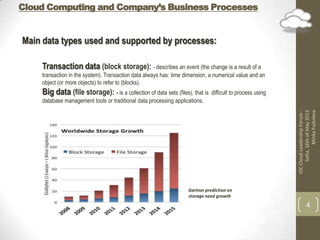
Main data types used and supported by processes:
Transaction data (block storage): - describes an event (the change is a result of a
transaction in the system). Transaction data always has: time dimension, a numerical value and an
object (or more objects) to refer to (blocks).
Big data (file storage): - is a collection of data sets (files), that is difficult to process using
database management tools or traditional data processing applications.
Gartner prediction on
storage need growth
Cloud Computing and Company’s Business Processes
IDCCloudLeadershipForum-
Sofia,16thofMay2013
MinkaFudulova
5
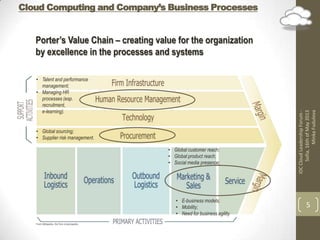
Porter’s Value Chain – creating value for the organization
by excellence in the processes and systems
From Wikipedia, the free encyclopedia
• Talent and performance
management;
• Managing HR
processes (esp.
recruitment,
e-learning).
• Global sourcing;
• Supplier risk management.
• E-business models;
• Mobility;
• Need for business agility.
• Global customer reach;
• Global product reach;
• Social media presence;
Cloud Computing and Company’s Business Processes
IDCCloudLeadershipForum-
Sofia,16thofMay2013
MinkaFudulova
6
Main strategies on the way to cloud adoption:
On-Premise: Your data and software applications are held in-house where
all servers, connections, access, and data are controlled and hosted
internally. You can still continue doing so and use cloud technology on your
premises.
On-Demand: Your data and applications are available via the web where
servers and data are hosted by the application vendor (SaaS). You have
outsourced infrastructure and application data management.
Hybrid Solution: Solution that combines best of both extreme options -
data and applications can be hosted by a third-party, but ownership is still
held internally. Sensitive data are controlled by your trusted staff, you can
even host some of it in-house using cloud technology/ storage.
Cloud Computing and Company’s Business Processes
IDCCloudLeadershipForum-
Sofia,16thofMay2013
MinkaFudulova
7
Questions to ask yourself before the final decision to
migrate to the Cloud is made:
1. Are my process data an important asset to my business? Do I
need better availability, reliability, performance etc.?
2. What is the total cost of the solution over next 3 to 5 years?
(licenses, extra functionality, current data center vs. external
hosting, configuration and process mapping, training and support)
3. Do I need data mobility in the field where my direct business
takes place?
4. How can I integrate the on-demand solution with my
processes running on-premise (existing back-office data)?
Cloud Provider and SLA (service level agreements)
IDCCloudLeadershipForum-
Sofia,16thofMay2013
MinkaFudulova
8
What is Service Level Agreement (SLA)
(based on Cloud Computing Use Cases Whitepaper by IBM)
- List of services the provider commits to deliver, i.e. complete definition
of each service;
- Metrics to evaluate whether the provider is delivering the service and
an auditing mechanism to monitor the service.
- Responsibilities of the provider and the customer, i.e. remedies to both
if the SLA conditions are not met.
- NB.: Most providers offer standard SLA. Negotiations might be
quite a difficult process.
Cloud Provider and SLA (service level agreements)
IDCCloudLeadershipForum-
Sofia,16thofMay2013
MinkaFudulova
9
Which are the critical topics to clarify before signing the SLA?
(based on Cloud Computing Use Cases Whitepaper by IBM)
Security: Provider and consumer must understand and agree on security requirements and what
kind of controls are necessary.
Data encryption: Data must be encrypted while in motion and while at rest. Specific algorithms
are not likely to be provided to the customer.
Privacy: Basic privacy concerns should be addressed by requirements such as data encryption,
retention, and deletion. Isolation of data must be also clear.
Regulatory compliance: If regulations must be enforced (i.e. due to a given data type), the
cloud provider must be able to prove his compliance.
Transparency: Providers must be informing customers in case of SLA breaches (infrastructure
issues like outages, performance problems, security incidents).
Cloud Provider and SLA (service level agreements)
IDCCloudLeadershipForum-
Sofia,16thofMay2013
MinkaFudulova
10
Which are the critical topics to clarify before signing the SLA?
Certification: The provider should be responsible for having required certifications and keeping it
up-to-date. (Especially data center certifications).
Performance definitions: Availability of all resources (i.e. servers on any continent etc.)
Monitoring: Proofs given by the provider or third party monitoring.
Auditability: The SLA should make clear how, when and by whom audits should be performed.
Human interaction: Specialized staff should be made available to the customer in case of a
need.
Cloud Provider and SLA (service level agreements)
IDCCloudLeadershipForum-
Sofia,16thofMay2013
MinkaFudulova
11
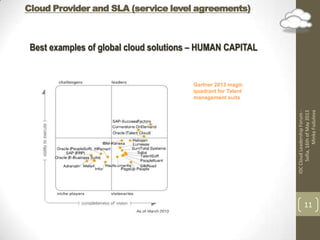
Best examples of global cloud solutions – HUMAN CAPITAL
Gartner 2013 magic
quadrant for Talent
management suits
Cloud Provider and SLA (service level agreements)
IDCCloudLeadershipForum-
Sofia,16thofMay2013
MinkaFudulova
12
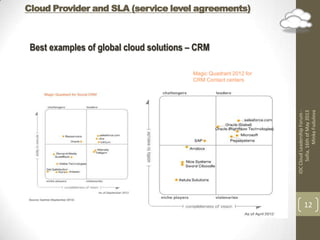
Magic Quadrant 2012 for
CRM Contact centers
Best examples of global cloud solutions – CRM
Cloud Provider and SLA (service level agreements)
IDCCloudLeadershipForum-
Sofia,16thofMay2013
MinkaFudulova
13
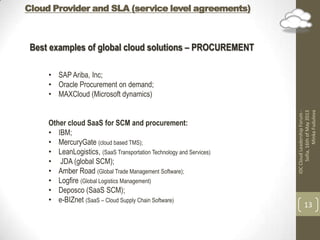
Best examples of global cloud solutions – PROCUREMENT
• SAP Ariba, Inc;
• Oracle Procurement on demand;
• MAXCloud (Microsoft dynamics)
Other cloud SaaS for SCM and procurement:
• IBM;
• MercuryGate (cloud based TMS);
• LeanLogistics, (SaaS Transportation Technology and Services)
• JDA (global SCM);
• Amber Road (Global Trade Management Software);
• Logfire (Global Logistics Management)
• Deposco (SaaS SCM);
• e-BIZnet (SaaS – Cloud Supply Chain Software)
fudulovam@gmail.com
minka@kloudpros.com
Skype: minka.fudulova
Cloud Computing and Company’s Business Processes
IDCCloudLeadershipForum-
Sofia,16thofMay2013
MinkaFudulova
14
Questions?
Let’s meet among the clouds soon:
Thank you!
Cloud Provider and SLA (service level agreements)

Cloud cpmputing and busness processes

  • 1.
    Business processes withurgent need to implement and adopt cloud technology and to integrate them into the existing core ERP. Main topics to consider in choosing the right cloud provider and the best SLA. IDCCloudLeadershipForum- Sofia,16thofMay2013 MinkaFudulova 1
  • 2.
    Cloud Computing andCompany’s Business Processes 2 Main characteristics Cloud technology is promising/ offering to Business • Availability – 99,999%; 24/7 • Reliability • Performance • Elasticity • Scalability – be always able to use what you need (scale up and down) without to think about resources and capital expenditure. • ROI / TCO – pay for what you have used • Better Security of data against third parties • Outsourced Privacy of core processes, data, business development IDCCloudLeadershipForum- Sofia,16thofMay2013 MinkaFudulova
  • 3.
    Cloud Computing andCompany’s Business Processes 3 Basic financial benefits: • Cost savings from using cloud technology – When migrating ERP resources or parts into a public/private cloud infrastructure, the number of servers running in-house and the number of racks used will reduce significantly. Estimated up to 70% ROI for a Tier 3 workload and about 50% for Tier 1. • Cost Savings from labor and application maintenance – Cloud technology will reduce costs for application development and maintenance. Highly reduced need for installed software as cloud-hosted software can be made available to any workstation with an internet connection, which significantly lowers the required budget for software. • Cost savings from external hosting – Hosting on-premises means acquiring own hardware which is considered as a capital expenditure and is usually larger planned than the current need. Availing of cloud hosting is considered as an operational expenditure because due to pay-per-use models. IDCCloudLeadershipForum- Sofia,16thofMay2013 MinkaFudulova
  • 4.
    Cloud Computing andCompany’s Business Processes IDCCloudLeadershipForum- Sofia,16thofMay2013 MinkaFudulova 4 Main data types used and supported by processes: Transaction data (block storage): - describes an event (the change is a result of a transaction in the system). Transaction data always has: time dimension, a numerical value and an object (or more objects) to refer to (blocks). Big data (file storage): - is a collection of data sets (files), that is difficult to process using database management tools or traditional data processing applications. Gartner prediction on storage need growth
  • 5.
    Cloud Computing andCompany’s Business Processes IDCCloudLeadershipForum- Sofia,16thofMay2013 MinkaFudulova 5 Porter’s Value Chain – creating value for the organization by excellence in the processes and systems From Wikipedia, the free encyclopedia • Talent and performance management; • Managing HR processes (esp. recruitment, e-learning). • Global sourcing; • Supplier risk management. • E-business models; • Mobility; • Need for business agility. • Global customer reach; • Global product reach; • Social media presence;
  • 6.
    Cloud Computing andCompany’s Business Processes IDCCloudLeadershipForum- Sofia,16thofMay2013 MinkaFudulova 6 Main strategies on the way to cloud adoption: On-Premise: Your data and software applications are held in-house where all servers, connections, access, and data are controlled and hosted internally. You can still continue doing so and use cloud technology on your premises. On-Demand: Your data and applications are available via the web where servers and data are hosted by the application vendor (SaaS). You have outsourced infrastructure and application data management. Hybrid Solution: Solution that combines best of both extreme options - data and applications can be hosted by a third-party, but ownership is still held internally. Sensitive data are controlled by your trusted staff, you can even host some of it in-house using cloud technology/ storage.
  • 7.
    Cloud Computing andCompany’s Business Processes IDCCloudLeadershipForum- Sofia,16thofMay2013 MinkaFudulova 7 Questions to ask yourself before the final decision to migrate to the Cloud is made: 1. Are my process data an important asset to my business? Do I need better availability, reliability, performance etc.? 2. What is the total cost of the solution over next 3 to 5 years? (licenses, extra functionality, current data center vs. external hosting, configuration and process mapping, training and support) 3. Do I need data mobility in the field where my direct business takes place? 4. How can I integrate the on-demand solution with my processes running on-premise (existing back-office data)?
  • 8.
    Cloud Provider andSLA (service level agreements) IDCCloudLeadershipForum- Sofia,16thofMay2013 MinkaFudulova 8 What is Service Level Agreement (SLA) (based on Cloud Computing Use Cases Whitepaper by IBM) - List of services the provider commits to deliver, i.e. complete definition of each service; - Metrics to evaluate whether the provider is delivering the service and an auditing mechanism to monitor the service. - Responsibilities of the provider and the customer, i.e. remedies to both if the SLA conditions are not met. - NB.: Most providers offer standard SLA. Negotiations might be quite a difficult process.
  • 9.
    Cloud Provider andSLA (service level agreements) IDCCloudLeadershipForum- Sofia,16thofMay2013 MinkaFudulova 9 Which are the critical topics to clarify before signing the SLA? (based on Cloud Computing Use Cases Whitepaper by IBM) Security: Provider and consumer must understand and agree on security requirements and what kind of controls are necessary. Data encryption: Data must be encrypted while in motion and while at rest. Specific algorithms are not likely to be provided to the customer. Privacy: Basic privacy concerns should be addressed by requirements such as data encryption, retention, and deletion. Isolation of data must be also clear. Regulatory compliance: If regulations must be enforced (i.e. due to a given data type), the cloud provider must be able to prove his compliance. Transparency: Providers must be informing customers in case of SLA breaches (infrastructure issues like outages, performance problems, security incidents).
  • 10.
    Cloud Provider andSLA (service level agreements) IDCCloudLeadershipForum- Sofia,16thofMay2013 MinkaFudulova 10 Which are the critical topics to clarify before signing the SLA? Certification: The provider should be responsible for having required certifications and keeping it up-to-date. (Especially data center certifications). Performance definitions: Availability of all resources (i.e. servers on any continent etc.) Monitoring: Proofs given by the provider or third party monitoring. Auditability: The SLA should make clear how, when and by whom audits should be performed. Human interaction: Specialized staff should be made available to the customer in case of a need.
  • 11.
    Cloud Provider andSLA (service level agreements) IDCCloudLeadershipForum- Sofia,16thofMay2013 MinkaFudulova 11 Best examples of global cloud solutions – HUMAN CAPITAL Gartner 2013 magic quadrant for Talent management suits
  • 12.
    Cloud Provider andSLA (service level agreements) IDCCloudLeadershipForum- Sofia,16thofMay2013 MinkaFudulova 12 Magic Quadrant 2012 for CRM Contact centers Best examples of global cloud solutions – CRM
  • 13.
    Cloud Provider andSLA (service level agreements) IDCCloudLeadershipForum- Sofia,16thofMay2013 MinkaFudulova 13 Best examples of global cloud solutions – PROCUREMENT • SAP Ariba, Inc; • Oracle Procurement on demand; • MAXCloud (Microsoft dynamics) Other cloud SaaS for SCM and procurement: • IBM; • MercuryGate (cloud based TMS); • LeanLogistics, (SaaS Transportation Technology and Services) • JDA (global SCM); • Amber Road (Global Trade Management Software); • Logfire (Global Logistics Management) • Deposco (SaaS SCM); • e-BIZnet (SaaS – Cloud Supply Chain Software)
  • 14.
    fudulovam@gmail.com minka@kloudpros.com Skype: minka.fudulova Cloud Computingand Company’s Business Processes IDCCloudLeadershipForum- Sofia,16thofMay2013 MinkaFudulova 14 Questions? Let’s meet among the clouds soon: Thank you! Cloud Provider and SLA (service level agreements)