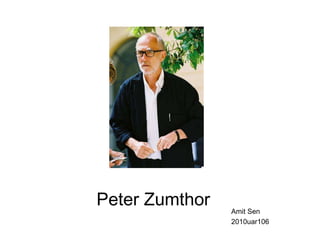
Peter Zumthor

Amit Sen
2010uar106
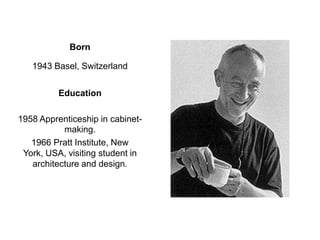
Born
1943 Basel, Switzerland
Education
1958 Apprenticeship in cabinetmaking.
1966 Pratt Institute, New
York, USA, visiting student in
architecture and design.
•He is a Swiss architect and winner of the 2009 Pritzker Prize.
•His father was a cabinet-maker and he was also apprenticed to a cabinetmaker in
1958.
•In 1966, Zumthor studied industrial design and architecture as an exchange
student at Pratt Institute in New York.
•In 1968, he became conservationist architect for the Department for the
Preservation of Monuments of the canton.
• His buildings explore the tactile and sensory qualities of spaces and materials
while retaining a minimalist feel.
•Zumthor founded his own firm in 1979.
•The attention Zumther pays to materials and to their visual, tactile and even
olfactory attributes.
•He applies materials with the sophisticated precision and he pursues the skills and
techniques of construction.
•Each of Zumthor’s works always responds to extraordinary architectural demands.
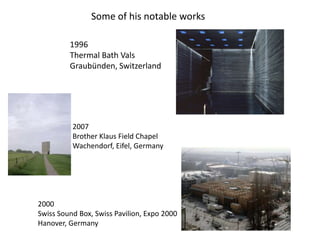
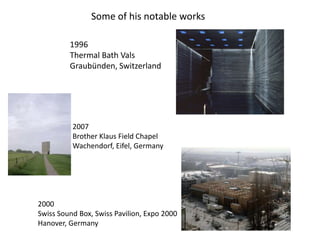
Some of his notable works
1996
Thermal Bath Vals
Graubünden, Switzerland

2007
Brother Klaus Field Chapel
Wachendorf, Eifel, Germany

2000
Swiss Sound Box, Swiss Pavilion, Expo 2000
Hanover, Germany
Some of his notable works
1996
Thermal Bath Vals
Graubünden, Switzerland

2007
Brother Klaus Field Chapel
Wachendorf, Eifel, Germany

2000
Swiss Sound Box, Swiss Pavilion, Expo 2000
Hanover, Germany
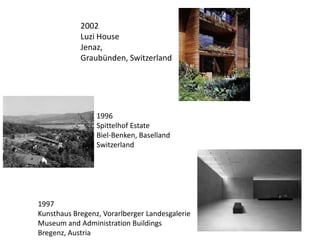
2002
Luzi House
Jenaz,
Graubünden, Switzerland

1996
Spittelhof Estate
Biel-Benken, Baselland
Switzerland

1997
Kunsthaus Bregenz, Vorarlberger Landesgalerie
Museum and Administration Buildings
Bregenz, Austria
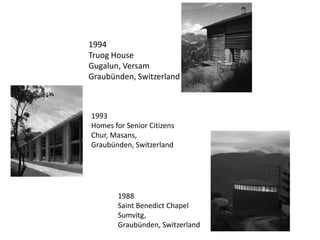
1994
Truog House
Gugalun, Versam
Graubünden, Switzerland

1993
Homes for Senior Citizens
Chur, Masans,
Graubünden, Switzerland

1988
Saint Benedict Chapel
Sumvitg,
Graubünden, Switzerland
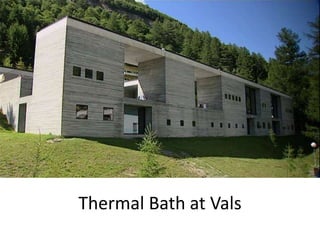
Thermal Bath at Vals
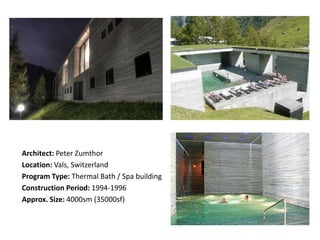
Architect: Peter Zumthor
Location: Vals, Switzerland
Program Type: Thermal Bath / Spa building
Construction Period: 1994-1996
Approx. Size: 4000sm (35000sf)
•
•
•

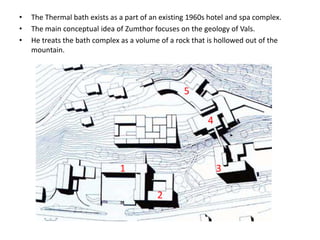
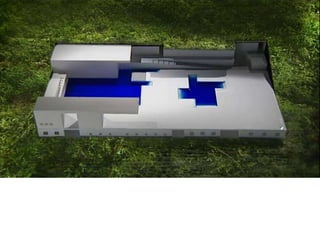
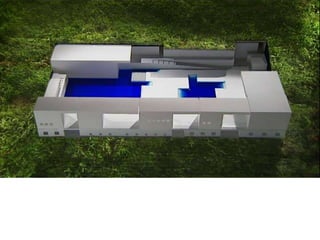
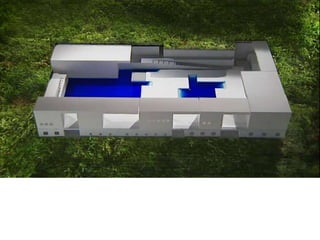
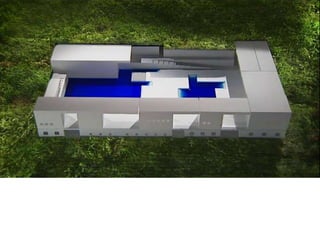
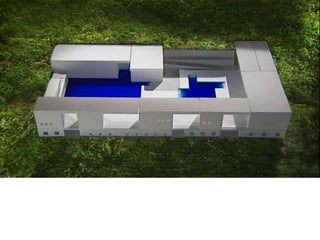
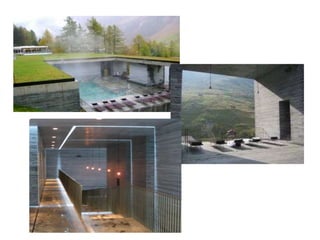
The Thermal bath exists as a part of an existing 1960s hotel and spa complex.
The main conceptual idea of Zumthor focuses on the geology of Vals.
He treats the bath complex as a volume of a rock that is hollowed out of the
mountain.

5
4

1

3

2
•

•

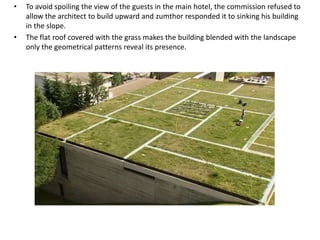
To avoid spoiling the view of the guests in the main hotel, the commission refused to
allow the architect to build upward and zumthor responded it to sinking his building
in the slope.
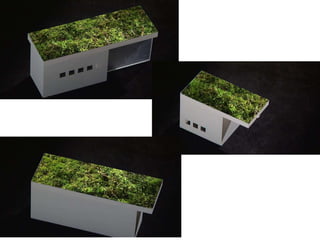
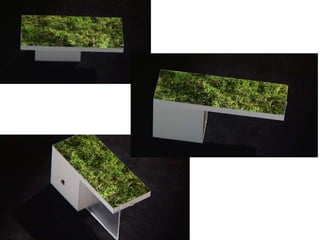
The flat roof covered with the grass makes the building blended with the landscape
only the geometrical patterns reveal its presence.
•
•

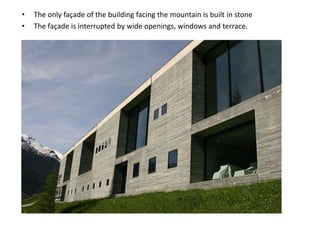
The only façade of the building facing the mountain is built in stone
The façade is interrupted by wide openings, windows and terrace.
4

5

3

1

6

2

1

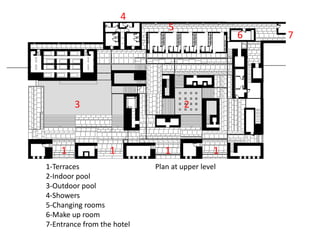
1-Terraces
2-Indoor pool
3-Outdoor pool
4-Showers
5-Changing rooms
6-Make up room
7-Entrance from the hotel

1

1

Plan at upper level

7
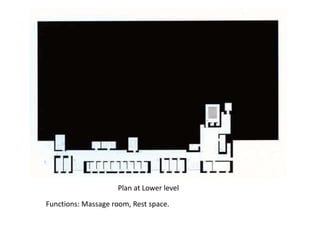
Plan at Lower level
Functions: Massage room, Rest space.
•

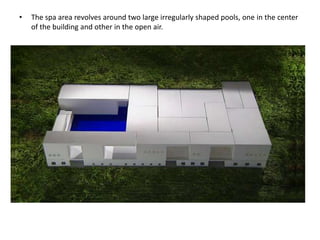
The spa area revolves around two large irregularly shaped pools, one in the center
of the building and other in the open air.
•
•

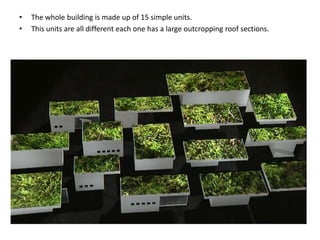
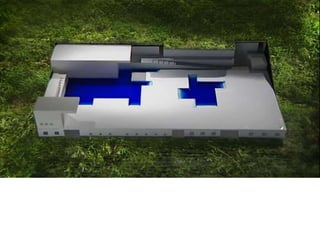
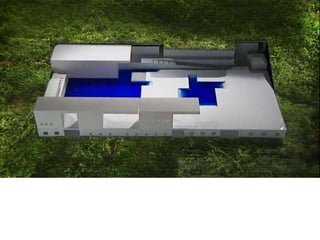
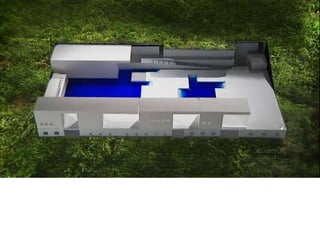
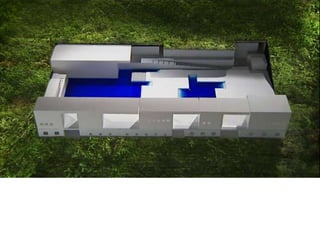
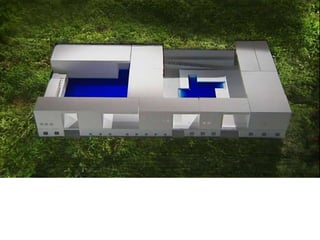
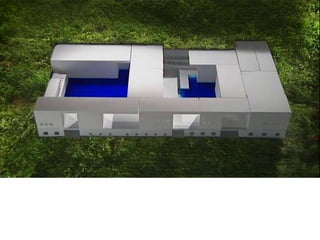
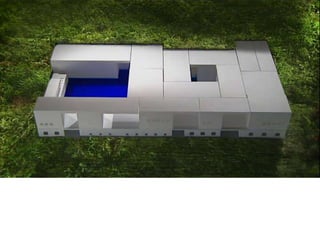
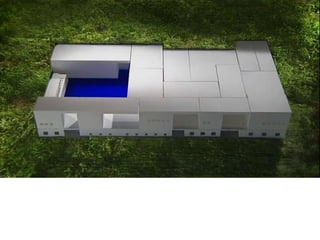
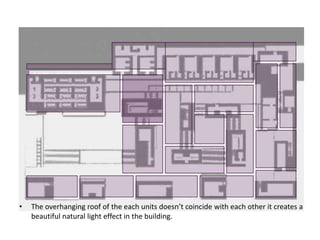
The whole building is made up of 15 simple units.
This units are all different each one has a large outcropping roof sections.
•
•

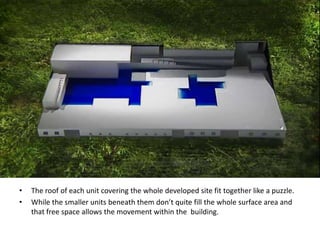
The roof of each unit covering the whole developed site fit together like a puzzle.
While the smaller units beneath them don’t quite fill the whole surface area and
that free space allows the movement within the building.
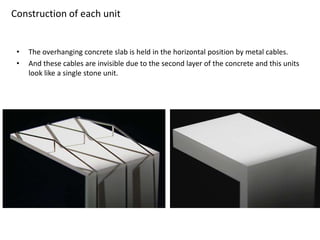
Construction of each unit

•
•

The overhanging concrete slab is held in the horizontal position by metal cables.
And these cables are invisible due to the second layer of the concrete and this units
look like a single stone unit.
•

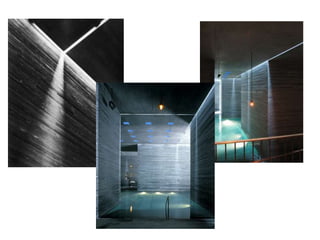
The overhanging roof of the each units doesn’t coincide with each other it creates a
beautiful natural light effect in the building.
•

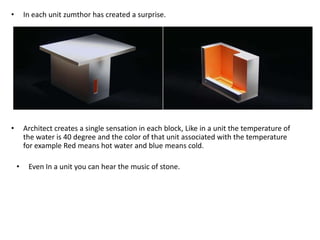
In each unit zumthor has created a surprise.

•

Architect creates a single sensation in each block, Like in a unit the temperature of
the water is 40 degree and the color of that unit associated with the temperature
for example Red means hot water and blue means cold.
•

Even In a unit you can hear the music of stone.
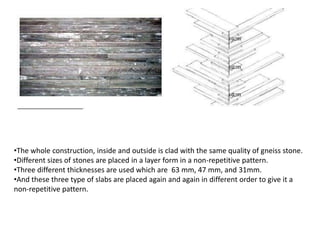
•The whole construction, inside and outside is clad with the same quality of gneiss stone.
•Different sizes of stones are placed in a layer form in a non-repetitive pattern.
•Three different thicknesses are used which are 63 mm, 47 mm, and 31mm.
•And these three type of slabs are placed again and again in different order to give it a
non-repetitive pattern.
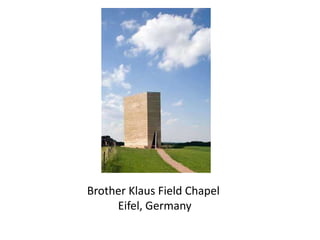
Brother Klaus Field Chapel
Eifel, Germany
•

•

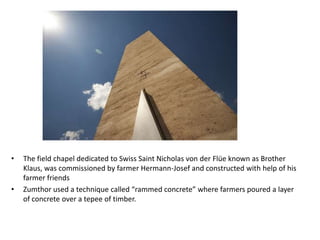
The field chapel dedicated to Swiss Saint Nicholas von der Flüe known as Brother
Klaus, was commissioned by farmer Hermann-Josef and constructed with help of his
farmer friends
Zumthor used a technique called “rammed concrete” where farmers poured a layer
of concrete over a tepee of timber.
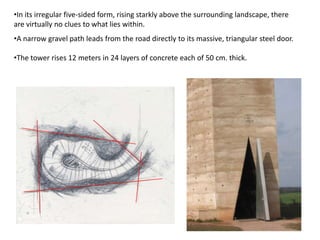
•In its irregular five-sided form, rising starkly above the surrounding landscape, there
are virtually no clues to what lies within.
•A narrow gravel path leads from the road directly to its massive, triangular steel door.
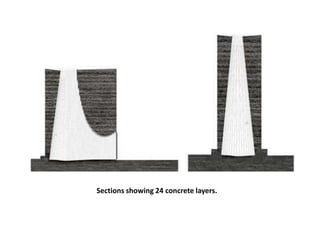
•The tower rises 12 meters in 24 layers of concrete each of 50 cm. thick.
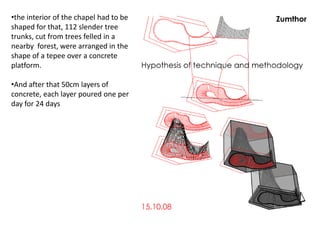
•the interior of the chapel had to be
shaped for that, 112 slender tree
trunks, cut from trees felled in a
nearby forest, were arranged in the
shape of a tepee over a concrete
platform.

•And after that 50cm layers of
concrete, each layer poured one per
day for 24 days
Sections showing 24 concrete layers.
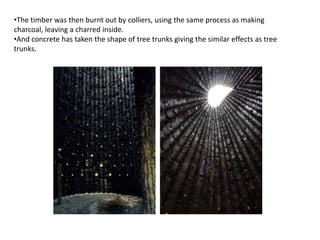
•The timber was then burnt out by colliers, using the same process as making
charcoal, leaving a charred inside.
•And concrete has taken the shape of tree trunks giving the similar effects as tree
trunks.
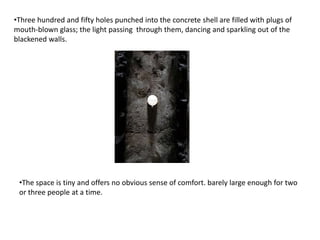
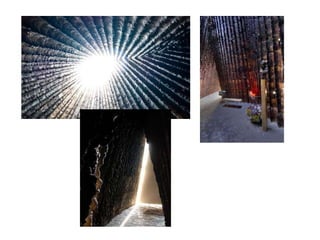
•Three hundred and fifty holes punched into the concrete shell are filled with plugs of
mouth-blown glass; the light passing through them, dancing and sparkling out of the
blackened walls.

•The space is tiny and offers no obvious sense of comfort. barely large enough for two
or three people at a time.
•References
Wikipedia
Youtube
Thinking Architecture by Peter Zumthor.

Thank You

Peter zumthor

  • 1.
  • 2.
    Born 1943 Basel, Switzerland Education 1958Apprenticeship in cabinetmaking. 1966 Pratt Institute, New York, USA, visiting student in architecture and design.
  • 3.
    •He is aSwiss architect and winner of the 2009 Pritzker Prize. •His father was a cabinet-maker and he was also apprenticed to a cabinetmaker in 1958. •In 1966, Zumthor studied industrial design and architecture as an exchange student at Pratt Institute in New York. •In 1968, he became conservationist architect for the Department for the Preservation of Monuments of the canton. • His buildings explore the tactile and sensory qualities of spaces and materials while retaining a minimalist feel. •Zumthor founded his own firm in 1979. •The attention Zumther pays to materials and to their visual, tactile and even olfactory attributes. •He applies materials with the sophisticated precision and he pursues the skills and techniques of construction. •Each of Zumthor’s works always responds to extraordinary architectural demands.
  • 4.
    Some of hisnotable works 1996 Thermal Bath Vals Graubünden, Switzerland 2007 Brother Klaus Field Chapel Wachendorf, Eifel, Germany 2000 Swiss Sound Box, Swiss Pavilion, Expo 2000 Hanover, Germany
  • 5.
    Some of hisnotable works 1996 Thermal Bath Vals Graubünden, Switzerland 2007 Brother Klaus Field Chapel Wachendorf, Eifel, Germany 2000 Swiss Sound Box, Swiss Pavilion, Expo 2000 Hanover, Germany
  • 6.
    2002 Luzi House Jenaz, Graubünden, Switzerland 1996 SpittelhofEstate Biel-Benken, Baselland Switzerland 1997 Kunsthaus Bregenz, Vorarlberger Landesgalerie Museum and Administration Buildings Bregenz, Austria
  • 7.
    1994 Truog House Gugalun, Versam Graubünden,Switzerland 1993 Homes for Senior Citizens Chur, Masans, Graubünden, Switzerland 1988 Saint Benedict Chapel Sumvitg, Graubünden, Switzerland
  • 8.
  • 9.
    Architect: Peter Zumthor Location:Vals, Switzerland Program Type: Thermal Bath / Spa building Construction Period: 1994-1996 Approx. Size: 4000sm (35000sf)
  • 10.
    • • • The Thermal bathexists as a part of an existing 1960s hotel and spa complex. The main conceptual idea of Zumthor focuses on the geology of Vals. He treats the bath complex as a volume of a rock that is hollowed out of the mountain. 5 4 1 3 2
  • 11.
    • • To avoid spoilingthe view of the guests in the main hotel, the commission refused to allow the architect to build upward and zumthor responded it to sinking his building in the slope. The flat roof covered with the grass makes the building blended with the landscape only the geometrical patterns reveal its presence.
  • 12.
    • • The only façadeof the building facing the mountain is built in stone The façade is interrupted by wide openings, windows and terrace.
  • 13.
    4 5 3 1 6 2 1 1-Terraces 2-Indoor pool 3-Outdoor pool 4-Showers 5-Changingrooms 6-Make up room 7-Entrance from the hotel 1 1 Plan at upper level 7
  • 14.
    Plan at Lowerlevel Functions: Massage room, Rest space.
  • 15.
    • The spa arearevolves around two large irregularly shaped pools, one in the center of the building and other in the open air.
  • 16.
    • • The whole buildingis made up of 15 simple units. This units are all different each one has a large outcropping roof sections.
  • 19.
    • • The roof ofeach unit covering the whole developed site fit together like a puzzle. While the smaller units beneath them don’t quite fill the whole surface area and that free space allows the movement within the building.
  • 33.
    Construction of eachunit • • The overhanging concrete slab is held in the horizontal position by metal cables. And these cables are invisible due to the second layer of the concrete and this units look like a single stone unit.
  • 34.
    • The overhanging roofof the each units doesn’t coincide with each other it creates a beautiful natural light effect in the building.
  • 36.
    • In each unitzumthor has created a surprise. • Architect creates a single sensation in each block, Like in a unit the temperature of the water is 40 degree and the color of that unit associated with the temperature for example Red means hot water and blue means cold. • Even In a unit you can hear the music of stone.
  • 37.
    •The whole construction,inside and outside is clad with the same quality of gneiss stone. •Different sizes of stones are placed in a layer form in a non-repetitive pattern. •Three different thicknesses are used which are 63 mm, 47 mm, and 31mm. •And these three type of slabs are placed again and again in different order to give it a non-repetitive pattern.
  • 39.
    Brother Klaus FieldChapel Eifel, Germany
  • 40.
    • • The field chapeldedicated to Swiss Saint Nicholas von der Flüe known as Brother Klaus, was commissioned by farmer Hermann-Josef and constructed with help of his farmer friends Zumthor used a technique called “rammed concrete” where farmers poured a layer of concrete over a tepee of timber.
  • 41.
    •In its irregularfive-sided form, rising starkly above the surrounding landscape, there are virtually no clues to what lies within. •A narrow gravel path leads from the road directly to its massive, triangular steel door. •The tower rises 12 meters in 24 layers of concrete each of 50 cm. thick.
  • 42.
    •the interior ofthe chapel had to be shaped for that, 112 slender tree trunks, cut from trees felled in a nearby forest, were arranged in the shape of a tepee over a concrete platform. •And after that 50cm layers of concrete, each layer poured one per day for 24 days
  • 43.
    Sections showing 24concrete layers.
  • 44.
    •The timber wasthen burnt out by colliers, using the same process as making charcoal, leaving a charred inside. •And concrete has taken the shape of tree trunks giving the similar effects as tree trunks.
  • 45.
    •Three hundred andfifty holes punched into the concrete shell are filled with plugs of mouth-blown glass; the light passing through them, dancing and sparkling out of the blackened walls. •The space is tiny and offers no obvious sense of comfort. barely large enough for two or three people at a time.
  • 47.