z ْ‫ح‬‫ه‬‫الر‬ ِ ‫ه‬
‫َّللا‬ ِ‫م‬ْ‫س‬ِ‫ب‬
‫يم‬ ِ‫ح‬‫ه‬‫الر‬ ِ‫ن‬َ‫م‬
-
NAME
CMS ID
SEMESTER
PRESENTATION
SUBMITTED TO
KASHIF WAHID
50533
6TH
ARTIST RESIDENCY / CLIMATE RESPONSIVE
ARCHITECTURE
AR.MASKA KHAN
AR.ZAKIR BALOCH
AR.SHEROZ KHAN
•“Architecture should speak of its time and
place, but yearn for timelessness” - Frank
Gehry.
z
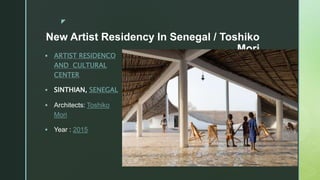
New Artist Residency In Senegal / Toshiko
Mori
 ARTIST RESIDENCO
AND CULTURAL
CENTER
 SINTHIAN, SENEGAL
 Architects: Toshiko
Mori
 Year : 2015
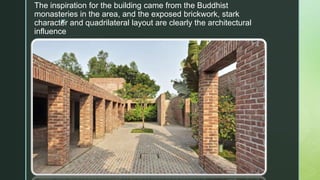
z
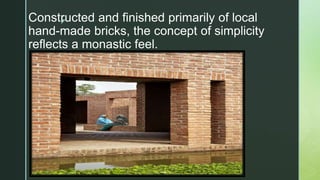
Credits
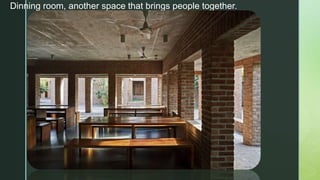
City Sinthian, Senegal
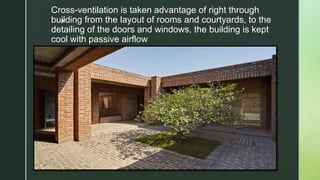
Client Josef and Anni Albers Foundation
Completion Date 02/2015
Gross Floor Area (mq) 1.022
Costs ($) 227715
Architects Toshiko Mori
Design team Jordan MacTavish
Main Contractor Dr. Magueye Ba
Consultants Schlaich Bergermann and
Partners
Suppliers entirely locally sourced
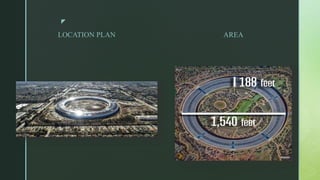
materials
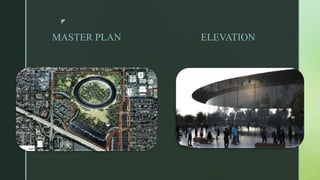
z
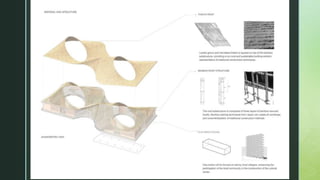
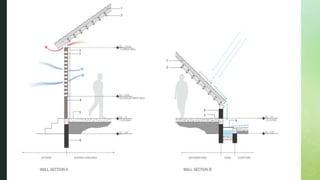
Materials, Construction and Technology:
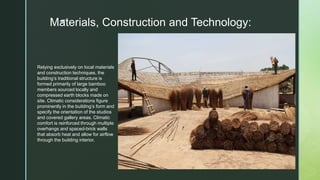
Relying exclusively on local materials
and construction techniques, the
building’s traditional structure is
formed primarily of large bamboo
members sourced locally and
compressed earth blocks made on
site. Climatic considerations figure
prominently in the building’s form and
specify the orientation of the studios
and covered gallery areas. Climatic
comfort is reinforced through multiple
overhangs and spaced-brick walls
that absorb heat and allow for airflow
through the building interior.
z
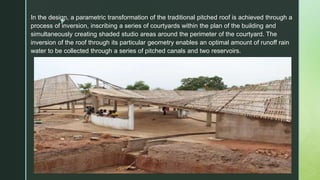
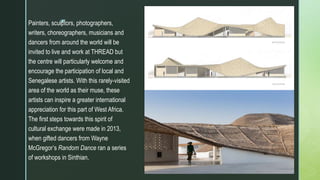
In the design, a parametric transformation of the traditional pitched roof is achieved through a
process of inversion, inscribing a series of courtyards within the plan of the building and
simultaneously creating shaded studio areas around the perimeter of the courtyard. The
inversion of the roof through its particular geometry enables an optimal amount of runoff rain
water to be collected through a series of pitched canals and two reservoirs.
z
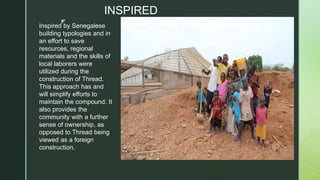
INSPIRED
Inspired by Senegalese
building typologies and in
an effort to save
resources, regional
materials and the skills of
local laborers were
utilized during the
construction of Thread.
This approach has and
will simplify efforts to
maintain the compound. It
also provides the
community with a further
sense of ownership, as
opposed to Thread being
viewed as a foreign
construction.
z
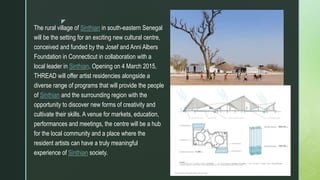
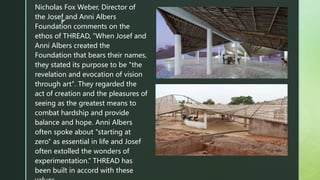
The rural village of Sinthian in south-eastern Senegal
will be the setting for an exciting new cultural centre,
conceived and funded by the Josef and Anni Albers
Foundation in Connecticut in collaboration with a
local leader in Sinthian. Opening on 4 March 2015,
THREAD will offer artist residencies alongside a
diverse range of programs that will provide the people
of Sinthian and the surrounding region with the
opportunity to discover new forms of creativity and
cultivate their skills. A venue for markets, education,
performances and meetings, the centre will be a hub
for the local community and a place where the
resident artists can have a truly meaningful
experience of Sinthian society.
z
Painters, sculptors, photographers,
writers, choreographers, musicians and
dancers from around the world will be
invited to live and work at THREAD but
the centre will particularly welcome and
encourage the participation of local and
Senegalese artists. With this rarely-visited
area of the world as their muse, these
artists can inspire a greater international
appreciation for this part of West Africa.
The first steps towards this spirit of
cultural exchange were made in 2013,
when gifted dancers from Wayne
McGregor’s Random Dance ran a series
of workshops in Sinthian.
z
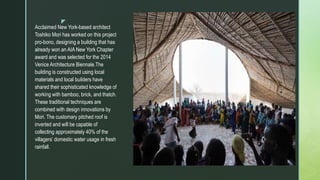
Acclaimed New York-based architect
Toshiko Mori has worked on this project
pro-bono, designing a building that has
already won an AIA New York Chapter
award and was selected for the 2014
Venice Architecture Biennale.The
building is constructed using local
materials and local builders have
shared their sophisticated knowledge of
working with bamboo, brick, and thatch.
These traditional techniques are
combined with design innovations by
Mori. The customary pitched roof is
inverted and will be capable of
collecting approximately 40% of the
villagers’ domestic water usage in fresh
rainfall.
z
Nicholas Fox Weber, Director of
the Josef and Anni Albers
Foundation comments on the
ethos of THREAD, “When Josef and
Anni Albers created the
Foundation that bears their names,
they stated its purpose to be "the
revelation and evocation of vision
through art". They regarded the
act of creation and the pleasures of
seeing as the greatest means to
combat hardship and provide
balance and hope. Anni Albers
often spoke about "starting at
zero" as essential in life and Josef
often extolled the wonders of
experimentation.” THREAD has
been built in accord with these
z
z
z
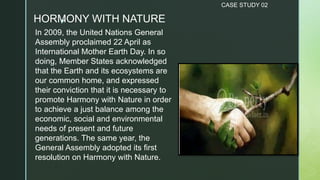
HORMONY WITH NATURE
In 2009, the United Nations General
Assembly proclaimed 22 April as
International Mother Earth Day. In so
doing, Member States acknowledged
that the Earth and its ecosystems are
our common home, and expressed
their conviction that it is necessary to
promote Harmony with Nature in order
to achieve a just balance among the
economic, social and environmental
needs of present and future
generations. The same year, the
General Assembly adopted its first
resolution on Harmony with Nature.
CASE STUDY 02
z
Friendship Center
Bangladesh
Technical Information
Award Cycle: 2014-2016 Cycle
Status: Award Recipient
Country of origin: Bangladesh
Location: Gaibandha, Bangladesh
Client: Friendship NGO
Architect: Kashif Mahboob
Chowdhury/Urbana
Design: 2008-2010
Size: Site area: 9'210 m2; Built area: 2’897
m2
Completed: 2011
z
ENERGY EFFICIENCY
SMALL IS GOOD
HIGH LEVELS OF INSULATION
EFFICIENT HEATING OF AIR & WATER -THERMAL MASS
VENTILATION
EFFICIENT LIGHTING
THROUGH DESIGNING IN MODULES
RECYCLING WHILE BUILDING
GREY WATER SYSTEMS
LOW FLOW TAPS & SHOWERS
BUILDING MATERIALS
USE OF RECYCLABLE/RECYCLED MATERIALS -LOCALLY SOURCED TO REDUCE
TRANSPORT HOW TO ACHIEVE SUSTAINABLE DESIGN.
z
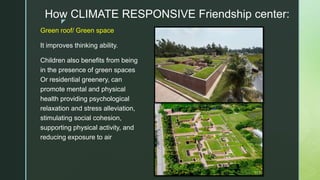
How CLIMATE RESPONSIVE Friendship center:
Green roof/ Green space
It improves thinking ability.
Children also benefits from being
in the presence of green spaces
Or residential greenery, can
promote mental and physical
health providing psychological
relaxation and stress alleviation,
stimulating social cohesion,
supporting physical activity, and
reducing exposure to air
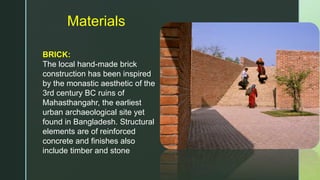
Materials
BRICK:
The local hand-made brick
construction has been inspired
by the monastic aesthetic of the
3rd century BC ruins of
Mahasthangahr, the earliest
urban archaeological site yet
found in Bangladesh. Structural
elements are of reinforced
concrete and finishes also
include timber and stone
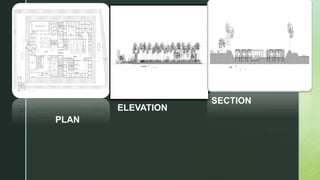
PLAN
ELEVATION
SECTION
z
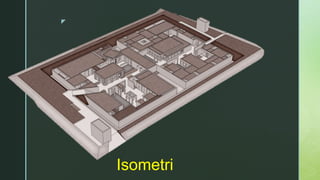
Isometri
z
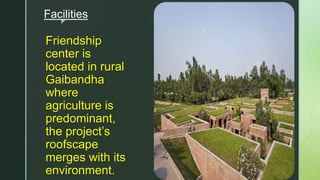
Facilities
Friendship
center is
located in rural
Gaibandha
where
agriculture is
predominant,
the project’s
roofscape
merges with its
environment.
z
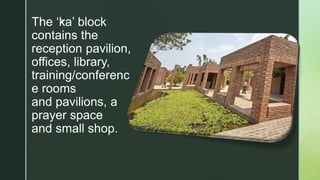
The ‘ka’ block
contains the
reception pavilion,
offices, library,
training/conferenc
e rooms
and pavilions, a
prayer space
and small shop.
z
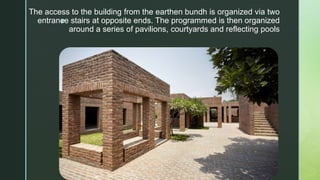
The access to the building from the earthen bundh is organized via two
entrance stairs at opposite ends. The programmed is then organized
around a series of pavilions, courtyards and reflecting pools
z
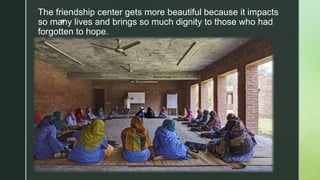
The friendship center gets more beautiful because it impacts
so many lives and brings so much dignity to those who had
forgotten to hope.
z
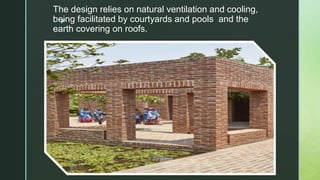
The design relies on natural ventilation and cooling,
being facilitated by courtyards and pools and the
earth covering on roofs.
z
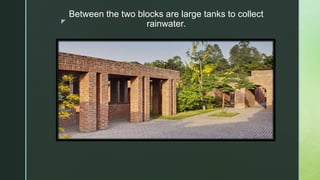
Between the two blocks are large tanks to collect
rainwater.
z
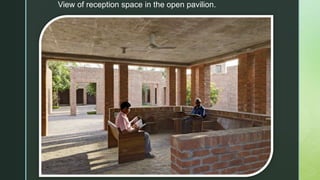
View of reception space in the open pavilion.
z
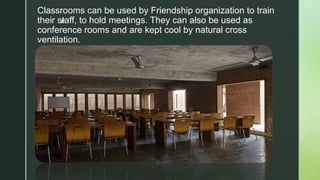
Classrooms can be used by Friendship organization to train
their staff, to hold meetings. They can also be used as
conference rooms and are kept cool by natural cross
ventilation.
z
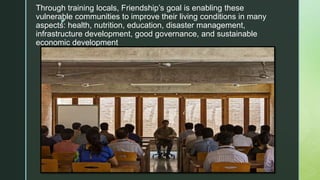
Through training locals, Friendship’s goal is enabling these
vulnerable communities to improve their living conditions in many
aspects: health, nutrition, education, disaster management,
infrastructure development, good governance, and sustainable
economic development
z
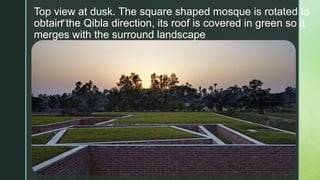
Top view at dusk. The square shaped mosque is rotated to
obtain the Qibla direction, its roof is covered in green so it
merges with the surround landscape
z
The inspiration for the building came from the Buddhist
monasteries in the area, and the exposed brickwork, stark
character and quadrilateral layout are clearly the architectural
influence
z
Constructed and finished primarily of local
hand-made bricks, the concept of simplicity
reflects a monastic feel.
z
Dinning room, another space that brings people together.
z
Cross-ventilation is taken advantage of right through
building from the layout of rooms and courtyards, to the
detailing of the doors and windows, the building is kept
cool with passive airflow
z
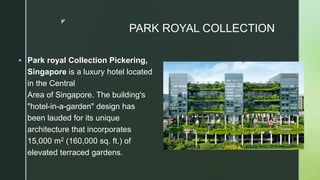
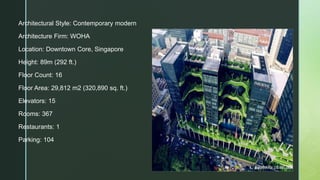
 Park royal Collection Pickering,
Singapore is a luxury hotel located
in the Central
Area of Singapore. The building's
"hotel-in-a-garden" design has
been lauded for its unique
architecture that incorporates
15,000 m2 (160,000 sq. ft.) of
elevated terraced gardens.
PARK ROYAL COLLECTION
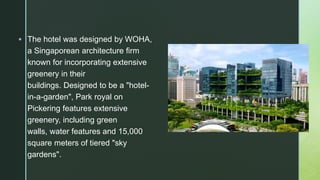
 The hotel was designed by WOHA,
a Singaporean architecture firm
known for incorporating extensive
greenery in their
buildings. Designed to be a "hotel-
in-a-garden", Park royal on
Pickering features extensive
greenery, including green
walls, water features and 15,000
square meters of tiered "sky
gardens".
Architectural Style: Contemporary modern
Architecture Firm: WOHA
Location: Downtown Core, Singapore
Height: 89m (292 ft.)
Floor Count: 16
Floor Area: 29,812 m2 (320,890 sq. ft.)
Elevators: 15
Rooms: 367
Restaurants: 1
Parking: 104
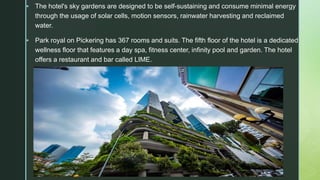
 The hotel's sky gardens are designed to be self-sustaining and consume minimal energy
through the usage of solar cells, motion sensors, rainwater harvesting and reclaimed
water.
 Park royal on Pickering has 367 rooms and suits. The fifth floor of the hotel is a dedicated
wellness floor that features a day spa, fitness center, infinity pool and garden. The hotel
offers a restaurant and bar called LIME.
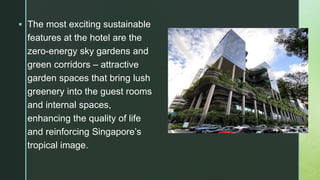
 The most exciting sustainable
features at the hotel are the
zero-energy sky gardens and
green corridors – attractive
garden spaces that bring lush
greenery into the guest rooms
and internal spaces,
enhancing the quality of life
and reinforcing Singapore’s
tropical image.
z
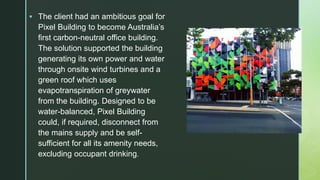
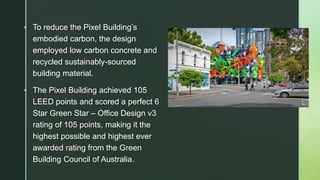
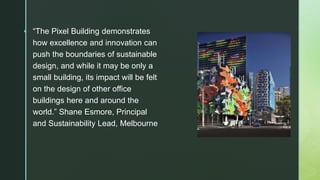
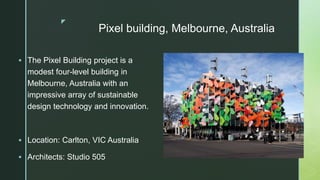
 The Pixel Building project is a
modest four-level building in
Melbourne, Australia with an
impressive array of sustainable
design technology and innovation.
 Location: Carlton, VIC Australia
 Architects: Studio 505
Pixel building, Melbourne, Australia
 The client had an ambitious goal for
Pixel Building to become Australia’s
first carbon-neutral office building.
The solution supported the building
generating its own power and water
through onsite wind turbines and a
green roof which uses
evapotranspiration of greywater
from the building. Designed to be
water-balanced, Pixel Building
could, if required, disconnect from
the mains supply and be self-
sufficient for all its amenity needs,
excluding occupant drinking.
 To reduce the Pixel Building’s
embodied carbon, the design
employed low carbon concrete and
recycled sustainably-sourced
building material.
 The Pixel Building achieved 105
LEED points and scored a perfect 6
Star Green Star – Office Design v3
rating of 105 points, making it the
highest possible and highest ever
awarded rating from the Green
Building Council of Australia.
 “The Pixel Building demonstrates
how excellence and innovation can
push the boundaries of sustainable
design, and while it may be only a
small building, its impact will be felt
on the design of other office
buildings here and around the
world.” Shane Esmore, Principal
and Sustainability Lead, Melbourne
z
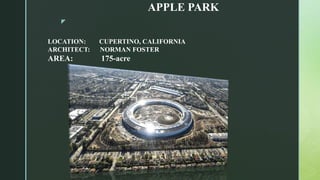
APPLE PARK
LOCATION: CUPERTINO, CALIFORNIA
ARCHITECT: NORMAN FOSTER
AREA: 175-acre
z
 APPLE PARK IS APPLE'S NEW, 175-ACRE CORPORATE CAMPUS. ITS 2.8 MILLION-
SQUARE-FOOT MAIN BUILDING, OR "SPACESHIP," IS CONSIDERED TO BE ONE OF
THE MOST ENERGY-EFFICIENT BUILDINGS ON EARTH.
Energy source
• The solar panels installed on the roof of the campus can
generate 17 megawatts of power, sufficient to power
75% during peak daytime,[49] and making it one of
the Biggest Solar roofs of the world
• The air flows freely between the inside and
outside of the building, providing natural
ventilation and obviating the need
for HVAC systems during nine months of the
year.[2]
z
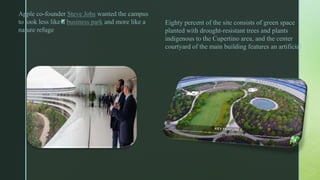
Apple co-founder Steve Jobs wanted the campus
to look less like a business park and more like a
nature refuge
Eighty percent of the site consists of green space
planted with drought-resistant trees and plants
indigenous to the Cupertino area, and the center
courtyard of the main building features an artificial
z
LOCATION PLAN AREA
z
MASTER PLAN ELEVATION
z Design and Construction
• The ring-shaped building, advertised as "a perfect
circle," was not originally planned as such.
• It is four stories above the ground and three
stories underground
• The campus uses only glass for its walls and
views of the inner courtyard as well as of the
landscape facing the exterior of the
building.[35][36] Around 83,000 square feet
(7,700 m2) of space is for meetings and breakout
spaces in the building

ARTIST RESIDENCY.pptx

  • 1.
    z ْ‫ح‬‫ه‬‫الر‬ ِ‫ه‬ ‫َّللا‬ ِ‫م‬ْ‫س‬ِ‫ب‬ ‫يم‬ ِ‫ح‬‫ه‬‫الر‬ ِ‫ن‬َ‫م‬ - NAME CMS ID SEMESTER PRESENTATION SUBMITTED TO KASHIF WAHID 50533 6TH ARTIST RESIDENCY / CLIMATE RESPONSIVE ARCHITECTURE AR.MASKA KHAN AR.ZAKIR BALOCH AR.SHEROZ KHAN •“Architecture should speak of its time and place, but yearn for timelessness” - Frank Gehry.
  • 2.
    z New Artist ResidencyIn Senegal / Toshiko Mori  ARTIST RESIDENCO AND CULTURAL CENTER  SINTHIAN, SENEGAL  Architects: Toshiko Mori  Year : 2015
  • 3.
    z Credits City Sinthian, Senegal ClientJosef and Anni Albers Foundation Completion Date 02/2015 Gross Floor Area (mq) 1.022 Costs ($) 227715 Architects Toshiko Mori Design team Jordan MacTavish Main Contractor Dr. Magueye Ba Consultants Schlaich Bergermann and Partners Suppliers entirely locally sourced materials
  • 4.
    z Materials, Construction andTechnology: Relying exclusively on local materials and construction techniques, the building’s traditional structure is formed primarily of large bamboo members sourced locally and compressed earth blocks made on site. Climatic considerations figure prominently in the building’s form and specify the orientation of the studios and covered gallery areas. Climatic comfort is reinforced through multiple overhangs and spaced-brick walls that absorb heat and allow for airflow through the building interior.
  • 5.
    z In the design,a parametric transformation of the traditional pitched roof is achieved through a process of inversion, inscribing a series of courtyards within the plan of the building and simultaneously creating shaded studio areas around the perimeter of the courtyard. The inversion of the roof through its particular geometry enables an optimal amount of runoff rain water to be collected through a series of pitched canals and two reservoirs.
  • 6.
    z INSPIRED Inspired by Senegalese buildingtypologies and in an effort to save resources, regional materials and the skills of local laborers were utilized during the construction of Thread. This approach has and will simplify efforts to maintain the compound. It also provides the community with a further sense of ownership, as opposed to Thread being viewed as a foreign construction.
  • 7.
    z The rural villageof Sinthian in south-eastern Senegal will be the setting for an exciting new cultural centre, conceived and funded by the Josef and Anni Albers Foundation in Connecticut in collaboration with a local leader in Sinthian. Opening on 4 March 2015, THREAD will offer artist residencies alongside a diverse range of programs that will provide the people of Sinthian and the surrounding region with the opportunity to discover new forms of creativity and cultivate their skills. A venue for markets, education, performances and meetings, the centre will be a hub for the local community and a place where the resident artists can have a truly meaningful experience of Sinthian society.
  • 8.
    z Painters, sculptors, photographers, writers,choreographers, musicians and dancers from around the world will be invited to live and work at THREAD but the centre will particularly welcome and encourage the participation of local and Senegalese artists. With this rarely-visited area of the world as their muse, these artists can inspire a greater international appreciation for this part of West Africa. The first steps towards this spirit of cultural exchange were made in 2013, when gifted dancers from Wayne McGregor’s Random Dance ran a series of workshops in Sinthian.
  • 9.
    z Acclaimed New York-basedarchitect Toshiko Mori has worked on this project pro-bono, designing a building that has already won an AIA New York Chapter award and was selected for the 2014 Venice Architecture Biennale.The building is constructed using local materials and local builders have shared their sophisticated knowledge of working with bamboo, brick, and thatch. These traditional techniques are combined with design innovations by Mori. The customary pitched roof is inverted and will be capable of collecting approximately 40% of the villagers’ domestic water usage in fresh rainfall.
  • 10.
    z Nicholas Fox Weber,Director of the Josef and Anni Albers Foundation comments on the ethos of THREAD, “When Josef and Anni Albers created the Foundation that bears their names, they stated its purpose to be "the revelation and evocation of vision through art". They regarded the act of creation and the pleasures of seeing as the greatest means to combat hardship and provide balance and hope. Anni Albers often spoke about "starting at zero" as essential in life and Josef often extolled the wonders of experimentation.” THREAD has been built in accord with these
  • 11.
  • 12.
  • 13.
    z HORMONY WITH NATURE In2009, the United Nations General Assembly proclaimed 22 April as International Mother Earth Day. In so doing, Member States acknowledged that the Earth and its ecosystems are our common home, and expressed their conviction that it is necessary to promote Harmony with Nature in order to achieve a just balance among the economic, social and environmental needs of present and future generations. The same year, the General Assembly adopted its first resolution on Harmony with Nature. CASE STUDY 02
  • 14.
    z Friendship Center Bangladesh Technical Information AwardCycle: 2014-2016 Cycle Status: Award Recipient Country of origin: Bangladesh Location: Gaibandha, Bangladesh Client: Friendship NGO Architect: Kashif Mahboob Chowdhury/Urbana Design: 2008-2010 Size: Site area: 9'210 m2; Built area: 2’897 m2 Completed: 2011
  • 15.
    z ENERGY EFFICIENCY SMALL ISGOOD HIGH LEVELS OF INSULATION EFFICIENT HEATING OF AIR & WATER -THERMAL MASS VENTILATION EFFICIENT LIGHTING THROUGH DESIGNING IN MODULES RECYCLING WHILE BUILDING GREY WATER SYSTEMS LOW FLOW TAPS & SHOWERS BUILDING MATERIALS USE OF RECYCLABLE/RECYCLED MATERIALS -LOCALLY SOURCED TO REDUCE TRANSPORT HOW TO ACHIEVE SUSTAINABLE DESIGN.
  • 16.
    z How CLIMATE RESPONSIVEFriendship center: Green roof/ Green space It improves thinking ability. Children also benefits from being in the presence of green spaces Or residential greenery, can promote mental and physical health providing psychological relaxation and stress alleviation, stimulating social cohesion, supporting physical activity, and reducing exposure to air
  • 17.
    Materials BRICK: The local hand-madebrick construction has been inspired by the monastic aesthetic of the 3rd century BC ruins of Mahasthangahr, the earliest urban archaeological site yet found in Bangladesh. Structural elements are of reinforced concrete and finishes also include timber and stone
  • 18.
  • 19.
  • 20.
    z Facilities Friendship center is located inrural Gaibandha where agriculture is predominant, the project’s roofscape merges with its environment.
  • 21.
    z The ‘ka’ block containsthe reception pavilion, offices, library, training/conferenc e rooms and pavilions, a prayer space and small shop.
  • 22.
    z The access tothe building from the earthen bundh is organized via two entrance stairs at opposite ends. The programmed is then organized around a series of pavilions, courtyards and reflecting pools
  • 23.
    z The friendship centergets more beautiful because it impacts so many lives and brings so much dignity to those who had forgotten to hope.
  • 24.
    z The design relieson natural ventilation and cooling, being facilitated by courtyards and pools and the earth covering on roofs.
  • 25.
    z Between the twoblocks are large tanks to collect rainwater.
  • 26.
    z View of receptionspace in the open pavilion.
  • 27.
    z Classrooms can beused by Friendship organization to train their staff, to hold meetings. They can also be used as conference rooms and are kept cool by natural cross ventilation.
  • 28.
    z Through training locals,Friendship’s goal is enabling these vulnerable communities to improve their living conditions in many aspects: health, nutrition, education, disaster management, infrastructure development, good governance, and sustainable economic development
  • 29.
    z Top view atdusk. The square shaped mosque is rotated to obtain the Qibla direction, its roof is covered in green so it merges with the surround landscape
  • 30.
    z The inspiration forthe building came from the Buddhist monasteries in the area, and the exposed brickwork, stark character and quadrilateral layout are clearly the architectural influence
  • 31.
    z Constructed and finishedprimarily of local hand-made bricks, the concept of simplicity reflects a monastic feel.
  • 32.
    z Dinning room, anotherspace that brings people together.
  • 33.
    z Cross-ventilation is takenadvantage of right through building from the layout of rooms and courtyards, to the detailing of the doors and windows, the building is kept cool with passive airflow
  • 34.
    z  Park royalCollection Pickering, Singapore is a luxury hotel located in the Central Area of Singapore. The building's "hotel-in-a-garden" design has been lauded for its unique architecture that incorporates 15,000 m2 (160,000 sq. ft.) of elevated terraced gardens. PARK ROYAL COLLECTION
  • 35.
     The hotelwas designed by WOHA, a Singaporean architecture firm known for incorporating extensive greenery in their buildings. Designed to be a "hotel- in-a-garden", Park royal on Pickering features extensive greenery, including green walls, water features and 15,000 square meters of tiered "sky gardens".
  • 36.
    Architectural Style: Contemporarymodern Architecture Firm: WOHA Location: Downtown Core, Singapore Height: 89m (292 ft.) Floor Count: 16 Floor Area: 29,812 m2 (320,890 sq. ft.) Elevators: 15 Rooms: 367 Restaurants: 1 Parking: 104
  • 37.
     The hotel'ssky gardens are designed to be self-sustaining and consume minimal energy through the usage of solar cells, motion sensors, rainwater harvesting and reclaimed water.  Park royal on Pickering has 367 rooms and suits. The fifth floor of the hotel is a dedicated wellness floor that features a day spa, fitness center, infinity pool and garden. The hotel offers a restaurant and bar called LIME.
  • 38.
     The mostexciting sustainable features at the hotel are the zero-energy sky gardens and green corridors – attractive garden spaces that bring lush greenery into the guest rooms and internal spaces, enhancing the quality of life and reinforcing Singapore’s tropical image.
  • 39.
    z  The PixelBuilding project is a modest four-level building in Melbourne, Australia with an impressive array of sustainable design technology and innovation.  Location: Carlton, VIC Australia  Architects: Studio 505 Pixel building, Melbourne, Australia
  • 40.
     The clienthad an ambitious goal for Pixel Building to become Australia’s first carbon-neutral office building. The solution supported the building generating its own power and water through onsite wind turbines and a green roof which uses evapotranspiration of greywater from the building. Designed to be water-balanced, Pixel Building could, if required, disconnect from the mains supply and be self- sufficient for all its amenity needs, excluding occupant drinking.
  • 41.
     To reducethe Pixel Building’s embodied carbon, the design employed low carbon concrete and recycled sustainably-sourced building material.  The Pixel Building achieved 105 LEED points and scored a perfect 6 Star Green Star – Office Design v3 rating of 105 points, making it the highest possible and highest ever awarded rating from the Green Building Council of Australia.
  • 42.
     “The PixelBuilding demonstrates how excellence and innovation can push the boundaries of sustainable design, and while it may be only a small building, its impact will be felt on the design of other office buildings here and around the world.” Shane Esmore, Principal and Sustainability Lead, Melbourne
  • 43.
    z APPLE PARK LOCATION: CUPERTINO,CALIFORNIA ARCHITECT: NORMAN FOSTER AREA: 175-acre
  • 44.
    z  APPLE PARKIS APPLE'S NEW, 175-ACRE CORPORATE CAMPUS. ITS 2.8 MILLION- SQUARE-FOOT MAIN BUILDING, OR "SPACESHIP," IS CONSIDERED TO BE ONE OF THE MOST ENERGY-EFFICIENT BUILDINGS ON EARTH. Energy source • The solar panels installed on the roof of the campus can generate 17 megawatts of power, sufficient to power 75% during peak daytime,[49] and making it one of the Biggest Solar roofs of the world • The air flows freely between the inside and outside of the building, providing natural ventilation and obviating the need for HVAC systems during nine months of the year.[2]
  • 45.
    z Apple co-founder SteveJobs wanted the campus to look less like a business park and more like a nature refuge Eighty percent of the site consists of green space planted with drought-resistant trees and plants indigenous to the Cupertino area, and the center courtyard of the main building features an artificial
  • 46.
  • 47.
  • 48.
    z Design andConstruction • The ring-shaped building, advertised as "a perfect circle," was not originally planned as such. • It is four stories above the ground and three stories underground • The campus uses only glass for its walls and views of the inner courtyard as well as of the landscape facing the exterior of the building.[35][36] Around 83,000 square feet (7,700 m2) of space is for meetings and breakout spaces in the building