Medieval leadership to the Age of
Absolute Monarchy
Ivan the IV, Peter the I and Catherine II
Unit 10 Russia
Ivan III (the great) to Ivan IV (the Terrible
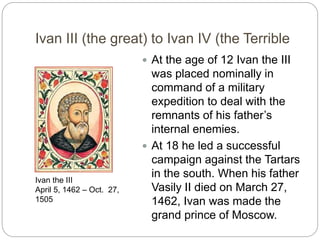
 At the age of 12 Ivan the III
was placed nominally in
command of a military
expedition to deal with the
remnants of his father’s
internal enemies.
 At 18 he led a successful
campaign against the Tartars
in the south. When his father
Vasily II died on March 27,
1462, Ivan was made the
grand prince of Moscow.
Ivan the III
April 5, 1462 – Oct. 27,
1505
Ivan the III (Great)
 Ivan’s policy was to
start the centralize of
the government
administration by
stripping the princes
of land and authority.
 As for the boyars,
they were stripped of
much of their authority
and swiftly executed
or imprisoned if
suspected of treason.
 What are Boyars?
 Landowners in Russia
with power and
authority over their
region with little or no
loyalty to the grand
prince.
 The Boyars acted
much the same as the
Italy princes in Venice
and Florence during
the Renaissance.
Ivan III Continued
 None dispute the
importance of his
diplomatic and military
successes.
 But Ivan’s family life
was as dysfunctional as
that of his grandson
Ivan the IV.
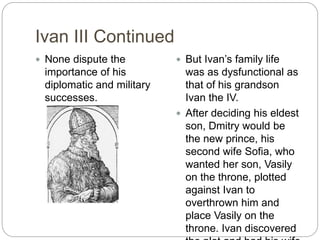
 After deciding his eldest
son, Dmitry would be
the new prince, his
second wife Sofia, who
wanted her son, Vasily
on the throne, plotted
against Ivan to
overthrown him and
place Vasily on the
throne. Ivan discovered
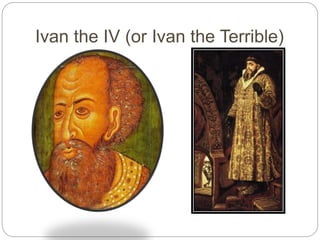
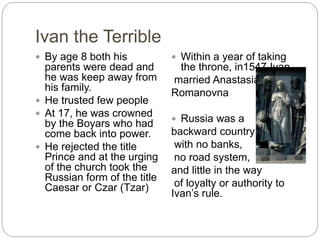
Ivan the IV (or Ivan the Terrible)
Ivan the Terrible
 By age 8 both his
parents were dead and
he was keep away from
his family.
 He trusted few people
 At 17, he was crowned
by the Boyars who had
come back into power.
 He rejected the title
Prince and at the urging
of the church took the
Russian form of the title
Caesar or Czar (Tzar)
 Within a year of taking
the throne, in1547 Ivan
married Anastasia
Romanovna
 Russia was a
backward country
with no banks,
no road system,
and little in the way
of loyalty or authority to
Ivan’s rule.
Ivan the IV
 Ivan and his new wife
had issues with power
struggles from the
beginning.
 But, Ivan’s power was
soon to be solidified
after an attack on the
Tartar’s (Remnants of
Genghis Khan’s army
known as Mongol
Golden Horde)
 Having defeated the
Tartars Ivan became
know as Ivan the
Terrible which was a
title of honor at the time,
but it was a precursor of
his actions later in his
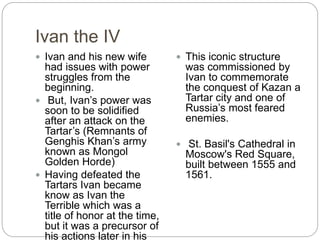
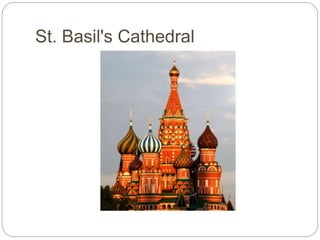
 This iconic structure
was commissioned by
Ivan to commemorate
the conquest of Kazan a
Tartar city and one of
Russia’s most feared
enemies.
 St. Basil's Cathedral in
Moscow's Red Square,
built between 1555 and
1561.
St. Basil's Cathedral
Ivan the IV and his family
 After the death of
Anastasia
Romanovna, Ivan would
marry 7 more times
often divorcing one wife
and taking another
within months.
 What do you think his
motives were for
taking wife after wife
from the royal
families?
 To gain loyalty from
the families.
 Remove power from
the Boyars
 Ivan went so far as to
ask Queen Elizabeth
of England for a
suitable English
princess to wed.
Ivan the Terrible
 Ivan become more and
more violent in his
dealings with his
enemies yet he was not
alone in his treatment of
his and his country’s
enemies.
 Over the next 24 years,
Ivan IV conducted a
reign of terror,
displacing and
destroying the major
Boyar families in the
region, and earning the
 Ivan created a secret
police that for 7 years
reigned with terror
under his direction.
Setting a horrific high
bar for campaigns of
state-instituted terror.
 It was only after Ivan
could not control them
he disbanded the group.
The end of Ivan’s reign
 Killed his eldest son in a fit of rage after attacking his
son’s wife.
 Become more secretive and religious as time passed
 Three years after killing the heir to the throne Ivan
died in 1584.
 His last living child Feodor, will come to the throne but
whose rule spiraled Russia into the catastrophic “Time of
Troubles,” leading to the establishment of the Romanov
Dynasty.
 It is now known that Ivan was treated with common
pain medicine which content high levels of mercury.
 What are the effects of high levels of mercury?
Elements in Ivan’s behavior
 Symptoms include tremors,
 emotional changes,
 insomnia,
 headaches,
 disturbances in sensations,
 changes in nerve responses, and performance
deficits on tests of cognitive function.
Peter I or Peter the Great - The first
absolute monarchy of Russia
 He will take the throne
after almost a century
after the death of Ivan
IV and the ensuing
chaos. (b. June 9,
1672 – d. 1725)
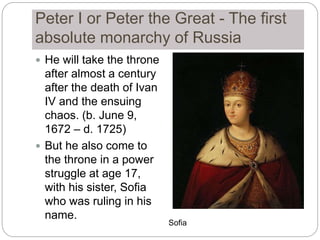
 But he also come to
the throne in a power
struggle at age 17,
with his sister, Sofia
who was ruling in his
name.
Sofia
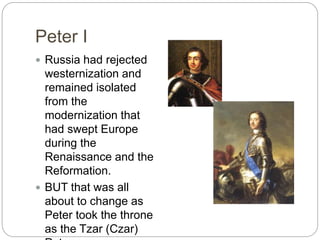
Peter I
 Russia had rejected
westernization and
remained isolated
from the
modernization that
had swept Europe
during the
Renaissance and the
Reformation.
 BUT that was all
about to change as
Peter took the throne
as the Tzar (Czar)
Peter’s reforms
 Peter as the monarch
engineered a series of
reforms that were to put
Russia among the
major European powers
of the day.
 He opened Russia to
the influences of the
West
 Invited the best
European engineers,
shipbuilders, architects,
craftsmen and
merchants to come to
Russia and modernize
the country.
 Why do you think he
wanted Russia to
westernize?
 Become a powerful
military nation not as
some in Europe
considered Russia a
weak and backward
country
 Become a powerful
economic force to
compete for goods from
Asia but also a conduit
for goods to travel
through Russia not
around it.
Peter creates St. Petersburg (later
know as Leningrad)
 When the Northern War
ended in 1721 Russia was
declared an Empire and
Peter the Great
proclaimed himself its
Emperor
 After expanding Russia
through his modern
military and navy, Peter
creates a new city on
land taken from Sweden
at the end of the Northern
War
 St. Petersburg is a warm
port city. Russia now had
a way to create an
economic relationship with
Europe.
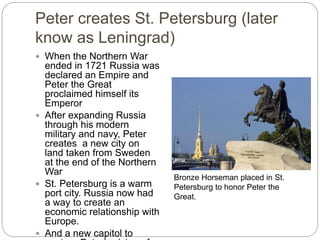
 And a new capitol to
Bronze Horseman placed in St.
Petersburg to honor Peter the
Great.
St. Petersburg
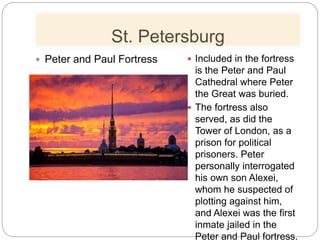
 Peter and Paul Fortress  Included in the fortress
is the Peter and Paul
Cathedral where Peter
the Great was buried.
 The fortress also
served, as did the
Tower of London, as a
prison for political
prisoners. Peter
personally interrogated
his own son Alexei,
whom he suspected of
plotting against him,
and Alexei was the first
inmate jailed in the
Peter and Paul fortress.
Peter’s Legacy
 Peter the Great died on
28 January 1725,
without naming a
successor.
 Peter’s wife Catherine I
took the throne but
Catherine’s reign did
not last long. She died
in 1727, just two years
after Peter.
 Peter the Second will
take the throne for 15
years unlike this
grandfather Peter would
not be remember for
reforms.
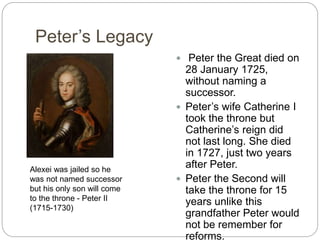
Alexei was jailed so he
was not named successor
but his only son will come
to the throne - Peter II
(1715-1730)
Legacy and Legend
 The Archbishop of Novgorod eulogized Peter the
Great stating: “We are burying Peter the Great . .
. who has raised Russia as if from among the
dead and elevated her to such heights of power
and glory. . . . He was your Samson, Russia. . . .
He was your Moses. . . . He was your Solomon,
who received from the Lord reason and wisdom
in great plenty. . . . Can a short oration
encompass his immeasurable glory?”
Peter’s Legacy
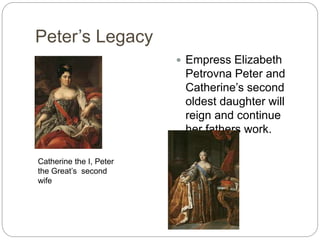
 Empress Elizabeth
Petrovna Peter and
Catherine’s second
oldest daughter will
reign and continue
her fathers work.
Catherine the I, Peter
the Great’s second
wife
Catherine the Great
 Emperor Peter III
nephew of Empress
Elizabeth and Duke Karl
Friedrich of Holstein-
(nephew of Charles XII
of Sweden) will only be
on the throne for six
months before his wife,
a German Princess,
who was hand selected
by Empress Elizabeth
will take the throne. She
will be become known
as Catherine the Great.
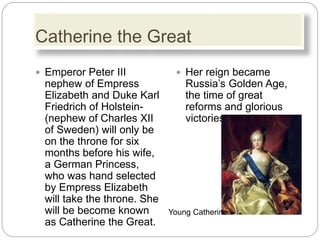
 Her reign became
Russia’s Golden Age,
the time of great
reforms and glorious
victories.
Young Catherine
Catherine the Great
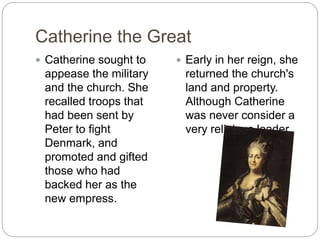
 Catherine sought to
appease the military
and the church. She
recalled troops that
had been sent by
Peter to fight
Denmark, and
promoted and gifted
those who had
backed her as the
new empress.
 Early in her reign, she
returned the church's
land and property.
Although Catherine
was never consider a
very religious leader.
Catherine’s Social reforms
 While Catherine believed in absolute rule, as did
all her European counterparts, she did make
some efforts toward social and political reforms.
 "Nakaz," a document on how the country's legal
system should run, with a push for capital
punishment and torture to be outlawed and calling
for every man to be declared equal.
 Catherine sought to address the dire situation of
country's serfs, workers who were owned by
landowners for life. Although she was fought by
the Senate and was not as successful as she
wanted to be she continued to fight for a more
equable system of labor in Russia.
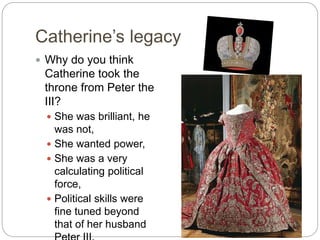
Catherine’s legacy
 Why do you think
Catherine took the
throne from Peter the
III?
 She was brilliant, he
was not,
 She wanted power,
 She was a very
calculating political
force,
 Political skills were
fine tuned beyond
that of her husband
Final question
On a separate sheet of paper
answer the following question
 Who do you think the Russians believe was their
greatest leader of the three discussed here?
 Explain your answer with at least 3 examples of
why you believe this.

Unit 10 russia

  • 1.
    Medieval leadership tothe Age of Absolute Monarchy Ivan the IV, Peter the I and Catherine II Unit 10 Russia
  • 2.
    Ivan III (thegreat) to Ivan IV (the Terrible  At the age of 12 Ivan the III was placed nominally in command of a military expedition to deal with the remnants of his father’s internal enemies.  At 18 he led a successful campaign against the Tartars in the south. When his father Vasily II died on March 27, 1462, Ivan was made the grand prince of Moscow. Ivan the III April 5, 1462 – Oct. 27, 1505
  • 3.
    Ivan the III(Great)  Ivan’s policy was to start the centralize of the government administration by stripping the princes of land and authority.  As for the boyars, they were stripped of much of their authority and swiftly executed or imprisoned if suspected of treason.  What are Boyars?  Landowners in Russia with power and authority over their region with little or no loyalty to the grand prince.  The Boyars acted much the same as the Italy princes in Venice and Florence during the Renaissance.
  • 4.
    Ivan III Continued None dispute the importance of his diplomatic and military successes.  But Ivan’s family life was as dysfunctional as that of his grandson Ivan the IV.  After deciding his eldest son, Dmitry would be the new prince, his second wife Sofia, who wanted her son, Vasily on the throne, plotted against Ivan to overthrown him and place Vasily on the throne. Ivan discovered
  • 5.
    Ivan the IV(or Ivan the Terrible)
  • 6.
    Ivan the Terrible By age 8 both his parents were dead and he was keep away from his family.  He trusted few people  At 17, he was crowned by the Boyars who had come back into power.  He rejected the title Prince and at the urging of the church took the Russian form of the title Caesar or Czar (Tzar)  Within a year of taking the throne, in1547 Ivan married Anastasia Romanovna  Russia was a backward country with no banks, no road system, and little in the way of loyalty or authority to Ivan’s rule.
  • 7.
    Ivan the IV Ivan and his new wife had issues with power struggles from the beginning.  But, Ivan’s power was soon to be solidified after an attack on the Tartar’s (Remnants of Genghis Khan’s army known as Mongol Golden Horde)  Having defeated the Tartars Ivan became know as Ivan the Terrible which was a title of honor at the time, but it was a precursor of his actions later in his  This iconic structure was commissioned by Ivan to commemorate the conquest of Kazan a Tartar city and one of Russia’s most feared enemies.  St. Basil's Cathedral in Moscow's Red Square, built between 1555 and 1561.
  • 8.
  • 9.
    Ivan the IVand his family  After the death of Anastasia Romanovna, Ivan would marry 7 more times often divorcing one wife and taking another within months.  What do you think his motives were for taking wife after wife from the royal families?  To gain loyalty from the families.  Remove power from the Boyars  Ivan went so far as to ask Queen Elizabeth of England for a suitable English princess to wed.
  • 10.
    Ivan the Terrible Ivan become more and more violent in his dealings with his enemies yet he was not alone in his treatment of his and his country’s enemies.  Over the next 24 years, Ivan IV conducted a reign of terror, displacing and destroying the major Boyar families in the region, and earning the  Ivan created a secret police that for 7 years reigned with terror under his direction. Setting a horrific high bar for campaigns of state-instituted terror.  It was only after Ivan could not control them he disbanded the group.
  • 11.
    The end ofIvan’s reign  Killed his eldest son in a fit of rage after attacking his son’s wife.  Become more secretive and religious as time passed  Three years after killing the heir to the throne Ivan died in 1584.  His last living child Feodor, will come to the throne but whose rule spiraled Russia into the catastrophic “Time of Troubles,” leading to the establishment of the Romanov Dynasty.  It is now known that Ivan was treated with common pain medicine which content high levels of mercury.  What are the effects of high levels of mercury?
  • 12.
    Elements in Ivan’sbehavior  Symptoms include tremors,  emotional changes,  insomnia,  headaches,  disturbances in sensations,  changes in nerve responses, and performance deficits on tests of cognitive function.
  • 13.
    Peter I orPeter the Great - The first absolute monarchy of Russia  He will take the throne after almost a century after the death of Ivan IV and the ensuing chaos. (b. June 9, 1672 – d. 1725)  But he also come to the throne in a power struggle at age 17, with his sister, Sofia who was ruling in his name. Sofia
  • 14.
    Peter I  Russiahad rejected westernization and remained isolated from the modernization that had swept Europe during the Renaissance and the Reformation.  BUT that was all about to change as Peter took the throne as the Tzar (Czar)
  • 15.
    Peter’s reforms  Peteras the monarch engineered a series of reforms that were to put Russia among the major European powers of the day.  He opened Russia to the influences of the West  Invited the best European engineers, shipbuilders, architects, craftsmen and merchants to come to Russia and modernize the country.  Why do you think he wanted Russia to westernize?  Become a powerful military nation not as some in Europe considered Russia a weak and backward country  Become a powerful economic force to compete for goods from Asia but also a conduit for goods to travel through Russia not around it.
  • 16.
    Peter creates St.Petersburg (later know as Leningrad)  When the Northern War ended in 1721 Russia was declared an Empire and Peter the Great proclaimed himself its Emperor  After expanding Russia through his modern military and navy, Peter creates a new city on land taken from Sweden at the end of the Northern War  St. Petersburg is a warm port city. Russia now had a way to create an economic relationship with Europe.  And a new capitol to Bronze Horseman placed in St. Petersburg to honor Peter the Great.
  • 17.
    St. Petersburg  Peterand Paul Fortress  Included in the fortress is the Peter and Paul Cathedral where Peter the Great was buried.  The fortress also served, as did the Tower of London, as a prison for political prisoners. Peter personally interrogated his own son Alexei, whom he suspected of plotting against him, and Alexei was the first inmate jailed in the Peter and Paul fortress.
  • 18.
    Peter’s Legacy  Peterthe Great died on 28 January 1725, without naming a successor.  Peter’s wife Catherine I took the throne but Catherine’s reign did not last long. She died in 1727, just two years after Peter.  Peter the Second will take the throne for 15 years unlike this grandfather Peter would not be remember for reforms. Alexei was jailed so he was not named successor but his only son will come to the throne - Peter II (1715-1730)
  • 19.
    Legacy and Legend The Archbishop of Novgorod eulogized Peter the Great stating: “We are burying Peter the Great . . . who has raised Russia as if from among the dead and elevated her to such heights of power and glory. . . . He was your Samson, Russia. . . . He was your Moses. . . . He was your Solomon, who received from the Lord reason and wisdom in great plenty. . . . Can a short oration encompass his immeasurable glory?”
  • 20.
    Peter’s Legacy  EmpressElizabeth Petrovna Peter and Catherine’s second oldest daughter will reign and continue her fathers work. Catherine the I, Peter the Great’s second wife
  • 21.
    Catherine the Great Emperor Peter III nephew of Empress Elizabeth and Duke Karl Friedrich of Holstein- (nephew of Charles XII of Sweden) will only be on the throne for six months before his wife, a German Princess, who was hand selected by Empress Elizabeth will take the throne. She will be become known as Catherine the Great.  Her reign became Russia’s Golden Age, the time of great reforms and glorious victories. Young Catherine
  • 22.
    Catherine the Great Catherine sought to appease the military and the church. She recalled troops that had been sent by Peter to fight Denmark, and promoted and gifted those who had backed her as the new empress.  Early in her reign, she returned the church's land and property. Although Catherine was never consider a very religious leader.
  • 23.
    Catherine’s Social reforms While Catherine believed in absolute rule, as did all her European counterparts, she did make some efforts toward social and political reforms.  "Nakaz," a document on how the country's legal system should run, with a push for capital punishment and torture to be outlawed and calling for every man to be declared equal.  Catherine sought to address the dire situation of country's serfs, workers who were owned by landowners for life. Although she was fought by the Senate and was not as successful as she wanted to be she continued to fight for a more equable system of labor in Russia.
  • 24.
    Catherine’s legacy  Whydo you think Catherine took the throne from Peter the III?  She was brilliant, he was not,  She wanted power,  She was a very calculating political force,  Political skills were fine tuned beyond that of her husband
  • 25.
    Final question On aseparate sheet of paper answer the following question  Who do you think the Russians believe was their greatest leader of the three discussed here?  Explain your answer with at least 3 examples of why you believe this.

Editor's Notes

  • #5 n 1490 Ivan’s eldest son by his first wife died of gout. He had been ineptly treated by a Jewish doctor who had been brought to Russia by Sofia’s brother, and Ivan suspected foul play. He now had to solve the problem of who was to be his heir—his eldest son’s son Dmitry (born 1483) or his eldest son by Sofia, Vasily (born 1479). For seven years he vacillated. Then, in 1497, he nominated Dmitry as heir. Sofia, anxious to see her son assured of the throne, planned rebellion against her husband, but the plot was uncovered. Ivan disgraced Sofia and Vasily and had Dmitry crowned grand prince (1498). http://www.britannica.com/EBchecked/topic/298142/Ivan-III/3599/Late-reign
  • #13 "Ivan the Terrible." Bio. A&E Television Networks, 2015. Web. 12 Apr. 2015.
  • #14 http://en.gallerix.ru/album/Hermitage-5/pic/glrx-532339477
  • #17 Northern war 1700-1721 This is the Bronze Horseman placed in honor of Peter the Great by Catherine the Great.
  • #22 Peter III and Catherine are married for 9 years prior to Elizabeth’s death and Peter the III’s raise to the throne. By then Peter and Catherine were no longer living together as man and wife as both had taken lovers and were living apart.