A Roadmap for Cloud
         Standards

         Peter Mell, Tim Grance
NIST, Information Technology Laboratory
               9-15-2009
NIST Cloud Research Team

      Peter Mell                  Lee Badger
     Project Lead

      Tim Grance
   Program Manager


     Contact information is available from:
     http://www.nist.gov/public_affairs/contact.htm


                                                      2
NIST Cloud Computing Resources

• NIST Draft Definition of Cloud Computing
• Presentation on Effective and Secure Use of Cloud
  Computing

• http://csrc.nist.gov/groups/SNS/cloud-computing/index.html


                                                               3
Caveats and Disclaimers

• This presentation is NOT intended to provide
  official NIST guidance and NIST does not
  make policy
• Any mention of a vendor, product, or
  standard is NOT an endorsement or
  recommendation


Citation Note: All sources for the material in this presentation are included within
the Powerpoint “notes” field on each slide
                                                                                       4
Cloud Standards Mission
• Provide guidance to industry and
  government for the creation and
  management of relevant cloud computing
  standards allowing all parties to gain the
  maximum value from cloud computing


                                               5
NIST and Standards

• NIST wants to promote cloud standards:
  – We want to propose roadmaps for needed
    standards
  – We want to act as catalysts to help industry
    formulate their own standards
    • Opportunities for service, software, and hardware
      providers
  – We want to promote government and industry
    adoption of cloud standards
                                                          6
Goal of NIST Cloud Standards Effort

• Fungible clouds
  – (mutual substitution of services)
  – Data and customer application portability
  – Common interfaces, semantics, programming
    models
  – Federated security services
  – Vendors compete on effective implementations
• Enable and foster value add on services
  – Advanced technology
  – Vendors compete on innovative capabilities
                                                   7
A Model for Standardization
 and Proprietary Implementation


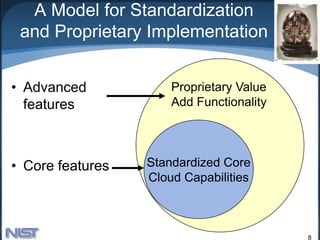
• Advanced            Proprietary Value
  features            Add Functionality


• Core features   Standardized Core
                  Cloud Capabilities


                                          8
Proposed Result

• Cloud customers knowingly choose the
  correct mix for their organization of
  – standard portable features
  – proprietary advanced capabilities


                                          9
A proposal: A NIST Cloud
     Standards Roadmap

• We need to define minimal standards
  – Enable secure cloud integration, application
    portability, and data portability
  – Avoid over specification that will inhibit innovation
  – Separately addresses different cloud models


                                                            10
Towards the Creation of
              a Roadmap (I)
• Thoughts on standards:
  – Usually more service lock-in as you move up the
    SPI stack (IaaS->PaaS->SaaS)
  – IaaS is a natural transition point from traditional
    enterprise datacenters
     • Base service is typically computation, storage, and
       networking
  – The virtual machine is the best focal point for
    fungibility
  – Security and data privacy concerns are the two
    critical barriers to adopting cloud computing
                                                             11
Towards the Creation of
           a Roadmap (II)
• Result:
  – Focus on an overall IaaS standards roadmap as
    a first major deliverable
  – Research PaaS and SaaS roadmaps as we
    move forward
  – Provide visibility, encourage collaboration in
    addressing these standards as soon as possible
  – Identify common needs for security and data
    privacy standards across IaaS, PaaS, SaaS

                                                     12
A Roadmap for IaaS

• Needed standards
  – VM image distribution (e.g., DMTF OVF)
  – VM provisioning and control (e.g., EC2 API)
  – Inter-cloud VM exchange (e.g., ??)
  – Persistent storage (e.g., Azure Storage, S3, EBS,
    GFS, Atmos)
  – VM SLAs (e.g., ??) – machine readable
    • uptime, resource guarantees, storage redundancy
  – Secure VM configuration (e.g., SCAP)

                                                        13
A Roadmap for PaaS and SaaS
• More difficult due to proprietary nature
• A future focus for NIST

• Standards for PaaS could specify
   – Supported programming languages
   – APIs for cloud services
• Standards for SaaS could specify
   – SaaS-specific authentication / authorization
   – Formats for data import and export (e.g., XML schemas)
   – Separate standards may be needed for each application
     space

                                                              14
Security and Data Privacy Across
            IaaS, PaaS, SaaS
• Many existing standards
• Identity and Access Management (IAM)
  – IdM federation (SAML, WS-Federation, Liberty ID-FF)
  – Strong authentication standards (HOTP, OCRA, TOTP)
  – Entitlement management (XACML)
• Data Encryption (at-rest, in-flight), Key Management
  – PKI, PKCS, KEYPROV (CT-KIP, DSKPP), EKMI
• Records and Information Management (ISO 15489)
• E-discovery (EDRM)

                                                          15
Questions?
• Peter Mell
• NIST, Information Technology Laboratory
• Computer Security Division

• Tim Grance
• NIST, Information Technology Laboratory
• Computer Security Division
      Contact information is available from:
      http://www.nist.gov/public_affairs/contact.htm
                                                       16

Peter Mell Cloud Standards 20090915

  • 1.
    A Roadmap forCloud Standards Peter Mell, Tim Grance NIST, Information Technology Laboratory 9-15-2009
  • 2.
    NIST Cloud ResearchTeam Peter Mell Lee Badger Project Lead Tim Grance Program Manager Contact information is available from: http://www.nist.gov/public_affairs/contact.htm 2
  • 3.
    NIST Cloud ComputingResources • NIST Draft Definition of Cloud Computing • Presentation on Effective and Secure Use of Cloud Computing • http://csrc.nist.gov/groups/SNS/cloud-computing/index.html 3
  • 4.
    Caveats and Disclaimers •This presentation is NOT intended to provide official NIST guidance and NIST does not make policy • Any mention of a vendor, product, or standard is NOT an endorsement or recommendation Citation Note: All sources for the material in this presentation are included within the Powerpoint “notes” field on each slide 4
  • 5.
    Cloud Standards Mission •Provide guidance to industry and government for the creation and management of relevant cloud computing standards allowing all parties to gain the maximum value from cloud computing 5
  • 6.
    NIST and Standards •NIST wants to promote cloud standards: – We want to propose roadmaps for needed standards – We want to act as catalysts to help industry formulate their own standards • Opportunities for service, software, and hardware providers – We want to promote government and industry adoption of cloud standards 6
  • 7.
    Goal of NISTCloud Standards Effort • Fungible clouds – (mutual substitution of services) – Data and customer application portability – Common interfaces, semantics, programming models – Federated security services – Vendors compete on effective implementations • Enable and foster value add on services – Advanced technology – Vendors compete on innovative capabilities 7
  • 8.
    A Model forStandardization and Proprietary Implementation • Advanced Proprietary Value features Add Functionality • Core features Standardized Core Cloud Capabilities 8
  • 9.
    Proposed Result • Cloudcustomers knowingly choose the correct mix for their organization of – standard portable features – proprietary advanced capabilities 9
  • 10.
    A proposal: ANIST Cloud Standards Roadmap • We need to define minimal standards – Enable secure cloud integration, application portability, and data portability – Avoid over specification that will inhibit innovation – Separately addresses different cloud models 10
  • 11.
    Towards the Creationof a Roadmap (I) • Thoughts on standards: – Usually more service lock-in as you move up the SPI stack (IaaS->PaaS->SaaS) – IaaS is a natural transition point from traditional enterprise datacenters • Base service is typically computation, storage, and networking – The virtual machine is the best focal point for fungibility – Security and data privacy concerns are the two critical barriers to adopting cloud computing 11
  • 12.
    Towards the Creationof a Roadmap (II) • Result: – Focus on an overall IaaS standards roadmap as a first major deliverable – Research PaaS and SaaS roadmaps as we move forward – Provide visibility, encourage collaboration in addressing these standards as soon as possible – Identify common needs for security and data privacy standards across IaaS, PaaS, SaaS 12
  • 13.
    A Roadmap forIaaS • Needed standards – VM image distribution (e.g., DMTF OVF) – VM provisioning and control (e.g., EC2 API) – Inter-cloud VM exchange (e.g., ??) – Persistent storage (e.g., Azure Storage, S3, EBS, GFS, Atmos) – VM SLAs (e.g., ??) – machine readable • uptime, resource guarantees, storage redundancy – Secure VM configuration (e.g., SCAP) 13
  • 14.
    A Roadmap forPaaS and SaaS • More difficult due to proprietary nature • A future focus for NIST • Standards for PaaS could specify – Supported programming languages – APIs for cloud services • Standards for SaaS could specify – SaaS-specific authentication / authorization – Formats for data import and export (e.g., XML schemas) – Separate standards may be needed for each application space 14
  • 15.
    Security and DataPrivacy Across IaaS, PaaS, SaaS • Many existing standards • Identity and Access Management (IAM) – IdM federation (SAML, WS-Federation, Liberty ID-FF) – Strong authentication standards (HOTP, OCRA, TOTP) – Entitlement management (XACML) • Data Encryption (at-rest, in-flight), Key Management – PKI, PKCS, KEYPROV (CT-KIP, DSKPP), EKMI • Records and Information Management (ISO 15489) • E-discovery (EDRM) 15
  • 16.
    Questions? • Peter Mell •NIST, Information Technology Laboratory • Computer Security Division • Tim Grance • NIST, Information Technology Laboratory • Computer Security Division Contact information is available from: http://www.nist.gov/public_affairs/contact.htm 16